Heather Bryant

Alaska couples await Supreme Court decision on DOMA, Prop 8

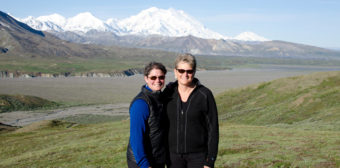
Aimee Olejasz and Fabienne Peter-Contesse at Denali Park in 2011.
Aimee Olejasz and Fabienne Peter-Contesse have been together for 23 years and have spent most of their life in Alaska. This fall, they’re headed to Washington to say their vows. (Photo courtesy Fabienne Peter-Contesse and Aimee Olejasz)

Update: The Supreme Court did not issue rulings in either the DOMA (United States v. Windsor) or Prop 8 (Hollingsworth v. Perry) cases on Thursday. The only remaining scheduled day for opinions is Monday, or the court may add an additional day.

The U.S. Supreme Court could rule as soon as Thursday on two same-sex marriage cases: The Defense of Marriage Act, and California’s Proposition 8, which recognizes  marriage only between a man and woman in that state.

For same-sex couples in Alaska who want to marry, the only option right now is to head out of state.

Alaska was the first state to ban gay marriage through a constitutional amendment in 1998. By statute same sex marriages from other states are not recognized.

In 2005, the Alaska Civil Liberties Union sued the state and Municipality of Anchorage on behalf of nine gay and lesbian couples who were seeking benefits for their spouses.

The Alaska Supreme Court said denying spousal benefits for gay couples was an equal protection violation. The result was that local governments as well as the state had to make employment benefits available to people in domestic partnerships.

Fabienne Peter-Contesse and her soon-to-be wife Aimee Olejasz were plaintiffs in the case. Both Peter-Contesse and Olejasz work for state agencies.

When the Alaska Supreme Court ruled in favor of the ACLU, Peter-Contesse describes it as a feeling of relief.

“It feels a little bit that way with DOMA, with the Defense of Marriage Act now. It’s just the right thing to do,” she says.

According to DOMA, marriage is between one man and one woman. DOMA’s definition prevents married same-sex couples from receiving any federal marriage benefits.

“If the Supreme Court decides that to strike down the Defense of Marriage Act and allow same sex partners to receive all the same protections and responsibilities and rights that heterosexual couples have, it will be on one hand a huge celebration and on the other hand it’s like ‘yeah, about time,’ ” Peter-Contesse says.

Peter-Contesse and Olejasz are planning a fall wedding in Washington state. Washington legalized gay marriage last year. When they heard the news they were elated, and that’s when they knew they would get married in Washington where Peter-Contesse has family.

They wanted to get married in Alaska, but Olejasz says they didn’t know how long they would have to wait for that to be possible.

“Until perhaps there’s a shift in the culture here in Alaska, I think that will be slow in coming,” she says.

University of Alaska Anchorage Justice Center Professor Jason Brandeis also thinks Alaska isn’t there yet:

“I just don’t see that happening anytime soon. But if there was a United States Supreme Court decision that required the state to change its laws then that would be a whole different story.”

The cases before the Supreme Court cover two main issues.

United States versus Windsor asks if the Defense of Marriage Act violates the right of equal protection under the law. In this case Edith Windsor sued the federal government over inheritance taxes she had to pay when her wife passed away. A married heterosexual person does not have to pay the tax when their spouse dies. (Here’s a link to the full transcript of the arguments heard in the case)

[learn_more caption=”Possible rulings in the United States versus Windsor case”] Justice Center Jason Brandeis believes there are three likely outcomes in the U.S. v.  Windsor case:

1. The Supreme Court could rule that in defining marriage as being a union between a man and a woman, the Defense of Marriage Act is unconstitutional; therefore same-sex couples who married in states that recognize same-sex marriage, would be entitled to the benefits available to heterosexual couples under federal law.
2. The court could rule the law is constitutional and the U.S. government has the power to define marriage as between a man and a woman. In that case, the status quo remains and married same-sex couples will continue to be denied those benefits.
3. The court could decide it lacks jurisdiction to hear the case, because the Obama administration has taken the position that DOMA is unconstitutional.  The administration is not defending it.  Some members of the U.S. House of Representatives have formed the Bipartisan Legal Advisory Group to intervene as a defendant in the case. The Supreme Court could say the group does not have standing to defend DOMA, therefore the Court of Appeals decision in U.S. v. Windsor would prevail.
[/learn_more]

Hollingsworth versus Perry deals with California’s current ban on same sex marriage. California allowed same sex marriage until 2004, when the California Supreme Court ordered officials to stop issuing marriage licenses until constitutional challenges to marriage statutes were resolved. (Here’s a link to the full transcript of the arguments in Hollingsworth versus Perry)

[learn_more caption=”Possible rulings in the Hollingsworth versus Perry case”] Justice Center Jason Brandeis believes there are four possible outcomes in Hollingsworth v. Perry:

1. The Supreme Court could uphold Proposition 8 as constitutional; therefore California’s ban on same-sex marriage is within the rights of the state.
2. Justices could decide the case on a technicality, ruling that groups intervening in the case don’t have standing. The California attorney general’s office and the governor are not defending the initiative because they don’t agree with Proposition 8.  One of the groups that supported the initiative intervened as a defendant in the U.S Supreme Court case.
3. The court could rule that a domestic-partner benefits law allowing same-sex couples the benefits and burdens of marriage without the designation violates the  constitution.
4. Because same-sex couples were allowed to marry in California for a period of time, the U.S. Supreme Court could say the state can’t withdraw a right established by the California Supreme Court after it’s been given.
[/learn_more]

Brandeis says marriage has traditionally been a state issue.

“If you think about marriage, you think about the classic wedding ceremony and someone says ‘by the power vested in me by the state of Alaska, I now pronounce you husband and wife.’ You never hear ‘by the power vested in me by the United States of America.’ Marriage is a creation of state law, though there are a number of federal laws that also affect marriage.”

Map of states that define marriage as between a man and a woman
States that define marriage as between a man and a woman. (Map courtesy National Conference of State Legislatures)

In fact, there are more than 1,000 federal laws and programs that affect married couples from taxes to adoption.

Jim Minnery is  president of Alaska Family Action. He calls same sex marriage an issue of state’s rights, federal overreach, and protecting the sanctity of marriage.

“It’s a 10th Amendment issue really in our view. That states should have the right to define marriage,” Minnery says.

Minnery believes same sex marriage does not uphold essential aspects of marriage such as monogamy, permanence and opposite-sex parents:

“It’s difficult for the public to grasp — but I think it’s important for people to know — that as some components of marriage become optional, meaning it’s no longer just one man and one woman, who’s to say that the other components are just as easily tossed aside.”

Professor Brandeis describes a number of U.S. Supreme Court justices as state’s rights advocates, who tend to defer to states to define social policies.

Given the makeup of the court and tenor of the oral arguments heard in March, Brandeis says it’s unlikely justices will ban all laws prohibiting same-sex marriage. However, he thinks the rulings will provide language that can be used in future cases to challenge bans on same-sex marriage.

No matter how the high court rules, couples like Olejasz and Peter-Contesse will be touched by the decision.

“If the Defense of Marriage Act is not struck down, basically that’s saying that we–our relationship of 23 years is not as important, it’s not equal to, it’s not recognized as any other straight couple would be. That doesn’t have just financial impact. That has emotional impact.”


Still no Supreme Court ruling on DOMA, Prop 8 cases

The U.S. Supreme Court
The U.S. Supreme Court (Photo by S.E.B/Flickr Creative Commons)

Update: June 25 – 8:07 a.m.

The Supreme Court has ruled that DOMA is unconstitutional. The court did not rule on Prop 8 (Hollingsworth v. Perry) saying there was not standing and sent the case back to the Ninth Circuit Court. Read the full story here.

Update: June 24 – 7:07 a.m.

The Supreme Court again did not issue rulings in either of the two cases.

Update: June 20 – 6: 24 a.m.

The Supreme Court did not issue rulings in either the DOMA (United States v. Windsor) or Prop 8 (Hollingsworth v. Perry) cases on Thursday. The only remaining scheduled day for opinions is Monday, or the court may add an additional day.

Additional Coverage: Alaska couples await Supreme Court decision on DOMA, Prop 8

Original Story: June 17 – 7:10 a.m.

With only two possible days for decisions from the Supreme Court left in this session, rulings in two cases have both sides of the same sex marriage issue on the edge of their seats.

Two cases currently before the Supreme Court could have an impact on same sex marriage laws and whether the federal government will recognize same sex marriage. The Supreme Court did not rule on either case this morning. The next possible days for the ruling are Thursday and next Monday.

The Supreme Court heard arguments in both cases back in March.

The first case, Hollingsworth versus Perry, has a complex legal history, but basically the court will rule on whether it was unconstitutional for California to have banned same sex marriage after having allowed it.

The second case, United States versus Windsor, is about whether the Defense of Marriage Act violates the right of equal protection under the law. DOMA defines marriage as between one man and one woman for the purpose of Federal marriage benefits. DOMA’s definition of what constitutes a marriage prevents married same sex couples from receiving any federal marriage benefits.

“There are over 1,000 federal laws and programs that confer some right or benefit or privilege to married couples who are of opposite sex,” says Jason Brandeis, a professor at the Justice Center at UAA. Brandeis teaches and researches constitutional law and civil liberties.

He thinks that it’s unlikely we’ll see a sweeping judgment from the court that decides the issue once and for all.

“The court is supposed to take the path of least resistance, issue a decision that is on the narrowest grounds possible. Generally, the court does not issue broad sweeping decisions that will make major changes. They will issue a ruling that is on the facts in front of them. And often times that decision will have a larger impact. For example, Brown versus Board of Education. Brown versus Board of Education dealt with segregation in public schools. It did not deal with all forms of segregation and racial discrimination. But the impact of the case was to establish the constitution does not look favorably upon certain types of racial discrimination and that paved the way for lots of other changes.”

What does this mean for Alaska?

Alaska banned same sex marriage through a constitutional amendment in 1998.

Unless the court issues a ruling that says all bans on same sex marriage are unconstitutional, the ruling won’t have an immediate impact on Alaska’s constitutional ban.

However, Brandeis says it’s likely the decision the court issues will have language that can be used in future court cases dealing with same sex marriage.

We’ll continue to follow this story as we wait for the ruling.

Runners race to raise money for suicide prevention group

More than a 100 people gathered on Sandy Beach on Saturday for the Every Mile is Worth It Race. This was the third year for the 5k hosted by the South East Alaska Regional Health Consortium.
Megan Gregory is the community project coordinator with SEARHC. Gregory’s main job is working on suicide prevention projects. She says she likes planning events that focus on healthy living:

“I’m thinking it’s more important to focus on the good in life rather than pointing out the bad which is why I coordinate events like Every Mile is Worth It. Specifically at Sandy Beach on this course, because it reminds me of life. The course isn’t always easy, there’s going to be a lot of challenges along the way but there’s no better feeling than crossing the finish line.”

The 5k is a fundraiser for the Southeast Alaska Youth Ambassador Program which was founded by Gregory in 2010 who was volunteering with the One is Too Many task force.  Funds raised by the race entry fee pay for travel for youth from southeast communities to participate in meetings.

“It’s taken a while to get it off the ground and get kids engaged because when they hear suicide, you know with the stigma attached they automatically don’t want to be involved or they think ‘oh, that’s not a problem in my community,’ but we don’t want to wait for it to become an issue.”

The 5k race included both runners and walkers. Each racer had a red or black bib. Participants started the course in different directions depending on the color of their bib. The goal was that nobody knew for sure whether they were ahead or behind of someone else. Gregory says the race wasn’t about who won or lost, but just getting out there and doing it.


Juneau celebrates National Trails Day with a day at Outer Point Trail

Saturday was National Trails Day and Juneau celebrated the annual event with a volunteer day at the Outer Point Trail.
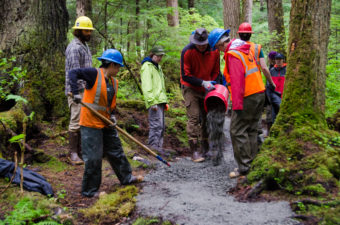
“We’ve had about 40 members of the public help out. They’ve been working on re-vegetating the sides of the trail, it gets pretty muddy, hauling out garbage, helping our crews move logs for a bridge we’re building. Everyone’s been out working hard,” says Erik Boraas, the executive director of Trail Mix.

“The Outer Point Trail–it’s a city project–and we’re working on it, making it wheelchair accessible down to the ocean because there’s no other place in Juneau that I can think of other than a boat ramp that you can get close to the ocean in a wheelchair.”

Trail Mix worked with Southeast Alaska Guidance Association, the Outdoor Recreation and Community Access program, State Parks and the Forest Service to coordinate work on the trail.

More than 40 volunteers spent hours replacing the trail’s slippery boardwalk with gravel—which had to be hand delivered one bucket at a time by volunteers. The new trail will be completely wheelchair accessible when it’s complete.

Trails wasn’t all about work though. In the afternoon, volunteers took a break for food and fun including guided tours and trail bingo for kids.


Endangered Species Act celebrates its 40th anniversary today

Today is the 40th Anniversary of the Endangered Species Act. Congress passed the act in 1973 over concerns that many species of plants and animals were in danger of becoming extinct.

Bill Hanson is the Field Supervisor of the Juneau Field Office for the Fish and Wildlife Service in Southeast Alaska. His office is responsible for recovery efforts and restoration programs in Southeast Alaska.

“Sometimes we look at species and we think ‘well does it make a difference if one disappears or another one disappears’ and the main thing to remember this is that each of those species represents some portion of that ecological network. So if you look at one species disappearing it’s not just one species disappearing it’s actually all the interactions that relate to it.”

U.S. Fish and Wildlife manages some marine mammals including the polar bear, walrus and sea otters. They also manage almost all of the endangered terrestrial species of animals and plants as well as freshwater fish. They work in conjunction with the National Marine Fisheries Service which also has a field office in Juneau. (Here’s a full list of endangered, threatened and candidate species in Alaska)

Marine Fisheries manages all of the other endangered marine mammals including whales, sea lions, seals, saltwater fish, and turtles.

Hanson says that Southeast Alaska doesn’t have very many endangered species compared to other parts of the country or Alaska, but a there are number of species including the Short-tailed Albatross, sea otters and a variety of whales that are monitored.

“A species doesn’t become listed unless it’s in real trouble. Once it’s listed, we go into the next phase which is recovery. Recovery doesn’t just mean getting it above the line which would be it’s either threatened or not threatened. It’s getting it back to healthy populations. That can take a long time and in some cases maybe it’s not possible. We don’t ever know the full answer to that. Success can be measured in a lot of different ways. Ideally, complete recovery is the measure of success and in other cases it maybe that we simply prevent it from becoming extinct.”

The specific reasons that a species becomes endangered can vary widely but most fall into one of two categories: either the species has lost its habitat for some reason or something has caused the species to not be able to function normally such as pesticides or pollution.

There have been success stories. In the Lower 48, the Bald Eagle was once on the edge of extinction due to pesticides, but after it was added to the Endangered Species List and pesticides were more carefully cleaned up and regulated, the birds bounced back.

In Alaska, the Arctic Peregrine Falcon and the Aleutian Canada goose were both successfully recovered.

Hanson says the most important thing to remember is that it’s never just one species that’s in danger because everything in an ecosystem in connected. When one species is endangered, they often represent a broader range of species than just themselves.


Mendenhall Glacier Visitor’s Center gets a new director

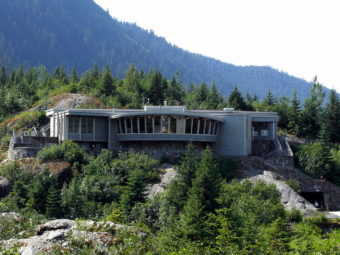
Mendenhall Visitor Center (Photo by Reywas92/Wikimedia Commons)

The busiest time of the year for the Mendenhall Glacier Visitor’s Center is getting underway with a new director.

John Neary is taking over from retiring director Ron Martin.

Neary has spent decades working in Alaska’s outdoors and the job at Mendenhall is a position he says he is very happy to have. His work as a wilderness manager with the Juneau ranger district and Admiralty Island prepared him for this position he says. He plans to bring all of that experience and community connections to his new work.

Neary is already busy with lining up his goals for the center. He sees a need for a number of improvements that he says will improve the viewing experience. Problems such as the long wait for restrooms, congested traffic, and unsafe areas are not suitable for the “world-class” Mendenhall, Neary says.

“A few days ago I was watching an older gentleman—and I was some distance from him—but he walked down on the beach right past a sign that said dangerous rocks ahead and he walked up on to the rocks and with his first step he slipped and slammed down onto his shoulder. And I thought ‘oh no, the poor guy is going to have some major injury,’ but he stood up and held his elbow and hobbled back towards us and he was okay. But you can see that’s an accident waiting to happen and it just begs for a really good design solution to have a nice kind of loop trail that goes through this area that people really want to go through, out to Photo Point.”

Neary emphasizes the importance of access to locals as well as tourists.

“We are the drive-up glacier–there’s, as you know, lots of glaciers in Alaska—but what makes the Mendenhall unique is the fact that we have this great highway that comes right up to it and you get a wonderful view, nice trails, very accessible and that’s our niche really. What we want to be able to develop is the partnerships with the tour operators, with local residents, with everybody else who enjoys that easy access to ensure the flow works well here.”

Neary calls Mendenhall our backyard glacier and says that Juneau values it highly. He says his goal is to preserve opportunities at the glacier for both residents and visitors.

The summer season is just getting underway, but Neary says people are quickly discovering what makes Mendenhall so special.

“Right now we have bears feeding on grass and cottonwood trees and that makes for a wonderful drive up bear-viewing experience which is also unique in Alaska. There are very few of them. Most of them entail expeditions to get out to some remote area.”

Site notifications
Update notification options
Subscribe to notifications