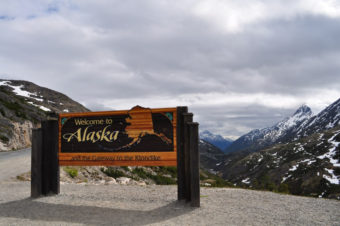
Welcome to Alaska…the most underrated state in the country. (Photo by Michael Grosch/ Flickr Creative Commons)
This morning Business Insider published the results from a series of questions on how Americans think of other states. More than 1,600 respondents were asked to answer each question with a state that wasn’t their own.
Results were displayed in a color scale so it’s a little tricky determining just how many votes Alaska got for each question. The percentage was only displayed for the winning state in each category.
So how did we do?
Alaska was named the most underrated state in a close race with Oregon and Maine. However, Alaska was voted as having the worst food.
Alaska picked up votes in other categories including having the best scenery, being the nicest, being ugly and having the worst sports fans. Alaska was also three shades of grey away from being voted the drunkest state. (Louisiana won that vote.)
On the other hand California was voted the craziest state and Texas was voted as the least favorite state and the state most people would like to see kicked out of America.
When you ask anyone to name animals in Alaska, answers run the gamut from wolves to whales and occasionally the erroneous penguin. But there’s one animal that hardly ever makes the list: sharks.

The revered–and often feared–fish are usually the last thing that comes to mind when you think of Alaska.
But Alaskans need look no further than our own chilly waters to find several species of the formidable fish.
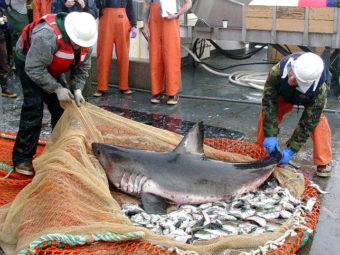
This salmon shark was released after being freed from the trawl net. (Photo by SST Kathy Hough aboard the NOAA Ship Oscar Dyson)
“When you hear ‘shark,’ the general public thinks of something patrolling the surfing beach and you know, sharks are everywhere. To be honest, there are ten foot sharks right outside our door here.”
Cindy Tribuzio works for NOAA at the Auke Bay lab. She’s been researching sharks for more than a decade.
It was originally Alaska’s more adored sea creatures that drew Tribuzio to the water.
A tagged spiny dogfish. (Photo courtesy Cindy Tribuzio/NOAA)
“I was going to save the whales for a long time, and then I realized that everyone else was going to save the whales too. And I really wanted to go to grad school and since everybody else was trying to save the whales in grad school, I started volunteering at the Seattle aquarium while I was waiting to get into school, still trying to save the whales, and I started working in their Puget Sound fish section and I realized there’s some really cool other things that happen out there.”
She says Alaska is home to three main species of shark including the Spiny Dogfish, the Pacific Sleeper shark and the Salmon Shark. And sometimes even great white and blue sharks are spotted stealing fish from lines and tangling up nets.
The Spiny Dogfish is a small shark that grows to about 3 feet long. It often turns up on beaches or in nets, particularly around Yakutat. Dogfish also appear in Haida and Tlingit stories and artwork.
The Pacific Sleeper is a much larger but more elusive shark that reaches lengths of 10 to 12 feet. They’re a dark, sluggish fish that often aren’t seen until they get hooked on long lines or scooped up by deep nets.
Spiny dogfish have destroyed more than a few nets near Yakutat. Tribuzio is researching why they like the area so much. (Photo courtesy Mike MacFerrin)
The salmon shark is perhaps the most familiar Alaska shark. Most common in Prince William Sound, these sharks look like smaller versions of their cousin the great white.
None of these species are targeted for commercial fishing, but there is a small charter fishing industry for salmon sharks.
Alaska Fish and Game biologist Dr. Ken Goldman has been studying sharks in Alaska for decades and the salmon shark in particular.
“This animal is one of five different species we know to be endothermic. So they are warm blooded like mammals.”
Goldman says the salmon shark’s ability to maintain body temperature means it is capable of hunting a diverse range of prey, more than 30 species in fact, including fast swimmers like salmon.
Goldman uses satellite tags to track the sharks’ movements around the Pacific, accelerometers to study swimming speed and dive patterns, and builds energy models by putting temperature tags in their stomach and muscles.
“We’re kind of radioshacking up the fish up a little bit. Most of the devices come off after a period of time so the fish isn’t left with all this jewelry hanging on it for the rest of its life.”
Goldman says though sharks have been in Alaska waters for tens of millions of years, not that much is known about them.
“The reality is for salmon sharks and even for spiny dogfish and sleeper sharks, for all three major species in Alaska we have no real, true population estimate.”
While few people are doing shark research in Alaska, NOAA’s Tribuzio says the number is growing.
Pacific sleeper sharks caught on a research vessel in the Gulf of Alaska. (NOAA)
Dean Courtney has been a researcher with NOAA for 15 years. He’s building computer models that create a realistic range of life history and commercial by catch rates to infer whether the current sleeper shark by catch is sustainable for the population.
“It’s become a conservation issue. Sharks are a relatively long lived and late to mature so they may be more susceptible to overfishing than the target species they’re captured with.”
Courtney is currently conducting shark research in Florida; he says he encounters people all the time who are surprised to hear that Alaska has sharks.
After 12 years working with spiny dogfish, Tribuzio says she’s used to it.
“Everybody focuses on what they call charismatic mega fauna, things that are cute and fuzzy or really shocking, sexy science, and spiny dogfish are anything but that. And the same with sleeper sharks, because you very rarely see them. I think that because there is no danger, the most press these species get is when they interact with commercial fisheries and are usually causing problems.”
Although Alaska waters have fewer sharks, Goldman cautions taking them for granted.
“There’s less sharks here as far as the number of species, but that doesn’t mean their role in the ecosystem is less important than an ecosystem that has 40 species of shark.”
(Editor’s note: This post has been updated to correct the spelling of Dr. Ken Goldman’s name.)
The Juneau Police Department, Capital City Fire and Rescue and the Coast Guard Auxilary visited neighborhoods across Juneau as part of National Night Out. (Photo by Heather Bryant/KTOO)
Last night police cars and fire trucks fanned out across neighborhoods in Juneau in a coordinated effort. No, there wasn’t a major crime spree. Last night was Juneau’s annual National Night Out celebration.
It’s Juneau’s sixth year participating in the event. Ten neighborhoods from Douglas to the Valley hosted block parties and got a chance to meet local law enforcement and first responders.
Juneau’s new police chief, Bryce Johnson said he looked forward to getting out in the community and talking to people about how JPD is doing and what they can be doing better.
“It’s a great event because it gets people thinking about crime. It gets communities together. Sometimes it’s nice to just get a neighborhood out and talking to each other. It does that also. And as people interact they can talk to each other about what they see in their neighborhood and what their expectations are, so it’s been a successful event all over the country.”
Johnson was one of the 11 uniformed officers attending the events along with firefighters and members of the Coast Guard Auxiliary.
The various departments broke into teams of three and greeted each party with a group of police cars and fire trucks.
Anne Weske’s family moved to their neighborhood three years ago and has participated in the event every year.
“It just ended up being outside our house the first year and it was awesome. Because all the kids come down, neighbors who we had no idea lived in the area came down and brought food and it was huge. We probably had 40 people the first time.”
Lt. Dave Campbell says the teams try to make it out to events where they know lots of kids are participating so the kids can have a chance to meet McGruff the Crime Dog and see the vehicles.
Curtis Holmes’ family has been participating in the block parties since the beginning when his wife was a volunteer with the police department.
“[It’s] fun for the kids to come see all the vehicles and see everybody and not be afraid of the police cars.”
Rachel Stauffer, 38, works for the city Treasury Department. She has captained a block party for the last two years.
“I just think that it’s great to know who your neighbors are. It’s great because when people walk by every day you feel comfortable saying ‘hi.’”
Stauffer started an email list for her neighborhood so that neighbors can stay in touch over things such bears problems or possible illegal activity in the area.
“I want to be able to contact all my neighbors when I need to.”
National Night Out was started in 1984 as a way of promoting crime and drug prevention in communities.
Dozens of people turned out at the block party near Aspen street. (Photo by Heather Bryant/KTOO)
The firetrucks and police cars announced their arrival with sirens and horns. (Photo by Heather Bryant/KTOO)
McGruff the Crime Dog greets Anne Weske and her children Drew, 4, and Abigail,7. (Photo by Heather Bryant/KTOO)
Gavin Lium, 1, gets the chance to sit in the driver's seat. (Photo by Heather Bryant/KTOO)
Deputy Chief Ed Mercer talks with residents about neighborhood watch programs. (Photo by Heather Bryant/KTOO)
Each of the parties featured a table of treats for folks to enjoy. (Photo by Heather Bryant/KTOO)
Firefighter Craig Brown helps Tristan Winchell, 4, from the front seat of Engine 31. (Photo by Heather Bryant/KTOO)
Maggie the dog called shotgun in one of the police cars. (Photo by Heather Bryant/KTOO)
Officer Steve Warnaca blows up a balloon for kids at the block party. (Photo by Heather Bryant/KTOO)
The Juneau Police Department, Capital City Fire and Rescue and the Coast Guard Auxilary visited neighborhoods across Juneau as part of National Night Out. (Photo by Heather Bryant/KTOO)
Probationary firefighter Cody Carver assisted dozens of kids in and out of fire trucks throughout the evening. (Photo by Heather Bryant/KTOO)
Officer Steve Warnaca tackles blowing up more balloons. (Photo by Heather Bryant/KTOO)
Lt. Dave Campbell hands out a balloon. (Photo by Heather Bryant/KTOO)
McGruff the Crime Dog was a big hit with kids at the parties. (Photo by Heather Bryant/KTOO)
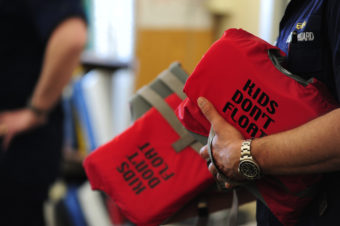
The Coast Guard often partners with Alaska’s Office of Boating Safety to educate students about cold-water safety. U.S. Coast Guard photo by Petty Officer 3rd Class Grant DeVuyst.
Usually a boating fatality story is a sad recounting of a life lost on the water. But not this story.

Alaska has not had a single recreational boating fatality since the start of the year.
That’s a record-breaking streak for Alaska, according to Jeff Johnson with the Office of Boating Safety.
“We’re excited. We just hope it continues.”
Last year, no fatalities occurred until the end of June when seven people died over a couple weeks.
Most recent years averaged a dozen fatalities, according to Johnson. July and August tend to be the most dangerous months. Last year saw 22 fatalities.
Deaths that occur in a commercial activity–including guided fishing trips, boat tours, or river rafting—are not included in these statistics.
Johnson says people often underestimate just how cold the water is.
“Our fatality profile in Alaska is a little different than the national profile. Our fatalities are most commonly a capsize, swamping or fall over board and it’s a cold-water immersion drowning.”
According to statistics kept by OBS since its start in 1998, nine out of ten victims are adult males that end up in the water without a life jacket.
Johnson says that it’s common among men to see life jackets as an inconvenience or as something only beginners wear.
“Without a life jacket on, most of these folks are not living long enough to become hypothermic. Life jackets are the single most important thing that people can do to avoid dying in an immersion event.”
The crowd outside the Supreme Court yesterday. (Photo by Photo Phiend/Flickr Creative Commons)
The U.S. Supreme Court ended its term striking down the federal Defense of Marriage Act and sending a California same-sex marriage case back to the lower court. But the court does not affirm gay marriage as a constitutional right.
DOMA controls more than a thousand statutes and numerous federal regulations pertaining to Social Security, housing, income taxes, and other benefits available to heterosexual married couples.
Kennedy said its “principal purpose is to impose inequality,” so in ruling DOMA unconstitutional, legally married same-sex couples would be eligible for federal benefits.
“In neither case, does the court say that there is a firm constitutional right for people of the same sex to get married.”
University of Alaska Justice Center Professor Jason Brandeis calls Justice Kennedy’s opinion a criticism of a “mean-spirited law.”
“It was intended to relegate same-sex couples to a level of being second class citizens and the impact that could have on their families and their children seems to be a part of his decision making process.”
Kennedy’s opinion also makes it clear that federal recognition and benefits would only apply to couples married in states that have legalized same-sex marriage.
Constitutional amendments in 29 states limit marriage to heterosexual couples. Alaska was the first to do so in 1998.
“After today about 1/3 of Americans live in a state that offers marriage equality,” says Joshua Decker.
Decker is with the Alaska ACLU.
“We’re really happy about this because with the Defense of Marriage Act case, Alaskans who get married outside and come back to Alaska are now able to have the thousands of federal benefits that apply to married couples, apply to them.”
It is likely states that ban gay marriage will become battlegrounds over the issue. Decker says Alaska may well enter the fray.
Both Alaska’s U.S. Senators applauded the Supreme Court’s DOMA ruling. Senator Mark Begich called it a “victory for individual rights.”
Senator Lisa Murkowski officially announced her support for same-sex marriage last week. After the court’s ruling, she said the federal government should empower households, respect the decisions of states and otherwise get out of the way.
Jim Minnery with Alaska Family Action says the Supreme Court is respecting states’ rights in the DOMA decision.
“It’s very clear that Alaska’s still in the driver’s seat with how we define and regulate marriage.”
But Minnery says the discussion has just begun.
“Alaskans need to stay engaged on the issue of marriage because Justice Kennedy, who wrote the majority opinion, basically acknowledges in no uncertain terms that states have the right to define and regulate marriage.”
Minnery said organizations like the Family Action council will do their part to make sure Alaska marriage remains limited to “one man and one woman,” as the constitution states.
Professor Brandeis believes a clear line can be drawn from the movement for racial equality to equality based on sexual orientation. History shows such movements take years, but Brandeis believes public opinion is shifting significantly on the issue of same-sex marriage.
“I think that people that are in charge of making laws that are consistent with the United States Constitution and state constitutions and have a responsibility to their constituents really need to take a step back and think about what side of history they want to be on.”
For the last few days, people have gathered outside the Court in anticipation of the rulings. (Photo by Victoria Pickering/Flickr Creative Commons)
Update: June 26 – 10:54 a.m.
Senator Mark Begich is calling the ruling a “victory for individual rights.”
His office sent out a press release with this statement:
“Today’s decision is a victory for individual rights and Alaskans who are fed up of government intrusion. I have said all along that I do not support discrimination of any kind and that is why I believe same sex couples should be able to marry and have the same rights, benefits, privileges and responsibilities as any other married couple. While we still have a long way to go, today, the Supreme Court confirmed that the government needs to step aside, leave the decision to states and churches, and stay out of our private lives and daily business.”
Update: June 26 – 7:22 a.m.
Senator Lisa Murkowksi has released a statement on the ruling:
“I welcome today’s Supreme Court decision to strike down the Defense of Marriage Act because the federal government should empower households, respect the decisions of states and otherwise get out of the way. This ruling represents victories for states’ rights and equal treatment under the law.”
Original Story: June 26 – 7:04 a.m.
The Defense of Marriage Act has been ruled unconstitutional by the U.S. Supreme Court.
This morning the court issued an opinion saying that DOMA deprives people of equal liberty as protected by the Fifth Amendment.
The opinion was issued by Justice Kennedy joined by Justices Ginsburg, Breyer, Sotomayer and Kagen.
Same sex couples who are legally married will be entitled to equal treatment under federal law.
After reading the ruling this morning, Peter-Contesse says it’s surprisingly more powerful than she expected.
“It’s indescribable. Not something I expected to experience in my life…and about damn time too.”
Olejasz was following the decision online but says she had a hard time believing what she was reading.
“I think my mind interpreted the words, but my emotions wouldn’t let me go there. I understood the words, but I kept saying ‘is this really true, is this really true. I don’t know.’ ’”
The ruling means when the couple gets married in Washington, a state where same-sex marriage is legal, their marriage will be recognized under federal law.
“Our marriage [will be] on the same par as everyone else’s marriage which is a bigger deal than I expected it to be. It’s definitely a very emotional time this morning.”
The court found there was no standing to rule on Hollingsworth v. Perry and the case was sent back to the Ninth Circuit Court with instructions to dismiss the appeal because it lacks jurisdiction.
This is a developing story, check back for more details from the ruling.