Heather Bryant

NOAA crew surveys beaches for tsunami debris

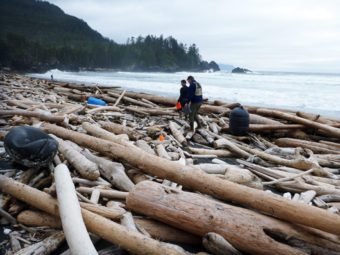
Marine debris is nothing new, and a NOAA crew found little of note in last week’s survey of outside Panhandle beaches.

Beginning in Ketchikan, five scientists from the National Oceanic and Atmospheric Administration hit 36 sites, looking for debris from the March 2011 tsunami that hit Japan.

They mostly found common stuff, including a lot of Styrofoam.  But large oval black, yellow and orange buoys turned up on 26 of 36 beaches.

“They were pretty ubiquitous throughout our survey area,” lead scientist Jacek Maselko said.

Maselko describes them as molded hard plastic with rings on either end.  Some had English, some Japanese writing.

Jeep Rice of  NOAA’s Auke Bay Lab, says they’re not fishing gear, and likely part of the Japanese fish farming industry.

“So the aquaculture farms with lots of nets and oysters and other things attached were swept up in the tsunami, and these would be the buoys that survived so to speak,” he said.

Rice said the buoys were about two feet in diameter and three and a half to four feet tall, and could support a lot of weight.

“These would be flying really high in the water so to speak, so they’re going to be easily taken by the wind and pushed by the wind further then say the water currents would take them,” Rice said. “Where there’s a conflict of the current versus air or current versus wide, these are going to be taken by the wind.”

The scientists also found a number of five-gallon jugs that appear to contain some type of waste oil.  Some were empty, others broken up, some still had liquid contents.  With no labels for a clue, Rice says the NOAA lab is trying to figure out what the substance is.

“One of them looks like of soapy-like.  I don’t know if that’s maybe kitchen grease and soap, or oil, or did it come out of a transmission? We don’t know” Rice said.

While some notable things have washed up in the Pacific Northwest  from the Japanese tsunami — such as a Harvey Davidson motorcycle, a dock, and the so-called ghost ship sunk in April by the Coast Guard —  Maselko says most of the stuff the NOAA scientists catalogued may have been dumped in the ocean or found its way there years ago.

“We don’t know.  Even finding a ball with name on it, you never know somebody just didn’t lose it playing beach volleyball in years past,” Maselko said. “That’s where the tough part of the proof comes in.”

The scientists will next survey beaches in the Yakutat area. Maselko says he intends to canvass as much of the Gulf of Alaska shoreline as possible this summer, looking for tsunami debris.

Possible route changes in store for bus system

A route change is proposed for Juneau’s Capital Transit bus system.  It would move portions of Route 4 off the Mendenhall Loop Road to the south end of Riverside Drive. The city is holding a series of meetings on the proposal, which was outlined on Wednesday’s Juneau Afternoon.
Capital Transit is also asking riders for feedback.  To take the survey, go to  www.juneau.org/capitaltransit/survey.

Oyster farming picks up steam in Southeast

(Click on “play” to see the OysterFest slideshow. Or click on a photo to see the next one.)

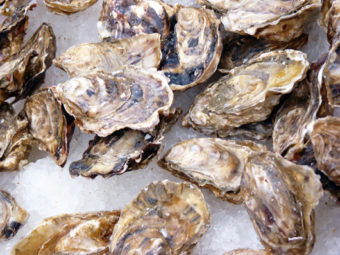
Robert Kinneen stands at a table, surrounded by shellfish and cooking gear.

“I’m going to be making oysters with a rhubarb shooter,” he tells a small crowd. “I’m going to start with a cup of water, then a third of a cup of brown sugar …”

Kinneen shared his recipes during OysterFest, held alongside the Southeast Native cultural event Celebration 2012. He holds a shucking knife in one hand and a microphone in the other, as he encourages his fellow Alaskans to try out – and experiment with – oysters.

“While they’re not indigenously found here, I think it’s a great opportunity to grow a beautiful-flavored specimen … (with) nice crisp clean subtle flavors,” he says. “They’re really, really tasty, and subtle on the brine. They’re just really amazing.”

Kinneen has been chef of the Seven Glaciers restaurant at the Alyeska Resort, Orso in downtown Anchorage, and other popular spots. He’s Tlingit, originally from Petersburg, with family ties to Sitka.

He works with the Alaska Seafood Marketing Institute, and is part of a regionwide effort to promote oysters from tribally-owned shellfish farms.

“The Alaska brand, the mystique behind the Alaska brand, always creates market opportunity for you,” says Russell Dick, president and CEO of Haa Aaní, LLC.

It’s the Sealaska Corporation subsidiary developing new Southeast businesses, including oyster farms.

“Everything we have in production today could get sold into the Alaska market easily. And as we look to expand, we certainly want to reach out into the other domestic markets and potentially internationally, if the logistics make sense and the economics make sense,” he says.

Sealaska doesn’t own oyster farms. But the Juneau-based regional Native corporation has formed partnerships with shareholders and tribal governments to set up three farms in  Yakutat and one each in Kake and Angoon.

“Haa Aaní is planning on developing three more farms in Hoonah as well, with one five-acre parcel  serving as an R&D mariculture site,” Dick says.

It’s not easy work.

“Sometimes it’s hard to get up and go out there because it’s blowing 40 or 50 knots and it’s snowing,” says Joy Klushkin, who left her job as business manager of Yakutat’s school district to become an oyster farmer. That was two years ago. “I’m still in shock when I come up to a table and I see they’re my oysters. I tell my husband, take a picture! I can’t believe it! Those are my oysters.”

Klushkin has about a half-million of the valuable shellfish growing in her farm. She just made her first delivery of around 25,000 to Haa Aaní’s OysterFest.

She and two other farms share an island about a five-minute skiff ride out of Yakutat’s boat harbor. There’s a lot of cooperation.

“We’ve actually learned a lot, and got a lot of information from others. It seems to be an industry that everybody is excited to promote,” says Cindy Bremner, president and CEO of Yak-tat Kwaan, the community’s village Native corporation.

It just harvested its first oysters, and hopes to produce as many as 3 million a year.

“So it’s not like they don’t want to share what they know with us because we’re going to have a better oyster. It’s an industry that seems to support each other, is what I’ve felt. And it makes it exciting,” she says.

The farms take young oysters – called spat – and grow them until they can be sold. That can take from two to three years, depending on a variety of factors.

Spat comes from nurseries, also called “Flupsys.” Kake has one. And Sealaska’s Haa Aaní subsidiary recently signed an agreement with the Hydaburg Cooperative Association and the Organized Village of Kasaan to develop, build and operate a larger nursery near Hydaburg.

Haa Aaní’s Russell Dick says marketing is also part of the job.

“As these continue to mature and grow out, and they produce there high-quality oysters, our role then becomes ensuring we can find the market outlet, and the best market outlet, that provides the highest margin for the farmers,” Dick says.

So far, they’ve been sold to restaurants and grocers in Southeast and Anchorage.

Back at OysterFest, chef Ron Kinneen is passing around a tray of half-shells with his rhubarb-ginger topping.

The taste is new to many, including farmers in attendance.

“I ate my first oyster just the other day. It was very, very good, but I had nothing to compare it against,” says Bremner, of Yak-tat Kwaan. “I decided I had better try one, since we’re in the oyster business. So I’m going to be excited to try them numerous different ways.”

These are not the only shellfish farms in Southeast. In addition to oysters, littleneck and geoduck clams have been grown and sold.

Note: The Alaska Seafood Marketing Institute provided some of the Oysterfest audio included in this report.

Links:

Alaska Shellfish Growers Association.

Parnell signs shellfish farm bill at OysterFest.

Mountain climbers could cause solid waste problem in Denali park’s future


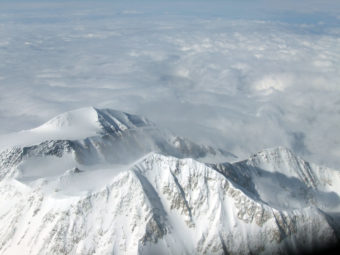
Denali as seen from an Alaska Airlines flight on Sunday June 24.
Denali as seen from an Alaska Airlines flight Sunday June 24. (Photo by Rosemarie Alexander)

About 1,500 climbers attempt to summit Denali each summer. And as they make their way up North America’s highest peak, a lot of the human waste they produce gets thrown into the mountain’s glacial crevasses. According to a new study, the waste from previous generations of climbers will begin reemerging farther down the glacier a few decades from now. And that reality threatens to transform the pristine quality of the National Park’s wilderness area.
Over the decades, climbers have generated a lot of human waste. More than 130,000 pounds, in fact, according to Mike Loso’s calculations. The glaciologist from Alaska Pacific University wanted to answer a few questions about that.

“Where is that waste going and when is it going to melt out at the surface again?”

So in 2007, Loso began a research expedition on the West Buttress Route, the most popular way to climb Denali. And the answer he found to that “when” question is surprisingly soon. Loso predicts the waste will begin surfacing on Denali’s lower Kahiltna glacier in 15 to 25 years.

“We can’t say it precisely, but I think the important piece of that finding is that it’s not centuries away. Within the lifetime of the people managing this mountain, these waste piles are going to start to emerge on the surface.”

Loso, and graduate student Katie Goodwin, also found that when the waste does emerge, it will still be quite potent. In turns out inner glaciers, which are dark and cool, are very good at preserving the type of harmful bacteria, like E. coli and fecal coliform, that live in human waste. But Loso says because it will be surfacing in such a remote area, the waste doesn’t represent a major risk to human health or to the environment.

“This human waste is going into a very, very large ecosystem that it’s difficult to argue is at all threatened. We could do the math and figure out how many kilograms of bear poop are out there and we’d come up with a huge number too.”

But it is a problem the National Park Service will have to pay attention to in the years ahead. And no one is more aware of that than Roger Robinson, a mountaineering ranger on Denali.

“People do travel down that way so it’d be something the Park Service will have to manage very closely, once we start finding this stuff.”

The mountain was obscured by clouds to those below. (Photo by Rosemarie Alexander)

Robinson is passionate about keeping Denali clean. He says the mountain is in vastly better shape today than when he first began his job more than three decades ago. Today, all climbers are required to use “clean mountain cans”- two gallon plastic tubs that can be strapped to a backpack or sled. That rule went into effect in 2006, following a bad outbreak of gastrointestinal illness on the mountain a few years earlier. Now, a lot of human waste collected in the cans is flown off the mountain. But Robinson says in the past, most of the waste ended up in crevasses.

“We had a lot of pit toilets that were used for the past 35 years or more out of Kahiltna Base Camp and once those start coming out, those will be huge piles of human waste that are surfacing.”

Climbers are still allowed to throw their waste in crevasses in the middle sections of the West Buttress route. Robinson would like to see the National Park Service require all waste be carried off the mountain. He says new regulations are tricky to pass, but it would be worth the extra expense and effort.

“There’s just no reason to have the prime mountain of the Americas filthy as it once was. It is a wilderness mountain and we need to keep it in that state.”

Loso, a climber himself who spent a summer as a junior ranger on Denali, says it’s a tough issue. He isn’t ready to advocate for climbers to pack all of their waste off the mountain. But he also doesn’t like the idea of spoiling, even in a small way, a remote wilderness area. And he doesn’t buy the argument that we shouldn’t worry about a place that sees so few visitors:

“Since when does the National Park Service, make the argument that the places that are least visited are therefore okay to contaminate or to pollute? It’s the opposite. The park service puts on a high pedestal the places that are the most remote and most wild. And they protect them the most intensely. And here that management practice is sending the contaminants to that very place and I think that’s the hard question.”

Roger Robinson thinks the day is coming when climbers will be required to carry out all of their human waste. But even if that does happen, decades of waste will continue marching down the glacier, emerging on the lower Kahiltna as a foul reminder of past expeditions to the top of Denali.

APRN’s Annie Feidt reports:


The jig is up for Juneau litterbugs

Last month the Juneau Empire reported on the new cameras being installed by George Schaaf, the city’s Park and Landscape Superintendent.

Juneau has a multitude of popular dump sites, Schaaf and (Community Services Officer Bob) Dilley said, including in North Douglas, Sunshine Cove, Shane Drive, Allen Court and near the university.
Schaaf says he intends on moving the cameras to various spots so they won’t be in one place too long.
“Wherever we have a problem, we can put them,” he said.

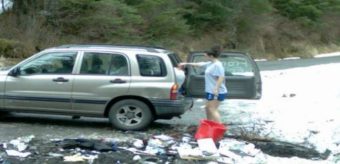
In Juneau, fines for littering start at $200 for the first offense. So far at least six people have been cited because of footage from the cameras.

ADN requested footage from the video cameras and published video of the offending litterers.

Alaska litterbugs caught on camera from Kyle Hopkins (khopkins@adn.com) on Vimeo.

UAF partners with Google to preserve Alaska Native languages

Alaska’s 20 native languages are a generation away from disappearing. But a new effort is adding technology to the list of tools for saving the languages.

The Alaska Native Language Center at the University of Alaska Fairbanks has joined Google in the Endangered Languages Project, a worldwide effort to collaborate on a website where users will find comprehensive information on endangered languages.

According to Google, more than 3,000 languages are in danger of disappearing. That’s roughly half of all languages in the world.

The site is designed to function as a social network, with users uploading speaking samples and videos, and interacting with each other. The project is encouraging speakers and language experts to share best practices for each language.

“It’s a great way to bring attention to the plight of native languages,” said Rosita Worl, president of Sealaska Heritage Institute. The institute is the cultural and educational foundation of Sealaska Corp., the Alaska Native corporation for people of Tlingit, Haida, and Tsimshian descent. Worl is Tlingit.

Alaska Native Languages map
Map: Native People's and Languages of Alaska by Michael Krauss. Map courtesy of the Alaska Native Language Center.

“Our language may never be spoken the way it once was, but the voices of our ancestors are not going to disappear,” Worl said.

The website will create an opportunity for Alaska Native communities to add language documentation to the site as well as comment on samples and documents uploaded by other users.

UAF linguistics professor Gary Holton is Director of the Alaska Native Language Archive which is part of the Alaska Native Language Center.

“So much language information is not housed in archives. It’s in minds and in shoe boxes of old recordings and in communities,” Holton said.

The last speaker of Eyak, the Native group of the Copper River Delta region, passed away in 2008. Marie Smith Jones worked with the Alaska Native Language Center to preserve her language.

Other languages range from having one or two speakers to thousands of speakers, like Central Yup’ik.

“It’s hard to count the number of speakers,” Holton said.

People move away or marry into different communities and while they may be able to speak the language, they don’t identify themselves as speakers of that language.

The goal of the Endangered Languages Project is to add real-time interactivity to the work that many language archives are doing. Archives already make materials available online and for download. This new project will be the first time people can upload their own materials and annotate the documentation of others.

Holton reminds people that the technology itself will not do the work.

“What this project provides is a platform. This is not a magic bullet for saving languages,” Holton said. “This is only as good as what people put into it.”

The center is encouraging local grass-roots efforts to contribute to the site. It’s also incorporating current programs, workshops and culture camps to contribute to the website.

“Documenting native languages is very different from restoring them,” Worl said. She emphasizes the need for immersive learning experiences that teaches the language by using it in school and home, rather than memorization.

“Unfortunately, I don’t think you can consider any of the languages of Alaska safe,” Holton said. “Most are in a situation of being one generation away from being lost. It’s only by sharing language and using language that we can save it.”


Site notifications
Update notification options
Subscribe to notifications