Heather Bryant

Low salmon runs around the state have subsistence fishermen worried

This year’s Chinook salmon run on the Yukon is poor, and the Alaska Department of Fish & Game is preparing subsistence closures to meet escapement goals. The closures begin tomorrow, but with so few fish in the river, it’s unknown how long subsistence fishermen will be unable to fish.

Fish & Game worked with the Yukon River Drainage Fisheries Association, a non-profit group of subsistence fishermen and commercial fishing interests, to estimate a king run this year between 109,000 and 146,000 kings.

Steve Hayes, Fish & Game’s summer season manager for the Yukon says that number breaks down to about 50,000 fish in both the U.S. and Canada for escapement, with another 50,000 for subsistence needs in both countries. Even if the run comes in on the higher end of that estimate, Hayes says it still falls short.

By mid-June, only 4,500 kings had passed the Pilot Station Sonar site, about 120 miles from the mouth of the Yukon. Hayes says those numbers should be 10 times bigger, closer to 45,000 kings during an average run, or 12,000 in years with a later run.

To hit escapement targets, and make sure enough king salmon make it upriver to spawning grounds in Canada, Fish & Game is preparing to close subsistence fishing on the lower Yukon as the first pulse of king salmon move upriver. There will be 36 hour closures, one district at a time, amounting to about a 5 day closure. And that could only be the beginning.

Similar closures on fishing on the Kuskokwim this year have met with anger and frustration by subsistence fishermen. While Hayes says no one is happy with the subsistence limits, he says similar weak runs in 2009 and 2011 have helped all involved recognize the importance of conserving the run.

Orville Huntington is the Wildlife and Parks Director for the Tanana Chiefs Conference, a tribal consortium of the 42 villages of Interior Alaska. He’s also a lifelong subsistence hunter and fisherman. As one who catches his kings upriver, he says most people were prepared for a bad year, and are looking at alternatives.

For now, while subsistence fishermen hope for a strong chum run later in the season, Hayes says Fish & Game will continue to monitor the first pulse of Chinook, and is prepared to implement more closures if necessary.

This follows the closing of the Kenai River from the mouth upstream to Skilak Lake to king salmon fishing beginning Friday, June 22. The closure will be in place during the early run of kings through the end of June.

Fish & Game says the early king run on the Kenai looks to be perhaps the lowest on record.

The department says it can’t even justify catch-and-release fishing because of the additional mortality given the low number of kings in the river.

When the king salmon late run begins July 1, bait and scent will be prohibited.


Update: Torched turf equipment leaves project behind schedule

Tuesday’s fire at Adair Kennedy Memorial Field in the Mendenhall Valley will delay the turf replacement project, but the contractor says it will be done by football season.

Juneau police and the Capital City fire marshal are investigating what appears to be vandalism of specialized equipment to be used in laying the new turf.

The old turf has been torn out; city crews are compacting the sub-base, and contractor, Shaw Sportexe, planned to begin installing new turf this week.

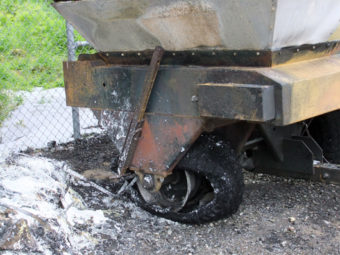
Instead, vandals destroyed the large Turfco spreader that disperses crumb rubber infill on the turf.

The Turfco is not something you will find in Juneau.

“Very hard to find. Not something that’s easily available in your local Home Depot,” said Shaw Sportexe field superintendent Eric Pratt.

The spreader is pulled by a small John Deere tractor. While Pratt calls the tractor “run of the mill,” its wide tires are not, a fact not lost on CBJ Project manager Catherine Wilkens.

She was on the field early Tuesday morning to assess the damage.

“You’ll notice on the John Deere tractor it has extra-wide wheels. Those are to run over the turf without leaving ruts or any of that type of thing, so not easily replaceable,” Wilkens said.

The rubber on the rear tractor tires had bubbled. The tires on the hopper were totally burned off their wheels. A big glob of unrecognizable material oozed next to the scorched hopper.

Pratt surveyed the mess, which was melted adhesive and turf seaming tape.

“This drop spreader is completely wasted. Pretty much unsalvageable at this point, except for spare parts. And the glue loss, it’s all gone…that is all the adhesive that was allotted for this project,” he said.

Pratt is from Port Townsend, Washington. He was part of the Shaw Sportexe team that installed the JDHS practice field downtown in 2005. The Georgia-based company is one of a few who specialize in synthetic turf fields. According to Shaw Sportexe website, it has installed more than 900 fields across the country, including several in Anchorage.

While CBJ project manager Wilkens said the cost of the vandalism will be covered by Shaw’s insurance, the cost to CBJ is a delay in the project. It was scheduled to be done July 15th.

Pratt said it will be done in time for football season. Practice begins July 30th.

“You know, Shaw Sportexe is going to do whatever we can to get this replaced and taken care of in a timely manner, so that kids are ready to practice come start of practice season,” he said. “Just look forward to getting it done and making sure the community has a nice field.”

Once the turf installation begins, it will take about three weeks to complete.

Increasing vandalism at city facilities
A year ago, vandals burned the old turf field in several spots, one of several incidents at the facility adjacent to Floyd Dryden Middle School.

In fact, vandalism at Juneau Parks and Recreation facilities and city buildings has steadily increased over the last few years. Parks Superintendent George Schaaf estimates vandals have cost the city nearly $60,000 so far this fiscal year, which ends June 30th.

Last year the city installed seven surveillance cameras at the Adair Kennedy concession stand and one on the field. A camera was dismantled in Tuesday morning’s vandalism and the housing found under a front-end loader on the field.

But Schaaf said footage from another camera will be useful in this case.

“We did get usable footage off of it and I turned it all over to JPD and they’re using it in their investigation,” he said.

Large rolls of turf have been staged in the parking lot at the field. They were not damaged in the incident.


House passes bill granting thousands of acres of National Forest to Sealaska

The U.S. House passed a bill on June 19, ceding tens of thousands of acres of the Tongass National Forest to the Sealaska Native Corporation. However, the vote is just one step the bill needs to clear Congress.

This is the furthest along the legislative process the Sealaska bill has made it. It passed the Republican controlled House with 232 votes including 16 Democrats.

The bill would transfer control of tens of thousands of acres of the Tongass from the U.S. Forest Service to the Sealaska Corporation, the final Regional Native Corporation to settle its land claims. The land is outside the plots originally agreed to in the Alaska Native Claims Settlement Act 40 years ago.

Some of the land will be used for logging, with some future sites left open to other possible ventures. Those future sites have Andi Burgess worried. She’s with the Alaska Wilderness League.

“There’s no prohibition on what can be done at these sites,” Burgess said.

Those sections of land could be parceled off as heritage sites or be designated for money-making projects, like ecotourism. While Burgess’s fears may be stoked by the bill’s passage in the House, it still has some way to go before it becomes law.

The bill needs to clear the Senate, and if its current pace there is any indication, that probably won’t come quickly. Senator Lisa Murkowski introduced her version into committee last year, but has yet to receive a markup – let alone a vote.

Aides to Murkowski say it’s possible the House vote will speed along the process, at least out of committee, but the full Senate is another story.

Murkowski’s plan is more scaled back than the House version.

“To have limited impact into those old-growth areas, to have limited impact in those watershed areas. That’s why we’ve gone through the negotiated process,” Murkowski said.

She’s says that process has taken years –years of negotiations with Sealaska, the U.S. Forest Service and Southeast residents. And those negotiations could make for a more pleasing bill for both parties in the Senate.

And While Young’s bill did earn some Democratic votes – it lost more Republicans, a sign it could be hard to move his version down the line.

Senator Murkowski says the chairman of the Senate Energy and Natural Resources Committee, Jeff Bingaman, hasn’t committed to another hearing on the bill, but she’s trying.

“We keep sitting down,” Murkowski said. “And I suppose the fact that we’re still talking about it is good.”


City and Borough Manager Kim Kiefer talks tax on Juneau Afternoon

City and Borough Manager Kim Kiefer.

City and Borough Manager Kim Kiefer was a guest on Juneau Afternoon on Monday, June 18.  This is the first of planned monthly conversations with Kiefer during her tenure as city manager.  She took the job on April 1st, after serving as Deputy Manager for several years.

This week she explains the temporary CBJ 1 percent sales tax that comes up for renewal in October. The CBJ Assembly has been holding Finance Committee hearings on the projects proposed for a portion of the tax.  Kiefer says the Assembly is expected to meet April 28th to make the final decision.

Jury finds Schaeffer Cox guilty of conspiracy to commit murder in Alaska Militia trial

Jurors in the federal case of three Alaska militia members have reached a verdict on 15 of the 16 counts.

Alaska Peacemakers Militia leader Schaeffer Cox, Lonnie Vernon and Coleman Barney were charged with conspiring to kill government officials and amass a cache of dangerous weapons.

Jurors took two days to deliberate after the month long trial.

Militia leader Schaeffer Cox was found guilty for most of the charges against him including conspiracy to commit murder.
Defendent Lonnie Vernon was also found guilty of conspiracy to commit murder.

Jurors told the judge Monday they were deadlocked on count of murder-conspiracy against Coleman Barney.

The Anchorage Daily News reported on Twitter that defendant Schaeffer Cox yelled at the jurors following the reading.

Sentencing has been scheduled for Sept. 14.

A grand entrance to Celebration 2012

Celebration 2012 is officially underway. Southeast Alaska’s largest Native cultural gathering kicked off in earnest this morning (Thursday) with the Grand Entrance Procession in Juneau. KTOO’s Casey Kelly has more.

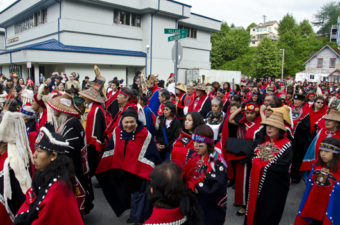
Hundreds of Native Alaskans gathered in downtown Juneau for the Grand Entrance for Celebration 2012.
Hundreds of Native Alaskans gathered in downtown Juneau for the Grand Entrance for Celebration 2012. (Photo by Heather Bryant/KTOO)

Dozens of groups, decked out in Chilkat blankets, button robes and other Native regalia, made their way singing, dancing and drumming through Juneau’s Willoughby District from the Alaska Native Brotherhood Hall to Centennial Hall.

Hundreds of spectators lined the parade route. Robert Sharclane, who grew up in Hoonah and now lives in Juneau, brought his kids.

“I’m half Tlingit, and it’s a fairly statewide, large and special event, and I just wanted them to participate in it and get an experience seeing it,” he said.

Sharclane’s nine-year-old daughter Pearl was wowed by the various dance groups.

“It’s cool to watch it and all the dresses they have,” she said.

Once all 55 groups made it into Centennial Hall, Sealaska Heritage Institute and Corporation officials formally opened the ceremony. SHI Trustee Clarence Jackson read a list of elders who have passed away since the last Celebration in 2010, including Dr. Walter Soboleff, the renowned Tlingit Presbyterian minister who helped found Sealaska Heritage Institute in 1980. Soboloeff was 102-years-old when he passed away last year.

Celebration was first held 30 years ago, after Sealaska Native Corporation founded the non-profit Heritage Institute to document and preserve the cultures and traditions of the Tlingit, Haida and Tsimshian people. The event is held every other year and has expanded to include Native groups from outside Southeast Alaska.

Representatives from the Nisqually Tribe of Washington performed a traditional welcome song at the Grand Entrance.

SHI President Rosita Worl thanked all the dance groups, which she credits for making Celebration a success.

“We owe Celebration to our dancers. We owe Celebration to our ancestors. We owe Celebration to our children,” Worl said. “We know our culture is going to be strong and carry on for the next 10,000 years.”

This year’s Celebration events run through Saturday at Centennial Hall and other locations around Juneau. Organizers estimate 2,000 people will participate, with another 5,000 attending as audience members.

Site notifications
Update notification options
Subscribe to notifications