Heather Bryant

Emmonak Women’s Shelter receives emergency funding

In May, the Emmonak Women’s Shelter – one of only two shelters in western Alaska and the only shelter located in a native village – was on the verge of closing its doors. Plagued by budget shortfalls, its funding for the year was nearly gone before the summer even began. On July 2, After working with Senator Lisa Murkowski, the Bureau of Indian Affairs provided the shelter with $50,000 in emergency funding.

“We just received word from our Senator Murkowksi that $50,000 is going to be sent to the tribe and the tribe is going to write a check for that amount to the Emmonak Women’s Shelter,” said Lynn Hootch.

Hootch is the former shelter director who now works with the Yupik Women’s Coalition in Emmonak. Still involved with the shelter, Hootch says its monthly costs range from $10,000 to $13,000. That includes keeping advocates on the phone 24 hours a day, and housing women and children for weeks at a time. After fearing closure just months ago, Hootch says the $50,000 will now keep the shelter open and staffed for the rest of the summer.

“The Emmonak tribe will transfer the money to continue to keep our shelter open until hopefully, we receive the grant that we applied for, in September,” Hootch said.

That transfer is from the BIA Office of Indian Services, which will be making the emergency funds available to the Village of Emmonak. As a federally recognized tribe, OIS allocated the money under its Tribal Priority Allocation authority.  The tribe will then send the funds on to the shelter.

This isn’t the only new funding for the shelter. After the New York Times ran an article on the shelter’s seemingly imminent closure in May, word spread on Facebook, and pledges of support were followed by donations of money and in-demand items like diapers, clothes, and non-perishable food. Hootch says the Department of Public Safety even donated an ATV. In all, the shelter collected close to $30,000 in donation.

“We received almost close to $10,000 in checks and we found out this morning that we have close to $20,000 from PayPal.”

Serving about 500 women and children a year, the Emmonak Women’s Shelter has been open for 34 years. It operates under a grant from the U.S. Department of Justice’s Office of Violence Against Women.

Alaska firefighters join fight against fires in the Lower 48

Update:

A slightly slower start to the fire season in Alaska has allowed the state to loan some of its fire crews to the lower 48 for the time being. The Alaska Fire Service says five crews of Fire Fighters have gone to Wyoming, not Colorado, as earlier reports had stated.

Five crews is just over a hundred firefighters and their equipment, Public Affairs Specialist Mel Slater said.  Fires are raging all over the west right now. Montana has 10 large wildfires burning, Utah’s largest wildfire has consumed more than 150 square miles, and there are reports of large fires currently burning in Nevada, Idaho, New Mexico, and Wyoming.   The Colorado Springs wildfire is reported 55% contained.

So far this year, firefighters in Alaska have had a slightly slower season than usual, Slater said, which enabled sending some to areas in the lower-48.

The Bear Creek fire, 13 miles southwest of Anderson, has burned more than 8,000 acres so far. Slater says officials determined what amount of personnel and equipment could be loaned out while still maintaining what is needed for response efforts in the state. Four more crews from Alaska are slated to depart for Wyoming Wednesday.

Original Story:

About 100 firefighters from Alaska are heading to Colorado to help fight wildfires there.

Alaska Incident Management Team spokeswoman Sarah Saarloos says Colorado authorities requested the five fire crews from Alaska.

Alaska was able to help out because of lighter-than-usual fire season so far this summer.

There’s two wildfires currently burning in Interior Alaska. Just over 110 firefighters continue to work the Allakaket fire, which has burned about 2,700 acres 180 miles northwest of Fairbanks. Four other fire crews were released from the fire over the weekend.

The other is the Bear Creek Fire, which has burned about 8,500 acres 13 miles southwest of Anderson.

Fourth of July festivities promise fun and games

Rain is in the forecast for the Fourth of July, but don’t let that dampen the fun. There is a ton of events and activities going on around downtown Juneau and on Douglas. With so many options, plan ahead because the parking goes fast.
Check out this video from Fourth of July in Douglas.


Here are some of the events going on for the holiday.

July 3

6:00 p.m. – Douglas Volunteer Fire District softball game at Savikko Park Field #4 followed by a watermelon eating contest.

8:00 p.m. – Midnight – Community dance at the JACC

11:59 p.m. – Fireworks on the Gastineau Channel

July 4

11:00 a.m. – Juneau Fourth of July Parade start

11:00 – 5:00 p.m. – Barefoot Bouncers Bouncy House at Savikko Park Field #3

12:00 – 6:00 p.m. – Deep Pit Beef Barbeque Dinner at Douglas Methodist Church

12:00 p.m. – Sand Castle Challenge at Sandy Beach

1:00 p.m. – Hotdog sale in front of Douglas Fire Hall

1:30 p.m. – Participants assemble for Douglas parade at Gastineau School.

2:00 p.m. – Douglas parade starts

3:00 p.m. – Field sports at Savikko Park Field #2

3:00 p.m. – Medieval fighting and dance at Savikko Park Field #3

3:30 p.m. – Super Dog Frisbee Contest at Savikko Park Field #3

4:00 p.m. – Make and Break Old-time Fireman’sHose Race at Douglas Fire Hall

4:00 – 9:00 p.m. – Dance, Music and other entertainment at Savikko Park Field #2

For more information check out the Douglas 4th of July Committee and the Juneau 4th of July website.

June rainfall broke record and prompted flood advisory

Juneau received 6.69 inches of rain in June.  That beats the previous record of 6.22 inches in June 1996, according to the National Weather Service forecaster Richard Lam.

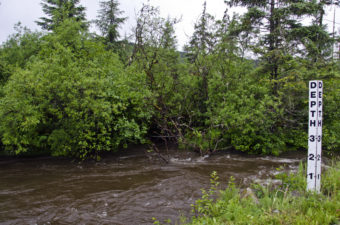
Rushing water floods the ditches along Montana Creek road and come withing a few feet of covering the road.
Rushing water floods the ditches along Montana Creek road and come withing a few feet of covering the road. (Photo by Heather Bryant/KTOO)

Due to the rainfall and near constant cloudy weather,  Juneau was nearly three degrees cooler than normal in June.

“We didn’t get much sun this past month,” Lam said, a fact not lost on most capital city residents.

The National Weather Service’s preliminary records for June recorded 23 cloudy days, 6 partly cloudy days and just one clear day.

The heaviest day of rain was on Friday, June 29 when 1.82 inches fell.

The steady rain prompted a flood advisory for Montana Creek in the Mendenhall Valley on Friday afternoon.  The creek rose rapidly Friday morning with the heavy rain and crested in the afternoon at 14 point 3 feet, a little more than a foot shy of flood stage, according to Edward Liske, at the National Weather Service Juneau office.

Rising water rushes along next to Montana Creek road, however the water did not rise enough to cover the road.
Rising water rushes along next to Montana Creek road, however the water did not rise enough to cover the road. (Photo by Heather Bryant/KTOO)

Since midnight, he said Juneau rainfall had ranged from about three-quarters of an inch to nearly an inch and a half of rain, depending  on location. The airport got 1.41 inches and the weather station off the Back Loop 1.46 inches.

As of 5 p.m. Friday, Liske said Mendenhall River and Mendenhall Lake hadn’t responded much to the rain event.   Jordan Creek in the valley had risen from 7.5 feet to 9 feet at 5 p.m.


Ahead Of Alaska drilling, Shell practices cleaning up

Royal Dutch Shell could drill several exploratory oil wells into the waters off the north shore of Alaska this summer. The potential prize is huge, but so is the risk, should there be an oil spill in this pristine and remote region. And that risk is on everyone’s mind since the BP blowout in the Gulf of Mexico two years ago.

Shell is now training hundreds of workers to confront oil in icy waters. But for now, the training is taking place in the calm, ice-free waters far to the south, near the port of Valdez.
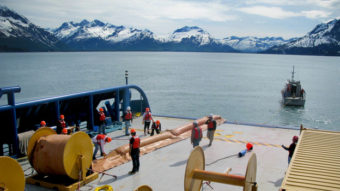
Trainees with Royal Dutch Shell learn to deploy oil spill booms in the waters near the port of Valdez in Alaska. The company is training about 200 spill responders. (Photo by Richard Harris/NPR)

A blue and white vessel, the Nanuq, pulls away from the dock and heads out into open water. This is just a few miles from where the Exxon Valdez came aground and spilled more than 10 million gallons of oil back in 1989.

Geoff Merrell, Shell’s superintendent for emergency response in Alaska, is here to observe a program that will train about 200 spill-responders. The plan today is to deploy and retrieve 1,000 feet of oil containment boom.

Anyone who has seen an oil spill response knows that step one is to corral the oil, as best one can, inside a ring of rubbery material.

“In this way the oil would be prevented from spreading out over the water’s surface in a large geographic area,” Merrell says.

The boom is slowly reeled off of a large yellow spool. As it’s dragged across the deck, the crew steps up with giant air hoses to inflate it, like an oversized air mattress.

As a 34-foot vessel off the stern pulls the inflated boom off the Nanuq, crew members take turns getting a feel for the air hoses. They deploy the first reel, containing 500 feet of this floating boom. They’re paying attention to detail, not urgency.

Geoff Merrell is Shell’s superintendent for emergency response in Alaska. The training mission on this day is to deploy and retrieve 1,000 feet of oil containment boom.

“These are fairly new trainees,” says Merrill. They’ve been in training for a week and a half so far. “In an actual situation, when these would be seasoned responders, this evolution would happen much more quickly.”

How Good Is State-Of-The-Art Oil Cleanup?

This training is taking place in ideal conditions, with no ice in the water. Merrell says he does have experience deploying this boom in icy waters, and the crew will get training in that as well — presuming there’s still floating ice in the Arctic Ocean once they get up there this summer.

It’s still possible to encircle spilled oil around ice, Merrell says. But it is more challenging. Ice can cut the floating boom, and if chunks of ice get inside the boom, they can push the boom out of the way, “which would then release the oil that we had spent all that time trying to contain,” he says.

Merrell watches as the crew pulls out a hacksaw and starts in on a cable attached to the end of the boom.

“I’m not happy with what I’m seeing here,” he says. This is not standard procedure. But the improvised procedure resolves the hang-up, and the last of the boom drops off the stern of the ship.

The first step in responding to oil spills is to try to ring the oil with floating booms.

The first step in responding to oil spills is to try to ring the oil with floating booms.
The first step in responding to oil spills is to try to ring the oil with floating booms. (Photo by Richard Harris/NPR)

It’s hard to imagine, standing on this deck on a calm and sunny day, what a real response would look like in the typical high winds of the northern Beaufort or Chukchi Seas, especially late in the season as ice starts to move back in.

Shell’s operation involves multiple vessels in the open ocean, other activity close to shore and contractors ready to hit the beaches should oil wash up. And the U.S. government has approved it. But just how good is the state-of-the-art in an actual oil-spill cleanup?

“It’s pretty abysmal,” says retired Coast Guard Vice Adm. Roger Rufe. “I don’t think anybody’s really proven they can clean up a spill very effectively in the ice.”

Spill response is a last resort, of course. The hope is that Shell will never have a blowout, or if it does lose control of a well, that a device called a blowout preventer will actually work, unlike what happened at the BP well in the Gulf of Mexico. If that fails as well, Shell is bringing along a device that’s designed to cap a runaway well.

“I think the chances of being able to get a cap on something more quickly than what happened in the Gulf is probably much better now than it was then,” Rufe said at a meeting in Washington, D.C., sponsored by the Pew Environment Group. “But once oil is in the water, it’s a mess. And we’ve never proven anywhere in the world — let alone in the ice — that we’re very good at picking up more than 3 or 5 or 10 percent of the oil once it’s in the water.”

Little On-The-Water Experience With Cleanup

Shell is also equipped to burn spilled oil on the sea surface, and it could use dispersants, which were used with much controversy at the BP blowout in the Gulf.

So an oil spill — and many of the possible response strategies — poses a risk to sea birds, whales, walruses and other wildlife that native villagers rely on for food. And there is very little on-the-water experience to demonstrate how well all of this would work.

“It’s Alice-in-Wonderland kind of promises that are being made and accepted by the government,” says Peter Van Tuyn, and environmental lawyer in Anchorage.

He says responding to a spill in the Arctic would be vastly more difficult than responding to one in the Gulf of Mexico.

“They have a miniscule number of boats compared to what was available in the Gulf of Mexico,” he says, and in the Gulf, “they didn’t have to deal with the extreme weather conditions that we’ve got in the Arctic.” High winds are the norm, and sea ice is always a possible hazard, “and yet they [Shell] claim they can collect as much as 95 percent.”

Deploying Oil Containment Booms

Watch Shell workers practice how to deploy and retrieve a containment boom. The boom is slowly reeled out, then inflated with giant air hoses. In a real spill, the boom would be used to contain the oil and make it easier to recover.

Credit: Richard Harris and Benjamin Morris/NPR

Merrell says the company has made no such claim. Instead, he says, the oil company’s plan is to confront 95 percent of the oil out in the open water, before it comes ashore. That doesn’t mean responders can collect what they encounter.

“Because the on-scene conditions can be so variable, it would be rather ridiculous of us to make any kind of performance guarantee,” Merrell says.

Cleanup success depends on how thick the oil is, how well trained the crew is, and, of course, weather and ice conditions. Of course, he hopes that this $100 million, 300-foot-long Nanuq will never have to be used for anything more than drills and training.

And as for that training, it’s clear these new recruits have a lot to learn before they become proficient.

They will have more time to practice. If Shell does get the final go-ahead to drill exploratory wells this summer, the company is permitted to start on July 15. But there’s been unusually thick ice off the coast of Alaska this year, so drilling is likely to be delayed by a matter of weeks.

Capital Transit proposes route change

Capital Transit will hold three meetings this week on a plan to provide bus service on Riverside Drive in the Mendenhall Valley.

Map A represents Routes 3 and 4 currently provided by Capital Transit.

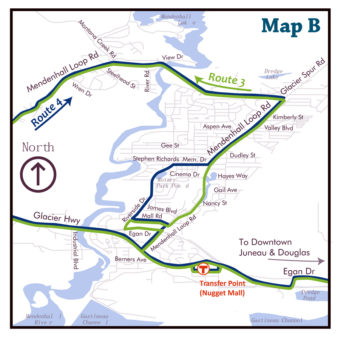
The Juneau bus system is considering moving some portions of Route 4 off Mendenhall Loop Road and onto the south end of Riverside Drive.

Because Juneau is a linear town with few routes, Capital Transit Superintendent John Kern says there are only so many routes the bus can run.

“With just two routes, Douglas and the Mendenhall Valley, we get within a quarter mile of most of the population, including the origin and destination of our ridership. So the goal in laying out the routes is to keep the bus stop at your origin and destination within a quarter-mile walking distance of where you catch the bus,” Kern says.

The proposal calls for a Mendenhall Valley bus to go down a section of Riverside Drive instead of Mendenhall Loop Road. That would provide service closer to Thunder Mountain High School.

CBJ Planner Ben Lyman says the city wants feedback from bus passengers on the proposed change.

Map B represents a change to Route 4 that would provide service to a portion of Riverside Dr (between Stephen Richards Dr and Mendenhall Mall Rd) while eliminating southbound service from a 1.7-mile portion of Mendenhall Loop Rd (between Stephen Richards Dr and Mendenhall Mall Rd).

“These aren’t really so much meetings as chances for the public to come in and talk to us, look at the maps, ask questions and then fill out a short survey so we can get more information and make an informed decision,” Lyman says.

The Monday session is from 5 to 7 p.m. Two more will be held on Tuesday, from 2 to 3 p.m., and again from 5 to 7 p.m. All three sessions will be held in the CBJ Public Library at the Mendenhall Mall.

Take the Capital Transit Survey.

Site notifications
Update notification options
Subscribe to notifications