Heather Bryant

Harbor seal makes rare visit to Mendenhall Lake

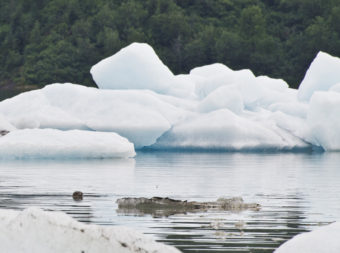
Gail Blundell with the Alaska Department of Fish & Game thinks it's likely a young harbor seal. (Photo by Heather Bryant/KTOO)
The seal is likely a juvenile harbor seal. (Photo by Heather Bryant/KTOO)

There’s a rare guest in the Mendenhall Lake this week.

A seal was spotted Friday morning, cruising between the icebergs in the lake.

“It’s an interesting phenomenon that every once in a while we have one or possibly two seals,” Laurie Craig said. Craig is the lead naturalist for the Mendenhall Glacier Visitor Center.

While the lake is about 6 miles from seawater, Craig said the presence of seals indicates that the fish are coming.

“We don’t expect sockeye until normally the third week of July, but this year who knows,” Craig said.

There have been two other sightings so far this year with one in May and the other in June.

A seal slips between icebergs in Mendenhall Lake on Friday, July 6, 2012.
A seal slips between icebergs in Mendenhall Lake on Friday, July 6, 2012. (Photo by Heather Bryant/KTOO)

Gail Blundell thinks it’s most likely a juvenile harbor seal.

Blundell is a Wildlife Biologist with the Alaska Department of Fish & Game. She heads up the statewide Harbor Seal Research Program.

“It’s not surprising,  they do swim up rivers and they follow food,” Blundell said.

While it’s not clear how long the seal has been in the lake, it won’t likely be there long.

“My guess is this one will just be there temporarily and will find that there’s nothing worth being up there for and will turn around and head back,” Blundell said.


Tulsequah water treatment plant temporarily shut down

A water treatment plant at the Tulsequah Chief Mine project in British Columbia has been shut down.

Mine owners Chieftain Metals shut off the plant on June 22nd. The company says it cannot continue spending money on water treatment without any mine income.

As Rosemarie Alexander reports, Acid Rock Drainage downstream of the mine has long been a concern to Alaskans, though a recent study shows metals concentration remains insignificant in some Taku River fish.

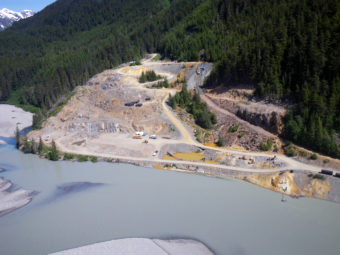
Cominco was the last company to mine the old Tulsequah Chief, closing it in 1957. The mine was never properly shut down and for 60 years acidic water has been leaching into the Tulsequah River. The Tulsequah flows into the Taku River, considered Southeast Alaska’s most abundant salmon producer.

Aerial view of the old Tulsequah Chief Mine. Chieftain Metals hopes to re-open the mine in 2016. (Photo by Joe Hitselberger/ADF&G)

Canadian company Chieftain Metals, Inc. purchased the property two years ago from Redfern Resources. With it, Chieftain acquired Redfern’s permits and the requirement that it would have to clean up the Acid Rock Drainage.

In December, the company started operating what’s called an Interim Water Treatment Plant – interim, because “a permanent solution is the complete development of the mine,” says Chieftain President and CEO Victor Wyprsky. And when the mine is all played out, he says there will be no acidic drainage if it is properly shutdown and “all sealed up.”

Early in June the company notified Environment Canada and B.C. Ministry of Environment of its plan to stop the water treatment for an unspecified period of time. Treatment plant costs had ballooned and to date the company has spent about $9 million on construction and operation.

As Wyprysky puts it, “no company in the world would be treating water without a mine.”

He likens it to paying a mortgage without the benefit of owning a house.

In 60 years, Chieftain is the only company to attempt to treat the Acid Rock Drainage from the Tulsequah.

Alaska Large Mine Coordinator Kyle Moselle says committing to and constructing a Water Treatment Plant prior to mine development is unique.

“The Interim Water Treatment plant was constructed to address the legacy ARD, the acid rock drainage from past mining. So that’s really unique,” Moselle says. “They’re not generating income or profit from development of the mine yet. I can’t think of a situation that mirrors that here in Alaska.”

The Tulsequah Chief Deposit is located at an elevation of approximately 110 metres above sea level. The Tulsequah Project covers a total area of approximately 14,220 hectares and is comprised of 13 mineral claims and 25 Crown-granted claims.

With the shutdown of the treatment plant, Chieftain is now in violation of its Environmental Management Act permit from the B.C. government.

But when the plant was operating, the discharge into the Tulsequah River “met permit water quality concentrations,” according to Suntanu Dalal, of the B.C. Ministry of Environment. Dalal says the government has required the company to develop an action plan to get back into compliance. It’s unclear how long that will take.

The international conservation group Rivers Without Borders believes Chieftain’s decision to shut down the Water Treatment Plant indicates the Tulsequah project is not financially feasible.

Spokesman Chris Zimmer wants the state of Alaska to take the lead and work with U.S. and Canadian agencies to solve the acid drainage problem.

“I’d like to see some cross-border cooperation to clean this up. I mean this is the most productive salmon river in the region. There’s a lot of jobs dependent on it, so what I’d like to see is Alaska step up and go to B.C. and say ‘alright, what are we going to do to clean this up,’ because clearly we can’t depend on the company,” Zimmer says.

Study: Low metals concentration in Taku River fish
Six months before Chieftain started the treatment plant, the state of Alaska collaborated with U.S. Fish and Wildlife Service and Canadian scientists to measure the impact of Acid Rock Drainage on Tulsequah and Taku River water quality. It was the first metals testing on the U.S. side of the Taku River.

Map of test sites for Alaska Fish and Game study on metals concentrations in Taku River Dolly Varden.

Fish and Game habitat biologist Joe Hitselberger says they captured juvenile Dolly Varden char at two sites on the Tulsequah and one on the Taku River, “well above the Acid Rock Drainage site on the Tulsequah, at the discharge site, and then on the Taku River right at the border.”

Southeast Alaska fishermen and environmental groups have long expected the worst. In fact, the Fish and Game study was precipitated by Alaska fishing organizations who concerned that drainage from the old mine 37 miles east of Juneau is threatening potential salmon harvests.

But Hitselberger says they did not find high metal concentrations in the fish.

“There was no significant difference between the fish we tested at the discharge site and the fish we tested on the Taku,” Hitselberger says. “From the metals that we looked at, the values that we got were lower than what we see at other sites in Southeast and lower than EPA criteria.”

It was a small study and Hitselberger says it would be good to gather years of data like Fish and Game has from other Alaska mining sites. But he says the results don’t indicate a need to immediately keep testing.

Meanwhile, the multi-metal Tulsequah mine is about four years from opening. Chieftain CEO Wyprysky says the feasibility study continues to show a viable project. He says it’s a matter of fine tuning the economics so it is more attractive to investors.

And, Wyprsysky says, there will be no barging up the Taku River this summer.


Search suspended for fisherman near Juneau

The Coast Guard has suspended its search for a fisherman who fell overboard near Juneau.
The man was identified Thursday as 63-year-old Richard Boyce of Haines.

The fisherman was aboard the 39-foot fishing vessel Eleanor S when he fell overboard Wednesday morning while trying to remove fishing gear from the vessel’s propeller.

The boat was near Mab Island 25 miles north of Juneau when the mishap occurred.

The Coast Guard says the crewman was wearing rain gear and no flotation device when he fell overboard in relatively calm seas.

A search was conducted covering more than 60 square miles. Several fishing vessels also participated in the search.

Glacial dam on Mendenhall Glacier bursts, prompts flood watch

Yesterday a glacial lake on the Mendenhall Glacier broke free and the waters are rising in Mendenhall Lake and Mendenhall River.
The National Weather Service has instituted a flood watch throughout today and Friday.

As of 4 a.m. Mendenhall Lake was at 6.2 feet. The lake is expected to crest at 9.5 feet on Thursday night. Flood stage for the lake is 9 feet.

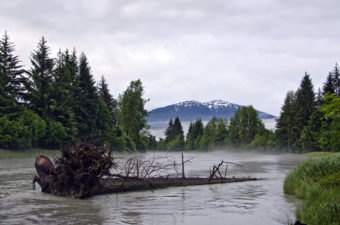
The Mendenhall River was at 9.16 feet this morning and is expected to crest near flood stage at 11.15 feet on Thursday night. The quickly rising water is a result of a glacial lake breaking and releasing a lake from approximately 2 miles up the Mendenhall Glacier.
The Mendenhall River was at 9.16 feet this morning and is expected to crest near flood stage at 11.15 feet on Thursday night. The quickly rising water is a result of a glacial lake breaking and releasing a lake from approximately 2 miles up the Mendenhall Glacier. (Photo by Heather Bryant/KTOO)

Mendenhall River was at 9.16 feet this morning and is expected to crest near flood stage at 11.5 feet on Thursday night.

“If the river level gets to those levels that means View Drive, the houses on it, may see some minor flooding,” said Richard Lam of the National Weather Service Juneau office.

“The Mendenhall Lake Spur Road between Skater’s Cabin and the West Glacier Trail, that section may be under water if the lake level gets to what we forecast it for. So some minor flooding along Mendenhall Lake Spur Road,” Lam said.

The Mendenhall Glacier Visitor Center is taking precautions, warning hikers and kayakers to be aware of their surroundings, and not get too close to icebergs or the glacier.

We will be on alert for public safety at the visitor center and other areas such as the Mendenhall Campground. We will monitor conditions at the lake as best we can by observing the glacier and icebergs. The National Weather Service has been keeping us informed,” said Laurie Craig, lead naturalist for the Mendenhall Glacier Visitor Center.

This photo was taken on July 4 at about 4 p.m. following a series of large calving events on Tuesday, July 3. "Today the lake is filled with icebergs including some huge pieces that are noticeably moving around the lake," said Laurie Craig, lead naturalist for the Mendenhall Glacier Visitor Center. "They are subject to rolling over or breaking apart. Waves could result from unexpected glacier activity."
This photo was taken on July 4 at about 4 p.m. following a series of large calving events on Tuesday, July 3. "Today the lake is filled with icebergs including some huge pieces that are noticeably moving around the lake," said Laurie Craig, lead naturalist for the Mendenhall Glacier Visitor Center. "They are subject to rolling over or breaking apart. Waves could result from unexpected glacier activity." (Photo courtesy of Laurie Craig)

“There was a series of large calving events on Tuesday, July 3 around 5:00 a.m. Today the lake is filled with icebergs including some huge pieces that are noticeably moving around the lake,” Craig said.

“Water is draining rapidly from the right side ice cave but no waterfall is visible, which we were able to observe last year,” Craig said.

Last year a similar event happened when a glacier lake burst in Suicide Basin. Water had built up and released over a four-day period from July 19-22, according to information from the University of Alaska Southeast.

The glacial lake was located in Suicide Basin which is approximately  2 miles up the Mendenhall Glacier’s east side. The event is actual called a Jökulhlaup (Yo-ko-laup) which is an Icelandic term for the glacial outburst flood.

For photos of last year’s event check out this gallery by Eran Hood, Associate Professor of Enviornmental Science, Department Chair at UAS.

Energy continues to keep Alaska’s cost of living high

Alaska’s cost of living continues to rise, and energy prices remain the big culprit.
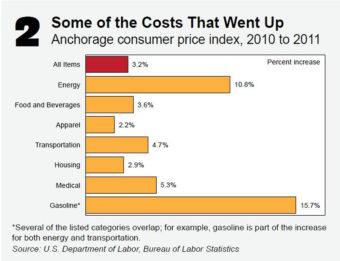
According to the state Labor Department, the cost of energy increased 10.8 percent last year. Three times over the decade, energy prices have risen even more.

Graph of rising costs on the consumer price index
Graph of rising costs between 2010 and 2011 on the Anchorage consumer price index

Gasoline went up nearly 16 percent. Gas and heating fuel are highest in rural Alaska. In the Interior village of Hughes, for example, a gallon of regular gas was $8.25 cents on average in January, and heating fuel was  $9 a gallon.

The Anchorage Consumer Price Index – or rate of inflation — rose from 1.8 percent in 2010 to 3.2 percent in Anchorage last year. It’s been higher only once before in the last ten years.

Anchorage is one of 26 cities used by the U.S. Bureau of Labor Statistics to track consumer prices over basic categories.  But the Labor Department says it should not be used to show whether one Alaska location is more expensive than another.

All Alaska cities are above the national average when it comes to cost of living, according to the Labor Department.  But Juneau was highest at 139 percent of the national average.  Fairbanks followed at 137 percent and Anchorage at just over 130 percent.

While Juneau had the highest cost of living in Alaska, it was only 10th nationwide.

Several cities were more expensive places to live, such as San Francisco and New York City.

Read the full report here.

Despite drop, Alaska STD infection rates still higher than national average

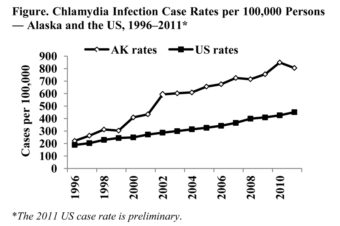
The Department of Health and Social Services released a health bulletin on June 21 documenting changes in the rates of chlamydia and gonorrhea infections in Alaska.

Alaska had the highest chlamydia infection rates in the United States in 2010 and 2011, and has consistently had the first or second highest rate in the nation since 2000, according to the report.

In 2011, there were 5,813 cases of chlamydia infections reported. Of those cases, 84 percent were under the age of 30.

The report also noted that despite being one of the highest rates in the nation this is a decrease of 5 percent from 2010 and the largest annual decrease ever recorded for Alaska.

Rates of infection declined everywhere in the state except the Gulf Coast region.

Chlamydia infections often coincide with gonorrhea infections.

Alaska saw an outbreak of gonorrhea in 2008 which peaked in 2010 and declined last year with 993 cases reported.

While Alaska still has rates higher than the national average, it was a 22 percent drop in cases between 2010 and 2011.

However, while reports decreased around the state, the number of cases increased in Interior Alaska and the Gulf Coast.

Both infections can result in pre-term labor, pelvic inflammatory disease, ectopic pregnancy and infertility in women and men among other problems.

The Department of Health and Social services recommends people at risk of sexually transmitted diseases use condoms correctly and consistently and limit the number of sexual partners.


Site notifications
Update notification options
Subscribe to notifications