Heather Bryant

Bellingham oil rig project under federal scrutiny for storm safety

The drilling-support barge that’s scheduled to get under way in the Arctic Ocean this month has a big Puget Sound connection.

A Seattle shipyard refurbished the two drill rigs that are currently making the long sea journey to the Arctic. The Noble Discoverer reached Dutch Harbor this week; the Kulluk is expected in Dutch later this week. The support-barge is designed to stop any oil spills from the first two.

It’s currently under construction, and federal scrutiny, on the Bellingham waterfront. Officials say it needs a stronger design.

For the past decade, the Bellingham Shipping Terminal has mostly resembled a ghost town.  After the big pulp mill next door shut down, the terminal has gone mostly unused. The main exception is an old Horizon Lines container ship that’s been tied up here for years. It only rarely wanders out of port, like a ghost of commerce past.

But this year, Big Oil has brought the terminal back to life with hundreds of short-term jobs. Contractors for Shell Oil are turning a 38-year-old barge into an oil-spill response unit they call the Arctic Challenger.

Right now, inspectors from the Coast Guard and the American Bureau of Shipping are inside the terminal. They’re going over the Arctic Challenger with a fine-tooth comb. And that’s where Arctic drilling has hit a snag.

Those inspectors found deficiencies in the Arctic Challenger’s construction and design, things like welding, piping, and wiring. The Coast Guard says some of those problems have already been fixed. John Dwyer is the Coast Guard officer in charge of the inspections.

“We’re committed to making sure that this vessel meets all the pertinent requirements and putting certainly our best effort into doing that,” Dwyer said.

But just what requirements are pertinent is now the question.

Shell Oil is in a rush to finish the rig and get it up to the Arctic Ocean before summer vanishes and ice returns to the far North. They want to place the rig between the two proposed drilling areas, in case a well blows out in either the Chukchi or Beaufort seas off Alaska’s north coast.

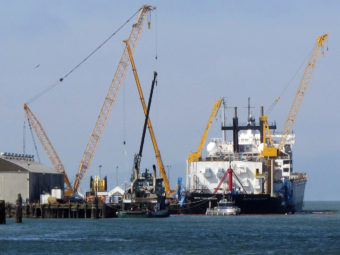
Shell Oil's Arctic Challenger oil-spill response rig is under construction at the Bellingham Shipping Terminal.
Shell Oil’s Arctic Challenger oil-spill response rig is under construction at the Bellingham Shipping Terminal. (Photo by John Ryan/KUOW)

Last week, Shell told the Coast Guard it can’t meet the design standard that the Coast Guard set for it.

Shell is currently required to build the Challenger to withstand storms so big, they only blow through the Arctic once a century. Those storms make waves 25 feet tall.

But Shell is asking the Coast Guard to soften the standards. The company only wants the Challenger to be seaworthy in the somewhat smaller, more frequent storms that blow through the Arctic every ten years. Those storms generate waves up to 20 feet high.

“If the 10-year standard is a 20-foot wave, you will definitely see waves higher than that,” David Atkinson said.

Atkinson teaches geography and researches Arctic storms at the University of Victoria. The difference between 20 feet and 25 feet might not seem like a big deal. But those five feet of water make a much more powerful wave.

The greater the height to which you can raise a wave, the more energy it has coming down to smash into something,” Atkinson said.

To be precise, the higher waves would smash with 56 percent more energy than the waves that Shell wants to plan for. If a storm were to damage the Arctic Challenger, it could cripple Shell’s ability to respond to an oil spill.

Atmospheric scientist Dave Battisti with the University of Washington calls it “silly” to design a vessel for a 10-year storm, unless you’ll only be using it for a few months.

“It’s like saying I expect to see a fire in my house once every 10 years. I might live in my house for a month, in which case, maybe it’s okay to not have fire insurance. But if you’re going to live there 10 years, and you know on average every 10 years, you have a fire, you better be prepared for it,” Battisti said.

There might be enough oil in the Chukchi and Beaufort seas to keep Shell drilling for decades. A Coast Guard permit for the Arctic Challenger would be good for five years.

Dave Atkinson says the Arctic usually has lighter winds and smaller waves than other oceans.

John Dwyer with the Coast Guard says that Shell would only get to drill in the summer. That’s the calmest time of year in the Arctic.

“If you reduce that from a year-round operation to  only a several-month operation during the best weather conditions of the year up there, that’s going to reduce your risk factor because you’re not there year-round, 10 years in a row,” Dwyer said.

Shell and its Bellingham contractors declined to be interviewed. Shell spokesman Curtis Smith also did not respond to written questions.

Atmospheric scientists say the climate of the Arctic is changing so fast that it’s hard to know how storms might behave in the years ahead. But over the past decade, it has become clear that the Arctic is rapidly losing its sea ice. That’s expected to continue as the world keeps burning fossil fuels.

Less sea ice means the wind can build up bigger waves as it blows across large areas of open water that used to be frozen.

“The ice is relatively stiff and it basically keeps the ocean from heaving.  The waves that will be experienced without sea ice, for the same storm, should be more intense,” Dave Battisti said.

The Coast Guard expects to decide what standard to apply to the Arctic Challenger in the next few days.

Ten environmental groups filed a lawsuit against the drilling on Tuesday. The groups say an oil spill will be extremely difficult to clean up in the remote Arctic Ocean–especially if oil mixes with ice.

Shell successfully tested the Arctic Challenger’s device for capping a blown-out oil well in June. The test was done in 200 feet of water in Puget Sound near Everett. But unlike the Arctic Ocean, Puget Sound lacks ice year-round.

Senate panel to hear issue of legacy wells

The issue of cleaning up abandoned wells in the National Petroleum Reserve-Alaska is coming before a U.S. Senate committee.
The Senate Energy and Natural Resources Committee has scheduled a hearing on the matter Thursday. Sen. Lisa Murkowski is a member of the panel.

The so-called legacy wells were drilled under the federal government’s direction as part of an exploratory oil and gas program between 1944 and 1981. They are currently managed by the U.S. Bureau of Land Management.

BLM-Alaska has been working with the Alaska Oil and Gas Conservation Commission to prioritize the plugging and reclamation of well sites. A single project can cost millions of dollars in large part due to mobilization costs. BLM-Alaska gets about $1 million a year to manage legacy wells.

Aquila the Eagle flies off into the sunset

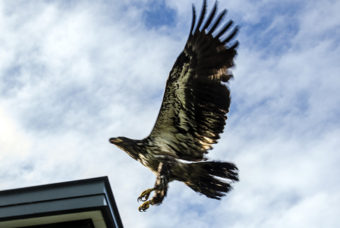
The clouds broke and the sun started to shine last night as almost 30 people gathered to watch the Juneau Raptor Center release Aquila the bald eagle back into the wild.

Aquila is a juvenile bald eagle, meaning she doesn’t yet have the bright white head and tail of an adult eagle. Her feathers are a mixture of brown and white.

Kay Gray was walking her dogs on June 30 when when she found the bird flat on her stomach next to Gray’s house.

Aquila is actually the second eagle Gray has found in her yard and she knew just who to call.

Pat Bock has been a volunteer with the Juneau Raptor Center for 15 years.  She’s answered both calls to Gray’s house.

“I’m so glad we have them,” Gray said. Gray admires the Center’s efforts to rehabilitate injured or sick birds. “It’s amazing that they can bring them back.”

Volunteers at the center cared for the eagle and after three days Aquila was getting back to normal.

“I’ve never seen a turnaround that fast,” Bock said. Bock said while they don’t know the exact cause of Aquila’s sickness it’s likely that the bird had ingested something bad.

Aquila now wears an ID band. Should something happen to her again, volunteers at the center will be able to identify her.

As the crowd gathered behind the police station, kids lined up around the truck to watch volunteers bring the eagle out.

After the door to the crate was opened, Aquila quickly took flight towards Egan Drive then swooped around and headed up Lemon Creek. She quickly disappeared from sight.

Bock urges anyone who finds a bird in distress to call the Juneau Raptor Center.

Panel delves into issue of high gas prices

A group of Alaska state lawmakers delving into the issue of high gas prices are finding no quick or easy answers for trying to provide Alaskans with some relief at the pump.

The panel, led by senators, is looking for ways to address the high cost of gas and heating fuel. A meeting Wednesday in Anchorage focused primarily on gas prices. Additional meetings are planned, and lawmakers also are seeking to hire a consultant to weigh in.

The attorney general’s office has looked into the issue in recent years and found no evidence of collusion or illegal price-fixing. Ed Sniffen, a senior assistant attorney general, says finding ways to increase competition in Alaska’s gasoline market could hold the most promise for trying to bring down the high costs Alaskans pay.

Currently, gas prices in Juneau are ranging between approximately $4.20 and $4.50 according to www.alaskagasprices.com.

U.S. House Repeals Healthcare Overhaul

The U.S. House of Representatives just voted to repeal President Barack Obama’s healthcare overhaul. Representative Don Young joined his entire party in the vote.

This was the 31st vote in the House to repeal the Affordable Care Act and it is one Republican leaders did not expect to take. After the U.S. Supreme Court mostly upheld the law, leaders scrambled to schedule this latest repeal bill.

Chief Justice John Roberts’s ruling labeled the so-called individual mandate that requires people to buy insurance or pay a fee as a tax and that tax has become a major talking point both at the Capitol and on the campaign trail.

Representative Young, who joined all of his Republican colleagues and a handful of Democrats in voting against the measure, called it just that.

“Healthcare is a tax. And we have a president who ran on “no new taxes.” Well that tax is going to hit everybody, to the point where it costs us billions of dollars – and they get worse healthcare,” Young said.

Republicans contend there are dozens of new taxes in the bill, though the individual mandate remains the most controversial. Democrats counter the law would save billions of dollars in the long run.

Military to remove debris from 1952 airplane crash on glacier

Military officials say a team is continuing to remove debris on an Alaska glacier from an Air Force plane that crashed in 1952, killing all 52 people on board.

Officials say the military team has been sent to Colony Glacier to remove airplane parts, not items needed to identify people on board.

The debris of the C-124 Globemaster was discovered June 10 by Alaska Army National Guardsmen flying a helicopter. The aircrew conducted aerial surveillance of the site to ensure it was aircraft debris before returning to Joint Base Elmendorf-Richardson.

Later in June, members of the Joint POW/MIA Accounting Command team recovered materials like a life-support system from the wreckage and possible bones from the glacier. The evidence was being taken to the command’s lab in Hawaii for analysis.

Site notifications
Update notification options
Subscribe to notifications