Heather Bryant

Buoy Tender Olympics wake up Juneau

The annual Buoy Tender Olympics got off to an early start Wednesday morning on Juneau’s downtown waterfront with a chain pull, swimming relay in Gastineau Channel, the tug of war, and welding and crane-operating competitions.

The Olympics are part of the 2012 U.S. Coast Guard Buoy Tender Round-up. The week-long event includes specialized training for crewmen and women aboard the ships as well as the mid-week competitive games.

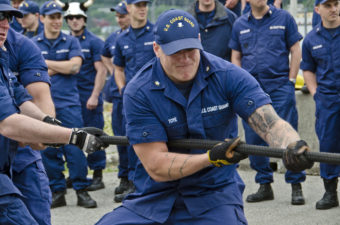
Ensign William Stark sported a viking helmet throughout the tug-of-war competition.
Ensign William Stark sported a viking helmet throughout the tug-of-war competition. (Photo by Heather Bryant/KTOO)

Wearing a Viking helmet with horns, Ensign William Stark of the Kodiak-based Spar was part of the ship’s tug-of-war team. He said the entire week is always a great experience.

“It’s competitive, but by the end of the day, it’s buoy tender camaraderie between all the different units. We’re all brothers. It’s a great thing,” he said.

The round-up is sponsored by the U.S. Coast Guard 17th District, headquartered in Juneau. This year vessels from Alaska, Washington, Oregon and British Columbia are participating.

Scott Bell is Lead Hand on the Bartlett, based in Victoria, B.C. Bell said the Juneau Buoy Tender Roundup is a good opportunity for Canadian Coast Guardsmen and women to spend time and train with their U.S. counterparts.

“Every year we have our own roundup out of Victoria and quite a few of the ships show up for that as well, from the U.S. side. It’s good to touch base with people we’ve met before and every new face is a bonus,” Bell said.

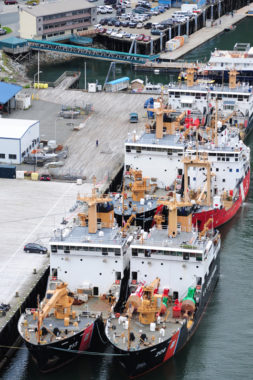
The ships docked at Station Juneau include the 225-foot buoy tenders SPAR and Sitka-based Maple. The three 175-foot buoy tenders are the Anthony Petit, from Ketchikan; the Fir, from Astoria, Oregon; and the Henry Blake, based in Everett, Washington. The Canadian Coast Guard medium-endurance ship Bartlett is 189 feet.

Alaska buoy tenders service 1,250 navigational aids along 42,000 miles of coastline. They also participate in law enforcement, search and rescue, and environmental protection.

Senators Say More Money Needs To Be Allocated For Debris Cleanup

The federal government is allocating a quarter of a million dollars to Pacific states to deal with debris washing ashore from the Japanese tsunami. Alaska’s senators say the amount is astonishingly low, and more needs to be on the way.

The National Atmospheric and Oceanic Administration, or NOAA, announced a grant that will give Alaska and four other states up to $50,000 apiece to help clean up debris washing ashore.

“Can you record my eye roll?,” U.S. Senator Lisa Murkowski said.

She says she’s offended the federal government would give states such a small amount to deal with a problem so big – and then divide it between them.

“So the state of Alaska, which has 33,000 miles of coastline – more than all of the coastline of all the other states, is to get their $50,000. Talk to the people of Yakatat – what they are already putting in their landfill from the collection of the debris off the beach,” Murkowski said.

NOAA would not comment for this story. But at a Senate hearing in May, NOAA’s David Kennedy, said the Marine Debris Program just doesn’t have the money for a large-scale cleanup.

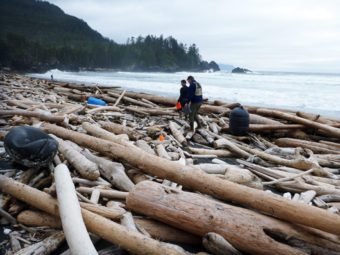
NOAA Marine Debris Program Deputy Director Jason Rolfe and contractor Marty Myers take note of marine debris as they walk along a beach on the south side of Noyes Island, east of Cape Addington.
NOAA Marine Debris Program Deputy Director Jason Rolfe and contractor Marty Myers take note of marine debris as they walk along a beach on the south side of Noyes Island, east of Cape Addington. (Photo by Jacek Maselko, NOAA. June 18, 2012 )

And the bulk of debris isn’t ashore yet. Most of the estimated 1.5 million tons of refuse is expected to make landfall over the next two years.

Senator Mark Begich called the amount of money outrageous and says he’ll speak with the NOAA administrator this week.

“They’ll probably claim that’s all the money they could find. Well this should be inter-agency activity. They should figure out how to get the resources, because when it comes in large volume? The net result is: FEMA’s going to be at the table then,” Begich said.

FEMA – the Federal Emergency Management Agency – helps coordinate disaster responses.

Begich says this is certainly not the last of the federal money for the project. And Murkowski, who’s on the appropriations committee, says there could be a way to get some money for the project on an Interior Department spending bill.

But whether the Senate actually takes up another funding measure this year remains unclear.

Related Story: NOAA crew surveys beachs for tsunami debris

USCG Opening Temporary Base In Barrow

The Coast Guard is launching a temporary base in Barrow beginning July 16 in a response to increased Arctic shipping. The Coast Guard calls it a Forward Operating Location and it will remain in place through October. It’s the largest presence the Coast Guard has ever had in the Arctic, although it has been conducting arctic outreach in Alaska since 2008. Petty Officer Kip Wadlow is a spokesperson for the Coast Guard.

“With the decrease in the Arctic ice, we’ve seen an increase in vessel traffic coming through the Bering Strait and operating off the north coast of Alaska and because of this trend and because of our primary mission protecting lives at sea, we want to make sure we’re fully capable of assisting mariners who may be in distress off the north coast of Alaska during the summer ice free months,” Wadlow said.

The Coast Guard is basing two Jayhawk helicopters in Barrow, a maintenance crew and a communications team, about 30 people in all. In addition, Wadlow says two Coast Guard buoy tenders and two cutters will be making trips up to the Arctic to patrol the waters of the Beaufort and Chukchi seas.

The Coast Guard says the temporary base is not a response to Shell’s planned exploratory drilling in the Arctic Ocean this summer. But that operation is one of the reasons the North Slope Borough is welcoming the increased Coast Guard presence. Jacob Adams Senior is the Borough’s Chief Administrative Officer. He says the Borough has been waiting for the Coast Guard to show up for a long time.

“I mean just Shell alone has well over a dozen ships operating out there to support two drill rigs. So the Coast Guard’s presence does a lot to ease the minds of the people on the North Slope,” Adams said.

Adams wants the Coast Guard to establish a permanent base in Barrow, even if it’s a small one. The Coast Guard says that decision hasn’t been made yet. The Coast Guard has documented a steady increase in vessel traffic in the arctic over the last several years. More than 400 vessels went through the Bering Strait last year and about 200 made it to the Arctic Ocean.

Gastineau grave does not contain Chilkat man’s body

It turns out a grave site uncovered last month in Juneau does not contain the body of a Chilkat man who died in 1927.
The tribal administrator of the Douglas Indian Association now says it appears the grave site at Gastineau Community School actually belonged to an unidentified young woman.

The City and Borough of Juneau Engineering Department and the Sealaska Corp. had said last month that the remains discovered during construction outside the school belonged to Sam Goldstein of Klukwan. Chilkat representatives conducted a ceremony at the site the following day.

But an archaeologist now says the remains are those of a woman aged 20 to 25, and the headstone appears unrelated to the disinterred grave.

Goldstein’s remains are still missing.

Annual Coast Guard Buoy Round-up gets underway

This week kicks off the 2012 Coast Guard Buoy Round-up held by the 17th Coast Guard District in Juneau. The event is a week-long series of training exercises for the Coast Guard.

There are 5 ships docked in Juneau including the 225-foot SPAR, Fir, Maple and the 175-foot Henry Blake and Anthony Petit. They are joined by the Canadian coast guard vessel Bartlett.

The event is an opportunity for crews to receive training and practice in areas such as buoy maintenance, safety equipment maintenance, and first aid.

The main event is the Buoy Olympics on Wednesday from 7:30 a.m. to 1 p.m., when crews will compete against each other.

According to the Coast Guard, crews in Alaska service 1,250 navigational aids along 42,000 miles of coastline.

Southeast Alaska shows population growth

Many communities in Southeast Alaska have seen population declines for a decade or more, but there appears to be a turnaround.

New estimates released by the Department of Labor and Workforce Development’s Research and Analysis Section show that all of Southeast saw growth at above the statewide average of 1.7 percent.

New state population estimates show Prince of Wales Island’s Hydaburg was the region’s fastest growing city of any size, adding 8 percent to its population. City Administrator Adrian LeCornu says he doesn’t know what caused it other than Hydaburg being an attractive place to live.

Thorne Bay, Klawock and Port Protection also are growing rapidly.

Site notifications
Update notification options
Subscribe to notifications