Jacob Resneck, CoastAlaska

Jacob Resneck is CoastAlaska's regional news director based in Juneau. CoastAlaska is our partner in Southeast Alaska. KTOO collaborates with partners across the state to cover important news and to share stories with our audiences.
Update: Assembly spares downtown pool, Douglas gym from budget cut list

Update | 6:42 p.m.

At its finance committee meeting this evening, the Juneau Assembly removed the Augustus Brown Swimming Pool and Mt. Jumbo Gym from a list of possible cuts.

The vote was 6-3 to spare the pool and 8-1 to spare the gym.

Original story | 5:32 p.m.

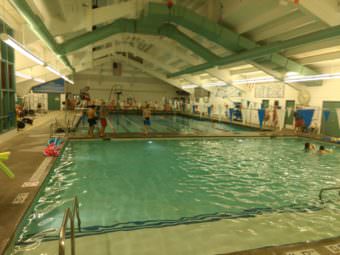
Students from Juneau-Douglas High School use the pool for an athletics program on Wednesday. (Photo by Jacob Resneck/KTOO)

Cost cutting efforts at the City and Borough of Juneau continue as the Juneau Assembly mulls closing the downtown pool and a gymnasium in Douglas.

Both are on the list of Parks and Recreation facilities facing closure. That’s because the Assembly is trying to fill a $1.9 million deficit without raising taxes. Limiting pool hours would save about $44,000. But shutting it down would save $562,100 annually.

Previous efforts to shutter the pool were scuttled due to public outcry.

“There’s some pretty passionate people about not wanting to close the pool,” Parks and Recreation Director Kirk Duncan said. “Quite frankly I’m really glad I’m not an Assembly member and don’t have to make those decisions. I think all of the Parks and Rec facilities are very important to the community, but also I recognize that we have some tough times.”

Even if the Assembly spares the downtown pool this year, the facility will need significant investment.  The building is about 45 years old and nearing the end of its lifespan.

“Augustus Brown pool has been here for many years,” Duncan said. “We estimate that it needs about $4.5 to $5 million in repairs. So that’s the long-term issue — how are we going to fund those repairs?”

Juneau has a more modern swimming pool: The Dimond Aquatic Center in the Mendenhall Valley. But Juneau-Douglas High School students would lose a pool literally next door and downtown residents would have to travel.

In downtown Douglas, the Mount Jumbo Gym is also on the proverbial chopping block.

Buckets catch water from a roof leak inside the Mt. Jumbo Gym in Douglas on Wednesday.
Buckets catch water from a roof leak inside the Mt. Jumbo Gym in Douglas on Wednesday. (Photo by Jacob Resneck/KTOO)

“It was built as a school,” Facilities Superintendent Brent Fischer said. “The gym was built in 1941, the school was built in 1937. It was part of the school district.”

The former Douglas High School building gym is now used as community space serving preschoolers, adults and everyone in between.

“We get a lot of adults and youth using this, so it’s a good venue for the community,” Dave Pusich, the city’s recreation manager. “It gives them another outlet because there’s not a lot of gym space available.”

Pusich grew up in Douglas and says the former high school is somewhat of a community landmark.

“We also have lots of birthday parties on the weekends — it’s real busy,” he said. “We have a bouncing house we set up, lots of toys, so it’s pretty popular and it’s affordable.”

Closing this gym would save less than $10,000 a year. But there are serious maintenance issues. The roof leaks. Patching things up would cost about $688,000. Renovations have been estimated to cost another $1.3 million. And to totally rehab the building so it’d be good for another 25 to 30 years would increase the cost to $4.8 million.

The Assembly’s budget deadline isn’t until June. With minimal publicity, public comment is already arriving by email with more than a dozen emails urging the Assembly to save these and other facilities whose futures remain uncertain.

Editor’s Note: Kirk Duncan is a member of KTOO’s board of directors.

Twin Lakes playground receives corporate matching grant

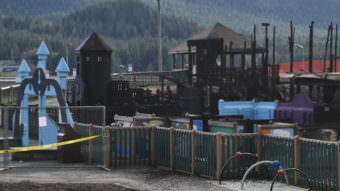
The remains of the Twin Lakes playground on April 25, 2017, the day after a fire burned it down. (Photo by Kelli Burkinshaw/KTOO)
The remains of the Twin Lakes playground on April 25, the day after a fire burned it down. (Photo by Kelli Burkinshaw/KTOO)

Fundraising efforts continue to rebuild the Twin Lakes playground destroyed by arson last week.

The city-owned playground was insured but has a $100,000 deductible that needs to be met to fund reconstruction of the popular playground.

A community meeting on Tuesday was well attended and the city continues to receive suggestions on how the reconstruction should proceed.

The Juneau Community Foundation reported that through Tuesday, more than $12,800 had been raised.

The oil giant BP has announced a $25,000 matching grant. Even so, that leaves more than $60,000 that needs to be raised to meet the deductible.

Authorities say two teenagers were arrested and admitted to intentionally setting the fire.

Donations are being managed by the Juneau Community Foundation, which is accepting checks and credit card payments on its website.

Editors’ Note: The Juneau Community Foundation has provided grants to 360 North for Gavel Alaska and maintains the KTOO Legacy Foundation fund.

Public input sought over Twin Lakes playground rebuild

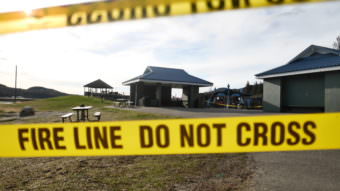
The day after fire on 4/24/17 at Twin Lakes Twin Lakes Playground fire scene the day after the fire on April 24th, 2017. (Photo by Kelli Burkinshaw/KTOO)
Twin Lakes Playground fire scene the day after the fire on April 24th, 2017. A wide fire line is in place around the entire Twin Lakes Playground area. (Photo by Kelli Burkinshaw/KTOO)

The Twin Lakes playground destroyed by arson will be covered by insurance — to a point.

The City and Borough of Juneau says the policy carries a $100,000 deductible that will have to be met.

The city would like to hear from the public on how to proceed, City Manager Rorie Watt said.

“I think the fundamental question really is how does the public want to be involved in the rebuild,” Watt said. “Do people want to replace what was there or are there different ideas? We’ll just have to work through that — I imagine there will be a lot of opinions.”

Donations toward the effort to replace the structure can be made in care of the Juneau Community Foundation which is managing fundraising.

BIA extends comment period for Central Council trust application

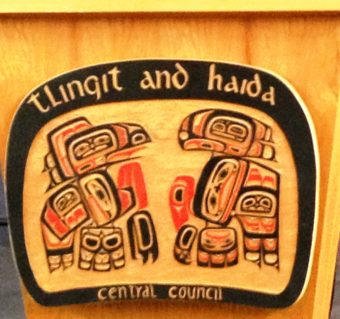
The Bureau of Indian Affairs has extended the public comment period over Southeast Alaska’s largest tribal organization’s effort to put its downtown offices and surrounding parking lots into trust.

The Juneau-based Central Council of Tlingit and Haida Indian Tribes of Alaska recently learned that a long-running effort to put seven parcels into a federal trust was nearly complete.

The Central Council of Tlingit and Haida Indian Tribes of Alaska will get about half the BIA settlement funds slated for Southeast tribal governments. (Photo by Ed Schoenfeld/CoastAlaska News)
The Central Council of Tlingit and Haida Indian Tribes of Alaska is the largest tribal organization in Southeast Alaska. (Photo by Ed Schoenfeld/CoastAlaska News)

The council’s trust application could give it more control and exempt it from local laws and regulations.

The federal government’s extension came at the request of the City and Borough of Juneau, which had asked for more time to consider its position.

The comment period will now run through June 5.

Both the council and the city say they are working on an agreement that would continue police and fire protection for the land that includes the Andrew Hope building and parking areas.

The council says it has no development plans for the land and that putting the land into trust would increase its ability to attract federal grants.

If approved, the trust application would be the second of its kind in Alaska.

The Department of Interior had — until last year — precluded Alaska Native tribes from putting land into trust.

Native American tribes in the Lower 48 routinely put land into federal trust to add sovereign territory exempt from state and local laws.

AJ Mine debate resurfaces in Juneau

A group of business leaders has recommended that the City and Borough of Juneau streamline its mining regulations — and in doing so, it’s rekindled debate over reopening Juneau’s long shuttered gold mine.

Anti-mining critics handed out stickers like these at a City and Borough Juneau Assembly committee meeting
Mining critics handed out stickers like these at a City and Borough Juneau Assembly committee meeting on Monday. (Photo by Jacob Resneck/KTOO)

The prospect of reopening a gold mine that’s been shuttered for 73 years brought throngs of people wearing yellow anti-mining stickers that read “Juneau — more precious than gold.”

The catalyst for all this is an initiative brought by five prominent gentlemen: Frank Bergstrom, Bill Corbus, Neil MacKinnon, Sam Smith and Jim Clark. The quintet argue that Juneau’s mining rules needlessly duplicate the state and federal permitting process.
None of the five attended the meeting. But Assemblywoman Beth Weldon made their argument for them.

Beth Weldon files her paperwork to run for Juneau Assembly, District 2 at Deputy City Clerk Beth McEwen's desk, Aug. 5, 2016. (Photo courtesy Beth Weldon for Assembly)
Beth Weldon

“So I am interested in economic development within the city,” Weldon said. “We are losing government jobs and population and we need to diversify the economy. This is both parts of the economic development plan made by the city, about looking to diversify the economy, and one of the ways is by opening AJ, and it’s also one of the priorities of this Assembly.”

There were few empty seats in the Assembly Chambers. The crowd watched impassively. There was no opportunity for them to speak.

A proposal in the late 1990s to reopen the AJ Mine culminated in years of debate. A city advisory committee studied its feasibility and issued a report in 2011. The city co-owns the mine with AJT Mining Properties, the sister company of Alaska Electric Light and Power Co.

Mining critics like Guy Archibald of the Southeast Alaska Conservation Council said it appears history is repeating.

“This came from the same proponents of the AJ Mine that came out in the advisory committee days when they came up with what they called a ‘Small Mining Plan,'” Archibald said.

He said Juneau’s mining ordinance is important because, unlike the state and feds, it requires community impacts to be analyzed in depth.

“I would think that CBJ would want to know what the social and economic benefits and impacts on reopening an AJ Mine would be,” he said.

The Assembly took no action other than to ask the mayor and manager to bring recommendations back at a committee meeting this month or the next.

Central Council working to put Juneau parcels into trust

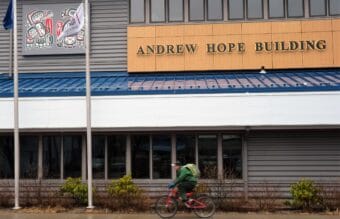
The Andrew Hope Building in downtown Juneau is home to the courtroom of the Central Council of Tlingit and Haida Indian Tribes of Alaska. (Photo by Ed Schoenfeld/CoastAlaska News)
The Andrew Hope Building in downtown Juneau is among the parcels that the Central Council of Tlingit and Haida Indian Tribes of Alaska is proposing to put in trust. (Photo by Ed Schoenfeld/CoastAlaska News)

Southeast Alaska’s largest tribal organization has applied to the federal government to put seven parcels in downtown Juneau into a federal trust.

For decades the federal government had prevented Alaska Native tribes from putting lands into trust that can exempt it from local laws.

But a court decision last year overturned the so-called Alaska exemption opening up new opportunities for tribal sovereignty that mirrors Indian country in the Lower 48.

The Juneau-based Central Council of Tlingit and Haida Indian Tribes of Alaska is nearly at the end of the process. Its application calls for putting seven downtown parcels into a federal trust. The land includes the Andrew Hope Building and surrounding parking on what was once a summer village inhabited by the Aakʼw Ḵwáan.

“It’s going to stay a parking lot. We have really no plans to get into any kind of big ventures there or anything. In fact, we need more parking — not less,” said Richard Peterson, the Central Council’s president. “So you’re not going to see us throw up a five-story shopping center or something like that.”

He said putting land into trust would be a milestone and make the tribe eligible for more federal grants.

So far only one other Alaska tribe has completed the process — and the issue remains complex.

Tribal sovereignty can affect anything from local zoning to police and fire coverage.

“When land goes into trust under these circumstances it removes regulatory authority over the parcels,” Juneau City Attorney Amy Mead said. “Those issues need to be worked out before the city can take a position. We really don’t know what Central Council’s position is with respect to how we’re going to coexist.”

The tribe plans to work all that out with the city, Peterson said.

“We want to have an agreement so that we have law enforcement,” he said. “We certainly are worried about fire protection so we want to talk to them about what that means.”

The city has asked for 30-day extension beyond the May 5 deadline imposed by the Bureau of Indian Affairs.

Mead said the law requires the Juneau Assembly to deliberate in an open meeting and scheduling that takes time.

“These are very new in Alaska so we’re doing the best we can trying to find our way through this process,” she said.

The city’s appeal to slow down the process hasn’t created acrimony.

“You know I understand their desire to want  a little extra time to make sure they can take a look at things,” Peterson said. “I don’t think we really have any opposition to that.”

A ruling by the Bureau of Indian Affairs over the city’s request for more time is expected within the week.

Site notifications
Update notification options
Subscribe to notifications