Jacob Resneck, CoastAlaska

Jacob Resneck is CoastAlaska's regional news director based in Juneau. CoastAlaska is our partner in Southeast Alaska. KTOO collaborates with partners across the state to cover important news and to share stories with our audiences.
Juneau Assembly clarifies legal quirk of hunting in Mendenhall Wetlands

Mendenhall Wetlands sign
(Creative Commons photo by Neerav Bhatt)

A legal quirk that had criminalized hunting waterfowl at the Mendenhall Wetlands State Game Refuge on private parcels was removed Monday by the Juneau Assembly.

Because some land in the refuge is privately owned, different rules for shotgun use technically apply.

Assemblyman Jesse Kiehl argued that the ordinance clarifies that hunting with a shotgun would be allowed unless the landowner objects.

“It doesn’t change anybody’s private property rights,” Kiehl said, “and it doesn’t do away with any responsibility of an individual who wants to hunt.”

The ordinance passed overwhelmingly. Assemblyman Loren Jones was opposed.

1917 Treadwell Mine cave-in remembered a century later

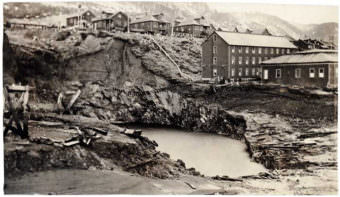
In this photo taken April 22, 1917, shows a massive sinkhole that opened up as the Treadwell Mines collapsed and filled with seawater.
This photo taken April 22, 1917, shows a massive sinkhole that opened up as the Treadwell Mines collapsed and filled with seawater. (Photo courtesy Alaska State Library, from the Harry F. Snyder Photograph Collection)

This weekend will be the centenary of a massive cave-in that flooded much of the Treadwell Mine complex.

At its peak the mines on Douglas Island were among the largest gold mining operations in the world and helped shape the development of Douglas and Juneau.

What today is a wooded walk on the outskirts of Douglas was once the site of a massive gold mining operation that drew laborers from around the world.

“This was a hoppin’ place in 1898,” said Paulette Simpson, chairwoman of the Treadwell Historic Preservation and Restoration Society.

From 1882 until the last mine closed 40 years later, Treadwell was a community in its own right. There were four mines here. They worked around the clock only pausing twice a year — on Christmas Day and the Fourth of July.

There were of course other gold mines in Alaska, but this one had an advantage.

“They had two things you needed,” she said. “They had energy with all the hydro power and they had transportation because it was right on the Gastineau Channel. So all of the supplies, equipment, people could easily access the site.”

Water flooded three of the mines as can be seen in this historic photograph dating from 1917 in the aftermath of the cave in.
Water flooded three of the mines as can be seen in this historic photograph dating from 1917 in the aftermath of the cave in. (Photo courtesy Alaska State Library, from the Harry F. Snyder Photograph Collection)

At its peak, shares in the mines were traded on the London and Paris stock exchanges.

“It was the biggest gold mine in the world at its time,” said Treadwell Society volunteer Wayne Jensen. “It produced that much and it was a big economic driver in world industry.”

But its fortunes would turn quickly, for a combination of reasons. The underground stone support columns had been eroding away from salty channel water. And a natural fault line parallels the Gastineau Channel that acted as a conduit for seawater.

An extremely high tide on the evening of April 21, 1917, was the tipping point.

“A few things happened it was kind of a perfect storm,” Jensen said. “The water started coming into the fault line and once it started, it eroded it and filled up all of the tunnels.”

The alarms sounded at 11:15 p.m. with an order to evacuate.

Paulette Simpson and Wayne Jensen of the Treadwell Historical Preservation & Restoration Society stand behind a marker on April 11, 2017, that shows where the 1917 cave-in began. (Photo by Jacob Resneck/KTOO)

“It could have been a real human catastrophe,” Jensen said. “If there would have been thousands of people in the mine at the time and they wouldn’t have had an opportunity to get out.”

It took about two hours for the 350 workers below to get to safety. It was only good fortune that there weren’t more.

“The mine was essentially empty, compared to what it would be on a normal day, and the people were able to get out,” Jensen said. “The unfortunate thing was that the horses and mules that were down in the mine that were used to move ore cars — they were all lost.”

Eyewitness accounts at the time describe a 200-foot geyser of saltwater shooting up from the main mine shaft as the tunnels collapsed. Three of the mines were lost forever — putting nearly a 1,000 men out of work. The fourth mine would close five years later.

The loss of the Treadwell complex was a blow to Douglas’ economy. But the community’s persevered.

“Douglas obviously survived,” Simpson said. “It’s been around, it has a great sense of community, it doesn’t seem to be going anywhere — which is a good thing.”

The cave-in a century ago was a calamity. But 100 years later it serves as a reminder of the town’s rich gold mining heritage that’s a source of community pride.

To commemorate the 100th anniversary of the cave-in, the community has organized Douglas Days with a series of events starting with a Miners Ball on Saturday, April 22, and leading up to the community’s Fourth of July activities on Sandy Beach. Details are on the Treadwell Society’s website.

Juneau Soccer Club defrauded in online scam

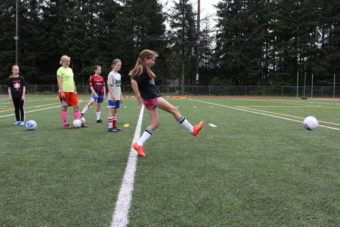
Juneau Soccer Club hosts a number of community soccer events including the coed camp, pictured here on June 26, 2015, which promotes the global sport. (File photo by Elizabeth Jenkins/KTOO)

An online fraud scheme has bilked the Juneau Soccer Club out of more than $13,700.

It began in February when a series of innocuous looking emails appeared.

“It’s a form of email scam called ‘spoofing’ where they make it appear that the email is coming from someone in your organization,” said Ellie Davis, a board member of the club, on Monday. The nonprofit has nearly 400 players — some as young as 4 — signed up and organizes teams and tournaments.

“The emails appeared to be from our board president to our board treasurer and the emails requested that payments be made on an invoice for some soccer equipment.”

The so-called invoices requested three separate payments: $2,800, $5,500 and $5,384.

The board treasurer paid what appeared to be legitimate expenses.

But when the club president denied ever making the requests, it was clear something was wrong.

That’s when the club took a closer look.

“Hindsight is 20/20,” Davis said. “When you looked back at some of the detailed information in the emails that you couldn’t get unless you were looking at it in an expanded view, the time zones suggested that they were not in Alaska or maybe not in the United States.”

Fortunately the club has enough savings to take the hit and doesn’t plan to cancel any programs.

Juneau Police Lt. David Campbell said the department is investigating the source of the emails.

“In the time I’ve been on the Juneau Police Department, I’ve seen lots of fraud cases come through,” Campbell said Monday. “I haven’t seen necessarily a spoofing one come through like this one has. But I think one of the best defenses that an organization can have is just really strong internal accounting principles.”

The Juneau Soccer Club has a 2014 policy requiring two signatures for payments in excess of $5,000.

Campbell said that’s a good policy. Though it wasn’t followed in this case.

“Having procedures in place that require funds to be distributed by more than just one person’s authorization would go a long way,” he said. “Having multiple eyes look at something before a transfer happens is always a good idea.”

The soccer club’s treasurer has since resigned.

Thane Campground reopens as Juneau’s downtown sleeping ban takes effect

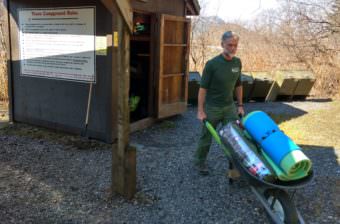
CBJ Park Ranger Dale Gosnell hauls donated camping supplies at the city-run Thane Campground on April 13, 2017. (Photo by Jacob Resneck/KTOO)

Juneau’s controversial ordinance prohibiting sleeping on private property downtown goes into effect April 15. The anti-camping initiative coincides with the reopening of the seasonal Thane Campground.
Spring has sprung at the Thane Campground and rangers from the City and Borough of Juneau are unloading donated camping gear.

“People have been extremely generous and they’ve donated lots of camping gear,” CBJ Park Ranger Dale Gosnell said.

This campground had traditionally been used by seasonal workers looking for low-cost housing.

With a new anti-camping ordinance coming into effect downtown, a number of homeless people are expected.

Juneau Assembly passed an ordinance that prohibits people from sleeping on private property in the downtown core.

The vote was in response to complaints about homeless people sheltering in business alcoves and creating a nuisance.

Juneau police officers have been reminding downtown homeless people about the social services that are available.

When the ordinance takes effect, Lt. David Campbell said, education will turn to enforcement.

“If an officer discovers someone in violation of the camping ordinance or if somebody calls in, we will respond like any other violation,” Campbell said. “We’ll give someone an opportunity to leave but if we need to cite them, then we will basically treat it like any other violation.”

The anti-camping ordinance passed in February was designed to correspond with the reopening of the city-run Thane Campground.

Mariya Lovishchuk, director the downtown shelter The Glory Hole, argues that the campground isn’t an option for many of the people she sees every day.

“People who are really self-sufficient do great at the Thane Campground. It’s really impressive, the campground that they set up,” Lovishchuk said.  She notes that many homeless people aren’t physically able to safely walk 2 miles down an unlit road — and there’s no bus service. “It’s wonderful, it really provides people a way to independently live in the great outdoors, but it’s certainly not for old people and it’s certainly not for vulnerable people.”

Those struggling with addiction and mental illness probably won’t make it far from the few streets affected by the ordinance, said Mandy Cole, co-chair of the Juneau Coalition on Housing and Homelessness.

“There’s a lot of talk of just moving to places where they’re not going to get confronted by the police,” Cole said. “They all heard, we all heard during the ordinance hearings that CBJ isn’t going to be enforcing it necessarily on their properties so it may be CBJ doorways — I’m not sure.”

The reason people might move onto city property is the camping ordinance was narrowly crafted to only apply to private property.

“We cannot move people off of public property,” said Mila Cosgrove, deputy city manager. The city, she said, is doing its best to confront a complex problem. “On the whole we’re a compassionate community, we want to care for our friends and neighbors — all of them,” she said. “I think everybody’s looking for the way to do that the most effectively.”

Leaflets like these have been left on tables on April 13, 2017, at the Glory Hole downtown shelter reminding patrons that the city’s anti-camping ordinance only covers private property. (Photo by Jacob Resneck/KTOO)

The ordinance is written in a way that the city isn’t able to push homeless people out of the downtown core completely.

But what about city parks?

‘They can sleep in parks that are open … some parks close and we prohibit any activity in those parks,” Cosgrove said. “There are plenty of other areas in the downtown core that are city property and if they choose to move from a private property to another area, say by the parking garage as an example, then that would be considered public property.”

Then there are property owners who opt out of the ordinance altogether.

The Glory Hole downtown shelter doesn’t allow people with alcohol on their breath to sleep overnight. But the shelter has decided it will allow people with nowhere else to go to sleep on the sidewalk outside.

“The Glory Hole is not going to participate in the camping ordinance out of respect of our patrons,” Lovishchuk said. “We will not condone the Juneau Police Department asking people to move and we have notified the police department of that.”

No one is sure what will happen until the city tries to enforce the ordinance.

There’s hope that able-bodied people will take advantage of the Thane Campground.

“We’re ready to go — we’ve cleaned up the campground,” Gosnell said as CBJ rangers put the finishing touches on the campground.

The city is also helping finance a 32-bed complex called Housing First that will house homeless people and allow drinking on site. But its opening has been pushed from mid-May to late July.

DOT artillery defends Thane Road from avalanche threats

Melissa Griffiths of Douglas walks her dog, Beau, on Sandy Beach, where she has a great view of the Thane avalanche chute across Gastineau Channel.

“I know that the state blasts a howitzer, and I was wondering, who does that and are there specialized skills that you need?” Griffiths asked.

Curious Juneau stars you and your questions. Every episode we help you find an answer. Catch up on past episodes, or ask your own question on the Curious Juneau page.

Alaska’s Department of Transportation operates the howitzer to protect Thane, a community of about 60 houses 5 miles south of downtown Juneau.
“The only way to Thane is on Thane Road and we have to drive through some avalanche chutes to get here — and so that’s just a given,” said Larri Irene Spengler, who is active on the board of the Thane Neighborhood Association.

That’s right: one way in and if an avalanche strikes, no way out.

Her husband, Steve Behnke, recalled a February 2009 avalanche that left him stranded in Juneau while his family was home in Thane.

“It makes you real aware of that mountain, ya’ know?” Behnke said. “It just makes it real because so much of the time we just drive back and forth and don’t pay full attention.”

DOT’s solution is gunning down the avalanches before they build up large enough to threaten the road.

On a recent afternoon, a crew is waiting for Juneau’s air traffic control tower to clear the airspace

“Are we gonna shoot?”

“They’re clearing the air … so I guess they’re gonna start now.”

“The last time we got one on our first shot and everyone got all excited and it brought a lot of snow down — after that nothing happened,” said Scott Gray, DOT’s operations superintendent for the Southeast District.

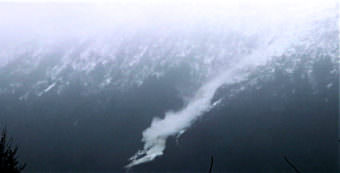
They fire the first shots. Within minutes, the snowpack begins to give way.

“There’s a nice little dump of snow there,” Gray said. “That was a nice one.”

More shots are fired.

Every two minutes the howitzer roars as an artillery shell is lobbed 3 miles across Gastineau Channel.

More snow cascades down. It’s effect is mesmerizing — almost hypnotic.

“It’s kind of interesting to watch,” Gray said. “The powder leaves the air — it’s like a waterfall just coming down — it’s pretty.”

The howitzer has triggered a slide to prevent a a larger, uncontrolled avalanche that could swallow up Thane Road.

A few days later DOT offers a closer look at the howitzer.

Casey Walker is DOT’s maintenance foreman in Juneau. He explains that the howitzer belongs to the U.S. Department of Defense.

“It’s pretty much like a big rifle,” he said. “This is your breach block. The bullet goes in and you close the breach behind it and then your triggering mechanism is just your typical rope pull.”

Military regulations only allow a handful of authorized people near the gun when it’s assembled and loaded.

“It’s a military weapon and we use it for avalanche mitigation strictly, and so they want to make sure that it doesn’t fall into the wrong hands, number one,” Walker said. “And number two, it is operated and maintained the way that the military expects it to be.”

A master gunner is always part of the DOT firing crew. It takes 10 years to reach that certification.

The rest of the crew are checking each other’s work to make sure the howitzer is sighted accurately to one of 24 pre-selected target points.

“We have a guy on each side of the gun. We plug in the coordinates. We have a guy that loads, he loads the gun and then he double checks everything,” Walker said. “And then the guy on the left-side of the gun triple checks everything and then we do our all-clear and make sure everything’s good to go and fire a round.”

Juneau city manager proposes shuttering history museum

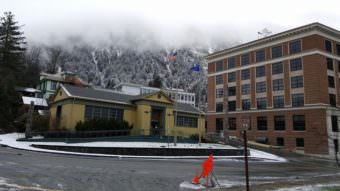
Fresh snow covers the ground surrounding the Juneau Douglas City Museum in Juneau on November 25, 2016, Alaska. (Photo courtesy Tripp J Crouse)
Fresh snow covers the ground surrounding the Juneau-Douglas City Museum in Juneau on November 25, 2016. The museum could be one public facility on the chopping block for City and Borough of Juneau. (Photo courtesy Tripp J Crouse)

Cost-cutting by the City and Borough of Juneau could mean closing several public facilities.

On the chopping block are the Juneau-Douglas City Museum, Mt. Jumbo Gym in Douglas and Eagle Valley Center. The cuts and efficiencies were presented Wednesday to the Juneau Assembly’s finance committee by City Manager Rorie Watt.

“We have a $1.9 million deficit between our revenues and projected expenditures,” Watt said. “We’ve suggested to the Assembly that we use $1.4 million on our fund balance savings and half a million in reductions.”

Closing the museum located next to the state capitol would save $228,000 in the first fiscal year. A projected annual savings would increase to about $375,000.

City Library Director Robert Barr whose office oversees the museum, said he hopes the Juneau Assembly will spare the museum.

“We believe that everything that we do provides value and is worthwhile to the community at large,” Barr said Thursday. “We of course recognize that it’s a tightening budget time and decisions will have to get made somewhere but we’d prefer it not be elimination of the museum.”

It’s still early in the budgeting process and the city manager’s proposed cuts are not a done deal.

The choice of the city museum stems from its low ranking in budgeting focus groups attended by about 90 volunteers.

Watt said it will ultimately be up to elected Assembly members to address the $1.9 million deficit.

“They could decide to use more or less savings,” he said. “They could decide to raise revenue and they could increase the cuts — it’s all on the table.”

The finance committee will continue to meet weekly through mid-May and is accepting public comment.

The city is scheduled to adopt next year’s budget in June.

Site notifications
Update notification options
Subscribe to notifications