Jacob Resneck, CoastAlaska

Jacob Resneck is CoastAlaska's regional news director based in Juneau. CoastAlaska is our partner in Southeast Alaska. KTOO collaborates with partners across the state to cover important news and to share stories with our audiences.

Income tax proposal well received at Alaska Native forum

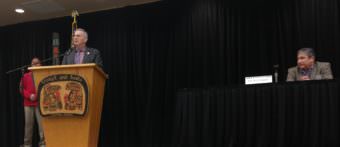
House Speaker Bryce Edgmon, D-Dillingham, addresses a March 30, 2017, forum organized by the Central Council of Tlingit and Haida Indian Tribes of Alaska at Elizabeth Peratrovich Hall in Juneau. Rep. Sam Kito III, D-Juneau, is also pictured. Photo by Jacob Resneck/KTOO)
House Speaker Bryce Edgmon, D-Dillingham, addresses a forum Thursday organized by the Central Council of Tlingit and Haida Indian Tribes of Alaska at Elizabeth Peratrovich Hall in Juneau. Rep. Sam Kito III, D-Juneau, is also pictured. (Photo by Jacob Resneck/KTOO)

House Speaker Bryce Edgmon received a warm reception Alaska Native leaders Thursday as he addressed the state’s fiscal crisis at a public forum. His Democratic majority coalition is pushing for a state income tax that targets wealthier earners to balance the budget.

“I think we as Alaskans are waking to the fact that it’s our future we’re talking about,” Edgmon told more than 100 people in Elizabeth Peratrovich Hall in Juneau. “We’re going to have to pay a little more to keep it the way we have it today.”

House Bill 115 would tax state income from year-round and seasonal workers as a way to balance the budget in two years. It also targets the wealthy by raising taxes on trusts and estates. And it would cap permanent fund dividend checks at $1,250 for two years.

Central Council of Tlingit and Haida Indian Tribes of Alaska Business Manager Myrna Gardner praised the plan. She said non-resident workers should be taxed to help fund services.

“You’re taking from the (Permanent Fund dividend check) but you’re also charging an income tax that will help alleviate our obligation, the ones that actually live here all year round,” she said.

Opponents of the plan say it would hurt Alaska’s economy. The Republican-led Senate is instead pushing for deep cuts to state spending and using dividend earnings to balance the budget. That’s the debate Edgmon says is largely driven by a geographic divide between coastal Alaska and the Railbelt.

“I think if you were to talk to a Mat-Su legislator, their constituents would tell them to cut the budget substantially before you look at any new revenues,” Edgmon said. “I’m not saying that’s right or that’s wrong but that’s very different from what my constituents tell me.”

Edgmon, a Democrat from Dillingham, earlier described how rural Alaskans are used to being taxed at a higher rate for goods and services to pay for vital services. He said cuts in those services would hurt the most in rural Alaska.

“Because in order to cut the budget means you take a chunk out of the school, you take a chunk out of anything that has anything to do with health and social services care and then you probably take a state trooper out when maybe you only have one to begin with,” he said. “And then you just start going down the line.”

Edgmon is the first House Speaker of Alaska Native descent. Sealaska regional Native corporation President Joe Nelson said the House majority has support from within the Native community.

“This year is a critical year and if there’s anything more that the Native community can do right now to push something over the hump in the next few days, before (the end of) this session or the next special session, I think we’re all ears standing by,” Nelson said.

Business groups oppose the income tax proposal. The Alaska Dispatch News reported this week that the Alaska State Chamber of Commerce has spent $40,000 for an advertising campaign that includes 30-second TV ads attacking the tax plan.

Juneau warehouse pot grow gets the green light

Juneau now has six licensed marijuana cultivation operations. (iStockphoto)

The Juneau Planning Commission unanimously gave the green light to a 6,000-square-foot warehouse marijuana grow operation at its Tuesday meeting.
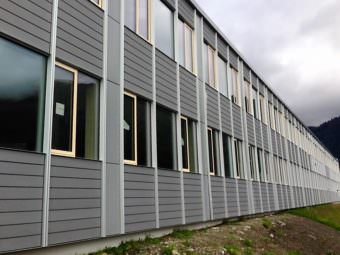
The decision marks the sixth licensed marijuana cultivation facility in the capital city.

It would be the second location for Green Elephant LLC, which plans a retail and growing operation at a Mill Street site south of downtown. The state has already licensed the Mill Street operation.

Co-owners Richard Dudas and Jennifer Canfield have also applied for an onsite consumption permit — but the state’s Marijuana Control Board remains undecided whether those would be allowed. Canfield is a former KTOO employee.

Alaska Department of Corrections denies reports of Douglas expansion

Alaska Department of Corrections houses administrative staff in the state’s Douglas Island Building, which recently underwent extensive renovation. (Photo by Ed Schoenfeld/CoastAlaska News)

Alaska Department of Corrections officials say Senate Bill 91 mandates expanded supervision of parolees who would otherwise be incarcerated. Rumors that a downtown Douglas office building could be the future processing facility has a neighborhood association alarmed and a state lawmaker demanding answers.
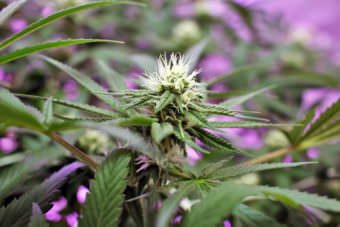
The Alaska Department of Corrections administrative presence in the capital city has long been in a Third Street office building in central Douglas. Recent building activity including the installation of what appeared to be reinforced glass caught the attention of nearby residents, many of whom have been calling their legislators.

“The public should know what the heck is going on,” Sen. Dennis Egan (D-Juneau) said. His office has been trying to get answers from the Commissioner of Correction’s office. “Now we’re hearing all these rumors. Some of these communications we get are totally different because — you know what happens with word-of-mouth — things change.”

The Department of Corrections is so far only saying where Juneau’s new facility won’t be.

“We are looking for suitable space but it will not be in Douglas,” Department of Corrections spokesman Corey Allen-Young said by telephone from Anchorage. He explained that Senate Bill 91 mandates closer supervision of parolees that have been diverted from prison.

The 2016 legislation was designed to reduce Alaska’s inmate population and create alternatives to prison.

“It’s a whole new section of Corrections, which means we have to set up a pre-trial in Juneau, Anchorage, Fairbanks, Mat-Su Valley, Kenai,” he said. “As part of that you have to have new offices, you have to have new UAs (for urinalysis) because pre-trial is basically something we’re working with the court system, law enforcement, attorneys.”

Sen. Egan said he and other legislators have recognized that SB 91 was rolled out faster than much of the state’s bureaucratic machinery could keep pace.

“Problem was, we implemented all of this stuff way before the departments had an opportunity to institute what we required them to do,” he said.

Plans for Juneau remain vague and there are still many decisions left to make, the Corrections spokesman said.

There will be a pre-trial in Juneau because we have to — a law gets passed — we have to follow the law,” Allen-Young said. “But determining where it is — it’s not going to be in Douglas.”

And that’s as much as the department is willing to divulge, he said, without a formal public records request. KTOO filed a freedom of information request; the agency replied Tuesday it would respond within 10 days.

The Douglas Island Neighbors Association is also seeking answers.

There was concern that a pre-trial service in that vicinity might be too close to other uses of those surrounding properties by other residents,” said Robert Sewell, association president.

State facilities are normally exempt from local zoning. Still, community members are digging in with this issue being the sole topic on next week’s agenda.

“One of our reasons to be is to work on a plan into the future for … Douglas as a community,” he said.

The meeting of the Douglas Island Neighbors Association will be held at 6 p.m. April 4 in the Douglas branch of the public library. The Department of Corrections has been invited to attend.

Juneau planning commission to consider warehouse pot grow

This undated photo shows a marijuana plant growing in an indoor, hydroponic garden in Washington, D.C. (Creative Commons photo by Adam Vartian)

An application for another marijuana grow facility is scheduled to come before the Juneau Planning Commission on Tuesday evening. If approved, it would add to the growing number of licensed cultivators in the capital city.
Green Elephant LLC proposes its second marijuana grow operation in a 6,000-square-foot vacant warehouse on Airport Boulevard. The product would be sold at the owners’ licensed retailer planned to open south of downtown.

Co-owners Richard Dudas and Jennifer Canfield already have a state-issued cultivation license to grow marijuana on Mill Street, where they have applied to open a shop. Canfield is a former employee of KTOO.

Juneau Assemblyman Loren Jones, who also sits on the state Marijuana Control Board, said local cultivation is essential for licensed retailers. That’s because federal law has always made shipping pot hard. And with the Trump administration’s tough talk against marijuana, he says, it’s even more so.

“Transporting marijuana is difficult and I think the new (U.S.) Attorney General has made it more difficult in that I think that TSA and the (U.S.) Postal Service and those places will be a little more cautious about shipping large quantities,” Jones said.

Regulatory hurdles remain. If the planning commission approves the growing operation on Airport Boulevard, there still remain permits for its retail operation. Green Elephant has also applied for cafe-style onsite consumption — but that issue still needs to be resolved by the state’s Marijuana Control Board.

AEL&P crews attack avalanches before they strike

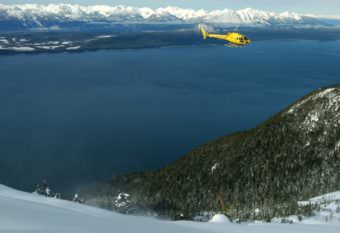
Most of Juneau’s power is hydroelectric. Getting that power to the community requires transmission lines that traverse miles of avalanche country. That’s why Alaska Electric Light and Power Company (AEL&P) uses helicopters to trigger slides to prevent destructive avalanches from knocking out the power.

Flying at about 4,000 feet in a chartered AStar helicopter, AEL&P’s avalanche forecaster Mike Janes gives the lay of the land.

“This is all power coming from Snettisham where we’re headed and the Lake Dorothy project is over there,” he points to high tension power lines that traverse an area across from Taku Inlet southeast of Juneau.

Extreme swings in temperature — blame it on climate change — have made the snowpack in the mountains less stable. That’s kept avalanche control crews busy.

“In the time that I’ve been doing this we’ve had record snow years at alpine and record low snow years at alpine all within a few years here. If anything it’s making it more extreme,” he said.

The bird’s-eye view has its limitations and the helicopter touches down near the summit of 3,300-foot Arthur Peak.

Avalanche technician Kanaan Bausler runs a simple test on the snowpack.

Avalanche technician Kanaan Bausler records the results of a stability test he’d run March 21 on the snowpack on Arthur Peak above AEL&P’s transmission line. (Jacob Resneck/KTOO)

“Basically we cut out a block in the snow and try to see how the energy, that we are putting on the snowpack by tapping on it with our shovel, how that transfers through the block,” he explained.

“Sudden collapse! Wow, that’s pretty exciting.”

Warmer conditions that bring rain or wet snow can form a weak layer on top of a snowpack. When the weight from a top layer exceeds the strength of an underlayer, it fails — triggering an avalanche. These readings mean this snowpack is unstable.

“This test definitely was a red flag for stability conditions from what we just saw here,” Bausler said.

It’s not long before Mike Janes returns in the helicopter. Dangling about 150 feet below is a device called a Daisybell. Fully loaded,  it weighs about 1,000 pounds.

The Daisybell creates a concussive blast by blending oxygen and hydrogen, then adding a spark that ignites the mix.

“You can see the flash,” Bausler says from the ground as he acts as a spotter. “It creates quite a nice explosion – a pretty good punch for the snowpack.”

Gone are the days of throwing explosives from the air. This is a cheaper — and safer — solution.

Hovering at just a hundred feet the pilot of the helicopter positions the Daisybell just a few feet over snowpack that’s layered into a natural cornice on the cliff’s edge.

There hasn’t been much movement. Then the radio crackles as the crew realizes they’d triggered something big.

“You can’t see it but we got probably 100-foot wide — it looks like it’s down on that layer,” Janes tells the crew. “I don’t know which shot it happened on. But it pulled about 20 feet below one of the shots we already made.”

After 45 minutes of firing the crew’s work is done — for now.

Modern avalanche control is often more methodic than dramatic. There haven’t been any huge slides this afternoon but the area has been secured.

“Any day that we can come out and trigger some snow off the slope that isn’t just stacking up there and waiting for a bigger slide to come — then we feel pretty good about that,” Bausler said.

Juneau was cut off from hydro power for 45 days in 2008 after a massive slide knocked out transmission lines. AEL&P had to burn diesel to keep the lights on.

It was as environmentally unfriendly as it was expensive for the company and ratepayers.

Much of Alaska Electric and Power Company’s power grid running from its hydro plants to the Juneau community traverse remote Avalanche-prone terrain. (Courtesy AEL&P)

After that experience, the utility invested millions into its avalanche control program. With the help of state grants, the company erected barriers to protect its most vulnerable transmission towers.

Avalanche crews will work through spring to keep nearly 60 miles of overhead transmission lines protected from slides. That should keep hydropower flowing to Juneau’s households and businesses during even the snowiest months.

Juneau hospital warns of big losses under GOP health care bill

Bartlett Regional Hospital could lose $3 to $4 million in federal funding under the House Republican bill that would repeal the Affordable Care Act, also known as Obamacare.

CEO Chuck Bill briefed the Juneau Assembly on Monday evening.

“It could be a several million dollar hit to Bartlett,” Bill said in an interview. “Primarily because they would repeal the Medicaid expansion and not replace it with the funds that we had to care for that population in the past.”

The House bill would allow people to deduct medical costs from their taxes. It would also roll back subsidies for most people and push more health costs to the states. Alaska has the highest health care costs in the nation.

The result would be higher levels of uninsured Americans. Bill said rural hospitals have benefited from Medicaid expansion, which helps cover those who normally can’t afford the full cost of insurance.

“If they repeal that, then we’re back to self-pay patients who we typically get 5 cents on the dollar verses 50 cents on the dollar for Medicaid.”

Bartlett Regional Hospital projects a $331,495 loss this fiscal year that it plans to make up from its own cash reserves. The hospital receives capital funding from the city and revenue from the city’s alcohol and tobacco taxes.

The U.S. House of Representatives is poised to vote Thursday on the bill. It would then go to the U.S. Senate. President Donald Trump says he supports it.

Editors Note: This article has been corrected to reflect that Bartlett Regional Hospital is not directly subsidized by the City and Borough of Juneau.

Site notifications
Update notification options
Subscribe to notifications