Jacob Resneck is CoastAlaska's regional news director based in Juneau. CoastAlaska is our partner in Southeast Alaska. KTOO collaborates with partners across the state to cover important news and to share stories with our audiences.
An informal gathering of about 20 Juneau women took the day off of work on March 8, 2017 and wrote about 100 post cards to lawmakers urging women’s rights as part of “A Day Without A Woman” a national call to action for women. (Photo Courtesy Jorden Nigro)
Wednesday is International Women’s Day and this year many women in the U.S. are staying home from work as part of a loosely coordinated “Day Without a Woman” that organizers say will highlight the economic clout of women.
In Juneau, Sarah Lewis took the day off from her job at the University of Alaska Fairbanks Cooperative Extension. She said she’s dedicating the day to writing letters to lawmakers.
“I am seeing today as a day to get active with other women. For me it’s not so much taking the day off from work because that really isn’t the statement for me,” she said. “It’s the being able to have a day when I can connect with a lot of other women in my community and do some things that feel like they could move toward some progress.”
According to the U.S. census, American women make up 47 percent of the workforce. But they still earn 80 cents for every dollar a man makes. They also have a lower median income.
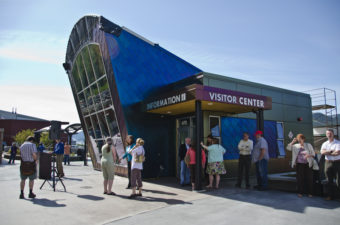
Visitors stop by the new waterfront visitor center in Juneau in 2012. Roughly 1 million people visit Juneau by cruise ship each summer. (Photo by Heather Bryant/KTOO)
Cruise ships will now be exempt from Juneau’s sales tax while in port. An overwhelming majority of Assembly members said the exemption sends a business-friendly message to the industry. This comes as the City & Borough of Juneau is proposing to use sales tax revenue to defend itself in a lawsuit brought by the cruise ship industry.
Assembly members lauded the cruise ship industry as an invaluable partner for the local economy and said the sales tax exemption was an important incentive.
“This isn’t a tax we’re forgoing this is a tax that we are not collecting because we haven’t done it in the past and I support trying to encourage businesses to do business in Juneau,” Deputy Mayor Jerry Nankervis said.
Only one cruise ship company had been paying sales tax — now all will be officially exempt in time for the first docking in May. The city’s finance department wrote in a staff report that levying sales tax on cruise ships would raise up to $100,000 a year.
The ordinance passed easily on a 7-1 vote. Only Assembly member Jesse Kiehl was opposed.
At the hearing, leaders in the tourism industry spoke in favor of the exemption.
“I do understand — or I’m led to believe that we are in negotiations right now with the cruise lines on the lawsuit issue,” said Bob Janes, owner of a whale watching and guiding company.
The “lawsuit issue” he referred to is a court challenge brought by the Cruise Lines Industry Association over how the city spends fees collected on cruise ships docking in port. So far there’s been no indication from public statements that the sales tax exemption and this ongoing litigation are linked.
But Janes said the exemption could help the city resolve the lawsuit.
“I think we need to step forward with our best foot here and show that we do cooperate, we can cooperate and we will cooperate with the cruise lines,” he said.
There were also a few critics at the public hearing. Guy Archibald said turning away sales tax money wasn’t responsible.
“A hundred thousand dollars or 10 cents per person is not going to change anybody’s vacation plans. But $100,000 is $100,000 less of a tax burden that the city is going to have to find somewhere else,” Archibald said.
As a matter of fact the city is looking for another $100,000. A separate ordinance proposed Monday evening would earmark $100,000 in sales tax revenue to keep paying lawyers retained specially for the cruise industry lawsuit.
City staff and Assembly members have declined to comment citing the pending litigation. Briefings are done by the city attorney in closed executive sessions.
But that doesn’t mean a lot isn’t happening behind the scenes. Court filings show the city and cruise industry are headed for a jury trial at the end of the year. And to date, the city has spent more than $280,000 on legal counsel. The city so far has relied on passenger and port development fees to pay these lawyers. In other words, it’s been using fees levied on the cruise industry to defend itself from the cruise industry.
Whether that’s a stroke of legal genius or a reckless maneuver really depends on who prevails in court.
The city manager’s office wrote in a brief report that the city strongly supports and welcomes cruise ship tourism, but at the same time needs the $100,000 in sales tax revenue to defend its marine passenger and port development fees now being challenged in federal court.
Why the city is no longer willing or able to finance its legal fight using marine passenger fees isn’t clear. City Manager Rorie Watt declined to elaborate aside from what he’d written in the staff report. The ordinance is now scheduled for a public hearing and vote at the Assembly’s April 3 meeting.
The Douglas Fourth of July parade in 2015. Douglas still holds separate Independence Day festivities from Juneau; residents have a lot of pride in their identity, but that all came into question during a 1970 controversial vote, in which Juneau voted to consolidate its smaller neighbor. (Photo by Elizabeth Jenkins/KTOO)
For 70 years, Juneau and Douglas were separate cities.
That came to end in 1970 following a controversial vote in which Juneau overwhelmingly voted to consolidate with its smaller neighbor.
Curious Juneau recently received a note from Miles Brookes. He’s lived in Alaska for 10 years and Juneau for four and works as a research analyst for the Alaska Department of Transportation.
Welcome to Curious Juneau, starring you and your questions. Every episode we’ll help you find an answer to your question. This episode we look into the consolidation vote affecting Juneau and Douglas. You can listen to the full podcast here:
He writes: “How has borough consolidation vote of 1969 shaped our current community? Would people that voted for it then vote differently now?”
For some insight we put the question to Rich Poor, 71.
Poor was born in Juneau’s hospital and raised in the city of Douglas. He served on the Juneau Assembly from 1981 to 1988.
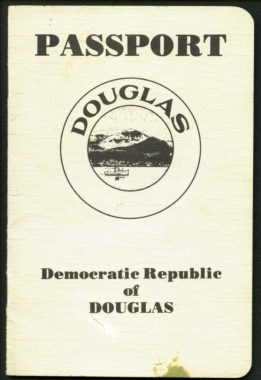
In 1981, the Douglas Lions Club created these gag passports for the Democratic Republic of Douglas to give as gifts during a fundraiser. (Courtesy Juneau-Douglas City Museum)
“It definitely stepped on some fingers and hands and whatever. You’re losing your community identity when you’re talking about merging two very competitive towns. But just looking at the overall picture it was probably the best thing for Juneau at the time, and Douglas, because it combined a lot of the forces like, the, you didn’t have two mayors to deal with, you didn’t have two city councils to deal with.“
I asked how it all come about in the late 1960s. How did one city effectively swallow up another whole?
“Basically you had a vote, and what they did at the time is they combined Juneau and Douglas as one vote instead of allowing Douglas to decide on its own whether it wantedto be part of the one local government,” Poor explained. “They voted it down 4 to 1. We were overwhelmed, so to speak, in Douglas.”
That’s some democracy.
“So more of an annexation than anything else? Or hostile takeover?” Brookes asked. “You’d mentioned we don’t need a passport to cross the bridge anymore, to go to the pub or to go to the ice arena to play hockey. Were there armedvigilantes that put a toll up across the bridge after the vote or before the vote?”
“No, I believe it did go to a legal question of whether they could legally do it,” Poor recalled, “but then the courts fell down on the side of unification.“
KTOO reporter Jacob Resneck, left, talks with Miles Brookes and Rich Poor on Friday, Feb. 17, 2017, about the Juneau-Douglas consolidation vote for Curious Juneau. (Photo by Tripp J Crouse/KTOO)
Did this help answer this Curious Juneau question?
Brookes said it did.
“I have a better understanding of how Douglas came to be, how Juneau has come to be and I look forward to both communities growing together in my future here in Juneau,” Brookes said. “Hopefully, it’s long andprosperous. Thank you guys for the opportunity.”
And what does Rich Poor think of all this?
“I’m glad you’re doing what you’re doing, because a lot of this stuff gets lost,” he said, “and you tend to lose these local people that lived through it.”
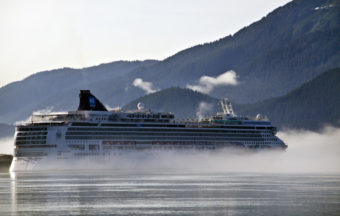
A cruise ships heads out of Juneau’s harbor on Feb. 13, 2013. (Photo by Heather Bryant/KTOO)
Juneau is moving toward exempting transactions aboard docked cruise ships from local sales tax. The initiative is touted as bringing the city in line with other Southeast communities.
There’s been little public discussion about the proposed sales tax exemption since it was introduced at an Assembly Finance Committee meeting.
“It behooves us to try and be good neighbors with the folks that like to come here and do business and try and continue to keep them coming here and doing business,” Juneau Deputy Mayor Jerry Nankervis said at Jan. 11 the meeting.
The exemption would still levy sales tax for tours sold by local operators aboard ships. But onboard services like food and drink, and services like spa time or hair cuts and massages would be exempt. The city hadn’t been collecting the tax until Disney Cruise Line filed with the city in 2011. The city won’t say how much the company’s paid since because it’s proprietary information.
Ketchikan already has an exemption on the books. And it seems to be standard practice for many cities and boroughs not to collect sales tax from onboard sales.
Juneau’s Finance Director Bob Bartholomew said Juneau is, “trying to be consistent among the ports. So that for the industry they’re kind of having to try to have similar rules.”
He stresses that state and local fees are levied on all passengers who pass through Juneau’s waters.
“Whether they disembark or stay onboard, we receive $12.50 and that is covering the cost of using the port, the building of the facilities and some of the direct city services,” Bartholomew said.
The city’s finance department last year analyzed the issue at the industry’s request, and concluded that cruise ships are legally liable to charge their passengers local sales tax. And if it did, the industry would be on the hook for between $50,000 to $100,000 annually.
Juneau’s business groups have stayed out of the debate. Neither the Downtown Business Association nor the Chamber of Commerce have taken a position. The city estimates it collects about $8 million in sales tax from cruise ship passengers who come ashore — an indicator of the amount of cash injected into the local economy.
Not all business owners are comfortable with the exemption.
“I think there are some business owners who are so intertwined with the cruise ship companies that it’s difficult for them to speak out on something like this. And there are a lot of businesses that have this perception of ‘don’t bite hand that feeds you,'” said Pat Race, who co-owns a comic shop and video production company in Juneau. “And I can absolutely understand that. But I think that we need to have a sense of fairness on how the city deals with businesses and the people who remit sales tax.”
He’s written to the Assembly questioning the wisdom of carving out an exemption for a large industry while aggressively enforcing sales tax on small fry.
“One of the goofy local events I host is a comic convention and when I brought people to town, I went to the sales tax office and got paperwork and I handed it out to all the people who were visiting town,” Race said. “So we’ve got these people who are guests to our community coming into town and making like $10 to $20 worth of sales who are remitting sales tax and then we’ve got these giant cruise ships that are doing the essentially the same thing on a much larger scale but they don’t have to remit a sales tax.”
Even so, if the emails written to the Assembly in recent weeks are an indicator, the sales tax exemption does have support within the community. So far just one Assembly member has gone on record to oppose the exemption.
“If I go to the barber, I’ve got to pay sales tax and the barber has to send it in. So it’s just fair and equitable tax treatment to apply the same rules to everybody,” said Assemblyman Jesse Kiehl. He notes that cruise ship companies make millions in commissions on tours sold on board – so fears that local taxes would drive them away are overblown. “I think this is not an exemption that makes economic or policy sense.”
If Juneau seems like it’s playing favorites, it is. Bartholomew said incentivizing key industries is not unknown in Juneau.
“We have in other areas tried to recognize the importance of certain industries,” the finance director said. “So we provide exemptions for manufacturing locally. We provide exemptions for housing, and so this is kind of a standard practice where we’re recognizing the significant value of the industry.”
The Juneau Assembly is scheduled to hold a public hearing and vote on the ordinance at its March 6 meeting.
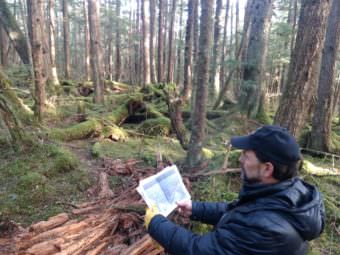
Greg Chaney, City and Borough of Juneau lands manager, consults the site plan for an 86-lot residential subdivision near Pederson Hill on Feb. 16, 2017. (Photo by Jacob Resneck/KTOO)
A unanimous Juneau Planning Commission approved the first phase of the Pederson Hill subdivision, clearing a major hurdle for the city’s housing initiative.
Commissioners heard testimony Tuesday night from the city’s Lands Manager Greg Chaney who made a pitch for 86 relatively small homes that could be entry-level housing for renters looking to buy.
“You could have a $250,000 starter home — nothing fancy,” Chaney said. “Compare that to living in an apartment and that’s what people will be considering with a mortgage payment here or a rent payment there.”
But the Planning Commission also heard pointed criticism.
“You guys, at some point when you went from infrastructure from roads and highways, airports, docks and harbors, water and sewer and you became housing developers for private sector,” said Jeremy Sidney, who owns a trucking company.
“You interjected yourselves into this market that was a really big mistake and you never should’ve done it,” he said. “And you shouldn’t do it now. I don’t believe it’s your place as a government.”
“Everybody’s always saying how we need to do something about affordable housing — this is something that we can do about it,” White said in an interview. “I have to say that I found it frustrating to find out that the same people that say they want affordable housing said, ‘Oh we want you to do this in a different way.’ And there’s no one way that is going to please everybody in Juneau.”
Now that the subdivision has been approved it will be up to the Juneau Assembly to decide how it will offload the lots.
Questions remain whether they will be put out to bid individually or in blocks.
Whether lots would be offered at fair market value or discounted to make them more affordable is another decision that’s still months away.
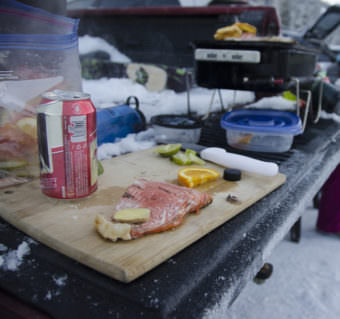
An après-ski drink and a filet of salmon prepped for barbecue sit on a truck tailgate in the ski area’s parking lot on Dec. 13, 2015. The Eaglecrest board wants to license alcohol sales and earn a share of the revenue. (Photo courtesy Sarah Cannard)
The Eaglecrest Ski Area’s outgoing manager made a pitch to the Juneau Assembly to allow alcohol sales at the public ski area.
“It adds to the community feel of the ski area,” Matt Lillard said in an interview after the meeting. “People are looking for places to meet, places to get together and a beer and wine venue of that sort is just a good place for adults to meet either after the ski day or during the ski day and enjoy a beer.”
None of the Assembly members spoke for or against the proposal. Assembly member Loren Jones said he’d sought legal advice from the city attorney’s office over any liability issues for the city and would present its findings to the Eaglecrest board when it meets on Thursday.
The Assembly would need to amend an ordinance to allow beer and wine to be sold in lodges. Nothing has been drafted and any decision is still at least several weeks away.