Jacob Resneck, CoastAlaska

Jacob Resneck is CoastAlaska's regional news director based in Juneau. CoastAlaska is our partner in Southeast Alaska. KTOO collaborates with partners across the state to cover important news and to share stories with our audiences.
Snow advisory stalls downtown Juneau street work

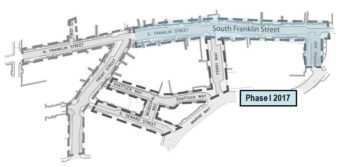
The first phase of downtown street improvements will be along South Franklin Street. (Courtesy City & Borough of Juneau)

Street improvements to South Franklin Street in downtown Juneau began Monday morning, though a winter weather advisory has led the city to temporarily suspend work.

The National Weather Service is forecasting 3 to 6 inches of snow overnight into Tuesday.

The city’s project manager Lori Sowa said planners knew weather would be a factor.

“February is not the ideal time to be doing construction, but with this project we are trying to get finished before the summer season hits in full force,” Sowa said. “We might be doing a bit of start and stop through these last weeks of winter and into spring.”

Crews are working on the first phase of improvements to sidewalks, lighting and the pavement from Manila Square to Ferry Way, and then Ferry Way to Front Street. Bus service is suspended along South Franklin as the road will be closed to cars while the work is being completed.

The $1.2 million phase of the project is being funded through marine passenger vessel fees, sales tax and water utility funds. The target date for completion is June 1.

City Engineer Lori Sowa will be a guest on Juneau Afternoon at 3 p.m. Tuesday to talk about downtown street work in greater detail.

Developers wary of city-planned Pederson Hill subdivision

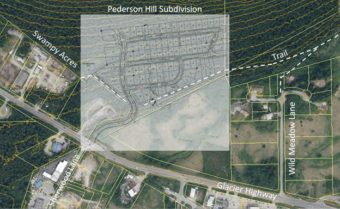
The proposed 86-lot Pederson Hill subdivision as envisioned by the City & Borough of Juneau. It goes before the Planning Commission on Tuesday, Feb. 28. (Courtesy City & Borough of Juneau)

A city-planned subdivision that aims to create dozens of buildable lots is set to go before the Juneau Planning Commission. City planners say the proposed Pederson Hill subdivision could help create relatively affordable housing for Juneau. Though some remain skeptical of the project.

About a half mile past the Brotherhood Bridge on Glacier Highway lies the entrance to what could be an 86-lot subdivision planned by the city.

“What our hope is is to make a compact neighborhood kind of in a traditional style similar to the areas of downtown Juneau or downtown Douglas,” said Greg Chaney, lands and resources manager for the City and Borough of Juneau.

This 26 acres of city-owned land has been identified as prime residential real estate for more than a decade. Mossy second growth forest lines a plateau between Auke Bay and the Mendenhall River.

Chaney sees potential here for scores of moderately priced homes. He said if the land were just sold outright there would be no guarantee that small lots would be carved out or developed at all. So what does the city have planned? Relatively small houses on dense lots: up to 10 houses per acre each not much more than 1,000 square feet. No garages and small backyards with the aim to make it affordable.

“Our magic number is $250,000 because the mortgage payment on a $250,000 home is about the same as a rental in Juneau right now,” Chaney said.

How the subdivision would be developed remains undecided. It would be up to the Juneau Assembly to determine whether shovel-ready lots would be sold off individually or in bulk to builders.

“The city is not building houses — we are only making land available. All construction will be done by the private sector,” Chaney said to allay the concerns of private developers. As one of the largest local landowners, the city and borough has to tread carefully when it offloads property onto the private sector. “Just because we build a project doesn’t mean we have to just dump them. We’ll hold onto the lots and disperse them as the land market dictates. So we’re not going to depress market.”

Still, some developers aren’t convinced and eye the project with suspicion. That’s because there is unease with the city being so closely involved with the economics of a housing project.

Earlier this month at a meeting of the Juneau Affordable Housing Commission, land developers that sit on the commission predicted pushback when it’s reviewed by the Assembly.

“There’s a bunch of players out there who pay a lot of property taxes and they got some influence on the Assembly,” said Wayne Coogan, a prominent developer. He made the remarks at a meeting Feb. 7 of the Juneau Affordable Housing Commission, which he vice chairs.

“I’m worried that if we don’t think about the political dimension of this project — that’ll come to the Assembly, they will meet head on the political dimension of it and then we will not have done our job,” Coogan said at the meeting.

He did not respond to requests for comment to clarify.

“The comment that I hear a lot is, ‘Oh you’ll be flooding the market,'” said Juneau’s Chief Housing Officer Scott Ciambor. (Ciambor is married to a Coast Alaska employee.)

He said the private sector hasn’t built moderately priced homes fast enough to meet market demand.

“And I think historically we’ve always struggled with this type of housing product. We’ll continue to have difficulties developing single-family homes, and so anything we can do to get these units on the market is important,” he said.

But those in real estate are not so sure. Much of the criticism seems based on principle.

“A free market is not something that you control. You put it out there and it becomes what it becomes based on what the market demand is,” said Juneau real estate broker Marty McKeown. He has specialized in residential real estate for more than a decade.

“It’s a great idea that the city gets involved and helps out with the infrastructure and putting that in place,” McKeown said. “But to get involved with competing with the local developers in developing a neighborhood is not the right way to go.”

He echoes developers who have called for the city to sell off larger parcels to private developers.

“Developing the lots and just asking builders and selling off lots one at a time to each contractor is not the way to do that,” he said. “They should sell off a parcel and let the developers develop the lots.”

The city would also be looking for partners. The Tlingit-Haida Regional Housing Authority has already been approached though nothing has been signed.

“The housing authority is very interested in a possible partnership with the city on the Pederson Hill subdivision,” interim CEO Joyce Niven said. “We’re supportive of the efforts of the city to meet the housing needs in Juneau, and in particular, to create affordable home ownership opportunities for moderate income, working families in Juneau.”

The Planning Commission will be asked to approve the plan on Tuesday. If it does, the Pederson Hill project gets its first hearing before the Juneau Assembly at a March 13 committee meeting.

Balancing free market principles against the currently high barrier to home ownership experienced by middle class families  is something the Assembly will have to grapple with.

Correction: A disclosure statement in an earlier version of this story misstated for whom Scott Ciambor’s spouse works. Ciambor’s spouse works for Coast Alaska, not KTOO.

Are more teeth decaying since fluoridation in Juneau ended? Dentists seem to think so.

dentist teeth cleaning
(Creative Commons photo by Allan Foster)

Earlier this year the Anchorage Assembly nixed a ballot initiative to cease fluoridating its water supply.

Despite setbacks, activists there vow to keep the effort alive.

Juneau grappled with the question over fluoridation a decade ago and people’s views remain the same today as they were 10 years ago.

“We’re now in the United States at over 70 years of community water fluoridation with levels of fluoride in the water,” said Brad Whistler, Alaska’s top dental officer. “The only health effect that’s seen is reduced dental decay.”

Critics don’t see it that way.

“I’m not against applying fluoride topically as needed,” said Emily Kane, a Juneau-based naturopathic physician and fluoridation critic. “But I didn’t think it was good judgment to medicate the entire population.”

It all began when Juneau’s Public Works Department quietly ceased fluoridation in 2003. After this came to light, dentists urged the city to put fluoride back in the water.

Faced with a deeply divided public, the Assembly appointed a six-member fluoride commission that spent two years studying the question.

“The long and short is the panel was divided 3-to-3,” recalled Bruce Botelho, Juneau’s mayor at the time.

Faced with that impasse, the Juneau Assembly voted to keep fluoride out of the water.

Botelho said that documented cases of fluorosis in other parts of the country — in which excessive fluoride levels can lead to pitted tooth enamel — swayed a number of Assembly members.

“I think even those studies that have been supported by the American Dental Association would acknowledge that there is an issue of fluorosis,” he said. “That for some, small portion of the population there is such a thing as too much fluoride.”

The American Dental Association bankrolled a ballot initiative to overturn the Assembly’s decision.

The Juneau Empire reported what it described as a “stunning amount of campaign spending” by the national group which bought TV and radio spots.

Botelho said the dental association’s pro-fluoride push was heavy-handed and tone-deaf.

“The message, the overall message, was trust us we’re the professionals,” Botelho said. “It didn’t play well.”

That’s an understatement.

Despite dentist groups greatly outspending critics of the pro-fluoride initiative, more than 60 percent of voters rejected fluoridation.

“They spent like $150,000 and we spent $7,000,” recalled David Ottoson, owner of a downtown health food store and vocal member of the grassroots anti-fluoride group at the time. “But just from the conversations I was hearing and the letters I was seeing in the paper, I still thought the money wasn’t going to win in this case and it didn’t.”

Dentist groups say fluoridation is a critical tool to fighting tooth decay. So this begs the question: More than 10 years have passed since fluoride was pulled from the water.

Has tooth decay worsened? Juneau’s dentists seem to think so.

“My own observation in the younger population … yeah, there was an uptick, no question about that,” said David Logan, a former Juneau-based dentist and current head of the Alaska Dental Society in Anchorage.

“You pretty much have to set the clock at the day the the fluoride came out of the water. And then you advance forward until you start seeing teeth erupt,” he said. “The six-year molars no question, saw an uptick in cavities. I’m really worried about the uptick we’ll see on the 12-year, though.”

Ten years ago Kristen Schultz headed the Juneau Dental Society. She’s convinced that tooth decay is rising among her patients 15 and younger.

“But that’s just a gut feeling,” she said. “I kind of wanted to go back and look at my practice and see if that’s just what I want to believe or if there’s actually some sort of trend that is there.”

She ran some numbers based on available records from the past 10 years. The amount of cavities she’s drilled out has risen over time.

But her sample is small and she admits, unscientific.

More complete data doesn’t exist, said Whistler, the state’s dental official. He’s inclined to agree with fellow dentists.

“But as far as having hard data to measure that there’s been a change, we didn’t even have base line data on these communities to even know what it was prior to going off fluoridation let alone having the ability to go in each year and assess if there were changes in dental decay,” Whistler said.

Skeptics aren’t likely to be won over.

“Anecdotal evidence? Well, it’s anecdotal,” Ottoson said. “And I think we suggested at the time might not be a bad idea to look at the results and see.”

The issue in Juneau seems decided — at least for now. That’s because dentists aren’t eager to reopen old wounds.

“It was pretty gut wrenching,” Schultz said. “It wasn’t a fun debate to go through so I don’t know that any of us are gung-ho to fight that battle again and possibly end up with the same results.”

Since Juneau dropped fluoride, the cities of Fairbanks and Palmer have followed suit. And activists in Anchorage continue to push for Alaska’s largest city to cease water fluoridation.

Police find shell casings in Switzer Village shooting incident

Juneau police found shell casings from a handgun during an investigation Wednesday in the area around Lemon Creek mobile home park.

Police officers were investigating a shooting on Forget Me Not Lane in the Switzer Village Mobile Park, according to a police news release. The area was cordoned off as officers searched a residence and a vehicle.

A preliminary investigation determined that someone was in an argument and fired several rounds from the handgun.

Police had responded about 6:30 a.m. to multiple reports of gunshots, but there were no reports of injuries or property damage, Campbell said.

At about noon, the area around Forget Me Not was reopened to the public, the release said.

Police did not release the caliber of the handgun or how many shots were fired. Drugs appeared to be a factor in the case. No other details were released. An investigation is ongoing.

Dzantik’i Heeni Middle School was notified, but classes were not affected, school officials said.

Juneau School District’s Chief of Staff Kristin Bartlett said in an email that police had advised that there was no immediate threat to public safety.

“The school wanted to make sure that they were taking all action necessary to maintain a safe and secure school environment,” she wrote in an email.

Juneau deputy mayor decries bumper sticker vandalism

Juneau Assembly Deputy Mayor Jerry Nankervis says his vehicle was vandalized while parked outside City Hall during a contentious debate over the Juneau Access Project on Jan. 23, 2017. The deputy mayor shared this photo during the Feb. 13 Juneau Assembly meeting. (Photo Courtesy Jerry Nankervis)
Juneau Assembly Deputy Mayor Jerry Nankervis says his vehicle was vandalized while parked outside City Hall during a contentious debate over the Juneau Access Project on Jan. 23, 2017. The deputy mayor shared this photo during the Feb. 13 Juneau Assembly meeting. (Photo courtesy Jerry Nankervis)

During Monday’s Juneau Assembly meeting, Deputy Mayor Jerry Nankervis shared this photo he took of his vehicle, saying it had been vandalized last month during the Assembly’s debate over a resolution supporting the Juneau Access Project.

He had city staff project it on a screen.

“I was parked downtown for this. I had my Assembly parking permit in the window of my vehicle and this is what I found on my vehicle when I left,” Nankervis told fellow Assembly members. “As you can see, I had a sticker and I got a sticker that was modified. I’m not sure who felt it was appropriate to vandalize my vehicle, but the vandalism was consistent with the tone set at the meeting.”

The former police captain said he was disappointed by the act and suspects critics of the proposed road. He said it reminded him of vandalism that appeared to be politically motivated during last year’s U.S. presidential campaign.

He summed up, “We should be able to politely and civilly agree to disagree at times.”

Juneau Assembly bans homeless from sleeping downtown

Homeless resident Catherine Duncan, far left, appeals to the Juneau Assembly not to pass a camping ordinance that would ban homeless from sleeping downtown on Feb. 13, 2017. (Photo by Jacob Resneck/KTOO)

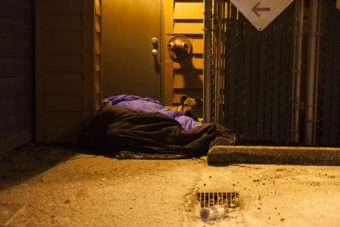
A divided Juneau Assembly passed a controversial anti-camping ordinance Monday to ban homeless people from sleeping near downtown businesses.

In the end, the controversial ordinance passed by a single vote. It will allow police to cite anyone caught sleeping on private property in the downtown core between midnight and 7 a.m.

The ordinance passed in a 5-4 vote. Supporters were: Mayor Ken Koelsch, Jerry Nankervis, Debbie White, Mary Becker and Beth Weldon. Opposed were: Norton Gregory, Jesse Kiehl, Loren Jones and Maria Gladziszewski.

Many downtown merchants have complained of people using shuttered storefronts to shelter from the cold. Those concerns were heard by a majority of the Assembly.

“This isn’t about the people who sleep on the sidewalk. This isn’t about people in Marine Park,” Assembly member Debbie White said. “This is about people who have invested in our downtown community, who employ our neighbors.”

Assembly member Jerry Nankervis echoed that it was a matter of rights of business owners.

“We are trying to reinforce — at least in my mind — that I believe people have private property rights,” he said, “and just because you’re homeless doesn’t supersede somebody else’s private property rights.”

Juneau Police Chief Bryce Johnson said the ordinance would be a tool which would give us the option of either writing a ticket or taking someone to jail for disorderly conduct.”

It takes effect in mid-April when the city-run Thane Campground reopens.

Opposition came from four Assembly members including Norton Gregory, who noted that many homeless people suffer from substance abuse and mental illness.

“Those are the discussions that I wish we were having tonight and we were talking about rather than passing an ordinance about pushing these people out of the downtown area,” Gregory said.

Assemblyman Jesse Kiehl disputed the police chief’s argument it would improve overall public safety.

Are people better off now in doorways? You bet they are,” he said. “Because those abandoned mine buildings above Gastineau Avenue are scary places and there are no lights and (the Juneau Police Department) doesn’t drive by and check.”

Merchants who had complained that homeless people had harassed and intimidated their customers and employees were pleased with the vote.

“I personally think this will help and I hope it’s the beginning of a longer process to address all the issues of the homeless in downtown Juneau,” said Eric Forst, owner of the downtown Red Dog Saloon.

Homeless residents reacted with dismay.

“I’m scared of what’s going to happen,” Lisa Williams, 27, said after the vote. “I don’t know where I’m going to go and I’m afraid to go up to the woods. I have no idea what it’s going to mean for me.”

The ordinance began as an initiative by Juneau Mayor Ken Koelsch, who proposed it after fielding complaints from merchants in December.

“I asked for the no camping ordinance to be drafted and introduced for action,” he said in prepared remarks. “I accept full responsibility. It speaks to a core value of mine regarding respect of property of others.”

The ACLU of Alaska has cautioned the city that a blanket ban on homeless people downtown would be unconstitutional.

Courts have ruled homelessness can’t be criminalized when the homeless population exceeds shelter space available.

For that reason City Attorney Amy Mead said this ordinance was drafted narrowly to only apply to private property.

So what if the homeless campers move to a public place like Juneau’s Marine Park?

My advice to (the Juneau Police Department) is that it would be potentially unconstitutional to enforce the camping ordinance against those people at that time,” the city attorney said in a brief interview.

The argument over this ordinance may be over.

But both sides here agree that the quandary over Juneau’s homeless problem continues.

Site notifications
Update notification options
Subscribe to notifications