Jacob Resneck, CoastAlaska

Jacob Resneck is CoastAlaska's regional news director based in Juneau. CoastAlaska is our partner in Southeast Alaska. KTOO collaborates with partners across the state to cover important news and to share stories with our audiences.

Juneau Human Rights Commission ‘deeply concerned’ over Trump’s executive orders on immigration

Juneau’s Human Rights Commission convened a special meeting to respond to President Donald Trump’s executive orders that suspended the nation’s refugee program and effectively caused more than 700 visa holders from seven predominately Muslim countries to be denied entry or detained at airports upon arrival.

Three commissioners with input from several community members at the Tuesday meeting drafted the statement.

“The President’s Order on Immigration violates the Universal Declaration of Human Rights. We uphold the right of all to seek and enjoy asylum from persecution. We hope that this is not the first step toward restricting human rights in our diverse country. We encourage all members of our community to respect and uphold the human rights of all people.”

Members of the commission said they were “deeply concerned” that the Department of Homeland Security has detained people at airports merely on the basis of religion.

The Juneau Human Rights Commission was created in the early 1990s. Its function has changed over the years but now acts primarily in an advisory role to the Juneau Assembly.

Juneau Planning Commission recommends ‘Field of Fireweed’ rezone

Fireweed blooms near Juneau International Airport on July 17, 2016. Many locals call this area "the Field of Fireweed." (Photo courtesy Skip Gray)
Fireweed blooms near Juneau International Airport on July 17, 2016. Many locals call this area the “Field of Fireweed.” (Photo courtesy Skip Gray)

Part of an 83-acre wetlands known colloquially as the Field of Fireweed has been recommended for rezoning for industrial use. The move by the Juneau Planning Commission is the first step in a series needed to clear the way for development of the property adjacent to Juneau International Airport.

The commission voted Tuesday 6-1 to support the rezoning of 23 acres. Commissioner Percy Frisby cast the dissenting vote. Commissioners Michael Levine and Dan Miller were absent.

The vote was first reported by the Juneau Empire.

Landowner Spike Bicknell of Bicknell Construction has been trying to develop the property for years. Bicknell could not be reached for comment. Previous efforts have been rejected by the city following public opposition from admirers of the wild purple flowers that bloom in late spring.
Those critics want the wetlands preserved.

Juneau’s Audubon Society chapter, has identified the parcel as part of the Mendenhall Wetlands complex that’s been recognized as important habitat. But the group hasn’t taken an official position on the rezoning.

“This whole area has been designated as an important bird area,” Audubon chapter President Gwen Baluss said. “Important bird areas are places that we watch from a conservation perspective because they host either migratory stopovers or breeding areas that are really important for several species’ life cycle.”

[googlemaps https://www.google.com/maps/d/embed?mid=1eI3k-xvFRGPnhvX66Y1PGjwGoWE&hl=en&w=830&h=600]

Major hurdles still remain before the property can be developed. They include ratification of the rezoning by the Juneau Assembly, as well as the landowner securing permission from the airport to access the property. The commission explicitly stated that access could not be from Egan Drive, and the Federal Aviation Administration regulates road traffic near the airport.

City planners have accepted an application to build a motocross track on the property, but the materials remain incomplete and aren’t yet scheduled for consideration.

Juneau’s downtown cruise terminal preparing for bigger boats

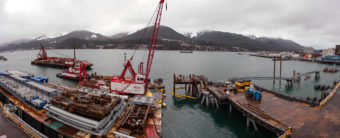
A $54 million project to add a pair of floating cruise ship berths to Juneau’s downtown waterfront is within months of completion.

The project will expand the port’s capacity to accommodate larger vessels. That’s because cruise ships in Alaska are getting bigger.

Juneau’s Docks and Harbors has been working to expand its terminal to keep up with industry requirements.

The city’s Deputy Port Engineer Erich Schaal said the downtown Alaska Steamship Dock was limited to tying up ships greater than about 800 feet. And the southern Cruise Terminal or CT dock, was not much longer.

“The original max length that we could receive at our southern CT dock was 960 feet and now we’ll be able to receive a 1,000-foot vessel and an 1,100-foot vessel at the same time,” he said.

Seattle-based Manson Construction is the lead contractor working to expand the cruise ship berths.

A 25-strong crew from the firm has been working double shifts drilling and driving piles in the daytime and welding in the evenings.

The final work should be wrapped up by May 7, project manager Monica Blanchard said.

Given all the activity on the water there’s not a lot of extra space for different ships to get in and out of the harbor.

Schaal said there was a lot of back and forth between different interests in settling on the final design.

Gastineau Channel has a busy summer season mixed with fishing boats, private yachts and cruise ships all competing for dock access in the summer.

This side of the dock is closer to shore than the south side and that’s because back in the design and we were working with stakeholders, especially the fishing fleet, they needed more access to the Taku Dock,” he said. “The original design was more parallel with the dock and there was going to be a kind of smaller area between the two.”

(Photo by David Purdy/KTOO)
Deputy Port Engineer Erich Schaal says the final design attempts to compromise between cruise ships and the commercial fishing fleet. Jan. 25, 2017. (Photo by David Purdy/KTOO)

The cruise ship industry says the new dock still isn’t as big as it should be.

We felt that the best design would be a new dock that handled two of the larger class ships,” said John Binkley, president of the Cruise Lines International Association Alaska, which represents companies sailing state waters. “The new class ships will be over 1,000-feet long. And we felt that it was wise to — in terms of an investment of this size — to have a dock that could handle two of those ships and leave the existing dock in place.”

Alaska is projected to receive larger vessels because bigger liners are now able to transit an expanded Panama Canal to arrive from the Carribean in the summertime, Binkley said, as well as a response to consumer demand.

“They like bigger ships, there’s more amenities, more variety of things to do on the ships and it’s also an economic reason,” he said. “The larger the ship just like with a bus or a car or an airplane, the more passengers you can get on, the better the economics are.”

The final project wasn’t without other local controversies.

For a quarter-decade the Blessing of the Fleet has been held at a dockside monument maintained by the Alaska Commercial Fishermen’s Memorial. The group challenged the city’s design in court  but its legal efforts were ultimately unsuccessful.

Memorial President Carl Brodersen said the court fights are over and now the board is focused on trying to find it a new home.

Until that time, the blessing ceremony is scheduled to go ahead in the midst of the expanded cruise ship terminal.

It is very hard for the two elements to co-exist and for both to function perfectly for their individual purposes. I mean we essentially do have an enormous wall of cruise ship in front of the memorial right now,” Brodersen said. “But the ceremony is over 25 years old — we can’t just stop doing it.”

Standing next to the new floating berths under construction, Assembly member Jesse Kiehl attended a recent tour to see the progress.

He said the new cruise ship terminal will aid the local economy.

“I really like that we’re replacing this infrastructure for the next 50 years of this piece of Juneau’s economy,” Kiehl said. “Of course, the added benefit is that Juneau sales tax and property taxpayers aren’t footing this bill. This is coming from taxes that the industry and the passengers pay for the services that we provide.”

The first cruise ships are scheduled to arrive on May 1 in Juneau. They are the Nieuw Amsterdam and the Eurodam, both 935-foot-long, Signature-class vessels operated by Holland America Line.

Juneau Assembly names new hospital board members

Bartlett Regional Hospital. (Photo by Jennifer Canfield/KTOO)
The 45-bed Bartlett Regional Hospital is owned by the City and Borough of Juneau. (Photo by Jennifer Canfield/KTOO)

The Juneau Assembly has appointed two new members to the nine-member governing board of Bartlett Regional Hospital, Dr. Bob Urata and Lance Stevens. Urata is a physician with a long-standing private practice in Juneau. Stevens is a former Juneau Chamber of Commerce president who works for Alaska USA Federal Credit Union.

The Assembly’s Human Resources Committee also reappointed incumbent Mark Johnson who’s been on the board since 2013. All three were appointed to terms that expire at the end of 2019.

The two vacancies were created when Mary Borthwick and Lauree Morton declined to reapply. Both had been appointed in 2014.

The other contenders for the board seats were Rory Darling and Rosemary Hagevig.

The Assembly also ratified the labor contract signed between Bartlett management and the International Longshore and Warehouse Union that represents nearly 400 nurses, medical technicians and other support staff.

The added pay increases are slated to cost about $3 million over the next year.

Juneau Assembly votes 6-3 to support the road

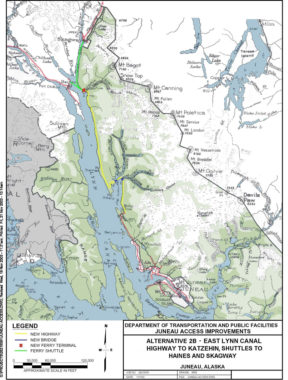
A map of the favored proposed route to Katzehin. (Map courtesy Alaska DOT)
A map of the proposed route to a ferry terminal on the Katzehin River. (Map courtesy Alaska DOT)

The Juneau Assembly reopened the debate over the stalled Juneau Access Project that envisions 50 more miles of road up Lynn Canal to a ferry terminal closer to the road system.

The road debate has divided the community for decades and faces significant opposition from other Southeast cities, including Haines and Skagway.

Citing the state fiscal crisis, Gov. Bill Walker pulled the plug on the $574 million project last month.

But on Monday evening, an overflowing crowd of pro- and anti-road advocates filled the chambers to speak passionately from opposing sides.

Corey Baxter of Juneau’s chapter of the International Union of Operating Engineers was joined by other union members who said the project would bring much needed employment.

“I know my family and my fellow union members put a high value on work and want to remind you that we are the ones that will actually build this road,” Baxter said as about a half-dozen other union members stood to show their support. “The project will provide work opportunity for dozens if not hundreds of Alaskans. Now more than ever we need the jobs that Juneau Access will provide.”

Other residents like Terri Lauterbach argued that a remote highway extension would not be feasible for the state to maintain.

“I haven’t heard avalanche chutes brought up yet,” she said. “At most we’re going to have summertime connection to the rest of the state and to other commerce. It’s not going to happen in the winter. There will be weeks that it takes to clear avalanches along that road. You can’t tell me that’s year-round commerce.”

After more than an hour of testimony, a divided Assembly voted 6-3 to pass the resolution that affirmed its support for the road extension and urged the Legislature not to divert funds  — estimated at about $40 million — to other projects.

Assembly members Jesse Kiehl and Loren Jones opposed the resolution. So did Assembly member Maria Gladziszewski.

“It’s not an easy issue,” she said. “It would be a lot harder for me if it were actually a road to Skagway or a road to Haines but it’s a road to another ferry.”

Deputy Mayor Jerry Nankervis spoke for the majority when he said counterarguments would not let him be swayed against supporting the road extension to a new ferry terminal on the Katzehin River.

“Even though there is a lot of opposition, I believe that it’s in the best long-term interest of the viability of this community to have a road,” he said.

The resolution was largely symbolic and is the product of a closed-door “brainstorming session” held earlier this month by the mayor with like-minded boosters.

Previous ballot measures and other polls have shown the community to be deeply divided on the issue.

Given the governor’s opposition and the state’s dire fiscal climate, it’s unlikely lawmakers will revisit the issue this year.

Vote postponed over Juneau’s controversial ‘camping ordinance’

Juneau homeless resident Everett Johnson, far left, testifies about sleeping on the streets before the Juneau Assembly on Monday. (Photo by Jacob Resneck/KTOO)

Juneau’s controversial anti-camping ordinance that would empower police officers to crack down on homeless people sleeping downtown has been postponed until next month.

That’s following more than 90 minutes of testimony from dozens of residents including merchants, social workers and homeless people.

They all agreed on one thing: Juneau has a serious homeless problem.

But speakers had radically different viewpoints.

Douglas resident Greg Capito told the Juneau Assembly on Monday night that tensions are rising between increasingly desperate people sheltering downtown, and that employees and patrons are increasingly afraid.

“In the last three years, downtown Juneau has changed and, ladies and gentlemen, not for the better,” Capito said. “There’s fear in the eyes of everybody. When you look in somebody’s eyes and see fear you never forget it.”

Other speakers also testified that they were feeling increasingly unsafe downtown, especially after dark.

But 27-year-old homeless Juneau resident Lisa Williams said that if the proposed ordinance is passed, she doesn’t know what she’d do.

“We have nowhere to go. And we’re already homeless,” she said. “If we had money to pay for something we would pay for it. You guys are trying to give us tickets or whatever — but if we’re homeless how are we going to pay for it? We don’t have anything, we don’t have a home. We’re staying in cubbyholes and everyone is saying they’re scared but — we’re harmless.”

Daryl Miller, owner of a downtown commercial printing business, said he likes the idea of more shelter capacity and an emergency warming station. But he’s reached the breaking point with people sleeping downtown.

“I’m tired of babysitting and cleaning up on a daily basis,” Miller testified. “So much so that I will be moving my business in the next three months from its current location, and one of the main reasons is because of the daily cleanup.”

Another longtime homeless resident, Everett Johnson, said elected officials don’t know what it’s like to be destitute and challenged them to put themselves in his place.

For people like him it’s a matter of daily survival, he said.

“You want to get us off downtown? OK — build us another shelter. Don’t make it difficult. We’re already having a hard time,” Johnson said, his voice trembling with emotion. “As I look at every one of you you guys got a bed, a warm place. Not me, not me. As a matter of fact, I brought my bed with me and that’s my sleeping bag.”

The Juneau Assembly concluded the ordinance’s public hearing and is scheduled to revisit the issue at its Feb. 13 meeting.

Site notifications
Update notification options
Subscribe to notifications