Jacob Resneck, CoastAlaska

Jacob Resneck is CoastAlaska's regional news director based in Juneau. CoastAlaska is our partner in Southeast Alaska. KTOO collaborates with partners across the state to cover important news and to share stories with our audiences.
Juneau count identifies homeless as predominately older, Alaska Native

Organizers of the Juneau Project Homeless Connect outreach event held last month have released numbers and related data on who attended. Most were in their 40s and identified as Alaska Native.

In the data released Friday, 238 people were counted, including 50 people living in a place federal housing authorities says are not meant for habitation.

The Juneau Assembly is slated to debate an anti-camping ordinance on Monday that would ban people from camping in the downtown core. Merchants say it’s necessary to prevent homeless people from sleeping on private property and so employees feel safe.

The Alaska Coalition on Housing and Homelessness opposes the ordinance. Executive Director Brian Wilson says the latest numbers run counter to the perception that the homeless population downtown has become younger.

“There’s a narrative going around that this is a new phenomenon in Juneau,” Wilson said. “But overall if you look at the numbers, it’s primarily individuals who have been experiencing homelessness for more than a year. … Two-thirds identify as Alaska Natives and are over 43 years old on average.”

Four Alaska Native institutions have also come out against the proposed ordinance and asked the Assembly to abandon it.

Numbers from a more comprehensive count of Juneau’s homeless population conducted the night of Jan. 24 are expected to be released soon.

Funter Bay landowners object as Juneau eyes expansion

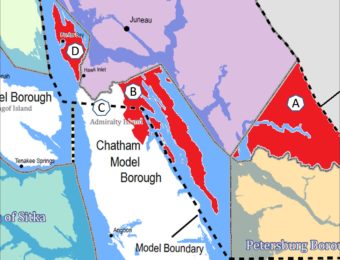
CBJ staff recommends annexing the red areas labeled A, B and D.
CBJ staff recommends annexing the red areas labeled A, B and D. (Courtesy City & Borough of Juneau)

The City and Borough of Juneau is eyeing four tracts of land it could annex into the borough. The most controversial piece includes the northern end of Admiralty Island and Horse and Colt islands, which have a number of mostly seasonal cabins.

At least a half-dozen people with property on Admiralty Island’s Funter Bay wrote to the Assembly this month to object.

“There’s taxable wealth out there that the borough wants to tax, and nobody wants to be taxed because we see no benefit at all from it,” said Gordon Harrison, who has owned a waterfront cabin on Funter Bay for more than 20 years. At the most, property owners could expect added zoning regulations over their remote region.

We’re Alaskans that have built cabins out there,” Harrison said. “We don’t have any electricity, some have some wiring for a generator, most don’t have plumbing. Any kind of building code would just be a terrible, terrible disservice to people out there.”

A Juneau commission studied annexation options in 2007 and urged that a “careful balance” should be struck between any new taxes and services delivered.

Remote property owners within the borough, such as those on the Taku River, are already unhappy with their level of services, the commission wrote a decade ago.

Other property owners make the argument that they would be asked to pay taxes without any added services.

If there were actual services provided to the residents there, whether they’re part-time or permanent, I don’t think there’d be any question that people would support it,” said property owner Joel Bennett. “But with no services?”

These types of debates play out all over rural Alaska as boroughs look to expand their tax base.

The Juneau Assembly discussed expansion back in December and referred the issue to its Lands Committee. The Assembly directed lands department staff to write a memo outlining how Juneau could annex new territories.

“The model borough boundaries were established by the State of Alaska several years ago as a guideline for where boroughs should expand to,” explained the city’s Lands Manager Greg Chaney, who penned a memo last month that recommended how Juneau could best expand out to the “model boundaries” drawn by the state.

These model boundaries are only a guideline and don’t hold legal weight. That was demonstrated in 2011 when Petersburg Borough annexed Hobart Bay – which lies within Juneau’s model boundary. Juneau took its challenge all the way to the state’s Supreme Court and lost.

Chaney said that was a teachable moment.

“If we wait and we don’t expand out to our model borough boundaries, neighboring communities could rightfully apply to have those areas annexed,” he said.

It’s a symptom of Alaska’s novel “unorganized borough” — unclaimed areas that breed competition between neighbors.

“It does tend to pit communities against each other,” Chaney said. “It tends to pit local governments against people who are in areas that are more remote who don’t want to be in a borough for lots of reasons. We’re Alaskans, we like our independence and so that’s not a surprise.”

If the Juneau Assembly petitions for the annexations, the state’s Local Boundary Commission would ultimately decide the issue. But so far, it’s just an outline; the Assembly hasn’t put it on the agenda. But that doesn’t mean potentially affected property owners aren’t already on their guard.

Juneau’s proposed ‘camping ban’ could affect HUD funding

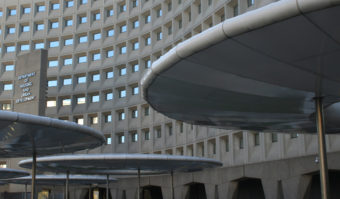
The headquarters of the U.S. Department of Housing and Urban Development in Washington in December 2006.
The headquarters of the U.S. Department of Housing and Urban Development in Washington in December 2006.(Creative Commons photo by David)

An ordinance to ban the homeless from camping in the downtown core continues to generate controversy. Now there’s questions over whether a ban could affect the community’s access to federal housing dollars.

There’s been a lot of outcry over a proposed ordinance that would ban homeless people from camping in Juneau’s downtown core. Proponents say it’s a public safety issue. Opponents say a camping ban would just move the problem around.

Juneau’s Downtown Business Association is itself divided within its membership. But a majority of its board members voted to support the initiative. That’s because many merchants and their employees report feeling increasingly unsafe by people who loiter and sleep in alcoves in the commercial center.

“The board made the decision that we were in support of the ordinance and I personally feel that was the right decision, not everybody on the DBA feels that way,” said Eric Forst, owner and manager of the Red Dog Saloon who penned the DBA’s letter of support for the ordinance.

He said it’s a complex problem and one that needs a lot of work.

“On either side of the issue we all feel that this not the silver bullet,” Forst said. “This is a step — there’s a lot more that needs to be done.”

He’s operated downtown businesses for about 20 years. There have always been homeless people around but that in the last 18 months or so it’s changed.

“(There’s) a  younger, meaner more aggressive element that does not want to be helped — and that’s what this is targeted at,” he said.

In recent weeks a number of social care organization have testified that a camping ban wouldn’t solve anything and would waste police resources.

Homeless residents have also weighed in. Mary Bailey, 46, has recently been staying at the Glory Hole downtown shelter though she said  she’s had to sleep by downtown storefronts.

“I mean, that’s the only thing that can protect us from the weather so I mean what’s going to happen?” Bailey said. “I mean, we need something what about a tent city? And if that law goes through, why don’t they put a tent city first?”

The city is working behind the scenes to identify a year-round campground. But that takes time. Rezoning would be at least several months away. City staff has proposed delaying any camping ban until mid-April when the city-run Thane campground reopens. It’s in an avalanche zone, so it closes down for the fall and winter.

Juneau Mayor Ken Koelsch, ordinance’s main proponent, said pushing the effective date to April 15 as a compromise. He’d like it to take effect earlier.

“We need to deal with our homeless problem,” Koelsch said. “We need to deal with our safety problem and we need to deal with both of them right now. And that’s the perspective I’m taking on it.”

Koelsch, elected last year in a special election, said merchants came to him with their concerns more than two months ago and he’s frustrated the Assembly still hasn’t taken action.

“As a former government teacher I thought government was a lot more responsive,” he said.

HUD funding could be affected

The Alaska Coalition on Housing and Homelessness has warned that a camping ban targeting homeless people could imperil the community’s access to federal grant dollars.

“In Juneau we have two programs that are operated by St. Vincent de Paul to a total of $130,000 that has over 30 permanent supportive housing units in place,” said coalition Executive Director Brian Wilson.

Those funds come from the federal department of Housing and Urban Development, or HUD. In addition to these two resources, the new 32-bed Housing First shelter slated to open in May will likely be applying for federal funds to further expand. These federal dollars will likely be crucial, Wilson said, and when it comes to HUD reviewing grant applications in Washington. It’s a numbers game.

“The higher your score the more funding that you receive. The lower your score, you’re at jeopardy of losing funds,” Wilson said.

But could a camping ban really imperil federal funding? HUD, as a rule, doesn’t get involved in policy debates. But HUD officials would talk freely about what approaches to tackling homelessness they encourage — and discourage.

“Most of the evidence shows and most experts would agree that homelessness is not a crime, homelessness is a condition,” said HUD spokesman Lee Jones in Seattle. Congress has appropriated $1.9 billion nationwide for grants to communities dealing with homelessness.  Typically 300 to 400 communities — both public agencies and private nonprofits — vie for a slice of the funds each year.

“It’s extremely competitive. $1.9 billion sounds like a lot of money, (but) we do have a fairly considerable homeless problem across the United States, in virtually every community large, small and in between,” Jones said.

How these communities — in HUD jargon they’re called Continuum of Care Programs — decide to deal with homelessness is definitely a factor, Jones said, when ranking funding requests.

“If the continuum has made efforts to essentially address homelessness as a condition rather than a crime they can score two extra points out of the 200 ideally they would need for a perfect application score,” he said.

Juneau Mayor Ken Koelsch poses for a shot in the City and Borough building on Tuesday, January 3, 2017. (Photo by Tripp J Crouse/KTOO)
Juneau Mayor Ken Koelsch

This is an issue some Assembly members want answered before the ordinance goes to a vote next week and city staff are working on trying to get answers.

“I think in order to make that policy decision the Assembly needs to understand that impact,” City Manager Rorie Watt said.

As for Mayor Ken Koelsch, he’s said he’s talked to the city’s DC lobbyist and congressional staffers for clarification but hopes to get the ordinance passed regardless.

“That would disturb me greatly to find out that a city that tries to help its citizens deal with trespassers on private property would suddenly not be received in the same light and that we would definitely follow up on,” the mayor said.

The Juneau Assembly likely won’t take further oral testimony, but with a vote scheduled for Monday, a crowded house is expected.

Juneau Docks and Harbors, UAS to restart talks over Auke Bay lab

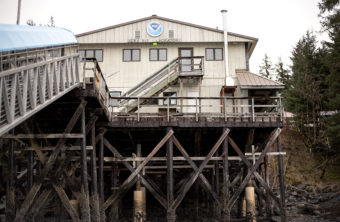
The Auke Bay Marine Station on Tuesday, Jan. 31, 2017. Juneau Docks and Harbors is interested in the property for a potential expansion of Statter Harbor. (Photo Tripp J Crouse/KTOO)

The Juneau Assembly has given clear direction to city staff to try and mend fences with the University of Alaska Southeast over a prime piece of federal property up-for-grabs on Auke Bay.

Both the city’s Docks and Harbors division and the university have competing applications with the federal government to take possession of the former NOAA Fisheries Auke Bay Marine Station next to the city’s Statter Harbor.

Previous attempts at forging a joint application stalled last year. But speaking Monday evening at a joint meeting of the Juneau Assembly and the Docks and Harbors board, University of Alaska Southeast Chancellor Rick Caulfield said the university remains open to a joint plan.

Rick Caulfield

“We’re interested in continuing to work with the city and see if we can’t find an arrangement that would work for Juneau,” Caulfield said. “But I do want to share our vision of what we believe is possible on this property if we can keep that kind of partnership in focus.”

The city’s Docks and Harbors has its own ambitious plan to extend boat slips from Statter Harbor to serve commercial fishing vessels, tourist boats and even small cruise ships. The city had offered to lease the main laboratory building to the university on a 30-year lease.

But Caulfield says the university is hesitant to invest $15 million in a building it didn’t own.

“We have some concerns about making the investments that would be required to really utilize this property fully and not have, if you will, if not fee-simple title but good control over use of the property,” he said.

Members of the Docks and Harbors board then put the question to the chancellor directly: “If the university’s questions were answered, if all the issues were addressed, is there any scenario that the university would drop its application and combine it with the city’s?” asked board member Dave Summers.

“There could well be an arrangement where we would do that. But again I think we would need to sit down and work through some of the questions that I’ve pointed to,” Caulfield replied.

Juneau Assembly members concluded by directing the city manager’s office to resume talks with the university over the 4-acre property. That doesn’t leave a lot of time. The federal General Services Administration is expected to make a ruling on the applications before May.

Alaska Marijuana Control Board nixes on-site consumption

marijuana smoke photo illustration
(Creative Commons photo illustration by Chuck Grimmett)

The state’s Marijuana Control Board was set to regulate the consumption of marijuana at licensed retailers. If it had been approved, Alaska would have been the first state in the nation to allow on-site consumption.

But that’s now moot.

A 3-2 majority voted Thursday to shelve the regulations after the control board’s staff said public notices contained errors and a decision would have to be postponed for at least another 30 days.

Control Board member Mark Springer of Bethel said he worried how the feds would react to marijuana consumption in public. Pot remains illegal under federal law.

“We don’t want to draw a whole lot of attention to what is going on in this state with marijuana,” Springer told fellow board members. “We don’t want a million people getting off a cruise ship in Juneau saying, ‘Oh yeah, it’s great. We’re going to go over a half-dozen stores and smoke marijuana,’ because it will draw a big spotlight on us.”

The control board has received dozens of public comments — many of them negative — ahead of its third meeting where it considered the rules.

Both Nicholas Miller of Anchorage and Brandon Emmett of Fairbanks — who are on the board as representatives of the industry — voted to keep the initiative alive.

After the vote, business owners from Alaska’s fledgling legal marijuana industry said they were dismayed by the decision.

“They’re putting everybody in violation that’s gonna be here consuming and it’s sad,” said Tara Bass, owner of The Remedy Shoppe in Skagway, the state’s first licensed retail marijuana store. She said renovations had already been made in anticipation of the new rules.

“We prepared it to be an outdoor consumption area so it would be plenty ventilated and it’s just interesting that they’re not giving people a place to go.”

The Alaska Marijuana Industry Association had lobbied for a legal way for customers to consume on the premises. Executive Director Cary Carrigan said retail outlets will need to regroup and rethink their strategy before bringing the issue back to the board.

“What I’m gonna do is push the membership to put forward solutions,” Carrigan said in an interview. “To not just say, ‘I want on-site consumption!’ How do you want it? And how are you going to accomplish that? And how do you make it so it’s not a health concern, so it’s not a public issue, so it’s not something that’s blowing smoke in everybody’s face, so to speak.”

Voters in Alaska approved legalizing marijuana for recreational use for those 21 and over in 2014. But it’s fallen to the five-member Marijuana Control Board to write the regulations of how to manage lawful consumption in the state.

UAS, Juneau Docks and Harbors vie for former NOAA lab on Auke Bay

The federal government is offloading some prime real estate on Auke Bay and both the city of Juneau and University of Alaska Southeast are making strong cases to receive it. The former NOAA Fisheries Auke Bay Marine Station is currently occupied by the Coast Guard, though that arrangement expires this spring. Now both UAS and the Juneau Docks and Harbors have put in competing proposals to take it over.

There are differing visions for what to do with nearly 4 acres of prime waterfront property on Auke Bay. Juneau’s Docks and Harbors division sees huge potential in expanding slips for commercial fishing boats, yachts and even small cruise ships. Port Director Carl Uchytil argues that Juneau’s geography has left mariners with too little harbor space and this location is prime.

We’re cramped on this long, linear ribbon of land in Juneau,” Uchytil said, “so having the opportunity to acquire more land and utilizing that land as a portal for expansion of the harbor we think is in the best interest of the marine users in Juneau.”

Docks and Harbors submitted a proposal last summer that called for an ambitious $30 million harbor expansion that would build a new boat slip connected to neighboring Statter Harbor. Docks and Harbors would also relocate its administrative offices to the property, saving $56,000 a year in rent. Juneau’s port director says it’s a rare chance.

This is kind of a once-in-a-generation opportunity to acquire property adjacent to a harbor than can really benefit the community for decades to come, and we’re excited about the opportunity that it presents,” he said.

The most prominent building on the site is a federal marine lab built in the 1960s. For decades it was occupied by NOAA Fisheries until they moved up the road to the Ted Stevens Marine Research Institute at Lena Point.

Since then several other agencies have come and gone. Now the Coast Guard is using some of the buildings but it’s not clear if they’ll renew their tenancy when it expires in May. Considered surplus property, the waterfront acreage and the buildings on it are in the hands of the General Services Administration, the agency charged with managing federal properties.

The University of Alaska Southeast whose main campus is literally across the street also has designs on the property.

Port Engineer Gary Gillette notes the city would be glad to lease out the 14,000-square-foot main building to the university.

All the labs and everything are still there, so if it’s something that the university or some research entity could use, we’d lease it out to them because as a Docks and Harbor facility we don’t particularly need the lab space,” Gillette said.

The university, for its part, has politely declined the city’s offer. Instead, it’s filed a proposal of its own that calls for expanding its campus on Auke Bay and using the entire 4 acres.

“What we’re trying to do is expand the campus along that waterfront and use those buildings and we have plans to utilize all of the buildings that are there,” UAS Vice Provost for Research Karen Schmitt explained. “So then we will have all of our science programs — which are very interdisciplinary in nature — on the same site and accessible to the water on the marine laboratory side going down to the waterfront and the dock there.”

At one point both the city and university were working on a joint-plan but that stalled last year. A memorandum of understanding remains unsigned because Docks and Harbors and the university disagree over how to share the property.

UAS facilities director Keith Gerken says both sides recognize a compromise would simplify the process but so far that remains elusive.

One of the questions we haven’t been able to answer is whether there is a workable plan that has the two agencies sharing the property,” Gerken said. “That’s what I think frankly neither party can say for sure works.”

The university projects it would cost up to $2.2 million to move in in the first year. Demolishing and replacing some of the buildings and bringing it up to standards could cost upwards to $25 million over 20 years.

Schmitt says the state’s fiscal crisis — and the prospect of deep spending cuts — is no reason to abandon investments in education and that’s the message they’d carry to the Capitol.

We’ll be serving a large number of people in the community, certainly the region, and I think that’s the kind of mission that our university really can advocate for strongly and do well to have that property to make that possible,” she said.

Both sides agree that it’s a prime piece of land that the community would be lucky to have access to — no matter how it’s used.

As it stands the ball remains in the feds’ court. The university’s application rests with the U.S. Department of Education. Docks and Harbors has applied through the U.S. Commerce Department’s maritime agency. The federal GSA is left with the task of weighing which proposal is better in the interests of the United States government.

How — and when — the federal government will make a decision is anybody’s guess.

Site notifications
Update notification options
Subscribe to notifications