Jacob Resneck, CoastAlaska

Jacob Resneck is CoastAlaska's regional news director based in Juneau. CoastAlaska is our partner in Southeast Alaska. KTOO collaborates with partners across the state to cover important news and to share stories with our audiences.

Return to sender: Juneau pot business blocked from mailing tax payments

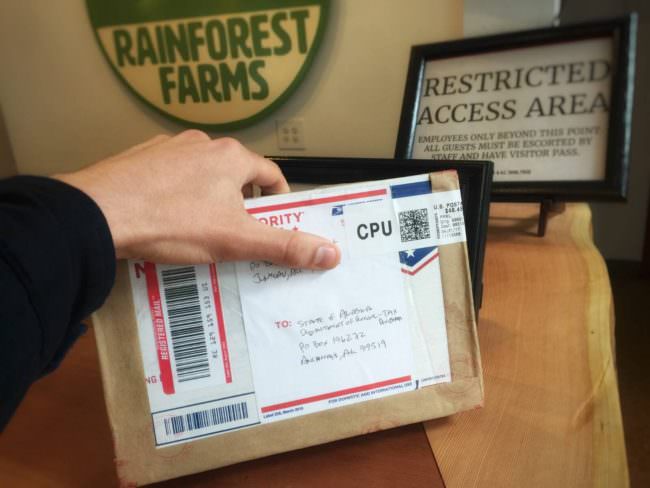
Rainforest Farms co-owner James Barrett said this parcel containing the pot business’ cash tax payment was rejected by the U.S. Postal Service on April 21, 2017. (Photo courtesy James Barrett)

Alaska tax officials have set up a system to tax licensed marijuana businesses.

Due to Alaska’s geography actually getting the revenue to the state isn’t always easy.

Usually sending a payment is straightforward — mail a check, pay online. But take James Barrett. He and his brother own Rainforest Farms, a marijuana shop in downtown Juneau.

“We’re able to do banking but we can’t put any of our cash sales into that bank account,” Barrett said.

Why not?

“Because it’s drug money.”

That’s how the federal government views the proceeds from Juneau’s first legal weed outlet.

None of the banks in Juneau will accept pot money, so his business can’t write checks.

There’s still cash.

That’s why Alaska’s revenue department set up a cash drop-off point in downtown Anchorage.

Yet for businesses off the road system — like Juneau — driving to Anchorage isn’t an option. So the state set up a special post office box to mail cash to.
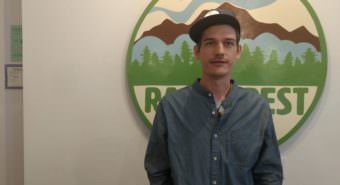
Rainforest Farms co-owner James Barrett says marijuana businesses should be treated like any other legal enterprise. (Photo by Jacob Resneck/KTOO)

Alaska taxes marijuana bud at $50 an ounce and Rainforest Farms tax bill is often in the thousands of dollars.

In mid-April, Barrett dropped a brick of cash into the mail — with insurance of course.

“About an hour or so after I shipped my payment out,” he recalled, “I got a phone call from the post office and they said, ‘Come pick this up. We’re not gonna send it.'”

Tacked to the rejected parcel was a print-out reminding him of federal law.

“Proceeds from marijuana sales are illegal to send through the mail, and that does include tax payments even though it’s legal in the state of Alaska,” said Jeremy Leder of the U.S. Postal Inspection Service in Seattle. “From my agency’s perspective we have not seized any of these tax payments and we really have no plans to. It’s just if you’re going to use the United States mail, you’ll have to abide by federal regulations and marijuana businesses in Alaska sort of have to know that.”
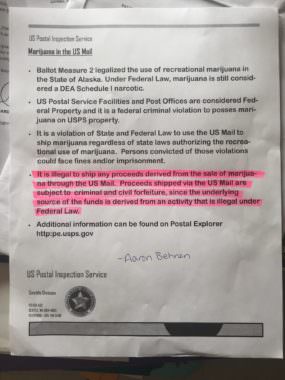
Rainforest Farms claims this note from the U.S. Postal Service was the only explanation offered for rejecting the parcel. (Photo courtesy James Barrett)

The feds throwing up roadblocks for state taxpayers isn’t just exasperating for marijuana businesses.

“It’s such a weird in-between world world we’re in,” State Tax Director Ken Alper said. “I mean, this is a licensed business these guys have spent hundreds of thousands of dollars and gone through a pretty intense regulatory process. But yet they are operating and they’re prevented from doing just the normal things that a business is supposed to be able to do like use a bank or pay their taxes.”

In the end Barrett bought a plane ticket to Anchorage to pay his taxes in person.

He admits there may be  alternatives — he could set up a shell company, hire a courier or invent some other work around.

But his point is he shouldn’t have to.

“We want to do business like regular businesses do,” Barrett said. “In America, we have a common currency for a reason just so that all these businesses can work together.”

Guidance from the Department of Justice or an act of Congress is needed before the postal service can change its policy, Leder said.

“I think it can be kind of attributed to, you know, the states are moving a lot faster than the federal government when it comes to marijuana laws,” he said by phone. “Until that changes the postal service and the inspection services will have to abide by those laws.”

Alaska’s geography means there really isn’t any way in or out of roadless communities without triggering some sort of federal jurisdiction — even though it’s not leaving the state.

That needs to be addressed, Alaska’s tax chief says.

Alaska’s tax division chief Ken Alper says the federal government should recognize the cash as legitimate tax revenue. (Photo by Jacob Resneck/KTOO)

“The issue comes down to … we don’t want a new rule,” Alper said. “We want to interpret what’s being shipped is something other than the proceeds of a drug transaction. In our view, it is tax money.”

Clarity in Washington has been in short supply.

On one hand, Congress passed a $1 trillion spending bill last week that extends a rule barring the federal government from using funds to block state marijuana laws.

But in his signing statement, President Donald Trump said he reserves the right to ignore it.
Juneau police propose expansion of patrol car fleet

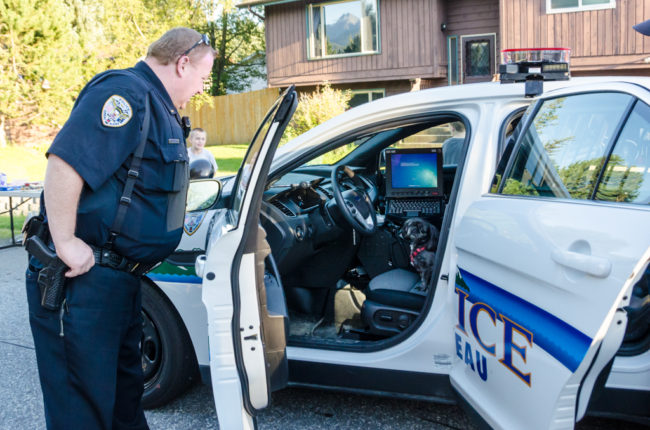
Maggie the dog called shotgun in one of the police cars.
Maggie the dog called shotgun in one of JPD’s marked cruisers on August 17, 2013. (File photo by Heather Bryant/KTOO)

The Juneau Police Department is asking to increase its fleet of marked patrol cars so more officers can take them home after their shift.

A request to purchase five new cruisers for about $210,000 will go before the Juneau Assembly on Wednesday.

There would be benefits for both the department and the community, Juneau Police Lt. David Campbell said.

“You know, they last longer because they don’t get driven 24/7 and officers tend to take care of them a little bit better when there’s a sense of ownership of the car,” Campbell said. “But for the community what’s really important is that you end up having more police presence and more police cars out on the streets, so it’s a good way to increase our visibility.”

The police department will have four vacancies in its patrol division at the end of the month. A take-home car program, Campbell said, sweetens the deal when it comes time to recruit new officers.

“Some police departments have take-home cars and some don’t and when we’re looking to recruit, having a take-home car program also makes us a little bit more competitive with other agencies.”

Currently about half the department already has take-home cars.

Those include administrators, investigators and school resource officers who are constantly on call.

Adding five cars to the fleet of 22 marked cars would cost at least $109,000 annually.

It’s unclear how the Assembly will receive the proposal.

The city is currently grappling with a $1.9 million deficit and looking for ways to cut spending to balance the budget without dipping too far into reserves or raising taxes.

Bartlett CEO: A decade under House GOP health care bill could cost hospital $69 million

Bartlett Regional Hospital CEO Chuck Bill. (Photo by Lisa Phu/KTOO)

Juneau’s public hospital could still stand to lose tens of millions of dollars under the bill passed by the U.S. House of Representatives to replace the Affordable Care Act, commonly known as Obamacare. That’s according to numbers from the American Hospital Association.

“It actually cuts the reimbursement to Bartlett Regional Hospital by $69 million over the next 10 years if it stays in the format that it’s currently in,” Bartlett Regional Hospital CEO Chuck Bill said Monday.

A breakdown of the House GOP’s American Health Care Act would cut Bartlett’s Medicaid reimbursements by about $52 million over 10 years. Adding to that would be nearly $17 million in higher costs in treating the number of patients who would be uninsured in Juneau.

Alaska’s House Rep. Don Young voted in favor of the bill that passed on a razor thin margin. Now it’s the U.S. Senate’s turn to tackle the GOP initiative to repeal and replace former President Barack Obama’s signature health care act.

Neither Sen. Lisa Murkowski nor Dan Sullivan has publicly staked out a position, though Murkowski has criticized House Republicans for stripping away protections for patients with many pre-existing conditions.

Alaska’s health care sector is making its case in Washington.

“We’re working with the Alaska Hospital and Nursing Home Association to reach out to Sens. Murkowski and Sullivan to let them know that the impact is and that we certainly believe that it can’t be passed in the format that it’s been presented to the Senate,” Bill said.

It’s unclear when the Senate will produce its version of the law though the GOP-led working group’s goal is before the Fourth of July recess.

Eaglecrest Ski Area names new general manager

David Scanlan will take the helm of Eaglecrest this summer. He comes to Juneau from Greenwood, Maine where he’s managed a ski area since 2013. (Photo courtesy of City and Borough of Juneau)

The Eaglecrest Ski Area has a new general manager. The board of directors announced Monday that David Scanlan would come on board June 26.

Scanlan will relocate from Greenwood, Maine, where he’s been the general manager of the Mt. Abram Ski Resort since 2013.

He’ll replace Matt Lillard who left earlier this year for a ski area job in Vermont.

Scanlan had been a business owner on the Kenai Peninsula and has been an advocate of community owned ski areas like Eaglecrest.

“He’s an Alaskan which was not a main thing but it’s something to consider in terms of somebody that knows what they’re getting into up here as far as weather and such,” Eaglecrest Board President Mike Stanley said. “We just felt he’s the candidate to take Eaglecrest forward. He’s the right person for the job.”

In a statement, Scanlan said he was honored to have the opportunity to return to Alaska and help Eaglecrest reach its potential as a long-term community asset.  Eaglecrest is owned by the City and Borough of Juneau, which subsidizes its operations. His starting salary will be $84,136.

Police: Thane Road stabbing suspect arrested

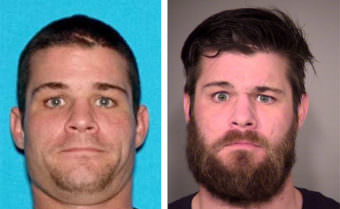
Juneau Police Department released these images of Joshua Levi Brown is sought in the stabbing of a 24-year-old victim along Thane Road on April 22 (Photos courtesy Juneau Police Department)
Joshua Levi Brown, 37, faces a charge of felony assault for allegedly stabbing a 24 year old at a party last month on Thane Road. (Photos courtesy Juneau Police Department)

A fugitive accused of stabbing a Juneau man last month on Thane Road is now being held at the Lemon Creek Correctional Facility.

Juneau Police Lt. Dave Campbell said the department received a tip that 37-year-old Joshua Levi Brown was hiding out in the Switzer Village Mobile Park.

Officers were dispatched at 11:50 a.m. Thursday with a warrant for Brown’s arrest on the charge of first degree assault, a felony.

“They saw Mr. Brown peaking out of a window and they recognized him and ordered him to come out,” Campbell said. “He came out and was arrested without incident.”

Also known by the alias Charlie Hustle, Brown is accused of critically wounding a 24-year-old with a knife on the evening of April 22.

The victim was airlifted to Harborview Medical Center. Authorities say his condition has stabilized; he’s recovering in the Seattle area.

Site notifications
Update notification options
Subscribe to notifications