Jacob Resneck, CoastAlaska

Jacob Resneck is CoastAlaska's regional news director based in Juneau. CoastAlaska is our partner in Southeast Alaska. KTOO collaborates with partners across the state to cover important news and to share stories with our audiences.

Juneau’s homeless population prefers Marine Park over Thane campground

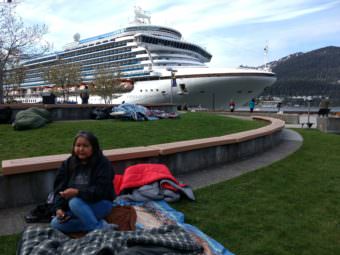
Lorraine Paul, 42, wakes up the morning of May 17, 2017, in Marine Park, Juneau. The city wants to begin enforcing the park’s posted hours of midnight to 7 a.m.

Juneau’s controversial anti-camping ordinance has been in effect for more than a month. The result has been more people are sleeping in downtown’s Marine Park.  Now the city is looking to empty the park of overnight campers.

It’s just after 8 a.m. on Juneau’s downtown waterfront. The Emerald Princess cruise ship empties of tourists as people sprawled out on the soft grass begin to stir inside their sleeping bags.

Lorraine Paul is one of those early risers. The 42-year-old and others often sleep in Marine Park though police sometimes try to move them on.

“Some of us sleep in the booth over here and have to be out by 5:30 a.m. to be respectful,” she said. “We get up to try and come over here and lay down and then here comes JPD and they’re like: ‘You need to get up and pick your stuff up.'”

The reason she chooses to sleep out in the open, in a public park, is security. There are aggressive drug addicts around who can be threatening.

“I hate to say this but because some of these people do meth, you know. I feel like they ruin it for us,” she said. “It’s really hard to find somewhere to sleep. I mean, I’m an alcoholic. Some of us try to stick together — how do I say it — pack off to ourselves.”

Juneau has one of the largest homeless populations in Alaska. A statewide survey in January found the capital city had 215 homeless people — 59 of them unsheltered.

Earlier this year the Assembly passed a controversial ordinance banning sleeping on private property in the downtown core.

Juneau Police Lt. David Campbell says officers have been able to coax people away from storefronts without serious conflict.

“Since the initiation of the ordinance, no citations have been issued,” Campbell said. “Which means that people are basically moving on if requested to and it hasn’t gotten to the level were the officers feel like they have to write a citation.”

Federal judges have ruled cities can’t pass laws that criminalize homelessness. That’s why the city’s recent ordinance is limited to private property. Many people moved to public property, like Marine Park, where Campbell says police were instructed to be more lenient about restricted hours.

“With the new camping ordinance and the directions to the officers we were told not to enforce that in Marine Park,” he said.

But soon the city will try to make Marine Park off-limits after midnight.

“We think that making sure that the park remains open as a park and not as a camping areas is best for everyone,” Deputy City Manager Mila Cosgrove said.

She says the decision was made Tuesday at a meeting of city department heads. The logic is to close the downtown parks to drive people toward alternatives, such as the seasonal campground near Thane.

“The thought was people would naturally migrate up to Thane as the weather got a little bit warmer, which it certainly has, and that hasn’t been happening. We want people to know that that’s a designated option for them.”

Unidentified sleepers sprawl out in Marine Park on May 17, 2017. (Photo by Jacob Resneck/KTOO)

Complaints in recent weeks about rowdy behavior in Marine Park is what led the city to take action.

“At times people don’t feel safe transiting through that area and that’s just not acceptable — everyone has the right to feel safe in their community,” she said.

The Tuesday afternoon directive to clear Marine Park after hours hadn’t filtered down to the police lieutenant on Wednesday morning.

But Campbell says it could be done.

“When we encounter someone it gives us the ability to legally justify contact with them to identify them and see who they are and then ask them to go out of the park,” Campbell said. “Because it’s after hours and if they refuse then to issue them a citation.”

Back in Marine Park, this is not welcome news to Lorraine Paul.

“Now that I hear that we can’t be sleeping out here — it sucks,” Paul said. “Wish they’d have somewhere for us to camp.”

What about Thane campground? She says it’s 2-miles from downtown on an unlit road. Not safe for a single woman.

“You hear a lot of stories. For example, if I walked out there myself — I’m told there’s guys out that way that camp that would hurt you and rape you,” she said. “It’s kind of hard because I’ve been on the streets off-and-on all my life.”

It’s unclear whether the city would be able penalize anyone caught in the park after hours, because there’s a typo in the city’s code that likely would need amending before a court could impose the $25 fine.

Juneau’s ‘Field of Fireweed’ rezoned industrial

Fireweed blooms near Juneau International Airport on July 17, 2016. Many locals call this area "the Field of Fireweed." (Photo courtesy Skip Gray)
Fireweed blooms near Juneau International Airport on July 17, 2016. Many locals call this area “the Field of Fireweed.” (Photo courtesy Skip Gray)

The Juneau Assembly voted 7-2 to rezone land around Honsinger Pond also known as a “Field of Fireweed” near the airport for industrial use. Public outcry over blooming fireweed and bird habitat had helped scuttled previous efforts to rezone the land.

After hearing comments from nature lovers and off-roading advocates, Assemblywoman Debbie White noted that owner Spike Bicknell had been denied permission to rezone it on two previous occasions.

“It’s about time that this Assembly have a backbone and allow a private property owner to develop their property and not give in to — I’m not even going to use the words,” she said.

Bicknell has also applied for a permit for a motocross park on the site. Opposition came from skeptical Assembly members Loren Jones and Jesse Kiehl who said the current zoning would already allow a motocross park.

“I’m deeply confused at the idea of a motocross or an off-road bike track as the reason we have to rezone it because the current zoning allows the permit for that on exactly the same terms that the new zone would,” Kiehl said. “So that — that can’t be it.”

Deputy Mayor Jerry Nankervis said future plans for the property weren’t the issue being discussed.

“I don’t know what Spike Bicknell is going to do with this property, I don’t know what he’s going to do — it’s private property,” Nankervis said. “There’s a conditional use permit requirement if he wants to do something with it, he’s going to be back before the Planning Commission to discuss that and discuss the merits of that.”

The 26 acres will now be zoned industrial, a move that the Planning Commission ruled in January is consistent with the city’s long-term plan. An application for a motocross park remains incomplete and would have to go before the Planning Commission before moving forward.

Landowner Spike Bicknell was present at the meeting but didn’t speak.

Fundraising for Twin Lakes playground exceeds $100,000 target

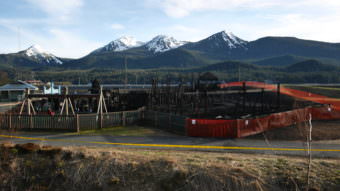
The remains of the Twin Lakes playground on April 25, 2017, the day after a fire burned it down
The remains of the Twin Lakes playground on April 25, 2017, the day after a fire burned it down. (Photo by Kelli Burkinshaw/KTOO)

Fundraising efforts to cover a $100,000 insurance deductible toward rebuilding the Twin Lakes playground destroyed in last month’s arson fire have succeeded.

The Juneau Community Foundation said Monday that a mix of private and corporate donations have raised just over $110,000. Alaska Airlines, BP Alaska and, most recently, $25,000 from the Cruise Lines International Association Alaska have helped fundraisers reach the target.

The city’s insurance policy is expected to cover the remaining costs to rebuild. But the actual cost of rebuilding the city-owned playground won’t be known until a revised design is approved. Any expansion beyond the original footprint wouldn’t be covered by insurance and would need to be raised separately.

The original Twin Lakes playground was completed in 2007. It was a community fundraising effort involving thousands of volunteer hours. Volunteers also raised nearly a half million dollars in cash.

The structure was destroyed by fire on April 24. Police arrested two 13-years-olds who authorities say admitted to setting the fire.

Juneau Assembly to review ‘Field of Fireweed’ rezone in advance of proposed motocross park

Spike Bicknell, owner of the Honsinger Pond property, wants to build a motorcross park on 26 acres near the airport. Public opposition has been fierce over the loss of bird habitat.

Efforts to rezone land around Honsinger Pond in advance of a proposed motorcross park is set to go before the Juneau Assembly on Monday.

Public opposition to rezoning the former gravel pit known for its swathes of blooming fireweed was taken to the Planning Commission in January.

But a majority of commissioners found it fit with the city’s long-term land use plan.

“Sometimes the best part of your day is seeing the fireweed with the sunrise,” said Juneau resident Denise Elston. “That seems like a much more economic directive because there’s millions of people that come to Juneau and the audience of a motorcross park would be very small, a very select few and the fireweed field as it is, you know, it’s for everyone.”

Landowner Spike Bicknell also has submitted an application to build a motorcross park on 26 acres. The Planning Commission hasn’t considered it yet.

Bicknell didn’t respond to a request for comment.

Fireweed blooms near Juneau International Airport on July 17, 2016. Many locals call this area "the Field of Fireweed." (Photo courtesy Skip Gray)
Fireweed blooms near Juneau International Airport on July 17, 2016. Many locals call this area “the Field of Fireweed.” (Photo courtesy Skip Gray)

The Juneau chapter of the Audubon Society is barred from taking stances on land use decisions. But the chapter’s President Gwen Baluss said biologists recognize the area as a key stopover for migrating birds.

“The Mendenhall Wetlands Complex is a designated important bird area by the Audubon Society, state and national,” Baluss said. “It does not give it any legal protection. But it is — it can be used for conservation priorities.”

A previous effort to rezone the property was rejected by both the Planning Commission and the Assembly back in 2013. But the make up of both decision-making bodies have changed significantly since then.

The public will have a chance to weigh in at the hearing scheduled at an earlier than normal start time: 5 p.m.

Funding for pro-road group approved by Juneau Assembly

At a budget belt-tightening meeting Wednesday, the Juneau Assembly teed up $20,000 for a pro-road group that’s backing the Juneau Access Project.

Gov. Bill Walker effectively killed the divisive road project in December by pulling the state’s financial support.

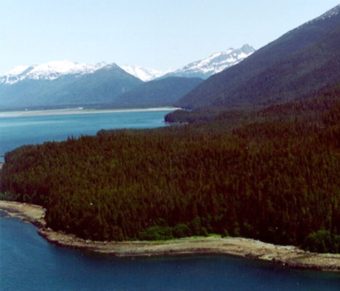
Berners Bay
The view of Berners Bay from Cascade Point. The Juneau Access Lynn Canal Highway would be built through this area. (Photo courtesy Alaska Department of Transportation & Public Facilities)

The pro-road First Things First Alaska Foundation penned a letter to the Assembly’s Finance Committee this week asking for $20,000 for a transportation survey.

The group also would spend $8,000 of its own money to pay for the professional survey, but didn’t name the polling firm it had in mind.

Would the survey help the group’s cause to extend the road?

“I think it would. But we’re willing to roll the dice and find out,” said Denny DeWitt, executive director of the First Things First Alaska Foundation.

Neither he nor anyone from the group attended Wednesday’s meeting to make the pitch.

The Assembly voted 6-3 to approve the money.

That vote mirrored a contentious resolution passed in January to support the Juneau Access Project, which would extend Juneau’s road system by 50 miles up Lynn Canal and shorten the ferry connection to Skagway.

During both votes, opposition came from Juneau Assembly members Jesse Kiehl, Loren Jones and Maria Gladziszewski.

The 6-3 majority’s enthusiasm for the road isn’t matched by Gov. Bill Walker’s administration, which pulled the plug on the $574 million project last year.

DeWitt makes the case that extending highways wouldn’t harm the state ferry system.

He argues shorter travel distances would make maritime transport more efficient to run.

“What we’re seeing now is a ferry system trying to protect and operate itself without really looking at other types of transportation modes that can in fact help strengthen it,” he said.

The Juneau Assembly also voted to grant $20,000 to Southeast Conference which advocates for the ferry.

The Assembly decided not to mothball the city’s arboretum or the Eagle Valley Center.

This comes at a time that the Assembly is trying to find ways to make deep cuts to close a $1.9 million shortfall before it passes its budget next month.

Site notifications
Update notification options
Subscribe to notifications