In this newscast:
- Juneau’s airport preps for Uber and Lyft;
- Gov. Walker says he’s working on a compromise deal on budget impasse as
- State workers warned of possible layoffs, government shutdown.
Jacob Resneck is CoastAlaska's regional news director based in Juneau. CoastAlaska is our partner in Southeast Alaska. KTOO collaborates with partners across the state to cover important news and to share stories with our audiences.

In this newscast:

U.S. Sen. Lisa Murkowski, R-Alaska, said she’s skeptical President Donald Trump will be able to negotiate a better deal after pulling the U.S. out of the 195-nation Paris climate agreement.
“That to me seems incredibly difficult,” she said Thursday from the sidelines of a luncheon hosted by the Juneau Chamber of Commerce. “I don’t know how we come in as the holdout. As I understand it, it’s Syria and Nicaragua and the United States now that are not in this, how we renegotiate it. I don’t think we have that kind of leverage, quite honestly.”
Murkowski is a strong proponent of expanding oil drilling. But she says she’s “agnostic” over the wisdom of whether to stay in the Paris agreement. She walks a fine line as climate change threatens the survival of Arctic villages and natural resources like fisheries.
“My hope is that with the president’s decision to go this route it does not mean that we fall back as a nation on our efforts to address and mitigate on the impact that we see from a warming climate,” she said. “Because we see it here in this state and it is real and I think we’ve got an obligation to help address it.”
Health care reform also is moving in Washington, D.C.
The Senate is poised to take up the Republican House bill that the Congressional Budget Office estimates would result in 23 million fewer Americans covered.
Some projections say Alaskans could be hit the hardest.
The Senate should move deliberately as it takes up the bill, Murkowski said.
“There are some who are very interested in moving it as quickly as possible to quote, ‘Kinda get it behind us,'” she said. “I don’t think that that’s the responsible path. I want to get it right rather than get it behind us.”
A bipartisan agreement will be necessary to get the best deal for Americans, she said.
“We can’t go from Obamacare, which was a Democrat-led only health care, to a Republican version of that where it’s just all Republicans that doesn’t work for the good of the country,” she said.
The U.S. Senate is in recess.

Juneau library’s youth and adult outreach programs are apparently no longer facing budget cuts. Fans of popular children’s and adult literacy programs were alarmed after the Assembly briefly put the programs under review in advance of adopting its final budget.
When a Juneau Assembly member requested library staff to detail the expense of youth and adult literacy activities for possible cuts, the city found it could save as much as $146,000 by slashing programs and reducing the hours of six librarians.
That alarmed the Friends of the Juneau Library, a nonprofit whose fundraising pays for the program materials.
“We provide pretty much almost 100 percent of the programming budget as a gift to the library annually to the tune of about $40,000,” said Jonas Lamb, president of 250-member nonprofit. “So to see the personnel piece threatened in terms of the the devoted and trained staff that deliver these pretty essential programs to youth and community members, we were called to action to say the least.”
And take action it did. At least 36 emails and letters arrived at city hall opposing the cuts in advance of a scheduled finance committee meeting.
“We were going to have signs indicating support whether they were the common summer reader superstar yard signs or just some stickers indicating that they were a ‘Friend of the Juneau Library,'” he said.
But the meeting never happened.
“We didn’t have a quorum to have our discussions so we had to pull this one off the agenda,” explained Finance Committee Chairman Jesse Kiehl who said he opposed the cuts. “I was very happy to see the committee process end without any cuts to those library outreach services. Reading for kids is really important and I wouldn’t want to see that change.”
The review of library programs came at the request of Assemblywoman Mary Becker who said she received a lot of letters of concern.
“I do appreciate receiving responses from the public on this issue,” she said.
The literacy programs run the gamut from Storytime where small groups of young children are read to, to traveling librarians that visit seniors with limited mobility and youth offenders housed in a secure facility.
“Our outreach is really all about getting out into the community, specifically the parts of the community that can’t get to us,” Library Director Robert Barr said.
By Wednesday, Becker said she became satisfied that the programs are worth it.
“I wanted to be sure that all of the things that are being credited to being done are actually – most of them are being done,” she said. “And I’m finding that they are which gives me a lot of comfort in what we are doing to support the libraries, so I am not planning on bringing it back.”
There still will be tweaks in the program next year. There’s an alarming level of illiteracy among Juneau’s homeless population.
“There are a lot of people at the Glory Hole who cannot read or write – at any level — it’s very sad,” said Mariya Lovishchuk who runs the Glory Hole downtown shelter.
But the library is ending its practice of sending librarians to the downtown shelter. The program had been running for four years but lately hadn’t been productive.
“It was a mutual decision to not have the librarians come to the Glory Hole anymore but the folks from the Glory Hole will still be able to go to the library – as they do a lot,” she said.
Library resources will be redirected to increasing visits to seniors. Now that the programs appear safe, Lamb said he’s glad the Assembly recognizes the library’s support.
“I get the impression that based on the amount of correspondence that went out from our membership to the Assembly members that perhaps they thought this was a bad idea to cut so late in the budget,” he said.
The budget isn’t a done deal. At next week’s June 5 meeting the Assembly will hold a public hearing and could still make cuts at the eleventh hour.
Finance Committee Chairman Jesse Kiehl said he hopes there won’t be any surprises.
“But I can never predict who will offer what amendments when an ordinance gets in front of the full Assembly,” he said.
As it stands the city envisions closing no facilities and no layoffs; it will lose a community service officer and a city planner through attrition. And city departments are projecting about $400,000 in savings through belt tightening.
A homeowner shot and killed a brown bear on Douglas Island last week. It’s the first brown bear documented on the island in more than 40 years.
Sightings of brown bears are often reported but there’s been no proof – until now, said Ryan Scott, regional conservation supervisor for Alaska Department of Fish & Game.

“Over the years we’ve had reports of bears swimming around, being sighted in the water adjacent to Douglas and some other anecdotal information,” Scott said Wednesday. “Folks see a bear and they believe it is a brown bear, but we’ve never been able to confirm it.”
Authorities didn’t name the man who reported that he heard a racket outside his home about 6:30 a.m. May 25 near mile 5 of North Douglas Highway.
“The homeowner went out to scare the bear away, which is a normal thing for Juneau,” he said. “Instead of responding like we would normally expect, running away, essentially, the bear actually turned to face him. The homeowner felt like the bear was imminently going to come to him and he dispatched the animal.”
The homeowner reported the shooting shortly afterward.
Alaska Wildlife Troopers investigated the killing of the male bear, which reportedly weighed more than 700 pounds. The shooting was ruled justified.
“The wildlife troopers did visit the site and talked to the homeowner and looked around a little bit and it looked like the home was well-kept,” Scott said. “There were no noticeable attractants or things like that. It’s a little bit of a head-scratcher as to why the bear was as agitated as it was.”
— Jacob Resneck, KTOO
The first confirmed brown bear on Douglas Island in decades was killed last week in what state officials say was reported as a shooting in defense of life or property.
Tom Schumacher, a Douglas-based Fish and Game management coordinator, said the adult boar was killed at a residence near Mile 5 of the North Douglas Highway, across Gastineau Channel from Juneau. The homeowner, a commercial fisherman, was awakened by “a bear tearing up things behind his house,” according to Schumacher.
“He went outside with a rifle and intended to just yell at the bear,” Schumacher said. “When he did that, the bear looked at him, so he thought it was going to charge him.”
Alaska Wildlife Troopers visited the scene of the shooting afterward. Troopers spokeswoman Megan Peters said in an email that the bear was “black-ish” in color and the investigation indicated the shooting was appropriate.
“At this point, it is highly unlikely that a citation is warranted,” Peters wrote.
Schumacher said Douglas Island’s bear population is “not numerous.” Although visitors to the island’s west side, facing away from Juneau, have reported seeing brown bears, Schumacher said they’ve been difficult to identify in photos.
“We haven’t had a brown bear documented on Douglas Island since 1974,” Schumacher said.
That bear was also killed, by a hunter near Fish Creek, slightly farther north along the highway than Thursday’s shooting.
The hide and skull of the bear killed last week have been submitted to Fish and Game, Schumacher said, in accordance with state requirements for any defensive bear death. The remains are undergoing testing to be compared with other samples at Fish and Game in an attempt to determine whether the animal came from the mainland or nearby Admiralty Island – a 3-mile swim the bears can readily make.
“The homeowner told us he keeps a very clean yard, so why the bear was there and acting the way it was remains a mystery,” Schumacher said. “We don’t know where it came from or how long it’s been here.”
Schumacher said island-bound brown bear populations, including more than 1,000 estimated on Admiralty Island, are generally more abundant than mainland bears in Southeast Alaska. They also tend to be genetically distinct due to their isolation.
“New bears don’t go there and bears from there don’t generally leave,” Schumacher said. “They have a lot of salmon streams on them – there’s a lot to eat, so those islands tend to be particularly productive.”
Editor’s note: This story has been republished with permission from the Alaska Dispatch News.
In this newscast:

The historic neighborhoods of Juneau and Douglas were built more than a century ago long before the city adopted zoning rules.
That’s led to all kinds of complications for homeowners trying to rebuild on these historic lots.
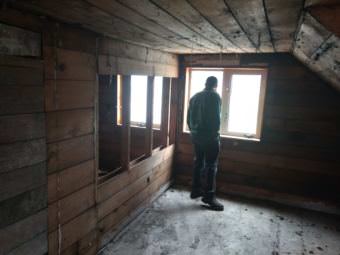
A two-story house built in 1914 sits vacant in the Flats neighborhood of downtown Juneau. A previous owner began tearing it apart to remodel it, but gave up in the middle of the job. So from the outside its exposed timbers and boarded up windows don’t make it much to look at.

Erica and Don Andrew Roguska bought this fixer-upper last summer for themselves and their two young children.
“Our plans were to keep as much of the house as we could and rebuild it,” Erica Roguska said.
The house has character and the couple wanted it preserved.
“But then we ran into troubles with the foundation crumbling and being cracked and so it just kind of snowballed into tearing the house down and rebuilding it,” she said.
The house’s zoning issues are complex.
It’s bounded by two streets and an alley on three sides. That leaves little room to legally build because of modern setback requirements.
The couple’s solution was building a new house on a smaller footprint, but even that would need permission from the city.

They were denied.
“It’s pretty disheartening to come up against so many roadblocks, when we’re just trying to rebuild a home in a neighborhood so that we don’t have this derelict building here,” Don Andrew Roguska said.
Even members of the Planning Commission, who voted to deny the Roguskas, admit it was a tough decision.
“The particular variance that was denied highlighted the quantity of problems that exist with the current zoning,” said Nathaniel Dye, member of the Planning Commission. “The commission found that we needed to find a different way to move forward because variances are, in essence, permission to break the law.”
He’s sympathetic to what they’re trying to do — the problem is with the city’s zoning, not their plans.
“If you look at what they would be allowed to build without a variance — it would not fit the character or feel of the neighborhood and no one would like it,” Dye said.
This story isn’t unique. Planners see it all the time.
“The downtown historic neighborhoods of Juneau and Douglas were predominately built by miners and fishermen long before today’s zoning was put into place — we didn’t have setbacks. We didn’t have lot sizes,” City Senior Planner Jill Maclean said. “For people to do any renovations or expansion of their building or new residential development, they now are required to meet the current zoning which doesn’t reflect the character of the neighborhoods.”
The city’s planners have come up with a workaround, which would give the Planning Commission greater discretion to bend the rules and be more flexible in historic neighborhoods.
It won’t be a free-for-all. And it’ll only be for houses in areas defined as historic neighborhoods.
“Projects will have to meet the height requirements,” Maclean said. “They’ll still have to meet the use requirements and this doesn’t also address density.”

Would this help out the Roguskas struggling with their fixer-upper in the Flats?
Probably not. Even if the city changes the rules it’ll likely be too little, too late for this couple.
Instead the couple is working on a plan that’ll keep them from having to revisit the Planning Commission.
It just won’t be as pretty.
“Now we’re looking at ways to build the house that will not require special consideration,” she said. “We’ll shrink the house, make it more box-like. Not what the neighborhood wants.”
The city’s initiative is technically called Alternative Development Overlay Districts, or ADOD. It would run for a limited time – the idea that it’d be a temporary fix while the city tweaks its zoning rules.
The Juneau Assembly is slated to weigh the plan next month.