Jacob Resneck is CoastAlaska's regional news director based in Juneau. CoastAlaska is our partner in Southeast Alaska. KTOO collaborates with partners across the state to cover important news and to share stories with our audiences.
But the bill hasn’t become law yet. The governor’s staff said it’s under legal review.
The Alaska Municipal League calls the bill “poor public policy.” Last week the city of Juneau joined a chorus of voices asking the governor to put the brakes on the whole thing.
“If the legislation gets signed, we are allowed to enact traffic ordinances and impose sales tax,” City Attorney Amy Mead told the Assembly on Monday night. “We cannot regulate Uber or its drivers or any of the other transportation network companies in any other way.”
And that’s a problem for the city, which already regulates other forms of surface transportation – everything from taxis to buses and shuttles.
“For us that’s such an economic engine, and we have so many private businesses that operate in that corridor doing transportation services to cruise ship passengers that we’re very touchy about not being able to completely control what happens down there,” City Manager Rorie Watt told KTOO on Tuesday.
Mead told the Assembly that enforcement would be tricky in Juneau.
“Under the Alaskan legislation that right is reserved to the Department of Transportation and only at the international airports owned and operated by the state,” she said. “Juneau is the only international airport owned and operated by a municipality, and we would not have that same right under the legislation as it’s currently drafted.”
Then there’s the prime tourist sites like the Mendenhall Glacier. The visitor center is on national forest land. Without an agreement in place the U.S. Forest Service won’t let drivers pickup or drop off near Juneau’s number one tourist attraction.
Of course the companies can tailor their software to manage where passengers are picked up and dropped off. An Uber delegation was in town this week meeting with city officials to discuss just that.
“We have worked with jurisdictions across the globe to reach operating agreements that benefit riders, drivers and cities,” Uber’s Alaska representative Brian Gebhardt said in a statement. “We’re confident we’ll be able to do the same in Alaska.”
Juneau’s mining ordinance will face scrutiny from a subcommittee appointed by the mayor. That’s despite advice from the city manager and some skeptical members of the public.
There are no known proposals to reopen the historic AJ gold mine. Or any other mine for that matter.
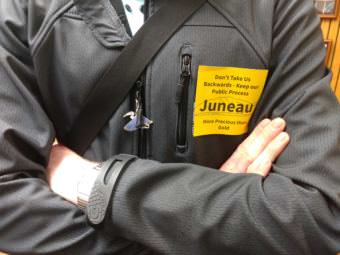
Yet about 30 people turned up at Monday night’s Juneau Assembly committee meeting. Many wore yellow stickers to express their opposition to scaling back the city’s mining ordinance.
Residents against changing the city’s mining ordinance wore yellow stickers to express their opposition at the June 12 Juneau Assembly meeting. (Photo by Jacob Resneck/KTOO)
Assemblywoman Debbie White pushed back saying mining jobs are more important than the concerns of green groups.
“I feel that this Assembly needs to grow a backbone and stop caving in to people who think they are going to force mob rule on this group,” White said. “I believe that we need to start listening to people that are going to make jobs instead of break jobs, because right now the pressure we are getting is not necessarily from the majority — they’re just better organized.”
A group of five businessmen, some with ties to previous mining efforts, originally brought the initiative to the Assembly. They argue the existing ordinance duplicates state and federal review and makes Juneau less attractive to mining companies looking to invest.
But City Manager Rorie Watt counseled the Assembly to take a go-slow approach that would include more public participation and all nine members. His advice went unheeded.
Instead, Mayor Ken Koelsch proposed he appoint a three-member subcommittee, “and that three-member subcommittee be charged with what actions should be taken on the proposed mining ordinance.”
Assemblyman Jesse Kiehl pushed back.
“It appears that the three-member committee is both supposed to recommend the final action and recommend the process to take people to the final action and whether it should be a three-member committee at all,” Kiehl said. “That doesn’t make a lot of sense to me.”
But with skepticism from only two other Assembly members, Loren Jones and Maria Gladziszewski, Kiehl was overruled.
It’s not entirely clear why the Assembly is looking at the mining ordinance now. It’s historically been a divisive issue in Juneau. The most obvious motive would be to reopen the AJ gold mine which has been idle since 1944.
Others have speculated that there’s interest in other parts of the borough. Assemblywoman Beth Weldon, who brought the mining proposal to the Assembly, said as much at Monday’s meeting.
“We’re more likely to have mining out the road at Herbert (River) or Peterson (River) right now than we are at AJ. No one’s even looking at AJ right now. People are looking out the road, though,” Weldon said.
The Southeast Alaska Conservation Council has been organizing opposition to changing the mining ordinance. After the meeting, the group’s mine specialist Guy Archibald said he was disappointed with the Assembly majority.
“I think the more they try to fast-track the process the more divisive it’s going to be. Now we have the mayor and the city manager not even agreeing,” Archibald said. “This is going to be a long, resource-intensive process and that’s not what we needed here. And that’s not what any mining company wants to see, either.”
The mayor said he’d name the three-member mining subcommittee at the June 26 meeting. In the meantime he invited any of the other eight Assembly members interested to apply to him directly.
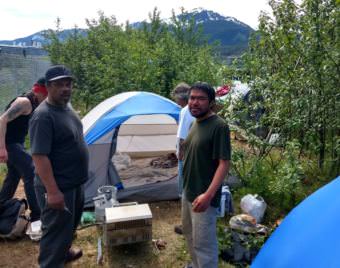
Campers gather near a small group of tents about noon Thursday near the 300 block of Egan Drive in Juneau. (Photo by Tripp J Crouse/KTOO)
A tent village has sprang up near the abandoned subport in recent weeks. Juneau continues to struggle with a housing and homelessness crisis that’s culminated in a new community on the edge of downtown.
In the encampment, there’s steak grilling on a propane stove. Tents began appearing in this wooded area about three weeks ago.
“I set up mine and then I woke up and there were three or four next to me. They followed, it just kind of came in waves,” said Kevin Howard, 44.
He looks around and sees community among the cluster of tents.
“Everybody here looks after each other and nobody does nothing to nobody. … (We) make sure everybody’s OK in the morning. Need something to eat? Need some water? We look after each other here.”
Juneau has been wrestling with a rising homeless population. Responding to complaints from downtown merchants, the Juneau Assembly passed an ordinance this winter banning camping on private property in the downtown core.
Kevin Howard and his friend David Waits recall officers telling homeless people in the park, “You guys get your s— out of here or otherwise it’s going in the trash,” Howard recalled.
“Somebody got a ticket, too,” Waits said. “We were like, ‘Aw, dude you can come down here and hang with us. We got our, you know, set up.’”
Howard added: “They threw everybody out of the doorways and threw everybody out of the park and now we’re all down here.”
Lorenzo Jefferson, left, and Kevin Howard grill steak on a propane stove in an encampment near the former subport off Egan Drive on June 6, 2017. (Photo by Jacob Resneck/KTOO)
Critics of the anti-camping ordinance had warned that a crackdown would just move the problem around.
“What happened is what we’ve seen happen in other communities that have similar ordinances is they’re displacing homeless individuals,” said Brian Wilson, executive director of the Alaska Coalition on Housing and Homelessness. “If we displace these individuals again, I’m not really sure where they’re going to go.”
The city of Juneau is coming around to this reality. City Manager Rorie Watt said a new Assembly-appointed task force is looking for a new strategy.
“People genuinely don’t have somewhere to go,” Watt said. “So if people got trespassed repeatedly they would be moving around. And if a situation is quiet and not causing issues that likely could be better than a lot of alternatives if those people got moved along.”
Juneau police won’t move on the camp without a trespassing complaint from the landowner. In this case that’s the Alaska Mental Health Trust Authority.
Wyn Menefee, deputy director of the trust’s land office, said the waterfront acreage is in the process of being sold to private developers. But for now there’s no plan to try and move the camp.
“If it were to get into a situation where it started in hindering the ability to make revenue off of the trust, we may have to do something further about it,” Menefee said. “But right now it hasn’t stopped us from doing what we intend to do with the parcel.”
About half of Juneau’s homeless population report suffering from mental illness. That’s according to a spring survey conducted by social workers who canvassed the community.
Brian Wilson said of the 96 unsheltered people that social workers interviewed, 45 people self-reported mental health issues or concerns.
“That’s typically an under-reported number as well,” Wilson said.
The irony of the mentally ill trespassing on Mental Health Trust Authority land is not lost on the organization.
“We’re actively engaged in the community on a number of different levels and probably target this population in one way or the other,” said Steve Williams, the authority’s chief of operations.
“The folks that we’re seeing down at the camp are candidates for Housing First interventions,” Brian Wilson said, “but at the current state of our capacity, we don’t have that here locally. We need a lot more units.”
The city and the trust authority have received at least one complaint from the public concerned about health and sanitation. That will inevitably be an issue if the camp remains here long term.
David Waits said there’s a sense of pride about making the best out of what little you have.
“It doesn’t matter how much money you make or how much you have or anything else,” Waits said. “We’re all common people. I’m a Lakota Sioux Indian and we believe everybody’s related. Nobody’s higher or lower than the next person.”
So with few options available for Juneau’s homeless population, it appears a cluster of tents on the edge of town has become the status quo.
Editor’s note: KTOO’s building sits on land leased from the Alaska Mental Health Trust Authority. KTOO has also applied for and received occasional grants for special reporting projects from the authority.
The Juneau Assembly adopted a budget Monday without closing any facilities or laying off any staff. The $335 million budget taps into more than $800,000 in savings, imposes cost-cutting across city departments and repays debt at a slower pace.
The city will still have more than $10.5 million in its reserves.
But two vacant city staff positions will remain unfilled to cut costs, a city planner and a community service officer for the Mendenhall Valley area.
Alaska Fish & Game wildlife biologist Stephanie Sell appealed to the Assembly not to cut the community service officer because of its role in keeping household garbage from attracting bears.
“I realize that the city faces a lot of budgeting decisions that are very difficult but I’m concerned that the remaining four CSOs will struggle to maintain the level of service they currently provide,” she said. “Particularly their role in education and enforcement of the CBJ bear nuisance attractants law which I’ve been informed will be cut to compensate for the loss of this staff.”
The budget was adopted unanimously without funding the CSO position.
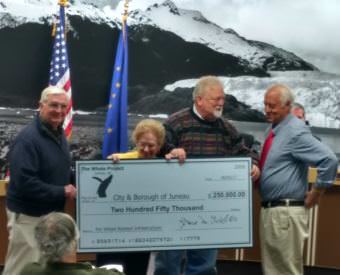
Whale Committee members Jim Clark, left, Jean Overstreet and Bruce Botelho present an oversize check for $250,000 to Mayor Ken Koelsch to help fund the infrastructure for the whale statue at the June 5, 2017 meeting of the Juneau Assembly. (Photo by Jacob Resneck/KTOO)
Former Mayor Bruce Botelho presented the Assembly with an oversized check alongside fellow committee members Jean Overstreet and Jim Clark.
“We believe that this whale sculpture and the park will be an enduring monument to Alaska’s 50th anniversary for statehood and will become a great symbol,” Botelho said.
“I know they have the tailgate parties and all that but tailgate parties are outside where it’s cold and miserable,” Becker said. “And inside the lodge where it’s nice and warm and lovely, drinking will be more appealing and I think that it will cause more drinking.”
Under the terms of the ordinance no hard liquor will be sold. Beer, wine and cider will be allowed at special events and by approved vendors. Eaglecrest board members pitched the alcohol sales as a way to raise revenue for the city-owned ski area.
This week the airport’s board approved a draft fee schedule that would charge companies like Uber and Lyft $100 a year to operate on airport property.
It would also tack on a $3 surcharge on each fare to and from the airport that the airport manager said is industry standard.
“We want to meet the demand, we know it’s imminent,” Airport Manager Patty Wahto said. “We have to have something in place. And we’ll look for comments and see if there’s changes that have to be made.”
The ride surcharge is a departure from how taxis are charged now. Conventional cabs pay at least $150 a year per vehicle. But there’s no ride fee.
So what do Juneau’s cab companies think about tacking on a ride fee for Uber and Lyft?
“That’s hogwash. If that’s the basis of it then they should charge the tour companies, the shuttle companies and everybody else the same fee,” said Shane Williams, owner of EverGreen Taxi, Capital Cab and Taku Taxi. He’s against the ride surcharge on principle. “There is no return to the airport other than a sticker that they basically give to you to permit you to drop and to pick up at the airport. Why go after Uber and Lyft? They’re not going to make anymore money than the cabs – in fact Uber and Lyft charge less.”
Uber released a statement Friday after being asked for comment.
“We are looking forward to finalizing an agreement with the Juneau airport, which will bring ridesharing services to people traveling to and from Juneau,” said Brian Gebhart, Uber’s general manager for Alaska, in the statement.
It’s unclear whether Lyft would protest the fee schedule though it did send the airport business office a template that would include a surcharge for rides.
Wahto said the airport board also is reviewing how it regulates all forms of grounds transport servicing the airport.
“Whether it’s limos, whether it’s shuttles, whether it’s taxis and cabs – and the idea is to collect data for about a year and then go back and see if we need to adjust or make changes to other ground transportation,” she said.
Public comment is open through June 21. Then the fee schedule will be sent to the Juneau Assembly for consideration.
Clarification: This article has been changed to note that Lyft has not taken a position on the proposed fee schedule.
Close
Update notification options
Subscribe to notifications
Subscribe
Get notifications about news related to the topics you care about. You can unsubscribe anytime.