In this newscast:
- University of Alaska’s president reacts to Legislature’s $8 million cut
- Two dozen of Wrangell’s unionized municipal workers strike over pay raise
- 360 North’s documentary Inside Out: Leaving Prison Behind premiers tonight at 8 p.m.
Jacob Resneck is CoastAlaska's regional news director based in Juneau. CoastAlaska is our partner in Southeast Alaska. KTOO collaborates with partners across the state to cover important news and to share stories with our audiences.
In this newscast:

A 62-year-old Juneau woman has received one of the nation’s top awards recognizing traditional folk art.
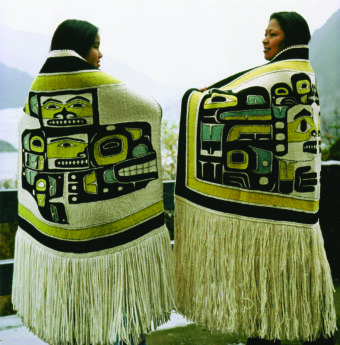
Chilkat weaver Anna Brown Ehlers is one of nine fellows named this week by the National Endowment for the Arts.
The NEA’s director of folk and traditional arts Clifford Murphy said this year’s National Heritage Fellowship artists are a diverse lot.
“If you look at this class of fellows you have Anna Brown Ehlers, who’s a Chilkat weaver; you have Phil Wiggins, who’s a blues harmonica player from the metro Washington, D.C., area; and then you have everything in between: craft, dance, music – it’s pretty extraordinary,” Murphy said.
Chilkat weaving is an indigenous art form practiced by coastal people in Southeast Alaska and British Columbia.
Traditionally, mountain goat wool is woven on a loom and blended with thin strips of cedar bark to create elaborately patterned blankets.
“One thing that is just stunningly beautiful about it is that to see something like this outside in the natural environment,” Murphy said. “It’s like the colors are utterly complementary to the landscape. These are the colors that you see in your trees and in your waterways and on the mountainside. It’s really quite striking.”
Anna Brown Ehlers was born and raised in Juneau. Her Tlingit ancestors come from the village of Klukwan.
“The designs on the Chilkat blanket represent our clans,” Ehlers said. “The designs say who you are and by knowing that, I’m from the Whale House, people know where you’re from. And it’s not an ownership of the land, it’s our identity.”
She said the art seemed to come easy for her when she started in the early 1980s.
“It was as if I’d always done it, it was kind of like deja vu,” she said. “I’m really happy to be included in this group and I’m really satisfied that us Chilkat Tlingit Indians are included.”

One of the challenges she said is gathering the traditional materials needed. Her children have helped her since they were old enough to use a knife, she said.
“We prepare the materials in the springtime and whenever mountain goat hunters call me and ask me to meet them at the ferry terminal or they send me a hide on a plane, my children and friends and relatives of mine, all show up and work the mountain goat together,” Ehlers said. “It’s not a fun job, that part I can tell you – but it’s a necessity!”
She spoke of one of her latest works: an 8-foot-by-7-foot blanket with the design of a newborn orca.
“When I finished that one, I did some research on the baby killer whales and when they’re born, they’re 7 feet long and they weigh 400 pounds,” she said. “That weaving, the killer whale was exactly 7-feet wide. So it’s a life-size killer whale.”
Ehlers and the other eight National Heritage Fellows will receive $25,000 and be honored at a September awards ceremony in Washington, D.C.

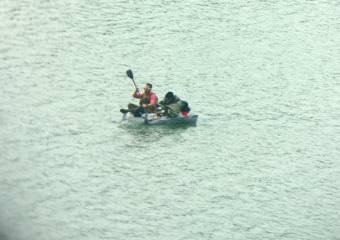
As KTOO reported, the Coast Guard pulled a man, his dog and a makeshift raft out of Gastineau Channel on June 7. As is usually the case, there’s always more to the story.
Coast Guard Lt. Joey Schlosser was standing in his kitchen on his day off.
He has a nice view of Gastineau Channel and it was a beautiful sunny day.
“I was making breakfast and noticed something coming down Gastineau Channel,” Schlosser said in an interview. “I grabbed a pair of binoculars that I have there in the family room. And it looked like a kayak at first – I was like, ‘I don’t know what the hell that is.'”
As he got a better view he decided he’d better call the office.
“This is gonna be kind of a funny phone call,” Schlosser told the duty officer in a 3-minute recording released to KTOO. “So I’m home and I’ve got a guy going by my house on Gastineau Channel on what looks like a makeshift float out of duct tape and god knows what else … I can’t see a visible life jacket and he’s a got a dog on this thing.”
His concern was for Brandt Smith, 32, and his black dog Sam.
“He’s paddling away right now but this thing is janky as hell,” Schlosser said. “So I figured I’d just give you guys a heads up because this probably doesn’t look like it’s going to end well for this guy.”
A few days later Smith and his black dog Sam visited KTOO’s studio to explain himself.
“My original plan was to get somewhere kind of off-the-beaten path and build like a log barge that I could pull behind me on low tide so I could walk along the shoreline,” Smith said in an interview. “And then I was at Fred Meyer picking up some last-minute supplies and they had this sale for these small, little inflatable rafts. They were only like $22 bucks and so I decided to go ahead and buy that.”
What Schlosser saw from his kitchen window concerned him.

“I’m a search-and-rescue controller here in Juneau so I’m looking at something that just doesn’t look inherently safe,” Schlosser told KTOO. “What kind of set my sensors off is when a barge went by and once the wake caught up to him he got waked out pretty good. And that’s when I was like OK, we have some issues here.”
“I was trying to get down a little past Snettisham,” Smith said of the fjord about 30 miles south of Juneau. “I mean, I was gonna try and modify the little inflatable raft as I went. Because it was going to take me a few days, maybe even a week to get down there with the raft. But that kind of didn’t really pan out.”
The Coast Guard launched a 25-foot lifeboat at about 2 p.m.
“When I saw the orange bowed Coast Guard thing I was like ‘Aw, crap,'” Smith recalled. “They were trying their best to figure out ways to try and tow me down there – they really tried.”
Both sides report the interaction to be positive.
“They’re always going to try and give the mariner the benefit of the doubt,” Schlosser said. “Up here in Alaska when someone’s trying to go somewhere that’s pretty far out and visually you’re taking a look around and you don’t see proper safety equipment, that’s where we tend to intervene.”
The Coast Guard crew loaded Smith, Sam the dog and the makeshift raft into their boat and took them across the channel to Douglas harbor.
In a wide-ranging interview, Smith explained he’s in Alaska to establish a homestead even though he knows it’s no longer legal.
“I was planning on going out there and kind of just making myself a little kind of home-away-from-home area where I could grow some food and maybe have some little inconspicuous house or something and be there for a little bit,” Smith explained.
He used to live and work in Juneau.
“I used to be a helicopter mechanic. Actually I used to work here for Coastal Helicopters – that was four years ago, almost five,” he said.
Coastal Helicopters’ management confirmed this.
“I kinda got burnt out on working on helicopters, got burnt out on pretty much everything,” Smith said. “I kind of saw the world as a bleak side of life where all you’re doing is paying to live.”
He’s since set up camp outside of town and says he’s already got his cold weather crops in the ground. His goal is self-reliance, he said.
“Hopefully if I keep myself quiet enough and not make a nuisance of myself, hopefully where I’m at, I can be left alone,” Smith said. “I mean, it’s not a permanent thing and I’m fairly discreet – but I just don’t want to become another homeless person in the city of Juneau because there’s only two ways out of this friggin’ town: one by air and one by boat.”
He’s already tried the boat.

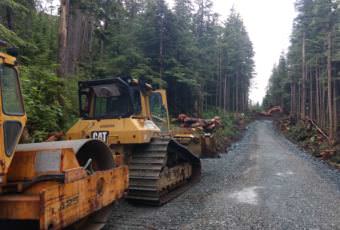
Work is nearing completion of a gravel road extending toward the west side of Douglas Island. The City and Borough of Juneau is spending $3 million in grant funding to punch out a so-called pioneer road on city property for future development.
We’ve crossed the gate and made our way up a steep grade on the gravel road.
“West Douglas has identified for many decades as a future growth area for Juneau,” said Roger Healy, the city’s director of Engineering and Public Works, from behind the wheel. “So this is basically the first step in this direction.”
On paper this area is called West Douglas. The city’s identified this area as a potential community hub in a conceptual plan drafted in 1997.
There are three major landholders here: The city’s 3,400 acres. The steep, mountainous parts are part of Tongass National Forest. The more valuable coastland is held by Goldbelt, Juneau’s urban Native corporation.
Goldbelt holds more than 1,700 acres along the coast and has expressed interest in building a port and developing the far-side of the island. It’s a significant step, and largely symbolic as the road will be gated off and closed to motorized traffic.
“We’re not going to build it to full city standards now with pavement and two-lane traffic and all that,” Healy said. “And that will come some point later when firm development is identified in this area.”
In about 2 miles, we run out of road. Heavy equipment is clearing felled trunks from giant Sitka spruce. The choicest timber will be sold off by Enco Alaska, the Juneau-based contractor selected by the city to build this road.
“What you’re seeing now is about the end of it,” Healy said. “There’s another ¼ mile maybe of new pioneer road going to be established but that’s about it for the first phase.”
Coastal access would have to cross Goldbelt’s land. There have been development proposals over the years including an 18-hole golf course but that project fell through when investors pulled out in 2010. The absence of firm development plans has led critics to question the wisdom of building this road at all.
“I guess you could call it a hiking path for people right now,” said Phillip Gray, a retired fisheries biologist. “But it doesn’t go anywhere. It just goes part way to where they want to go and it ends.”
The city has relied on nearly $3 million that began as a federal dredging grant. It was later transferred to the state’s commerce department. In 2012 the state agency green-lit the city’s request to use the money for building this road.
Gray said it seems like the city’s building a road through wilderness just to keep from having to return the grant money.
“I mean why would you put a road – if you were a businessman – would you put a road into somewhere that didn’t end where you wanted to go just because you had part of the money?” Gray said by phone from his home in North Douglas where he’s lived for about 40 years. “That’s sort of like building part of a house without having money to complete it just because you got some money to blow. Then ruin some good habitat – deer habitat to boot.”

Construction is expected to wrap up by the end of summer. A second phase is under review by the U.S. Army Corps of Engineers. Healy said that would get it another mile, yet still shy of Goldbelt’s coastal holdings. “We may extend another 6,000 feet beyond the current end of this phase to get to the Middle Creek area,” Healy said.
Since it’ll be closed to motorized traffic, even upon completion this pioneer road will likely serve mountain bikers and hunters. It doesn’t connect to Douglas Island’s existing trail system. But it does provide more than 2 miles of access into what was until recently just wild stands of towering spruce and hemlock.
In this newscast:

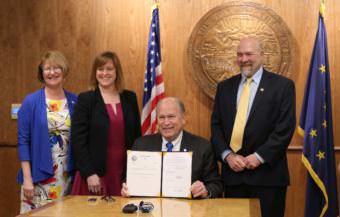
Gov. Bill Walker signed legislation Thursday paving way for ride-share companies, such as Uber and Lyft, to operate in Alaska.
The companies dispatch private cars to act as taxis via smartphone app. Passengers are billed electronically and private drivers receive a portion of the fare.
But the new state law signed by the governor precludes local governments from regulating the ride-share companies except by ballot measure.
And that’s led to opposition from cities – including Juneau, whose manager had urged the governor not to sign the bill.
But now that it’s law the city will try to iron out issues directly with the companies.
Deputy City Manager Mila Cosgrove said there are concerns.
“Particularly in the cruise ship area,” she said. “I think we’ll try to work with them to come up with an agreement that will best serve the needs of that particular area”
The Alaska Municipal League, which represents local governments, also lobbied against the bill.
“The issue is not them coming into town,” Executive Director Kathie Wasserman said. “The issue is them coming into town and having the Legislature exempt them from any municipal or local government ordinance. That we have a problem with. We should all be lucky enough to come into a town and say, ‘Yeah, I don’t feel like playing by those rules.’ And so we get exempted? I mean, that’s just not the way things work.”
A delegation from the San Francisco-based Uber recently met with city officials in Juneau to discuss concerns about congestion around cruise ship ports and the city-run airport.
The company says it plans to begin service in Juneau on Monday.
Uber’s competitor, Lyft also is talking to officials in Juneau.
“You know we’re constantly looking to work with city officials to make sure that we’re operating in a way that’s helpful to the city,” Lyft spokesman Scott Coriell said. “We also want to make sure that people have access to our service and are able to get to where they need to go.”
Juneau’s airport board recently proposed imposing a $3 surcharge on all pickups and drop-offs at the passenger terminal.
But it’s unclear whether that would be enforceable under state law.