Jacob Resneck, CoastAlaska

Jacob Resneck is CoastAlaska's regional news director based in Juneau. CoastAlaska is our partner in Southeast Alaska. KTOO collaborates with partners across the state to cover important news and to share stories with our audiences.

Why’d they put the whale way over there?

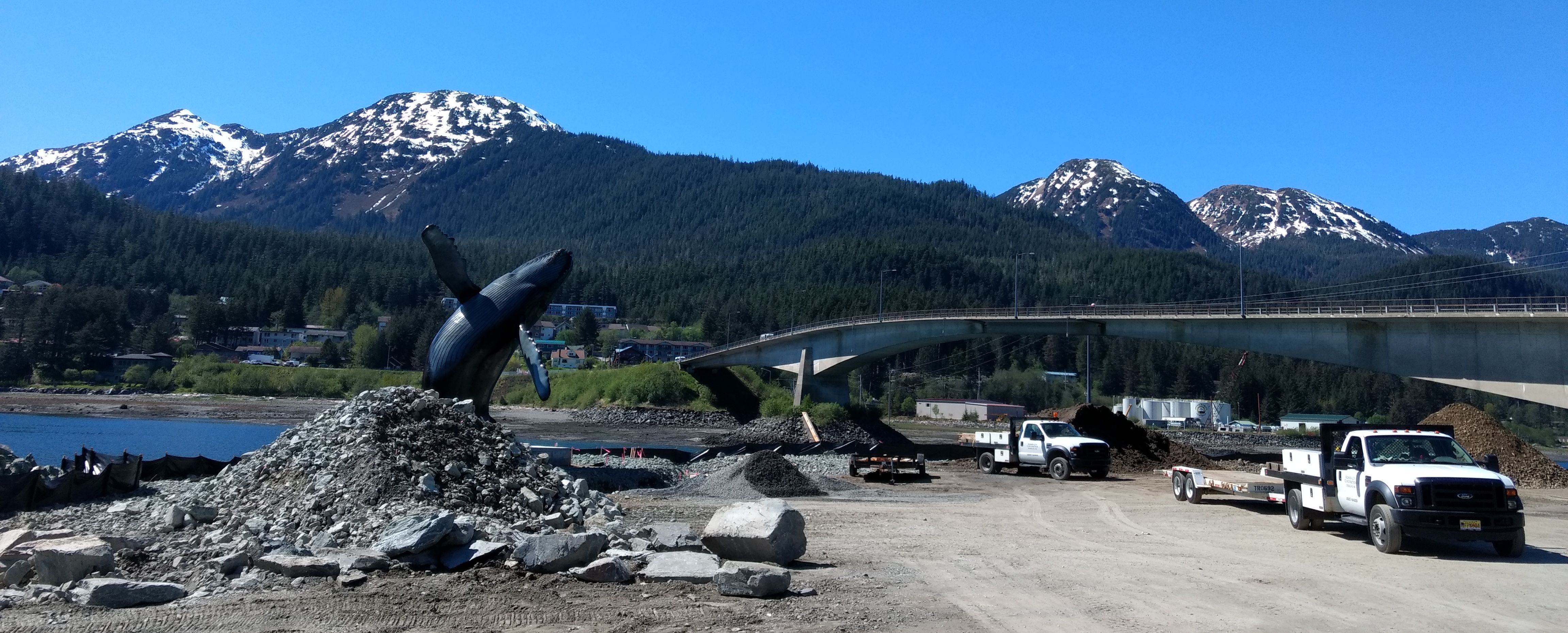
Work continues on the Juneau's Whale Park on May 16, 2017. (Photo by Jacob Resneck/KTOO)
Work continues on the Juneau’s bridge park on May 16, 2017. (Photo by Jacob Resneck/KTOO)

Aaron Woodrow is a commercial fisherman in Juneau. Often he can be found selling fresh seafood off the side of his 38-foot boat in Harris Harbor.

“I drive up and down the channel a lot fishing and so I see the whale as I go by and when I’m coming in, you can’t really see it with the naked eye until you’re just about to it,” Woodrow said.

Which led the mariner to wonder why the city chose to put the new bronze whale sculpture in a location that only seems visible from the Douglas Bridge or the Breeze Inn parking lot in West Juneau.

“I think most people seem to think it was going to go up on the island that was being constructed where it would’ve been visible from the highway. Unless you have binoculars coming up the channel, you wouldn’t even know it was there.”


Curious Juneau stars you and your questions. Every episode we help you find an answer. Catch up on past episodes, or ask your own question on the Curious Juneau page.

Listen to the podcast version here:

To try and answer Mr. Woodrow’s question I paid a visit to the city’s engineering department.

“Well, there’s always a lot of questions and obviously how it ended up there was a long process,” said Skye Stekoll, a city engineer.

The original whale committee had proposed the sculpture to be downtown in Marine Park. But the whale park isn’t just a 6-ton piece of bronze that towers 25 feet skyward. There will also be a pool of water around it.

So engineers pushed back.

“One of the problems we came to when we tried to look at the downtown area like Marine Park is you know, the size of the whale – sure if it was just the whale by itself it could fit in – but with the pool infrastructure it became large enough that essentially it’d be the entire Marine Park and it wouldn’t have a lot of usable space,” Stekoll said.

So how about down near where the cruise ships dock?

“Those areas are already dominated by seasonal tourism and that would not be good location for Juneau citizens,” said City Manager Rorie Watt, who headed the engineering department back then.

A whale park could get cluttered amid T-shirt shops. The whale committee looked further north.

“The other areas on the waterfront are controlled by the Mental Health Trust, so we didn’t control the land, or they are city tidelands that are not filled and would take a long time to develop,” Watt said. “The bridge park really was the best location.”

And the artificial island? There are no utilities out there. Running power and water out there would get expensive. Not to mention it would need more permits from the U.S. Army Corps of Engineers.

It turns out there isn’t as much free space on Juneau’s waterfront as one might imagine.

Artist R.T. “Skip” Wallen is the guy who sculpted the whale.

“I think it’s a good site. … This sculpture requires some room. Because it’s so tall,” Wallen said, speaking from his studio in Florida. “It requires space enough around it so that people can get back a bit from it. So it can’t really be shoehorned into a small space.”

Then there’s another consideration: lighting.

“Because the sun arcs over Douglas Island, items on the waterfront tend to be backlighted,” Wallen said. “In its current site in the early morning and again in the late afternoon, the whale gets some light on its front face – the side that most people will be viewing.”

The city is being sued by the cruise ship industry over its use of marine passenger fees for the seawalk and whale park. That’s still playing out in federal court.

The whale park site is still mostly a muddy building site. Work is progressing slowly around the solitary humpback whale sculpture.

Portions of the seawalk should be opening in coming weeks, though the whole park with its elaborate water features won’t be ready until next spring.

No public funds went into the whale sculpture – it was paid for through donations.

There is sales tax and marine passenger fee money going into the infrastructure around it, so Juneau taxpayers and cruise ship passengers are paying for much of the project.

I press Aaron Woodrow a bit to see if he’s just a whale hater.

“But you do like the sculpture itself, though?” I asked.

“I think the whale sculpture is awesome,” Woodrow said. “I don’t think anyone would deny that it’s a pretty amazing piece of art. But I think they could’ve chosen a better location for it.”

The city’s staff is appealing for patience for when it’s finally done.

“I think when we’re finished, people are really going to enjoy it and they’ll forget there ever was a controversy,” Watt said.

Optimistic talk from a city manager. We’ll check back in a year’s time.
NTSB investigating helicopter crash on Herbert Glacier

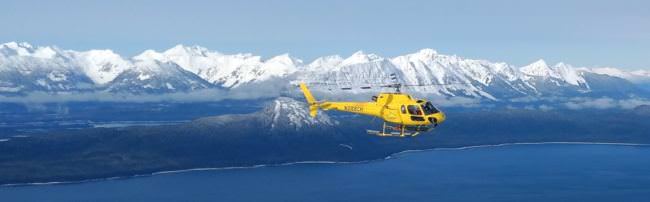
A May 22 crash involved an Airbus AStar 350 similar to this one flown by Coastal Helicopters of Juneau. (File photo by Jacob Resneck)

The National Transportation Safety Board is investigating how and why a Juneau-bound helicopter ferrying tourists crashed during a glacier excursion.

The pilot and six tourists were treated and released at Juneau’s hospital with minor injuries.

Coastal Helicopters released a statement that its helicopter was returning about 6 p.m. Monday to Juneau when it ran into trouble on Herbert Glacier.

The NTSB says that the AStar helicopter sustained major damage and was disabled.

“My understanding is a second Coastal Helicopter was able to reach the site and were able to get the folks off of the glacier before nightfall,”said Clint Johnson, NTSB’s regional aviation chief in Anchorage.

The Juneau-based charter company still is trying to retrieve its aircraft, he said.

Coastal Helicopters operates out of Juneau International Airport and regularly ferries tourists to the ice fields about 20 miles north of Juneau.

What we understand is that this helicopter was operating in connection with a dog sledding excursion on the Herbert Glacier or in that area,” Johnson said. “We’re working very closely with Coastal Helicopters at this point right now to find out exactly what the circumstances were that led up to this accident and also what the extent of the injuries – if any.”

No names have been released. Investigators say the company is fully cooperating with the NTSB.

Regulators to hold hearing in Juneau over garbage contract transfer

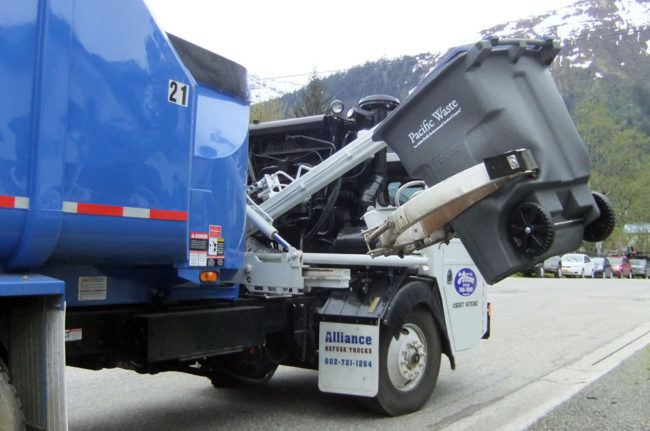
An Arrow Refuse truck demonstrates its automated roll-cart system in 2012. Waste Connections Inc. has purchased the company and is petitioning the state regulator to take over service in Juneau. (File photo by Heather Bryant/KTOO).

Juneau residents will have a rare opportunity this week to sound off over trash service.

The company that runs curbside pick up has been acquired by Waste Connections, a Canada-based business with customers in 39 states and five provinces.

But the new company still needs approval from the Regulatory Commission of Alaska to take over trash collection in Juneau.

This is an opportunity for consumers to bring any concerns they might have before the RCA commissioners,” said Grace Salazar, head of the commission’s consumer protection office in Anchorage.

The city manager’s office wrote a letter in March outlining its concerns about trash pickup and requesting the state commission consider ceding more local control over community trash service.

I think this hearing is at a point in time where the company’s really going to be listening to the community,” said Michele Elfers, who runs the city’s recycling program. “They will be in the same room, look face to face at people and recognize that we’re a community with concerns and needs. I think that it’s an important time to make comment and it potentially could be more powerful.”

The public hearing will be held from 5:30-7 p.m. Thursday, May 25, in the Assembly chambers.

Juneau Assembly forms task force on homelessness

Facing criticism to its handling of the community’s growing homelessness population, the Juneau Assembly has formed a task force on homelessness.

Juneau has the third largest homeless population in the state – after Anchorage and Fairbanks.

After fielding complaints from merchants, the Assembly banned sleeping overnight on private property in the downtown core. But many campers have since moved into downtown parks.

I don’t find myself being able to tell you that we are organized to proactively make decisions,” City Manager Rorie Watt told the Assembly on Monday. “I think we need to figure out how not to be in react mode.

He pointed to a Monday letter from the Juneau Coalition on Housing and Homelessness that questioned the city’s wisdom of ordering police to crackdown on sleepers in the city’s Marine Park. The coalition’s letter closed with an appeal to work closer with the city.

Assembly member Maria Gladziszewski agreed that the status quo isn’t working.

“We are, exactly as the manager said, doing something and then people get mad and then we do something else and then other people get mad,” she said.

The committee moved unanimously to form a three-member taskforce with Gladziszewski and fellow Assembly members Norton Gregory and Debbie White.

The task force will work with the city manager, housing officer and members of the Juneau Coalition on Housing and Homelessness and report back its findings at a future meeting.

Mining boosters, environmentalists dig in over Juneau’s mining regulations

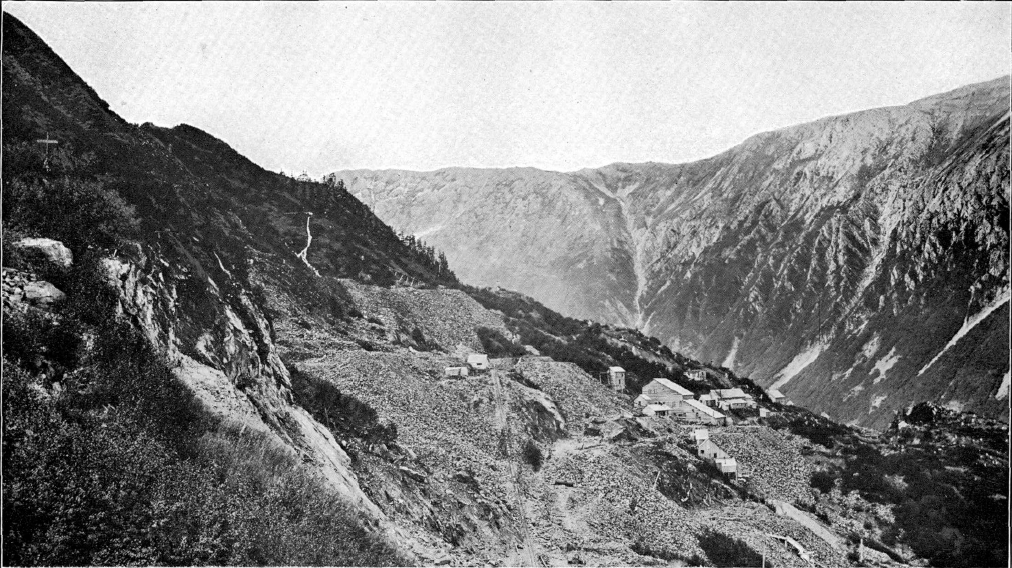
This public domain photo shows the Alaska Juneau Gold Mine and Mill along Gold Creek. (Photo by Arthur C. Spencer, USGS Bulletin 287, The Juneau Gold Belt, Alaska, via Wikimedia Commons)This public domain photo shows the Alaska Juneau Gold Mine and Mill along Gold Creek. (Photo by Arthur C. Spencer, USGS Bulletin 287, The Juneau Gold Belt, Alaska, via Wikimedia Commons)
This photo from a 1906 U.S. Geological Survey bulletin shows the Alaska-Juneau Gold Mine and Mill along Gold Creek. (Public domain photo by Arthur C. Spencer/USGS)

Juneau should revisit mining as a future economic engine. That’s the pitch making the rounds by a group of well-connected businessmen and former political operatives. But their proposal to streamline the city’s mining review process has environmentalists on guard.

Bill Corbus is the former owner of Alaska Electric Light and Power Company, which co-owns the former Alaska-Juneau Mine property. He told a packed chamber of commerce luncheon that there’s nothing to announce.

“There is absolutely nothing going on that I’m aware of as far as a proposal to reopen the A-J Mine or any new mine,” Corbus said.

Why the disclaimer? Any plan to restart gold mining would be controversial.

Before it closed in 1944, the Alaska-Juneau Mine was among the largest of its kind. There have been plans to reopen the A-J in the past. In the mid-1980s Echo Bay Mines invested $100 million to restart mining here.

It didn’t end well.

MACC's Bill Corbus and Jim Clark
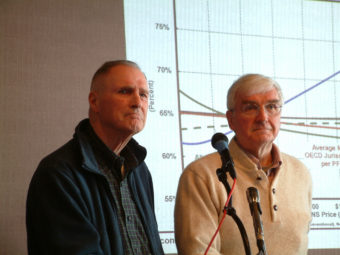
Bill Corbus, left, and Jim Clark are among the group of mining boosters that want the city’s mining regulations streamlined. (File photo by Matt Miller/KTOO News)

In 1994, there was a mass fish die-off in Gold Creek. There were lawsuits. A federal investigation found that the company allowed oil, grease and even sewage to leach into the watershed.

No charges were filed. But Echo Bay paid a $250,000 fine to the state. The price of gold then dropped, and the Canadian company pulled out in 1997.

Frank Bergstrom was Echo Bay’s environmental compliance officer. Today he’s the treasurer of a pro-business group called First Things First Alaska Foundation. He argues that the mining sector could help reverse economic decline in the capital city, which lost at least 300 jobs in the past year.

“What we have is an opportunity, we want to sell that opportunity and the Juneau government has an asset,” Bergstrom said in an interview. “It’s incumbent on the government of Juneau to see that asset developed for the benefit of the citizens. Yep, there’s gold in the ground. How much? Someone’s got to come and look.”

Bergstrom helped write a revised ordinance to make Juneau more mine friendly by cutting the existing mining ordinance from 17 pages to a lean 3 1/2.

“I looked at from the point of view of layers that took out process but didn’t change the environmental requirements,” said Jim Clark, a Juneau attorney and former chief of staff for Gov. Frank Murkowski. “What we’re primarily taking out of here is a CBJ staff review of whether the state and federal regulators properly issued the federal and state permits.”

The Southeast Alaska Conservation Council held a bonfire at the Auke Rec Picnic Site to discuss the pro-mining initiative. The group says it’s concerned the ordinance would undercut local authority and remove the required socioeconomic impact study for new mines.

“This isn’t about being for or against mining. It’s about wanting to make sure that anything we do is smart,” said Buck Lindekugel, the group’s staff attorney. “The proposal that’s gone forward has been — in my opinion — to put the borough’s arm behind its back. Not give it all the tools it needs to make a good decision for the Assembly for the planning commission — whoever makes the decision.”

Support for revising the mining ordinance has been received warmly by some members of the Juneau Assembly. But a motion to forward it to the planning commission failed. It’s scheduled to resurface at the Assembly’s June 12 meeting.

Site notifications
Update notification options
Subscribe to notifications