Jake Steinberg, KTOO

Invasive grass is taking over the Brotherhood Bridge meadow. This biologist is trying to save it.

Fireweed blooms in a field near the Brotherhood Bridge in Juneau on July 19, 2018. (Photo by David Purdy/KTOO)

John Hudson is waging a war against a silent invader.

After trooping through a dense and soggy wetland Wednesday, he arrived at the front line where an invading army of reed canarygrass is marching steadily forward. The tall grass is common in the Lower 48, but it’s relatively new to coastal Alaska. And it’s making its presence known.

“There are a few native plants here and there but they’re not long for this world because they’ll succumb to that reed canarygrass,” he said.

Hudson is a biologist for the Southeast Alaska Watershed Coalition. A few years ago, he discovered what he calls the “megapatch,” a vast swath of canarygrass slowly advancing across the Brotherhood Bridge meadow.

The “megapatch” of reed canarygrass in the Brotherhood Bridge meadow on Thursday. Note the lack of other plants. (Photo by Jake Steinberg/KTOO)

Most people wouldn’t notice a wetland under siege by reed canarygrass. It’s superficially similar to native grasses, but it can quickly transform an ecosystem.

“The worry here is that it’ll expand and take over all this habitat and we’ll lose a wonderful meadow that Juneau people enjoy,” he said.

The image of the Mendenhall Glacier behind a field of violet fireweed is ubiquitous in Juneau. In downtown shops, you can find it on postcards, coffee mugs, calendars—even the Alaskan Fudge Company put it on their box.

But its value isn’t just aesthetic. Meadows are rare in tree-covered Southeast Alaska. That means they provide unique habitat for plants like cow parsnip and nagoonberry.

Those native meadow plants provide food for insects, which in turn provide food for birds and small mammals. But reed canarygrass leaves little room for other plants. It conquers meadows and leaves them sterile. Hudson said it’s like replacing a forest with a parking lot.

“And so we’ll lose that complex habitat that we had and all those animals that depend on it over time,” he said.

Native plants just can’t compete. The canarygrass grows tall, blocking out the sun. It’s roots are voracious and crowd out other plants. It reproduces quickly and when it dies, it leaves behind a thick thatch that forms a barrier against other plants. Hudson said the grass’s resilience isn’t accidental.

“This plant is not playing by the normal ecological rules,” he said. “It doesn’t have a lot of competitors and it’s been actually modified by humans through plant breeding to be superior to other plants.”

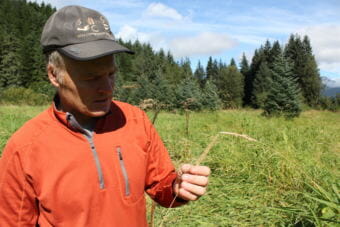
Biologist John Hudson holds a strand of reed canarygrass in the meadow on Thursday. (Photo by Jake Steinberg/KTOO)

For centuries, people have used its roots for food and turned its long, coarse stems into hay. Even its leaves have been cultivated. They contain a psychoactive chemical that can be used to make ayahausca.

Roadbuilders used to plant reed canarygrass along highways to prevent erosion. Hudson thinks that’s how it got to Juneau.

But Hudson has found a way to fight back. He’s exploiting one of the plant’s strengths as a weakness. He said reed canarygrass is the first plant to sprout in the spring and the last to go dormant in the fall.

“That creates a great opportunity for invasive plant managers to come in and spray the plant after the other plants have gone dormant,” he said.

This allows Hudson to stop its spread without dousing the entire meadow in herbicide.

Returning to a patch he sprayed last fall, Hudson found small Native chocolate lilies sprouting from the withered thatch.

“They were probably living underneath that infestation at a very low level, not doing very well,” he said. “Now they’ve been released from the bonds of the reed canarygrass.”

This patch of the Brotherhood Bridge meadow was previously infested with reed canarygrass, pictured here on Thursday. (Photo by Jake Steinberg/KTOO)

Hudson said it’s a start, but there’s still a lot of work to be done.

“This meadow is not pristine by any means. There’s not just reed canarygrass out here but creeping buttercup and other nonnative plants,” he said. “It’s going to be a long time to figure out how we can heal it.”

In addition to the meadow, reed canarygrass has been found all over Juneau, including the Mendenhall Wetlands Game Refuge. Hudson said he’d like to eradicate the grass completely, but he’s just an army of one.

You can report invasive species to the Alaska Department of Fish and Game online or by calling their invasive species hotline at 1-877-INVASIV (1-877-468-2748).

After 8 months of silence, family of Juneau man killed by police in Fairbanks demands answers

Cody Eyre at a family cabin in Cantwell in winter 2017. (Photo courtesy Samantha Eyre-Harrison)

Cody Eyre died on Christmas Eve.

His family said the 20-year-old was feeling depressed. He’d been drinking and left the house on foot to clear his head in the cold night air. His mother Magdalena Rose-Eyre followed him in the family car. Concerned that he wasn’t dressed for 15 below, she called for help.

“I was telling the police where he was and at one point I just broke down and said please save my baby. Please save my son,” she said.

She told authorities Cody had a .22 revolver in a hip holster. He was in the habit of carrying it when he worked construction in the bush. Fairbanks police and Alaska State Troopers arrived and talked to him on the side of the road.

“He just wanted to be left alone and to walk,” she said.

Police closed the road and Magdalena lost sight of her son.

Officials said at about 7:34 p.m., more than an hour after his mother called 911, Cody Eyre brandished his pistol toward police. Three state troopers and two Fairbanks city officers opened fire.

Magdalena said it sounded like “Black Cat fireworks.”

Eight months later, the family doesn’t know anything more about what happened to Cody Eyre that night.

Authorities named the officers who fired their weapons. To date, that’s all they’ve released.

The family paid for an independent autopsy. They sent the body to a specialist in Michigan. He’d been shot numerous times, including a fatal shot that entered the back of his head.

In Alaska, when troopers kill someone it’s investigated internally. Then it’s referred to the state’s Office of Special Prosecutions to review if force was justified.

John Skidmore heads the Department of Law’s criminal division. He said that prosecutors rely on police to do the field work.

“The investigations themselves, those investigative efforts are conducted by law enforcement,” he said. “We don’t actually have law enforcement personnel that work for us directly.”

The family’s attorney Mark Choate said that’s a problem.

“My big concern is that the same folks that are involved in the investigation are also the troopers,” he said. “You’ve got law enforcement investigating itself.”

Prosecutors can bring criminal charges against police. Skidmore said it’s pretty cut and dry whether force is justified.

“If there wasn’t force displayed towards you, you would not be authorized to use force generally. That’s just the way that the law works,” he said.

Since 2009, Skidmore could only recall a single instance when charges were filed: A Bethel police officer injured a man during an arrest in 2014. The officer was convicted of felony assault two years later.

The location near City Lights Boulevard in Fairbanks where police killed Cody Eyre. (Photo courtesy Samantha Eyre-Harrison)

The Eyre family suspects race was a factor in their case. Cody Eyre was Alaska Native.

“You hear a lot about unarmed black men being shot and killed by the police,” said Samantha Eyre-Harrison, Cody’s sister. “Most people would be surprised to learn that Native Americans and Alaska Natives are killed in police encounters at a higher rate than any other racial or ethnic group.”

Statistics from the Centers for Disease Control confirm that.

“I think that as Alaskans, with a large Alaska Native population in our state, this is something that we should be concerned about,” she said.

Magdalena said she told dispatchers Cody was Alaska Native. Authorities won’t release the recording of that 911 call while the case is being investigated. The family said troopers told them body cam footage exists. It’s also being withheld.

The family said it’s preparing to file a federal civil rights lawsuit for access and monetary damages.

“We’re worried that what happened is going to be swept under the rug. That things are going to start going missing, and that if you wait long enough, the public’s interest is going to decrease,” said Eyre-Harrison. “We don’t want people to forget about Cody.”

The case remains under review by the Office of Special Prosecutions.

Jacob Resneck contributed to this report. 

Sara Hannan wins Democratic primary, to face Chris Dimond in general election

Update | noon Wednesday

With 100 percent of precincts reporting in House District 33, the second and third place finishers have swapped places. Haines Borough Assemblyman Tom Morphet moved up to second place, and Steve Handy of Douglas fell to third. Sara Hannan remains the clear winner of the Democratic primary.

Original story | 12:38 a.m. Wednesday

Sara Hannan watches the results come in for the Democratic primary for House District 33 at the Jesse Kiehl’s campaign headquarters on Tuesday night. Hannan won the party’s nomination. (Photo by Jake Steinberg/KTOO)

Democratic primary voters chose Sara Hannan as their nominee to replace Rep. Sam Kito III on Tuesday. That means Hannan will go head-to-head with independent Chris Dimond in the November 6 election for House District 33.

Hannan, who lives in Douglas, defeated political newcomer Steve Handy of Douglas, who came in second, and Haines Borough Assemblyman Tom Morphet, who came in third. James Hart of Haines was also on the ballot, but asked voters not to vote for him. The district encompasses downtown Juneau, Douglas, Haines, Skagway and Gustavus.

Hannan spent Tuesday evening at a Democratic Party shared office space in downtown Juneau. She sat with supporters refreshing the election results as they came in.

“I had planned on prevailing tonight and now I’ve got 77 days to earn the votes to represent this district,” she said.

Hannan emerged as the front-runner early in the day. At downtown polling locations, many voters spoke enthusiastically about their support for Hannan. Her two decades as a teacher at Juneau-Douglas High School earned her many fans.

“She was my high school history teacher,” said supporter Robert Anderson. “I’ve been going to the marches and rallies at the capitol recently and I’ve been seeing her there and I more or less watched her evolution and decision to run. So I’ve been supporting her since.”

Other voters liked her progressive policy positions. Hannan supports single-payer health care and an income tax.

“I believe that she will be a strong supporter for issues relating to education and health care,” said supporter Laura Lucas. “I really believe that Sara has the experience to work as a team and to make things happen.”

A common image of Hannan prevailed among her supporters: that of a mediator who can reconcile differences in the House of Representatives without compromising on her progressive principles.

Hannan’s primary opponents spent Tuesday morning cramming in some last-minute campaigning. Handy and Morphet stood along Egan Drive flashing their campaign signs for passersby.

Morphet said he faced a steep learning curve.

“I learned a lot about campaigning and if I ever were to do it again I would do it very differently,” he said.

Strolling to the polls Tuesday morning to vote for herself, Hannan said she felt confident that she’d be nominated.

“I think from the outset I had a very serious plan to do a ground game and to just really engage with people on issues. I think voters respect that when people want to talk and engage and one of the other skills as a teacher that you develop is the ability to listen to people and hear their concerns,” she said.

Sara Hannan at the Juneau Fire Station after voting for herself on Tuesday. (Photo by Jake Steinberg/KTOO)

Hannan had other reasons to feel confident. She raised more money than either of her primary rivals. As of Aug. 18, she raised more than $34,000. Morphet raised around $8,000 and Handy raised just over $1,500.

Hannan proved to be a formidable fundraiser but her opponent for the general election has an even bigger war chest. Chris Dimond has raised over $62,000.

The general election is Nov. 6.

Did the blob drive humpbacks out of Southeast Alaska? Some scientists think so.

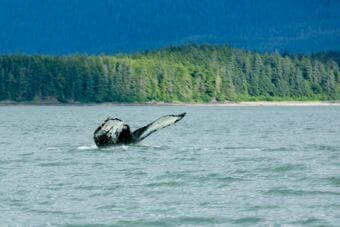
The humpback whale known as Sasha frequents Southeast Alaska waters and is pictured here in Auke Bay in an undated photo. The whale has a distinctive fluke with markings resembling the letters "AK."
The humpback whale known as Sasha frequents Southeast Alaska waters and is pictured here in Auke Bay in an undated photo. The whale has a distinctive fluke with markings resembling the letters “AK.” (Creative Commons photo by JD Lasica)

Humpback whales support a whale watching industry in Juneau worth tens of millions of dollars. The whales come to Southeast Alaska year after year and bring their newborn calves with them. But for the past few years, many whales haven’t come back.

The whales come to Southeast Alaska every summer to feast on herring and krill in the nutrient-rich northern waters. The same individuals return year after year. Some become local celebrities, like Sasha, whose fluke has a mark that resembles the letters “A” and “K.” Down in Hawaii, where humpbacks spend the winter, she’s known as the Alaska whale.

Captain Kayl Overcast spots the humpback whale known as Sasha from the whale watching vessel Odyssey on Aug. 9, 2018. (Photo by Jake Steinberg/KTOO)

But for the past few years, some whales have stopped coming back. Kayl Overcast has worked in the whale watching business for 12 years. He says he noticed a change around 2014, then things got worse.

“There was a point last year where there was only two whales in our whole area,” he said. “I never remember that in the whole rest of the time that I’d worked on whale watching boats.”

Overcast wasn’t the only one to notice a change.

Chris Gabriele works for the National Park Service in Glacier Bay. She spends the summer sitting in a boat and counting whales. Each whale’s fluke is unique, like a fingerprint, which allows Gabriele to keep track of who’s around. She said the whales were doing great until 2014, then the number of whales in the park plunged.

“It took me aback when so many whales that previously had come to Glacier Bay year after year after year, and we’re talking like 20, 30, even 40 years, all of a sudden disappeared,” she said.

Overall, the number of whales in Glacier Bay declined by nearly half between 2013 and 2017 and some whales that did come back were abnormally skinny. Glacier Bay is the only place in Southeast Alaska where humpback whale numbers are monitored year after year, and anecdotal reports throughout Southeast tell a similar story: Humpback numbers have been down.

An abnormally thin, 20-year-old humpback whale surfaces in Glacier Bay in August 2017. Note the visible scapula, or shoulder bone. (Photo by Janet Neilson/National Park Service under NMFS scientific research permit #15844-02)

Gabriele suspects the blob is responsible.

The blob was a marine heatwave that swept across the North Pacific beginning in late 2013 and disrupted the entire food chain. To understand why, you have to start at the bottom.

Normally the zooplankton in the North Pacific are rich in lipids and nutrients. But after the blob warmed up the ocean, the zooplankton didn’t grow as fat or plentiful. That meant less food for fish and krill, and malnutrition spread all the way up the food chain.

The whales returned to this food desert after fasting all winter in Hawaii. For animals that need as much food as whales do, there just wasn’t enough.

So does that mean that all the whales starved? Well, not exactly.

“We’re not seeing carcasses. We’re not seeing an increased number of dead whales,” said Suzie Teerlink, a marine mammal specialist for the National Oceanic and Atmospheric Administration.

She said it’s more likely the whales just went somewhere there’s more food.

“Humpback whales will follow the prey and they are very resourceful and adaptive,” she said. “The prey is not always reliable and it can be different from year to year and humpback whales are really good at adapting and finding the prey that they need.”

More humpbacks than normal have been reported in the Bering Sea and offshore in the Gulf of Alaska. But there’s no way to know for sure where all the whales went. They may be big, but the ocean is much much bigger.

So now that the blob is receding, will the humpbacks that left come back? That depends.

“It’s hard to say if humpback whales will come back but given that we don’t think that humpback whale numbers are decreasing and that they’re actually more likely to be shifting their distribution, it seems intuitive that there might be a shift back if the prey became available,” said Teerlink.

Until then, whales like Sasha will have to contend with more boats following them around. Research suggests that so long as whale watching boats give whales space, they don’t pose a threat. That’s good news for the industry. With 60 vessels in Juneau and counting, that makes each whale all the more valuable.

Correction: An earlier version of this story misidentified the photographer of the abnormally thin whale and has been corrected. 

Local OfficeMax donates $10,000 in supplies to Juneau schools

The Juneau OfficeMax donated $10,000 worth of school supplies to the Juneau School District on Thursday.

Superintendent Bridget Weiss accepted the donation at the OfficeMax at the Nugget Mall.

Store manager Adam Dordea said the supplies came from the store. Individuals in the community also made donations.
“It’s 1,500 notebooks. It’s 500 folders. It’s 500 composition books. There’s hundreds of binders that we’re donating. I’d say easily a couple thousand pens and thousands of pencils we’re donating,” he said.

Dordea said those are the items schools need most. He said every school in the district would get supplies, but the district is focusing on schools with a high percentage of students from low-income families.

He said the donations will be delivered by the end of next week. The first day of school is on Monday.

At Kindergarten Boot Camp, kids get a head start on learning

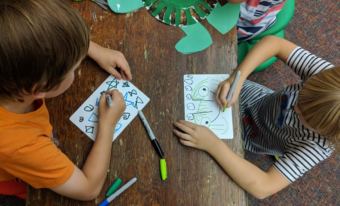
Children draw at the Kindergarten Boot Camp at Harborview Elementary School in summer 2018. It was the first year the Juneau School District put together the school-readiness camp.
Children draw at the Kindergarten Boot Camp at Harborview Elementary School this summer. It was the first year the Juneau School District put together the school-readiness camp. (Photo by Molly Hillis/Juneau School District)

The first day of school is right around the corner and it can be a scary time for kids. Especially if it’s their first time leaving home. A new summer camp at Harborview Elementary School aims to make that transition easier.

Imagine you’re 5 years old. You’ve spent your whole life at home, but now it’s time to start kindergarten. You’ve got to go to a place you’ve never been, filled with people you don’t know and do everything you’re told. Not only do you have to learn all the new rules, like standing in line and raising your hand, but you also have to be prepared to learn.

That’s an abrupt change, and many kids aren’t ready for it.

“We know that kids entering kindergarten in our school district aren’t prepared for learning,” said Juneau School District Kinder Ready Coordinator Molly Hillis.

To ease the transition, Hillis said the district tried something new this summer. They created a boot camp for kindergartners. The camp wrapped up on Thursday and over the course of three weeks, 45 soon-to-be kindergartners got a chance to interact with their peers and practice being away from home.

Kyle Lawson, 5, said he feels ready. He’s excited for kindergarten — and lunch.

The camp cost $100 for three weeks, making it a less expensive option than other pre-K programs. Hillis said making pre-K more accessible is one of the district’s goals.

“We need to be able to help those families that don’t necessarily have the same access as other families,” she said. “You can see that with different socioeconomic classes, some kids have more access than others.”

Last year, the Alaska Department of Education and Early Development found only about a third of kindergarten students in Juneau showed up to the first day of school ready to learn. Director of Student Services Bridget Weiss said the camp was meant to change that.

“We want to increase (student readiness) because it not only makes a difference for that particular student but it also makes a difference for the students around them,” she said.

Kindergarten readiness is like vaccinations. If more kids know the rules and won’t throw a fit, it will create a better learning environment for all the students in the class.

“The more students that we have ready, the better that classroom climate is and that whole classroom becomes more conducive to learning,” said Weiss.

Children practice the "Brain Dance" at Kindergarten Boot Camp at Harborview Elementary School this summer.
Children practice the “brain dance” at Kindergarten Boot Camp at Harborview Elementary School this summer. (Photo by Molly Hillis/Juneau School District)

In addition to being introduced to routines they’ll encounter in kindergarten, students also learn mindfulness techniques to help them stay focused. One of them is the “brain dance,” a series of movements kids do after lunch to help them calm their bodies. And that’s not all they learn.

“Uhh we’ve been learning about the ocean.”
“What about the ocean?”
“So, jellyfish, they don’t have any bones. They move by opening their heads and then it pushes them.”

Children made these jellyfish out of coffee filters, streamers and googly eyes at Harborview Elementary School during a 2018 kindergarten boot camp.
Children made these jellyfish out of coffee filters, streamers and googly eyes at Harborview Elementary School during a summer kindergarten boot camp. (Photo by Molly Hillis/Juneau School District)

That’s 5-year-old Cooper Reid. His mother Mallory said Cooper has learned how fun school can be.

“He’s choosing to go to school over playing with his friends in the summer,” she said. “I don’t know what they’re doing in there all day, but they’re making it really fun.”

The school district plans to offer the camp again next summer, at Harborview and at a new location in the Mendenhall Valley. Funding for the camp comes from state grants and the City and Borough of Juneau. Scholarships will be available for families who qualify.

Site notifications
Update notification options
Subscribe to notifications