Jake Steinberg, KTOO

Congressman Young addresses Native issues, gun violence at forum

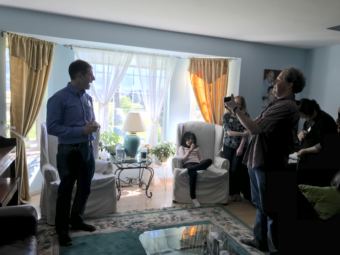
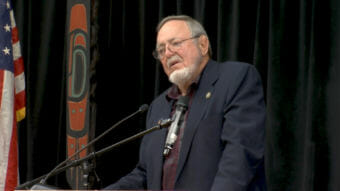
U.S. Rep. Don Young, R-Alaska, speaks at a Native Issues Forum on Wednesday at Elizabeth Peratrovich Hall in Juneau. The forums are put together by the Central Council of Tlingit and Haida Indian Tribes of Alaska.
U.S. Rep. Don Young, R-Alaska, speaks at a Native Issues Forum on Wednesday at Elizabeth Peratrovich Hall in Juneau. The forums are put together by the Central Council of Tlingit and Haida Indian Tribes of Alaska. (Still from video by Bob Laurie/360 North)

U.S. Rep. Don Young, R-Alaska, held a forum Wednesday with the Central Council of Tlingit and Haida Indian Tribes of Alaska in Juneau. The congressman fielded questions from tribe members on issues affecting Alaska Natives.

Several audience members spoke in support of efforts to expand tribal self-governance. Sealaska Board Member Jackie Pata said inconsistencies in what laws apply to Alaska Natives is a problem.

“We support using the ISDA, the Indian Self Determination Act definition because it doesn’t exclude one group or another, and certainly doesn’t exclude Alaska,” she said.

The crowd recognized Young’s previous work to expand Native self-governance and he resolved to continue that effort.

Harriet Brouillette of the Chilkoot Indian Association brought up the issue of transportation funding. Right now, the federal government funds tribes based on road miles. This leaves a funding gap for Southeast Alaska tribal communities that rely on the ferry. Young was supportive of changing that.

Young was also asked about his feelings on the National Rifle Association in the wake of mass shootings across the country. Young is an NRA board member and he said he doesn’t think guns are the problem.

“Is it the parents? Is it the phone? Is it the constant exposure to violence with no repercussions at all? I don’t know. I can’t solve it,” he said. “To me, the Second Amendment is still the most important amendment of all the amendments.”

Audience members also brought up the issue of drugs in Native communities. Young described how drug addiction has affected his family. He shared an anecdote about his granddaughter, who he said relapsed several times.

“Within two weeks or three weeks she falls back to those that she ran with before. And that just drives me crazy,” he said. “The dealer is the one I want to eliminate. I can’t do it legally but he’s the one I want to eliminate.”

Young said that personal responsibility as well as support services like halfway houses have a role to play in keeping people clean.

Valley Republican Jerry Nankervis promising jobs in statehouse bid

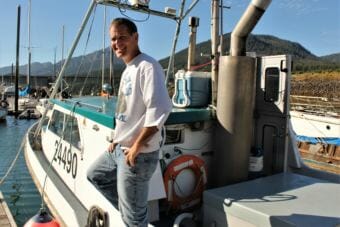
Jerry Nankervis stands in his boat, the Pisces, before heading out to fish on July 29, 2018. (Photo by Adelyn Baxter/KTOO)
Jerry Nankervis stands in his boat, the Pisces, before heading out to fish. (Photo by Adelyn Baxter/KTOO)

For half the week, Jerry Nankervis is a commercial fisherman. This season hasn’t been very good for him, but he’s not discouraged.

“I like being out on the water. It’s very satisfying,” he said. “Even though like I’ll have a week where I go ‘God, that was a pretty horrible week. I know other people caught a lot more fish than me.’ But, I still fed people.”

He said his pension helps, too.

Fishing is only one of Nankervis’ passions. He’s also Juneau’s deputy mayor, and that means he often has to call in from the boat for assembly meetings. He said that can be a challenge. His boat’s engine is pretty loud.

Nankervis doesn’t mind having a full schedule. But, he’s been busier than usual lately. He’s had to work campaigning for statehouse into his calendar.

“It’s hectic,” he said. “But, I enjoy busy.”

Democratic Rep. Justin Parish isn’t seeking reelection this November. He’s leaving House District 34, which encompasses the Mendenhall Valley, up for grabs. Nankervis wants to represent the valley in the House as a Republican.

“I wasn’t particularly satisfied with the representation I’d been getting the past couple years,” he said. “So, rather than stand back and throw darts, step up and try and make a difference. So that’s what I’m doing.”

Jerry Nankervis points out a boat at Harris Harbor on July 29, 2018. (Photo by Adelyn Baxter/KTOO)
Jerry Nankervis points out a boat at Harris Harbor. (Photo by Adelyn Baxter/KTOO)

He said he was especially upset that funding for the Juneau Access Project was spent outside the district. Nankervis is a big supporter of the road.

“It’ll be great for the economy. It’s jobs,” he said. “I don’t see a downside and I have yet to have somebody point me to a community that was better off economically because they didn’t have a road.”

Nankervis said one of his biggest priorities is jobs. He believes bringing more jobs to Juneau will stabilize its dropping school enrollment numbers. He opposes Ballot Measure 1, which would create greater regulatory protection for salmon habitat. He said it would make it harder for mines around Juneau to renew their permits.

“If we have our two mines shut down that’s going to be some serious economic disadvantage to this community and I don’t support that,” he said.

He also doesn’t support an income or a sales tax as a solution to the state’s budget crisis.

State House candidate Jerry Nankervis poses for a photo at the KTOO station on July 13, 2018. (Photo by Jake Steinberg/KTOO)

“I don’t believe in increasing the taxes during a recession. I think that’s bad policy,” he said.

Nankervis said he’s especially qualified to defend the interests of his district, like funding the marine highway system and keeping the capital in Juneau. For the past two years, he and Mayor Ken Koelsch have been meeting with legislators and building relationships.

“They love the fact that somebody that represents this city took the time to come to their office and ask them their opinion on what they thought we could do to make it better,” he said. “It’s those things that you do that combat capital move, and building those relationships are how you benefit your community.”

Nankervis grew up in Michigan. That’s where his love of hockey comes from. He still plays.

After leaving the Midwest, he bounced from Anchorage to Kodiak before finally landing in Juneau in 1987. He joined the Juneau Police Department the same year. He served on the JPD for 24 years, eventually retiring as a captain in 2011.

In 2012, Nankervis ran for the Juneau’s District 2 Assembly seat. He’s served on the Assembly since. He said he’s proud of his efforts to balance the city’s budget and fund education.

On the Assembly, Nankervis has been notable for his dissenting votes. Among them, funding for the JPD to equip officers with body cameras, a resolution reaffirming Juneau’s commitment to reduce carbon emissions and an ordinance that bars discrimination against LGBTQ people.

Nankervis has garnered a lot of support from local Republicans, oil and mining interests. He’s raised over $60,000 for his campaign. He’s running in the Republican primary unopposed. The general election is Nov. 6.

KTOO is publishing profiles of all the statehouse candidates for House District 33 and 34 and Senate District Q over the next few weeks. You’ll also find the profiles at KTOO.org/elections.

Looking to succeed his former boss, Jesse Kiehl mounts campaign for state Senate

Jesse Kiehl gives a speech
Jesse Kiehl gives a speech at a fundraiser for his campaign on July 19, 2018. (Photo by Jake Steinberg/KTOO)

Sen. Dennis Egan is retiring from the Alaska Legislature in January. He’s leaving open Senate District Q, which encompasses much of Southeast Alaska, including the capital city.

Egan’s longtime aide, Jesse Kiehl, is hoping to fill the vacancy left by his former boss.

Kiehl grew up in Anchorage and went to college in Washington state where he studied politics and theater. He said he got hooked on public policy while interning for former U.S. Sen. Ted Stevens in college. Kiehl, a Democrat, said the long-serving Republican senator always put his state before his party, and that’s something he took to heart.

Kiehl has spent the past two decades working in the Capitol, first as a staffer for former Gov. Tony Knowles, then as a legislative aide for former Sen. Kim Elton. He served as an aide for Sen. Dennis Egan until this year.

“I already know how to work with the legal drafters and know where the bathrooms are and know the route a bill takes through committee,” he said. “(I) know who to call about various issues. That is really critical.”

Kiehl has also had his hand in Juneau’s local politics. He’s been a member of the Juneau Assembly since 2011. He said his time on the Assembly has given him the ability to work with people all across the community. He cited the passage of Juneau’s equal rights ordinance, which protects LGBTQ people from discrimination in housing and employment, as one of his proudest accomplishments.

“I worked with a whole lot of folks, had a whole lot of meetings with both advocates and potential critics and we arrived at a comprehensive equal rights ordinance for Juneau,” he said.

Jesse Kiehl talking to supporters
Jesse Kiehl talking to supporters at a fundraiser for his campaign on July 19, 2018. (Photo by Jake Steinberg/KTOO)

He said his investment in the city’s infrastructure and transit, as well as his support of denser zoning demonstrate his long-term vision.

“One of the most valuable things we can do as elected leaders as we work on those is to keep the long-term vision in mind,” he said.

Kiehl wants to bring that same vision to the Senate, and he said that will mean hard work and tough decisions. Chief among them is finding a sustainable base for the state’s economy. He thinks Alaskans should vote on a constitutional amendment that sets how much the state draws from the permanent fund’s earnings each year for public services and dividends.

He also supports an income tax.

“When you put those things together, then we’ve got a stable base for the state of Alaska for the very long term,” he said.

Kiehl said he’ll fight to keep the capital in Juneau by making the government more accessible to the rest of the state. In his view, that means investing in reliable ferry service, better air transportation and improving digital access to the state government. He said the road is not a priority for him.

“I know there are folks who believe there’s a single infrastructure project that will change things,” he said. “But even if it happened tomorrow, folks would still need a passport to get to the capital city through Canada.”

State Senate candidate Jesse Kiehl
State Senate candidate Jesse Kiehl poses for a photo at KTOO on July 16, 2018. (Photo by Jake Steinberg/KTOO)

Kiehl has a lot he’d like to do. He said his years of experience at the Capitol will make him a more effective legislator.

His former boss, Sen. Egan, agreed. Though he’s not endorsing any candidates until after the Aug. 21 primary, he said he’d be delighted if Kiehl succeeds him.

“Jesse probably knows the ins and outs of the Legislature better than anyone that I know of,” he said. “He knows how the Legislature works and it sometimes gets very difficult, very complicated. But, Jesse understands.”

Kiehl’s political experience has lent itself to his campaign. He’s running unopposed in the Democratic primary and he’s raised nearly double his opponent Don Etheridge, who’s running as an independent. The general election is Nov. 6.

KTOO is publishing profiles of all the statehouse candidates for House District 33 and 34 and Senate District Q over the next few weeks. You’ll also find the profiles at KTOO.org/elections.

Young Coast Guardsman puts training to the test in Glacier Bay rescue

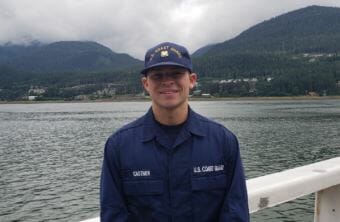
U.S. Coast Guard Seaman Colby Castner
U.S. Coast Guard Seaman Colby Castner poses for a picture on the deck of the cutter Douglas Munro in Juneau on July 18, 2018. Castner had recently rescued four kayakers stranded in Glacier Bay.
(Photo courtesy U.S. Coast Guard)

A young member of the Coast Guard participated in his first rescue mission on July 15 after the cutter Douglas Munro picked up an emergency beacon while on patrol in Glacier Bay.

Four kayakers were paddling in Reid Inlet when strong gusts coming down from a nearby glacier sent one of the paddlers tumbling into the frigid water. Another got separated in the waves. The group ended up trapped and freezing on the rocky shore. The kayakers activated their emergency beacon. The Douglas Munro, which was in a nearby inlet, moved to respond.

“We received the notification and we spotted an overturned kayak in the water,” said Coast Guard Public Affairs Officer Jacob Marx.

Three Coast Guard rescuers boarded a small boat and set out from the Douglas Munro to find the paddlers.

“I was mainly looking for one person,” said Seaman Colby Castner. “When I saw three people waving their arms frantically as we approached, I knew it was a lot bigger than I anticipated.”

This was 22-year-old Castner’s first rescue mission, but he was prepared.

Castner said when they arrived, the kayakers were in rough shape.

“They had flotation, which was really good,” he said. “But with that water temperature and then the air and that wind chill — easily they could’ve succumbed to hypothermia very quickly.

The small boat approached the shore but barnacle-coated rocks prevented the rescuers from reaching the kayakers. Castner had to jump into the 50-degree water and swim out to them. The paddlers got back into the water and Castner had to “buddy tow” them individually back to the boat.

“You put your arms around them to try to just hold on to them as hard as you can, and you swim them back. So you’re not only swimming yourself back but you’re swimming them back as well,” he said.

He had to do that multiple times, one for each person and again for their kayak and gear. The fourth kayaker was also safe 300 yards down the shore.

The Coast Guard helps bring a rescued kayaker aboard the Douglas Munro in Glacier Bay on July 15, 2018.
The Coast Guard helps bring a rescued kayaker aboard the Douglas Munro in Glacier Bay on July 15, 2018. (Photo courtesy U.S. Coast Guard)

Aboard the Munro, the group was shaken but unharmed. Castner said without their emergency beacon, they may not have been found at all.

“The number one thing was that they had the EPIRB: Emergency Position Indicating Radio Beacon,” he said. “It’s almost scary to say that might have been the only reason that they were found.”

The group was taken to Juneau the next day. Castner said the rescue was both humbling and rewarding.

Castner is from Clearwater, Florida. He joined the Coast Guard last year to specialize in search and rescue. He’s been training with the guard’s rescue swimmers since, following an intense regimen of long days in the gym and a lot of swimming. He plans to go to aviation survival technician school, to become a member of the guard’s elite rescue swimmer unit. The training is relentless and only around half of trainees make it through. But, Castner is undeterred.

“Everything I’ve trained for was exactly for this moment,” he said. “This is why I joined the Coast Guard, to be able to do this kind of stuff. I would never wish that it has to happen, but if it has to happen, then I definitely want to be the person to go out there and get them.”

49 Voices: Noatak Post of Juneau

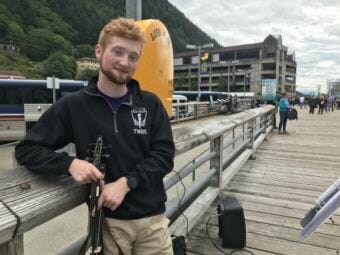
Noatak Post in Juneau (Photo by Jacob Steinberg/KTOO)

During the summers, Juneau’s Noatak Post can be found playing the violin for tourists visiting the state’s capital as they disembark from cruise ships.

POST: I started playing the violin 11 to 12 years ago. I started when I was turning 6-ish I think. I started at a bluegrass summer camp that was hosted here in Juneau by a band called Barefoot Bluegrass. And I went to the summer camp with no musical experience really in my family at all, and I came home after that first week and said, “Mom. Dad. I really want a violin. Please buy me a violin.”

And so they went to one of the band members and asked where we could get one, and they happened to have their old violin, sitting in their parents’ attic. And they sold it to us.

Whenever and wherever someone will hire me. I do weddings fairly often. I just played a birthday party a week ago, and I’ve done a couple family reunions. But weddings are fairly common. One of the songs I can do with my looped violin is Pachelbel’s Canon, which people love to have at their wedding.

Violinists are a dime a dozen. It’s great. I love that there’s so many people playing music, but there’s so many people. Especially here in Juneau. What I think is great is the JAMM program that’s in the elementary schools, getting everyone to play an instrument. I didn’t have that when I was in elementary school.

I haven’t played bluegrass in over a decade, it’s crazy. I only went to that camp for a couple more years before they stopped coming to Juneau. And after that, I started taking private lessons with Mr. Xia, who’s one of the teachers in town. And since then I’ve been classically trained, and in the past few years, have moved on to more modern and pop.

I’m gonna be a senior this year, so I’ve got one more year in Juneau, and I’ll keep doing it as long as people will listen to me, and with a different group of people on the cruise ships every day, that’s an easy thing to accomplish.

Correction: Spelling errors in references to the JAMM program, Mr. Xia and Pachelbel have been corrected. 

Cremator cited for attracting bears with dead pets

Juneau police and animal control responded to an incident early Tuesday at the home of a pet cremator on Cohen Drive.

A neighbor reported a bear at the home of Mike Dziuba, owner of the pet cremation business Bridge Pet Services, according to Juneau Police Lt. Krag Campbell.

“Specifically it’s because there were carcasses of deceased animals wrapped in a tarp that was attracting bears,” Campbell said.

Campbell said police issued Dzuiba a citation for a bear attraction nuisance.

Reached by phone, Dzuiba said the deceased animals were in a shelter at his home where he temporarily kept them before moving them to his shop for cremation.

“If I had multiple pets to pick up in the same day, I’d store them there until I got back to the shop,” he said.

Dzuiba said the shelter was not damaged but wouldn’t say whether a bear had gotten to the bodies, nor would he confirm how many bodies were stored there. He said the bodies were meant to be cremated together and their owners had elected not to receive their ashes.

He confirmed that he has removed the bodies from the shelter.

In March, Dzuiba apologized to several customers for keeping their pets’ bodies in the back of his car. He claimed to have gotten backlogged on cremation orders.

Dzuiba said he’ll stop taking pets for cremation for now and he offered his apologies to his neighbors and customers.

Correction: An earlier version of this story said Juneau police and animal control arrived late Tuesday night. The authorities arrived at 10 a.m. Tuesday. The story has been updated.

Site notifications
Update notification options
Subscribe to notifications