I dig into questions about the forces and institutions that shape Juneau, big and small, delightful and outrageous. What stirs you up about how Juneau is built and how the city works?
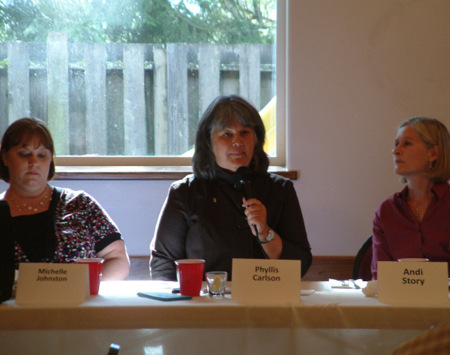
Phyllis Carlson in September 2012. (Photo by Matt Miller/KTOO)
The Juneau School Board elected new officers last night in its first meeting since the municipal election two weeks ago.
Phyllis Carlson is the new president. She’s serving her fourth term on the board.
“I have not taken a role with the board awhile and I think it’s time for me to step back in, since I have time and some flexibility, which I think the role of chair and facilitator needs in this case,” Carlson said. “So I’m willing to roll up my sleeves and get back to work on this.”
Andi Story, also in her fourth term, will be vice president. Lisa Worl, who was appointed to the board in 2011, will be clerk.
All three were nominated without opponents and elected without objection.
Tuesday’s meeting was also the first for newly elected Brian Holst, and the beginning of Sean O’Brien’s third term. Both men were sworn in last week and participated by phone.
Holst replaces Sally Saddler on the board. She was the previous board president and didn’t seek re-election.
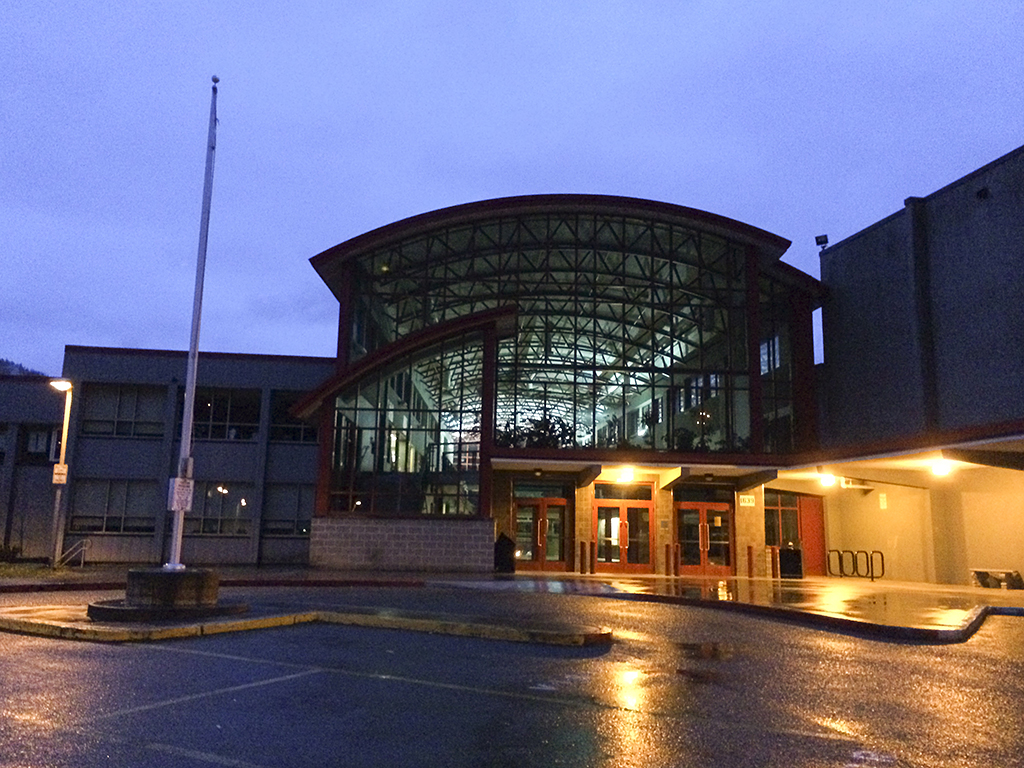
Juneau Douglas High School. (Photo by Sarah Yu/KTOO)
A Juneau-Douglas High School senior accused of being involved in a paddling incident in May unsuccessfully appealed his disciplinary suspension at last night’s Juneau School Board meeting.
The board planned to hold the proceeding in executive session, but the student, Adam Empson, asked it be public.
Empson, a football and basketball player, read a statement maintaining he was not involved. He appeared with his lawyer, Paul Grant.
School District Chief of Staff Kristin Bartlett says lawyers on both sides took part in an Oct. 15 school board subcommittee hearing on the matter. She says the subcommittee and the full board backed the administration’s suspension.
The suspension followed a third-party investigation that concluded seven incoming seniors paddled six incoming freshmen.
In 2013, Empson’s high school football team was recognized by the Alaska School Activities Association as being No. 1 for sportsmanship among medium-sized schools.
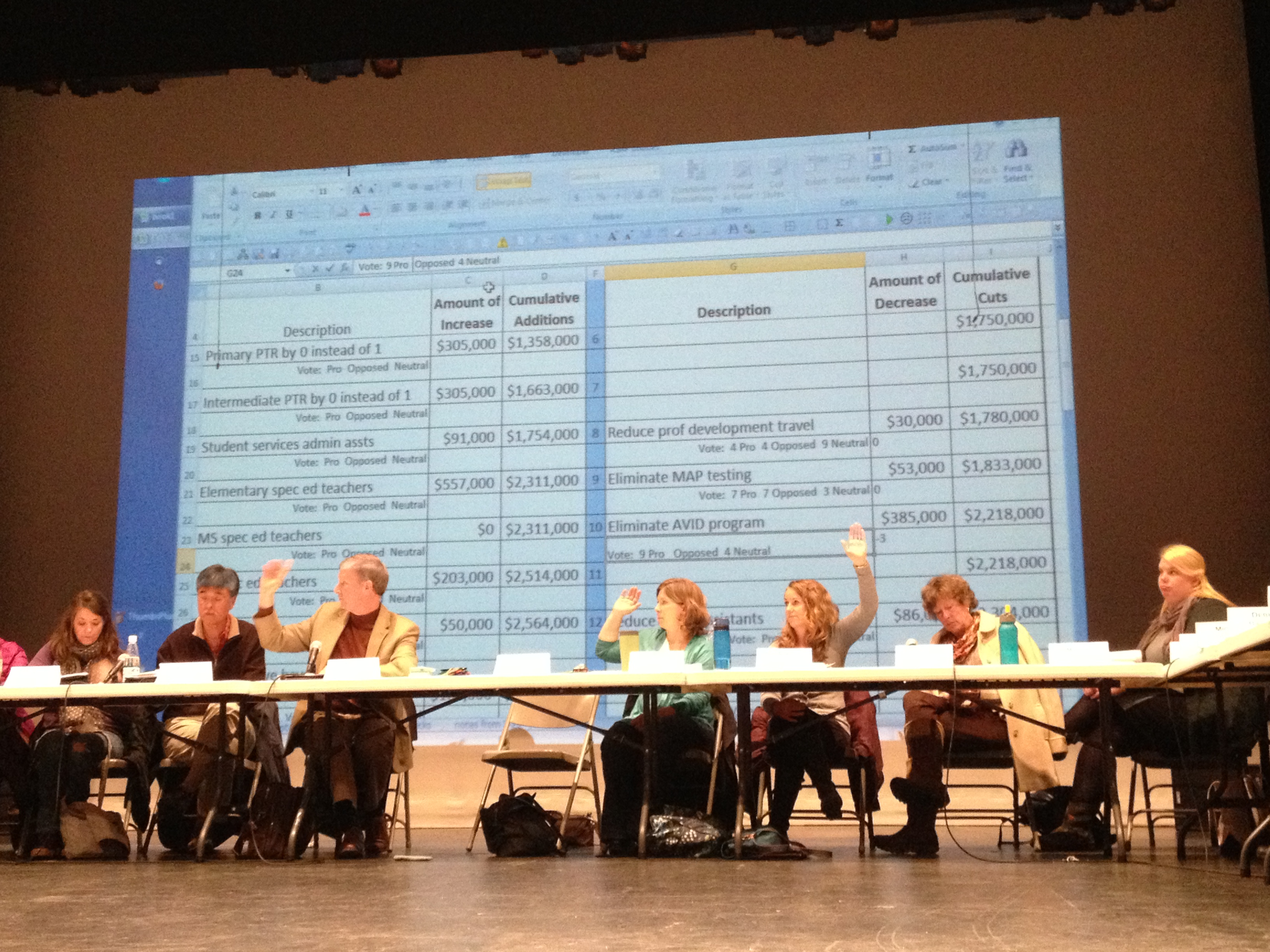
The Juneau School District’s advisory budget committee at its final meeting of the last budget cycle, and possibly its final meeting forever. (Photo by Lisa Phu/KTOO)
The Juneau School Board started work Tuesday on a plan for putting together the school district’s next budget.
Among the proposals from Superintendent Mark Miller: Get rid of an advisory committee tasked with making budget recommendations to the board.
School board members didn’t directly oppose Miller’s plan, but suggested changes to increase public involvement.
“That’s my biggest concern, that’s my only concern,” said Brian Holst.
In the last budget cycle, Holst chaired the advisory committee on the chopping block. Now, Holst is the newest member of the Juneau School Board.
“There just seems to be a pretty severe reduction in opportunity for public input,” he said.
Even so, Holst and several other board members said they were willing to try the new approach.
In a blog post, Miller critiqued the advisory committee process. He said the committee is too big. The members are appointed by individual schools’ site councils, which fails to create accountability between the board and the committee, and can pull the focus away from the big picture.
Parent Josh Keaton told the superintendent and board that he opposed axing the committee and doesn’t think the plan will work.
“I question, isn’t that the point of the committee? To collect the opinions of the public no matter how far they differ from yours? Sure, there’s going to be controversy, but eliminating a public process that has the attention of the general public–and I believe that budget committee did have the attention and it was the single focal point for a lot of parents and the public to be involved–is not the solution,” Keaton said.
He also said relying on school principals and their site councils for budget input, as Miller proposes, is a bad idea. Keaton said principals have a professional conflict of interest: pleasing the school board, and critiquing their budget.
The advisory budget committee process began in 2009 and has evolved over time. But in 2009, longtime board member Andi Story said it was a good thing, increasing transparency and public participation.
Almost six years later, Story said there’s been progress on both of those fronts. She said the public’s understanding of the budget and level of detail in questions and input from the public is evidence of that.
“And this has increased to people asking more programmatic questions because the numbers are very clear about what things are costing and so we’re getting into weighing, looking at programs,” Story said. “And I think it’s also a reflection of 5 years of budget cuts. So yes, I think that we have, continue to have a very transparent budget process.”
But, she said, she’s willing to try budgeting without the advisory committee, too.
In addition to making site councils more involved, Superintendent Miller’s plan also calls for more budget-specific meetings and forums to educate the public and solicit input.
Miller said he will incorporate the board’s input on his plan and formalize it for a vote at the board’s Nov. 18 meeting. If the new process is adopted, it will used to develop the budget for the 2015-2016 school year.
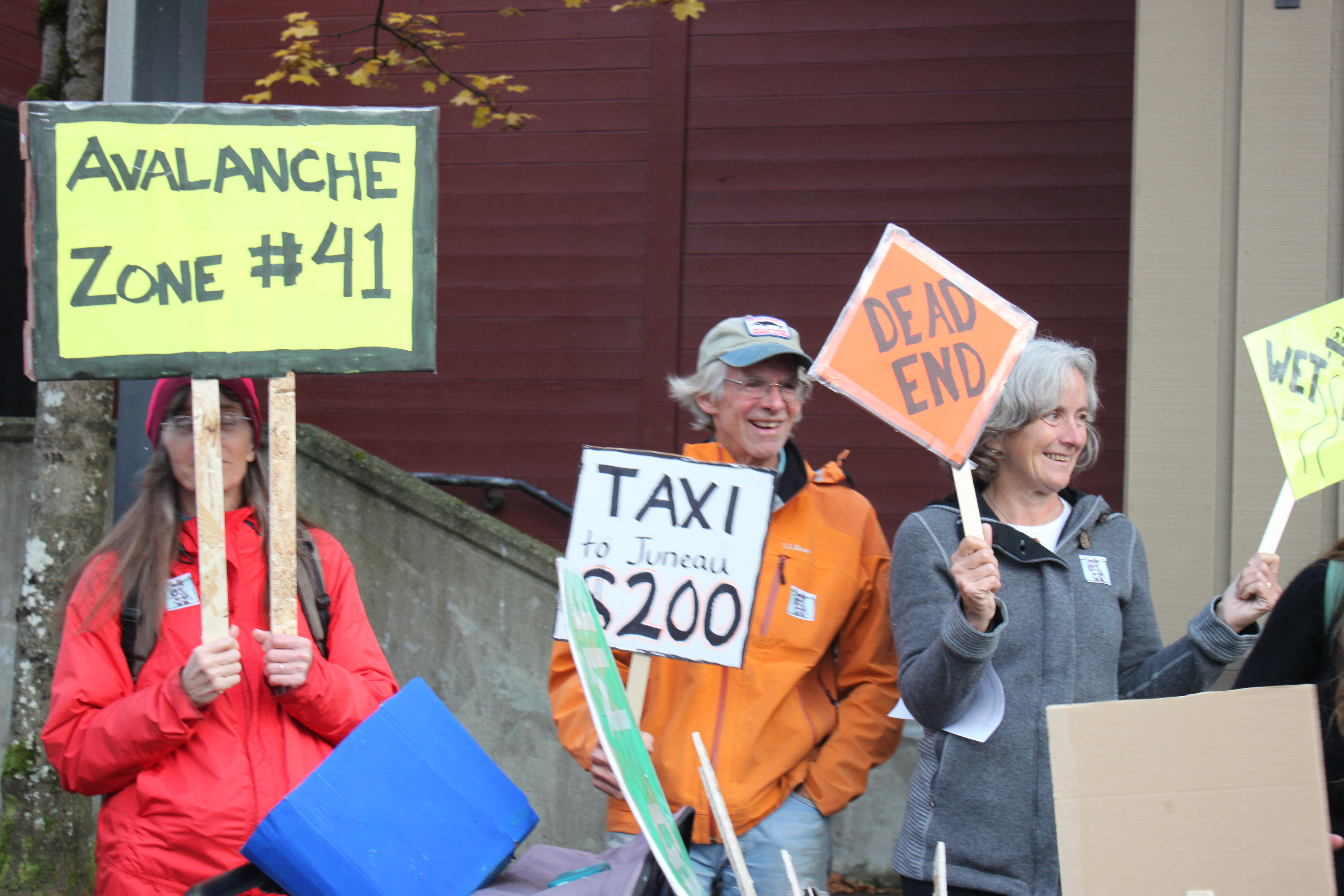
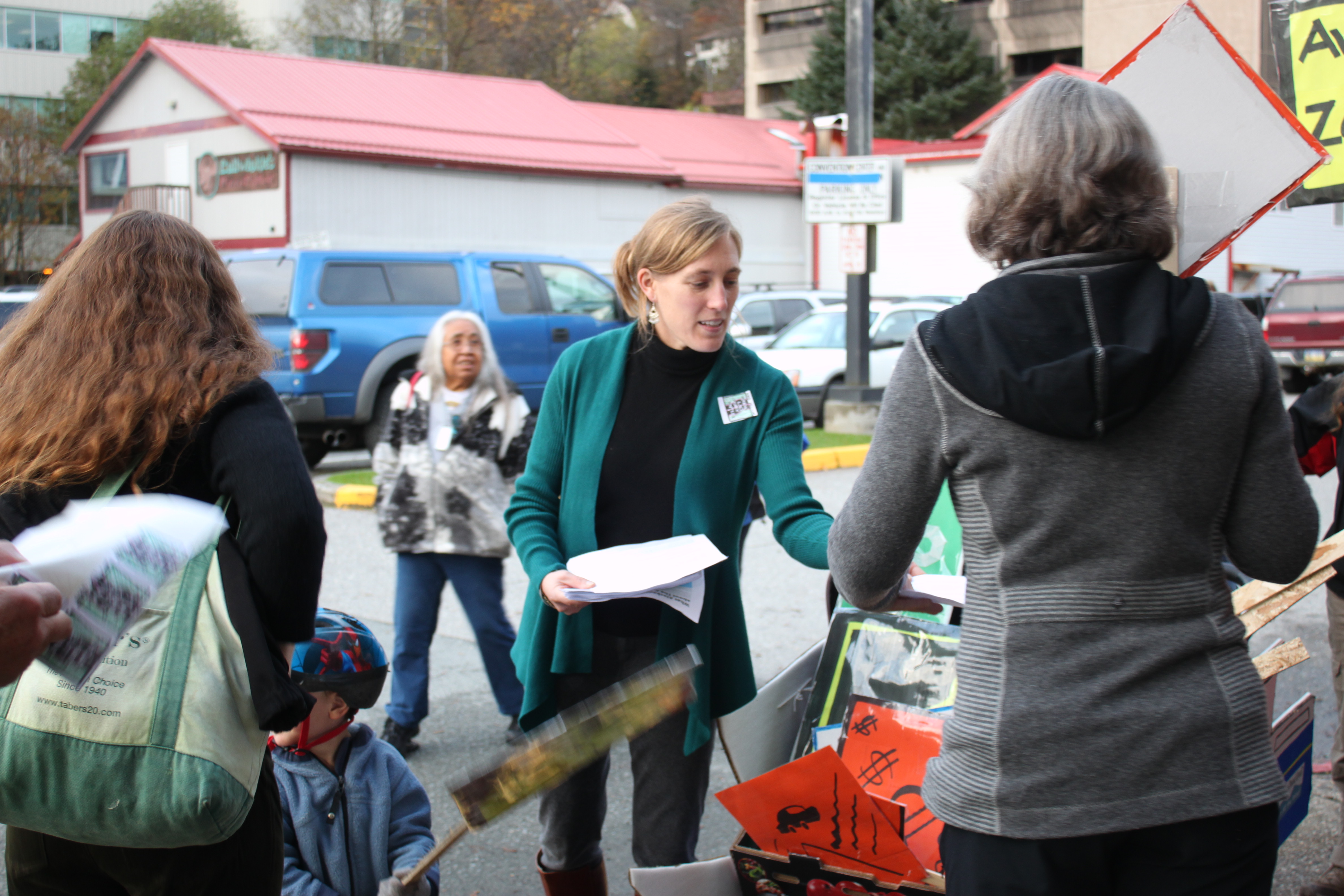
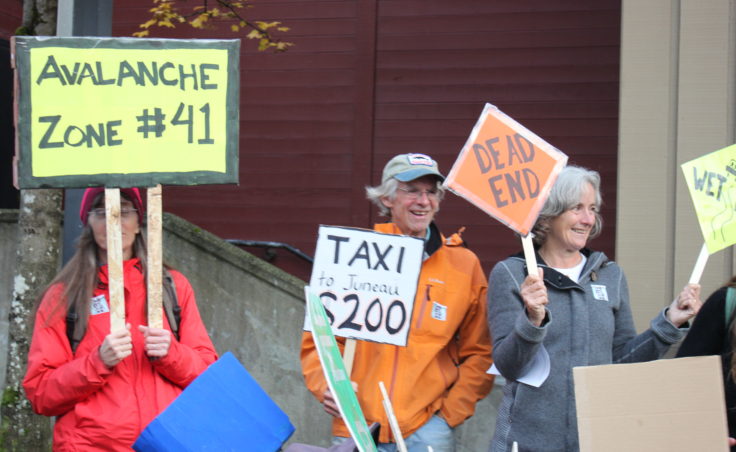
A few dozen people participated in a rally the Southeast Alaska Conservation Council organized outside Centennial Hall. They were supporting ferries and opposing an extension of the Juneau's main road. (Photo by Jennifer Canfield/KTOO)
Emily Ferry of the Southeast Alaska Conservation Council hands out rally materials. (Photo by Jennifer Canfield/KTOO)
At a public hearing last night in Juneau, locals spoke out nearly 4-to-1 against transportation officials’ effort to extend the capital city’s main road 48 miles farther north.
Mendenhall Valley resident Brandee Gerke summed up many of the opponents’ key concerns about the road-building option that transportation officials have favored for years.
“Perceived convenience is being prioritized over cost and safety,” she said.
Juneau Access Project Open Houses
Tuesday’s open house was the first in a series the Alaska Department of Transportation & Public Facilities is holding to present the draft supplemental environmental impact statement and solicit public comment.
Haines, Oct. 15 at Chilkat Center for the Arts
Open House: 3 p.m.
Public Hearing: 6 p.m.
Skagway, Oct. 23 at Skagway High School
Open House: 3 p.m.
Public Hearing: 6 p.m.
Juneau Access Improvements Project
Attn: Deborah Holman
DOT&PF Southeast Region
P.O. Box 112506
Juneau, AK 99811-2506
Highway construction along the east side of Lynn Canal is estimated to cost $523 million. The new road would end at the Katzehin River where a new ferry terminal would make short connections to Haines, Skagway and the road system. The new terminal and ferries are estimated at another $51 million.
According to the EIS, the plan would also drive up the state Transportation Department’s operations and maintenance costs by about 30 percent compared to the status quo.
On safety, the document projects about 22 crashes per year on the new road and about one traffic death every six years, based on statewide data from similar roads.
But the safety concern folks repeatedly cited was avalanches. The proposed road crosses 41 avalanche paths.
“The fear of the road would probably eliminate a lot of people’s actual access out of as well as to Juneau,” said Larri Spengler, who lives on the avalanche prone Thane Road.
“Do we want our children on their school buses driving up that road to a ferry terminal? I’d much rather put them on the ferry in Auke Bay.”
The high risk would be driven down through engineering, explosive avalanche control and simply closing the road when avalanche risk is highest – forecast at about 12 days a year. Motorists would still face moderate avalanche risk, though; more than on Thane Road, but less than on Seward Highway, according to an avalanche risk index in the EIS.
Juneau Mayor Merrill Sanford, speaking for himself, ticked off what the upside would be.
“To be able to transport 10 times the number of vehicles, provide 5 to 7 times the number of ferry trips per week, cut travel time in half or more, and cut traveler cost up to 75 percent,” Sanford said.
And he added, 3 to 5 years of construction jobs.
Wayne Jensen said it’s incumbent on Juneau as a capital city to support the road and improve access for other Alaskans. Enhancing Juneau as a capital city is the mission of the nonprofit Alaska Committee that he chairs.
Another common thread in opponents’ testimony was skepticism toward cost estimates and traffic projections in the 694-page EIS. A few people even made outright accusations that officials cooked the books.
That wasn’t exactly what project manager Gary Hogins said he’d be listening for.
“Federal Highways and the department will respond to all comments, but the comments that are most helpful to us is constructive—did we make a mistake? Is there a gap in our information? You know, that sort of thing,” Hogins said before the hearing.
Tim Haugh is the environmental program manager for the Alaska division of the Federal Highway Administration. His agency would pay for much of the capital cost of the project and has the final say in which option is greenlit. He said the selection is based on “a balanced analysis of the transportation need with the environmental impacts, be they social, economic or natural.”
He said building the road best serves the overall public interest while improving transportation. At this stage, he said politics aren’t a factor.
The public comments will become part of the Federal Highway Administration’s record and may lead to revisions in the final version of the EIS, expected next fall.
State officials are set to hold an open house and public hearing tomorrow at Centennial Hall on the Juneau Access Improvements Project, the state-backed effort to extend the capital city’s main road.
The state wants to extend Glacier Highway north along the east side of Lynn Canal to the Katzehin River. There, a new ferry terminal would make short connections to Haines, Skagway and the road system.
Highway construction is estimated to cost $523 million, and new ferry terminal and vessel construction another $51 million.
Other options in the latest version of a federally required environmental impact statement released last month include no road construction and improving existing ferry service.
The open house begins at 1 p.m. and the public hearing begins at 5 p.m. at Centennial Hall. Additional open houses and public hearings are scheduled in Haines on Wednesday and Skagway next week. The hearings fall within the public comment period for the environmental impact statement. Public comment closes Nov. 10.
Lt. Stacey Tate of Coast Guard Sector Juneau says the Phyllis Ann, its master and beacon have all been located, safe and sound.
Tate says it’s unclear what triggered the beacon, but it will be troubleshot. The beacon was aboard the vessel.
Original Post | Oct. 10, 2014 – 12:13 p.m.
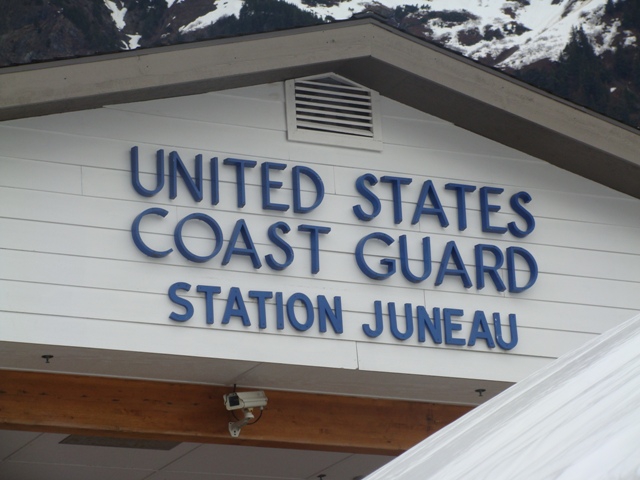
The Coast Guard in Southeast Alaska is trying to track down an emergency beacon and the vessel it’s registered to, the Phyllis Ann.
Lt. Junior Grade Eric Foerree with Coast Guard Sector Juneau says the vessel’s emergency position indicating radio beacon, or EPIRB, has been active since about 10:30 a.m. today.
An MH-60 helicopter from Sitka is searching for it. Foerree says the beacon is believed to be about 15 miles north of Port Alexander, near Mist Cove or Deep Cove.
The beacons can be activated manually, and some activate automatically when they hit the water.
The Phyllis Ann has a dark green hull with a tan pilothouse. Report sightings to the Coast Guard on VHF channel 16.
Close
Update notification options
Subscribe to notifications
Subscribe
Get notifications about news related to the topics you care about. You can unsubscribe anytime.