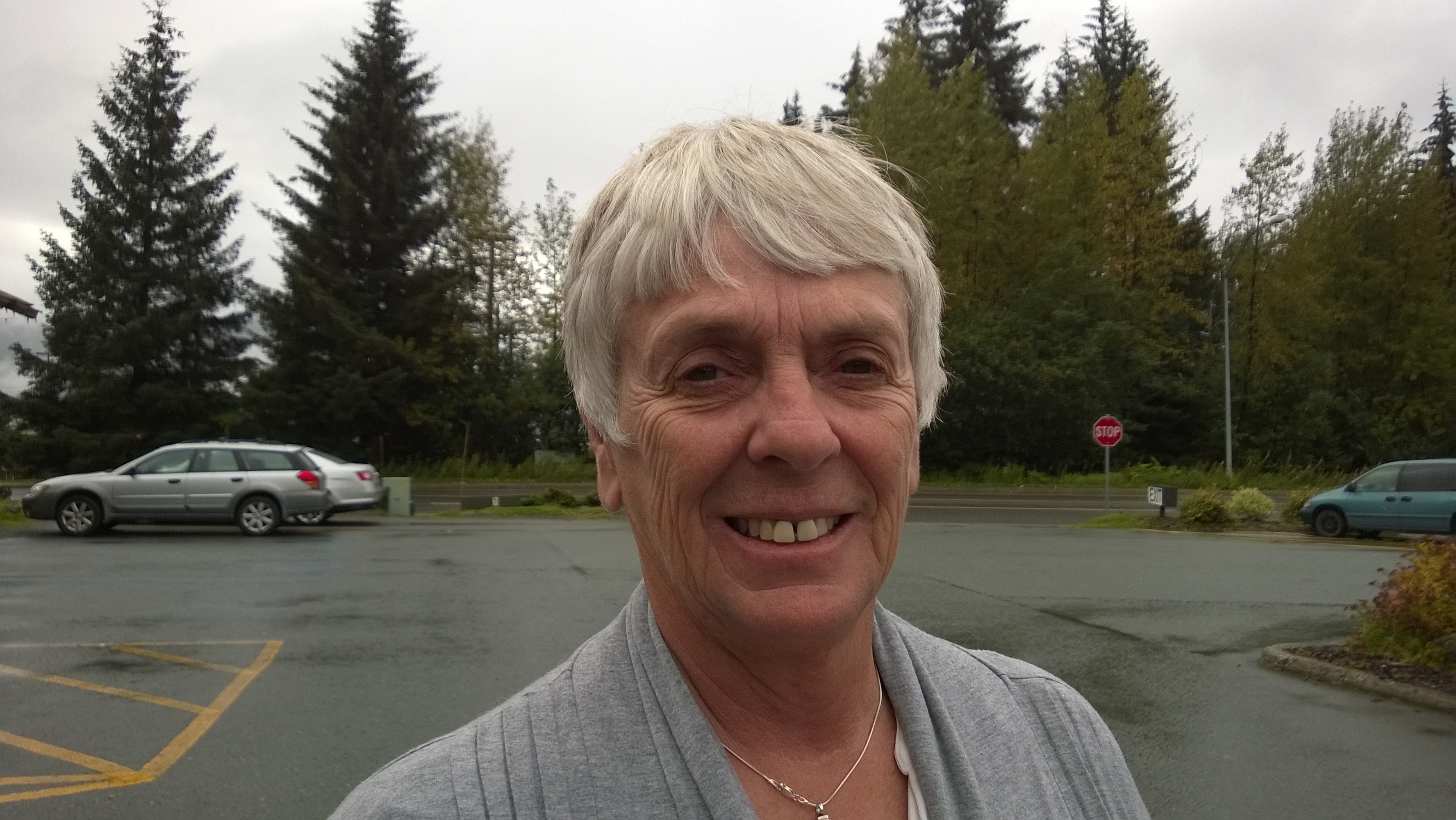
I dig into questions about the forces and institutions that shape Juneau, big and small, delightful and outrageous. What stirs you up about how Juneau is built and how the city works?
The Alaska Libertarian Party’s gubernatorial candidate Carolyn “Care” Clift thinks she could affect the outcome of the tight race.
“I do see myself as a spoiler,” she said during a taping of 360 North public television’s Forum@360 on Thursday.
Polls show incumbent Republican Gov. Sean Parnell and independent Bill Walker as close frontrunners. Clift and the Alaska Constitution Party candidate J.R. Myers are in distant third and fourth places.
Clift says after the Democratic candidate Byron Mallot stepped aside to run as Walker’s lieutenant governor, her ticket is now a better fit for socially liberal voters.
“There were a lot of socially liberal or socially tolerant voters who were going to vote the Democrat ballot, because traditionally, (a) Democrat ballot is the only one who supported their social beliefs,” Clift said. “And now they have a Republican heading that ballot.”
Walker had been a registered Republican, but switched to undeclared as a condition of getting the Democratic Party’s endorsement.
Clift is a retired special education teacher from Anchorage. She is a fiscal conservative and said her top policy priority is to establish a sustainable budget. She intends to limit annual state spending to $5.5. billion.
She voted against the repeal of Senate Bill 21, the last rewrite of Alaska’s oil and gas tax system. Critics called SB21 an industry giveaway; supporters say it makes Alaska a more competitive place for investment and will increase oil production.
On social issues, she’s pro-choice, supports same-sex marriage, supports public funding of contraception, and opposes the Affordable Care Act.
On the November ballot measures, she opposes the entire concept of a minimum wage, supports the requiring legislative approval of large scale mines in the Bristol Bay Fisheries Reserve, and supports legalizing marijuana.
The Juneau Crime Line is highlighting a missing vehicle and its driver.
Juneau Police Department’s Lt. Kris Sell says a 31-year-old Juneau woman rented a white, 2014 Chevrolet Impala at the airport on Sept. 16. As of Friday, the one-day rental had not been returned.
“Officers of the Juneau Police Department have not been able to locate the car or the woman who rented it, Tiffany Spaulding,” Sell says. “JPD officers would like to confirm that she is safe. JPD would like the public’s assistance finding both Spaulding and the car. The license plate on the vehicle is GTC565.”
Report tips at juneaucrimeline.com, or call 586-0600. You may be eligible for a reward.
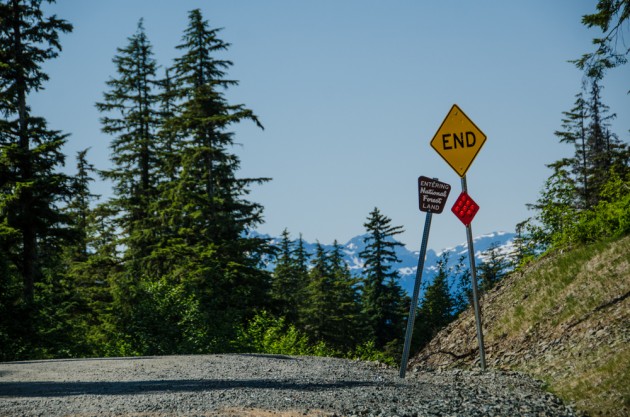
Signs mark the end of Juneau’s Glacier Highway in 2013. The latest environmental impact statement maintains a preference to extend the road 47 miles north along the east side of Lynn Canal to a new ferry terminal. (Photo by Heather Bryant/KTOO)
Today, the Alaska Department of Transportation & Public Facilities put out a draft document that addresses environmental issues stemming from the battle to extend Juneau’s only highway north toward Haines and Skagway.
Juneau Access Project Open Houses
The Alaska Department of Transportation & Public Facilities is holding a series of open houses to present the draft supplemental environmental impact statement and solicit public comment.
Juneau, Oct. 14 at Centennial Hall
Open House: 1 p.m.
Public Hearing: 5 p.m.
Haines, Oct. 15 at Chilkat Center for the Arts
Open House: 3 p.m.
Public Hearing: 6 p.m.
Skagway, Oct. 23 at Skagway High School
Open House: 3 p.m.
Public Hearing: 6 p.m.
The new document maintains a preference to build a road along the east side of Lynn Canal, north to the Katzehin River. There, a new ferry terminal would make a short connection to Haines, Skagway and the road system.
The new document attempts to fulfill a major regulatory hurdle to highway construction, estimated at $523 million. Ferry terminal and vessel construction is estimated to cost another $51 million.
The Southeast Alaska Conservation Council was one of the parties to challenge the 2006 environmental impact statement. It may do so again, says Executive Director Malena Marvin.
“Our lawyers have not analyzed it yet but it’s likely that it will be challenged.”
The federal courts in 2009 and 2011 said the original statement failed to adequately consider improved ferry service as an alternative to building the road. The new document addresses that and revises outdated information.
DOT spokesman Jeremy Woodrow says the next step for the department is to collect public comments that will eventually be integrated into an additional report.
“Depending on how many comments we receive will determine the length of time it takes us to put together the environmental impact statement for review by the Federal Highway Administration before we can reach a record of decision. So, that could take several months or longer.”
The public comment period on the draft document is open until Nov. 10.
This story has been updated with comment from the Alaska Department of Transportation & Public Facilities.
Lt. Gov. Mead Treadwell held a public hearing Monday in the Capitol on the marijuana legalization initiative. It’s part of a series of hearings his office is holding around the state before the Nov. 4 election.
I live tweeted from the hearing in the Capitol as @GavelAlaska. Here’s a recap via Storify.
More Gavel Alaska coverage of initiative hearings is available at 360north.org.
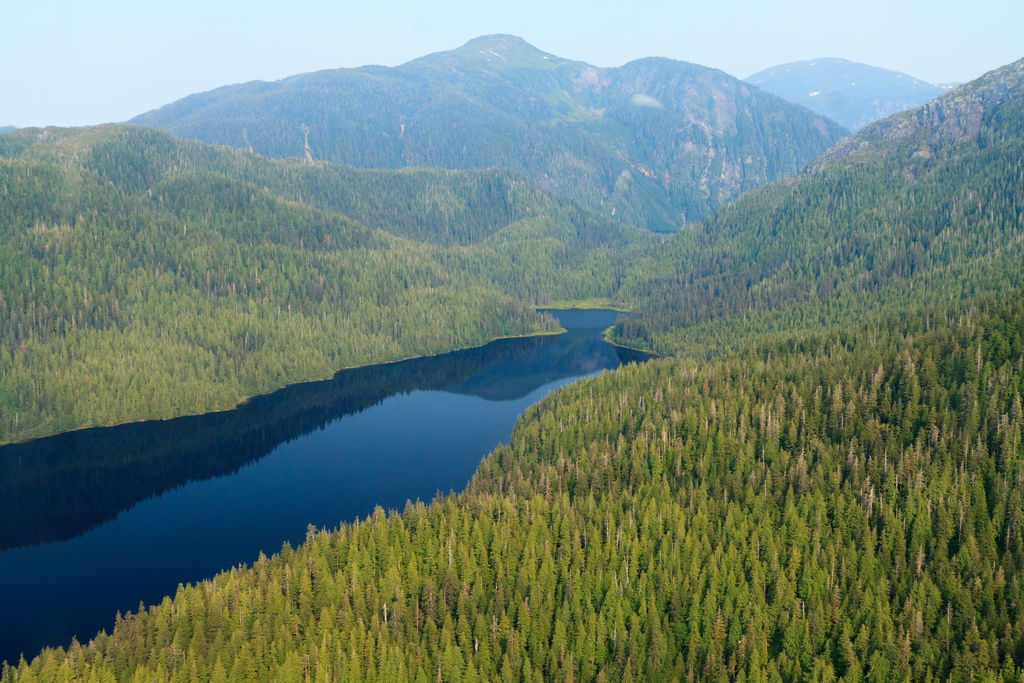
Aerial view of Tongass National Forest. (Creative Commons Photo by Alan Wu)
For three days last week, a few dozen people holed up in a Travelodge conference room in Juneau. There was coffee and donuts, PowerPoint presentations and an easel with big sheets of scratch paper. It was the second in a series of meeting that the Tongass Advisory Committee has leading up to its May deadline to produce its recommendations.
Representatives of the U.S. Forest Service, the timber industry, state government, local communities, tribal entities and conservationists on the committee are trying to work out policies that will let them all sustainably coexist. Their mutually shared mantra is what they’re calling the “triple bottom line”–ecological, social and economic sustainability in the Tongass National Forest.
One of their directives from U.S. Secretary of Agriculture Tom Vilsack is to transition the timber industry to harvesting only the Tongass’s young growth, that is, trees that have grown back in areas previously logged or disturbed.
“It is going to be a huge challenge to make a financially viable industry with 200,000 acres of young growth on a 17 million acre forest,” says Tongass Advisory Committee member Eric Nichols. He’s part owner of Ketchikan’s Alcan Forest Products Inc. and Evergreen Timber.“The land base, it’s going to be a huge impact, in that you’ve got to have the land base to grow the trees.”
“And the more we shrink this land base, the higher probability of failure you have.”
If the committee is successful and the Forest Service adopts its policy recommendations, it should head off the kind of legal wrangling that the community of Thorne Bay is on the sidelines of now.
Thorne Bay is a community of about 500 on Prince of Wales Island. It’s part of a census area that consistently has the highest unemployment rates in Southeast Alaska. Its economy used to be dominated by the timber industry. Nowadays, Wayne Benner says it’s down to “about a half a dozen small little working mills, ma-and-pa mills.”
Benner is the advisory committee’s co-chair and Thorne Bay city administrator.
“(We) definitely want to make sure they continue on, and have the ability to survive and prosper,” Benner says. “And at the same time, all the other uses of the Tongass National Forest are preserved so that the other entities, the lodges, people coming to hunt and coming to fish, also have the opportunity to enjoy ’em.”
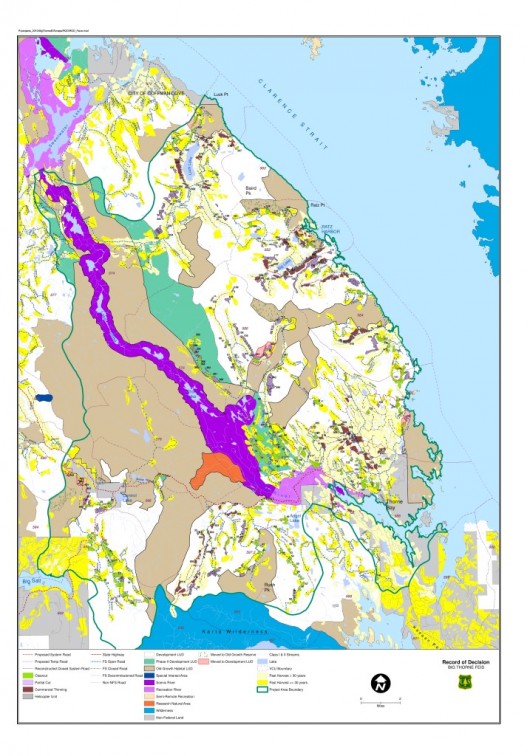
Benner says his government hasn’t formally taken a position on the Forest Service’s controversial Big Thorne timber sale, which could be a boon to the local economy but would destroy thousands of acres of old growth forest.
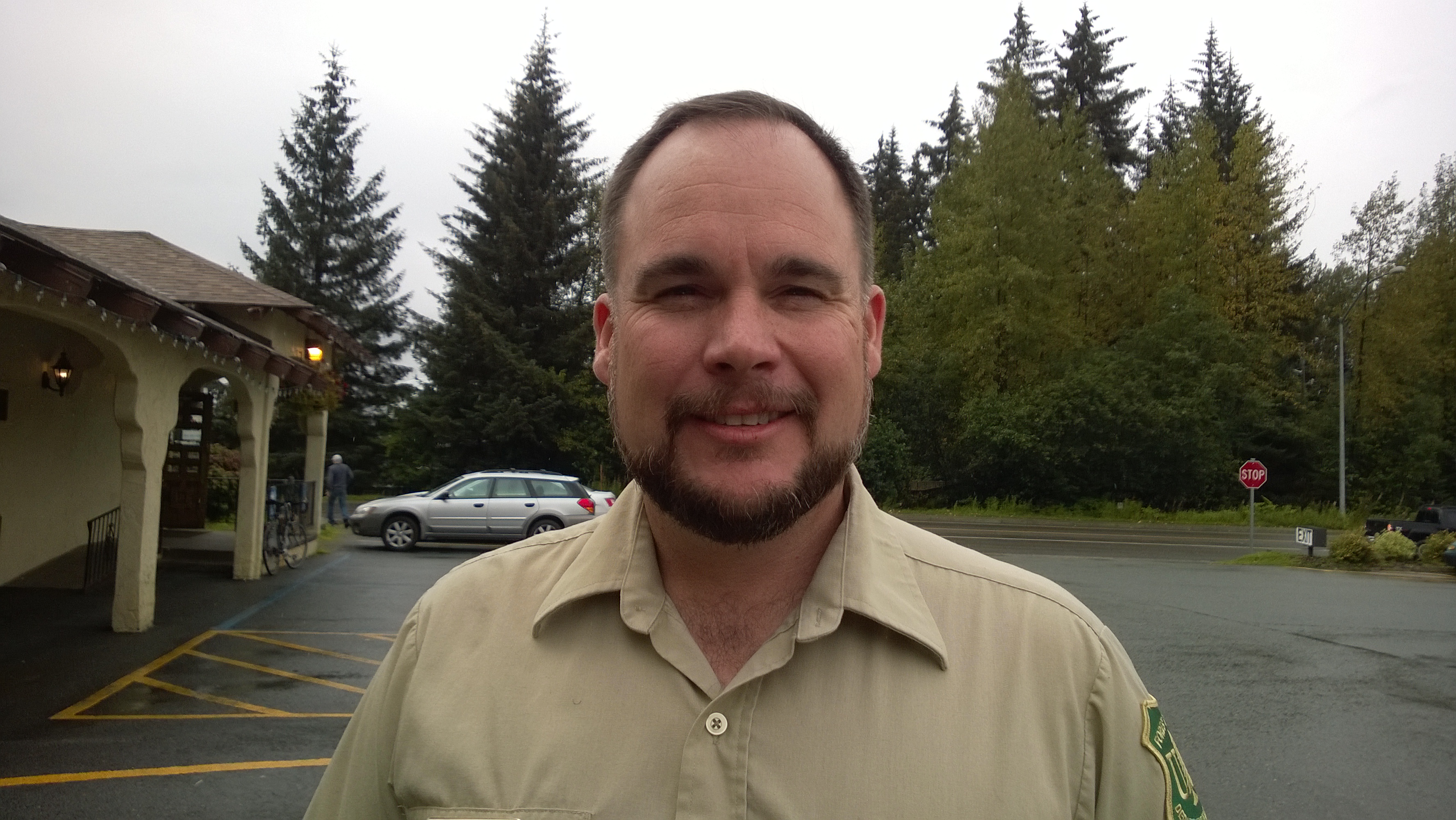
Deputy Tongass Forest Supervisor Jason Anderson. (Photo by Jeremy Hsieh/KTOO)
A conservation-based economy
Back at the Travelodge, community interests are getting a lot of attention, says Jason Anderson, deputy forest supervisor for the Tongass.
“Despite the difference of interests at the table, there’s a collective interest in doing good stewardship of the land as it benefits communities. There’s probably some difference of opinion of how that’s going to look, but the value of having them all at the table and hashing all that out, that’s really in my opinion the value in having an advisory committee.”
Tongass Advisory Committee co-chair Lynn Jungwirth. (Photo by Jeremy Hsieh/KTOO)
Lynn Jungwirth is the other co-chair of the committee. She brings lessons from her home in Hayfork, California, a town of 2,200 in the Shasta-Trinity National Forest. She says in the timber wars back home, both the industry and the conservation groups were powerful. When they fought it out, the communities got caught in the crossfire.
“So while the conservation industry might stop a sale in order to harm industry, we’re the people who lost our homes, lost our equipment, lost our jobs. We kind of thought, well, you know, we need to get together and have a voice, because this is a transition time. We have got to stop pitting conservation against economy and build a conservation-based economy.”
Thorne Bay City Administrator Wayne Benner says even if the committee fails, the learning and perspective is valuable.
“If nothing comes out of it, everybody goes back to where they’ve come from, they’re going to take back a little different vision of how the different entities and agencies really look at managing resources.”
The Tongass Advisory Committee plans to meet monthly until its work is complete.
This week, the Juneau Crime Line is highlighting an Aug. 26th theft of high-value tools in the Mendenhall Valley.
“A Juneau man reported tools valued at $4,300 dollars were taken from his shed in the 8400 block of Thunder Mountain Road,” says Lt. Kris Sell of the Juneau Police Department. “Also taken was a one of a kind gray Carhartt coat with ‘F/V Brittany’ embroidered on the back. The suspect was last seen wearing the coat and riding a bicycle.”
Some of the tools were recovered from a field near the victim’s home. A Senco Pro 455XP nail gun, a Stihl Chainsaw, and a Milwaukee right angle drill are still missing.
You can report tips to JPD at 586-0600 or at juneaucrimeline.com. You may be eligible for a reward.
Close
Update notification options
Subscribe to notifications
Subscribe
Get notifications about news related to the topics you care about. You can unsubscribe anytime.