I dig into questions about the forces and institutions that shape Juneau, big and small, delightful and outrageous. What stirs you up about how Juneau is built and how the city works?
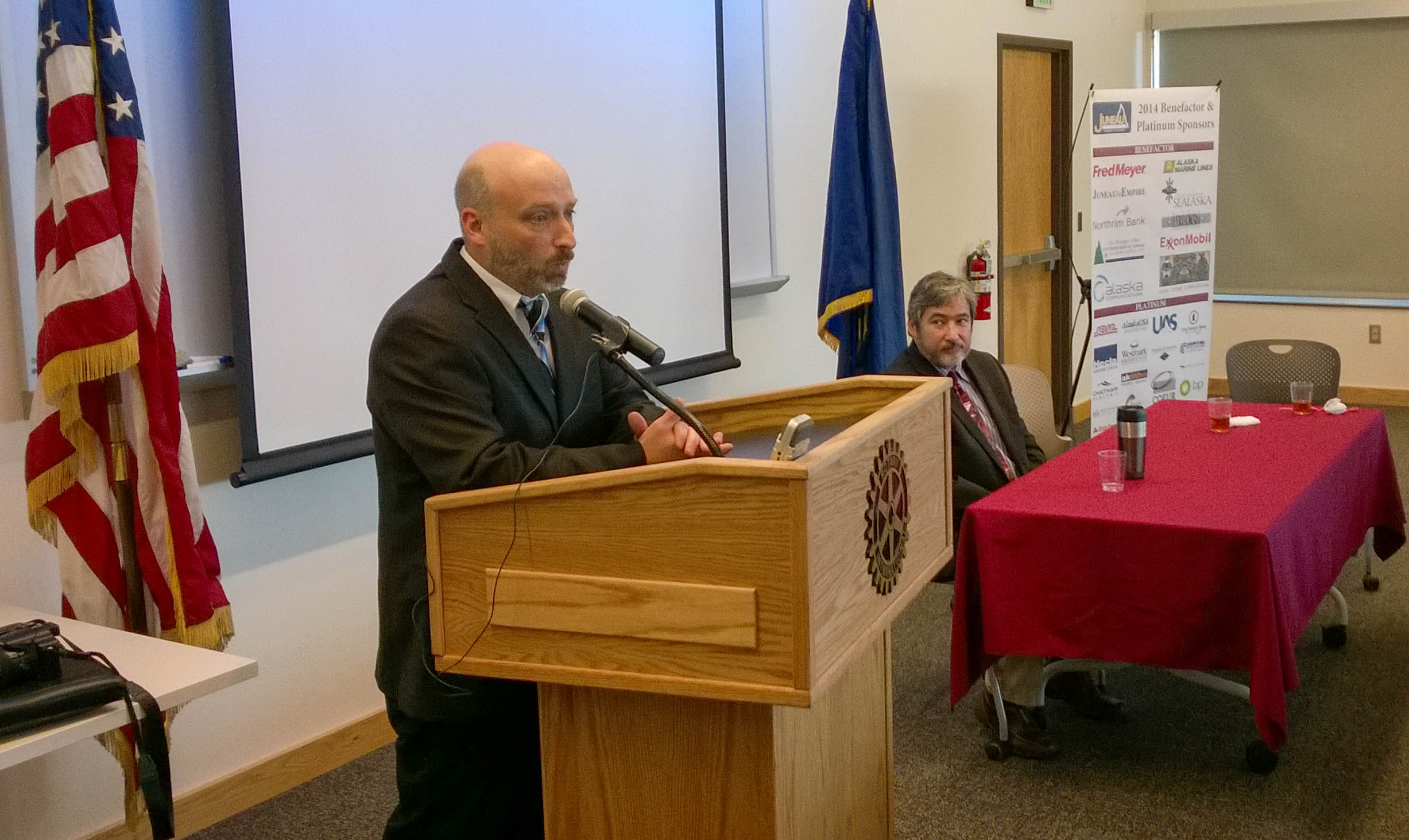
Republican challenger Peter Dukowitz addresses a question at a Juneau Chamber of Commerce candidate forum for House District 33. Incumbent Democrat Sam Kito III waits his turn. (Photo by Jeremy Hsieh/KTOO)
The candidates for House District 33 offered a lot of contrast on the issues at a Juneau Chamber of Commerce forum Thursday.
Democrat Sam Kito III is the incumbent facing Republican Peter Dukowitz in the Nov. 4 general election.
Potential construction projects were high on the chamber’s list of questions.
Kito didn’t say outright that he’s opposed to building the road to Haines, but said he is concerned about the costs.
“We’ve got a declining budget, we’ve got declining oil revenues, and I don’t think we can expand our transportation system significantly without a commitment to actually maintain those facilities. So, I’m concerned about the direction we’re going in to build a whole bunch of really big projects when we’ve got a gasline we also have to fund,” Kito said.
He said the state should prioritize projects that bring a return.
Dukowitz is pro-road.
“I think it’ll be great for Haines. It’ll give them, you know, jobs there, it’ll give them good jobs there for the ferry. It’ll do infrastructure. We’re going to be able to do hotels and restaurants. There’s going to be additional support with this road,” Dukowitz said.
He said the state Transportation Department expects the estimated $500 million dollar road will save the state another $500 million compared to new ferry service.
The candidates were also asked about what projects they’d like to bring to their district.
“We are seeing aging infrastructure, and as an engineer, I want to make sure we, as a state, provide adequate support to communities to maintain their infrastructure, their roads, their water and sewer projects,” Kito said.
Dukowitz said if he had one project, it would address housing.
“We need access to housing. We need — if it’s a corridor on Douglas Island, we need access to land, we need housing for the people. That’s something I’d like to work on as a priority for Juneau,” Dukowitz said.
There was more contrast on upcoming ballot initiatives. Dukowitz said he’ll vote to legalize marijuana. Kito is undecided. He said he’s OK with individuals using it, but is concerned about authorities’ ability to identify impaired drivers.
On raising the minimum wage, Kito supports raising it. He said he’s seen a lot of adults taking multiple minimum wage jobs to support families. And, the more revenue individuals make, “The more they can contribute to the economy. The more they spend in the economy. So raising that floor a little bit is the least we can do in Alaska, and I’d support that.”
Dukowitz:
“I’m the opposite. I am against the minimum wage. You have to have a balance between business. If you tax businesses too much, they go away. If you tax people too much, they go away. The minimum wage is not meant to live off of.”
Both candidates did agree that education and education funding are top priorities.
House District 33 covers downtown Juneau, Douglas Island and Lemon Creek, as well as Gustavus, Haines and Skagway.
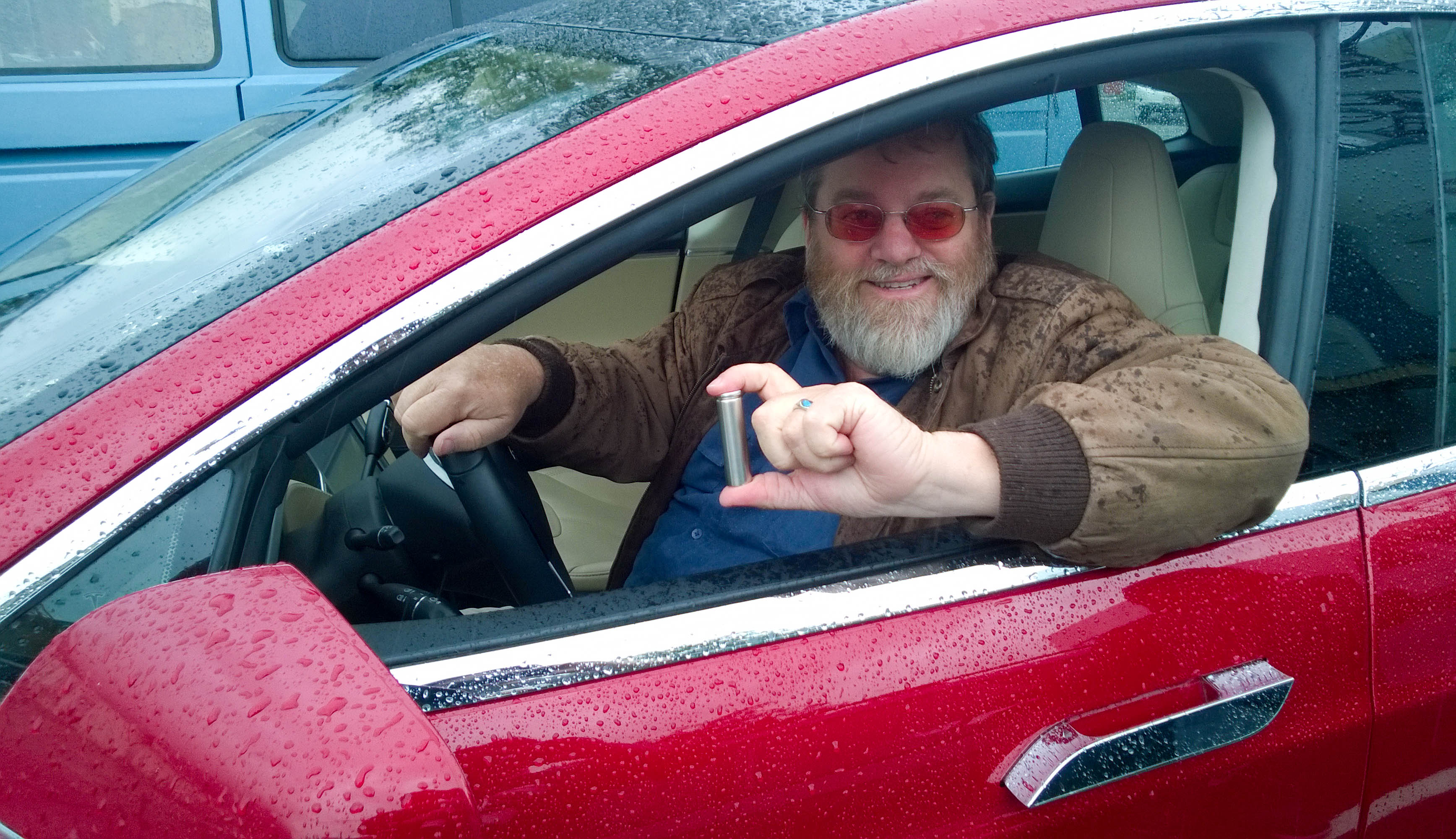
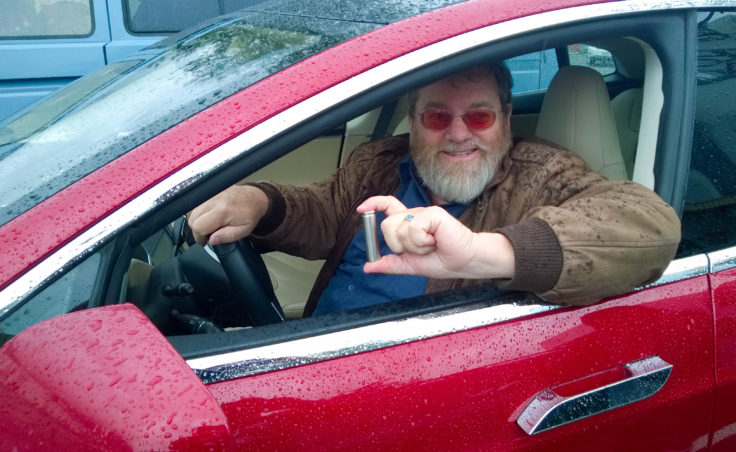
Guy Hall poses with a battery cell in hand. His Tesla Model S has more than 7,000 of the cells built into the undercarriage. It has a range of about 265 miles. (Photo by Jeremy Hsieh/KTOO)
KTOO's Casey Kelly drives Guy Hall's Tesla Model S on Basin Road. With a few taps on the touch-screen center console, Hall raised the suspension for the gravel road. (Photo by Jeremy Hsieh/KTOO)
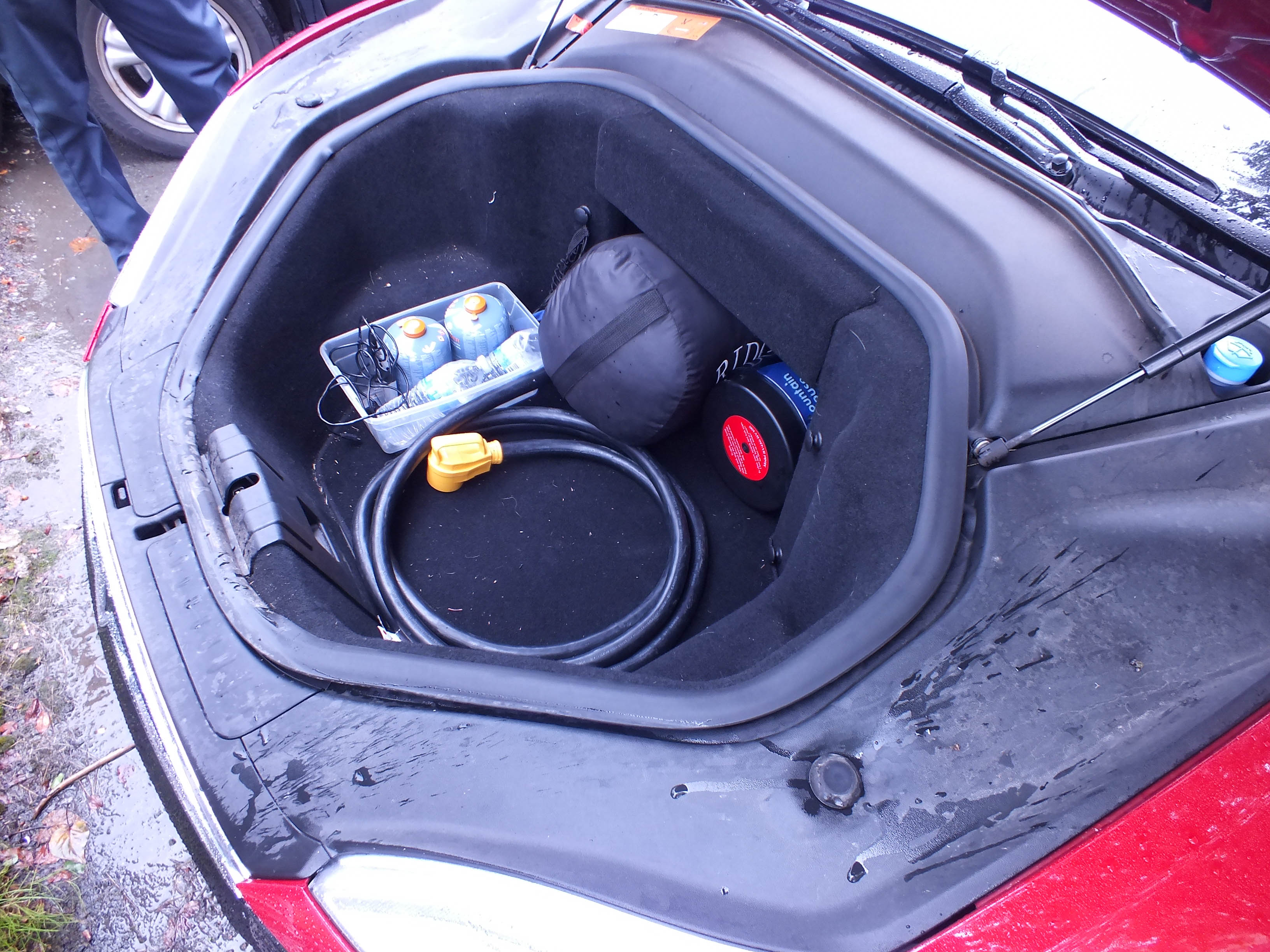
There's a second trunk where you'd expect the engine compartment in the Tesla Model S. Guy Hall calls it "the frunk." (Photo by Casey Kelly/KTOO)
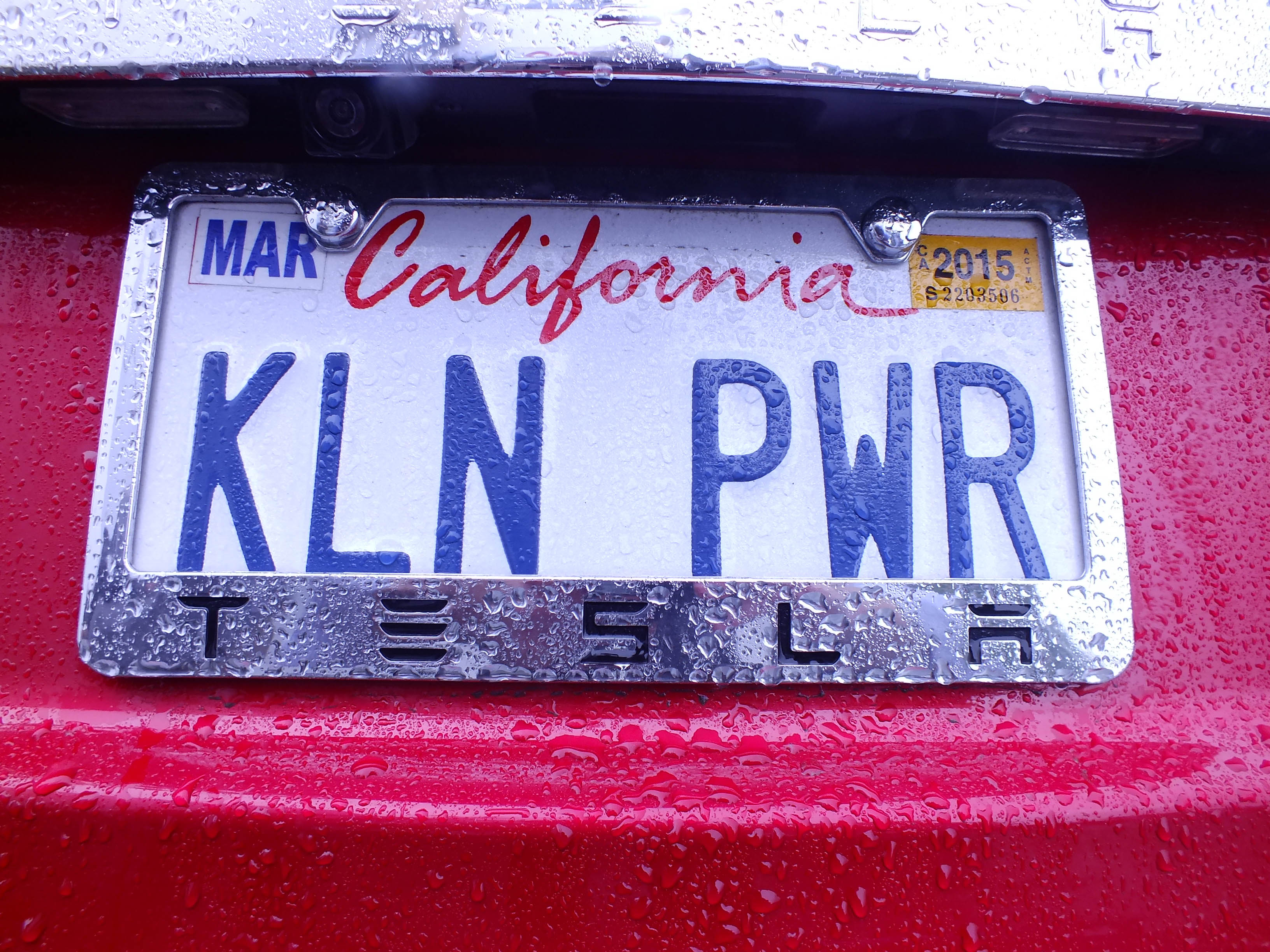
Guy Hall's vanity plate on his Tesla Model S. (Photo by Casey Kelly/KTOO)
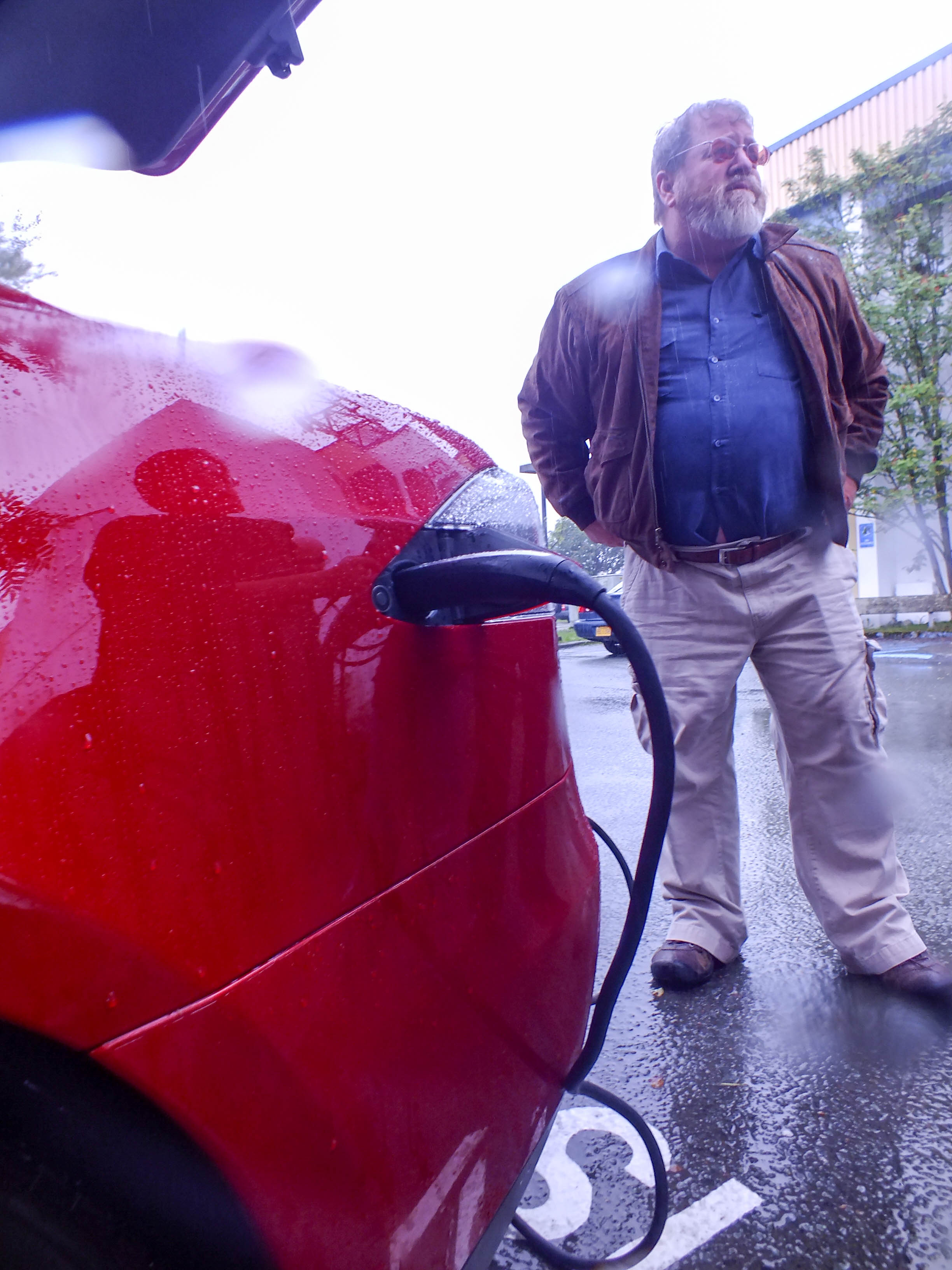
Guy Hall shows how he recharges his Tesla Model S. The power outlet for the electric car is hidden in the taillight. (Photo by Casey Kelly/KTOO)
Seconds after Guy Hall pulled into a parking lot full of Subarus at KTOO on Monday, five reporters were gawking at his sleek, red Tesla Model S.
Hall is the president of the Sacramento Electric Vehicle Association. He spent 17 days driving from the California-Mexico border to Fairbanks, and now he’s on the return leg.
He’s a retired Hewlett-Packard research and development guy and an electric car evangelist. At home in Sacramento, he has two more modest electric cars: a Nissan Leaf and a Chevy Volt.
But it’s the sporty, high-end Tesla that made the 3,400 mile journey north and has the wow factor.
He puts me behind the wheel and tells me to punch it when we’re on Egan Drive. We get pushed into our seats as the car accelerates, and we both break into giddy laughter.
“I won’t say what the speed is that we saw that go up to, but it was worthy of a ticket-me-red color car,” Hall says.
The laugh is symptomatic of what Hall calls “the Tesla grin.”
There’s no fuel to pump, no engine to rev, no gears to shift, no transmission. Pressing on the accelerator translates into electrons moving at the speed of light to the electric motor driving the rear wheels.
Where you’d expect an engine compartment up front is a second trunk. Hall calls it “the frunk.” Another big difference is at start up. The windshield wiper makes more noise than the drivetrain.
“Almost no sound compared to a gas car,” Hall says.
The battery is a heavy, flat panel that makes up much of the undercarriage. Its shape evenly distributes the weight and the location keeps the center of gravity low; that’s good for handling. The battery is actually made up of a series of more than 7,000 cells, each about the size and shape of a shotgun shell.
Hall says besides spreading the word, his trip was about seeing if an electric vehicle could even make it. His battery has a range of about 265 miles and charging stations are rare.
“But I was able to determine you can do it. There’s sources of electricity everywhere you go,” Hall says.
According to Tesla, a full charge would take more than three days from a standard 110-volt outlet. It takes about nine hours through a less common 240-volt outlet. Beefy appliances like laundry dryers and water heaters use those in the house. Electric car owners get them installed in their garages.
The 240-volt outlet is also a common hookup for RVs. So on the road, Hall charged up at RV parks. He says he even traded rides for some charging time at industrial shops and garages along the way.
“I wanted to set a baseline of how long it takes to get from the Mexican border up to Fairbanks,” Hall says. “And once that’s set, now others can try to beat it. And as someone gets a new record for it, (a) trophy will go on to them and it’ll rotate around.”
Will electric cars catch on in Juneau?
Right now, the only public charging station on Juneau’s isolated road system is at Alaska Electric Light & Power. But more are coming. The Juneau Economic Development Council helped raise $50,000 in grant money to build infrastructure supporting electric vehicles.
It required a $25,000 local match. The local donors are Juneau Hydropower, IBEW, Stanley Ford, AEL&P, The Leighty Foundation and the Juneau Community Foundation’s Blue Heron Fund.
The council’s Zach Wilkinson says five two-outlet electric vehicle chargers are on their way to Juneau thanks to the grant. They’ll be installed at the Eaglecrest Ski Area, downtown parking garage, new Mendenhall Valley library that’s under construction, University of Alaska Southeast and Eagle Beach State Recreation Area.
And Wilkinson says there’s money to buy a few more single-outlet chargers for local businesses willing to pay the installation cost.
“Part of what we’re aiming for is to lead the nation in public charging stations per capita,” Wilkinson says.
By his math, Juneau would only need 14 outlets. Wilkinson says some may be in place and available for public use before the end of the year.
Duff Mitchell is the vice president of the startup Juneau Hydropower, one of the local groups that chipped in for the grant. He’s been driving a Nissan Leaf since October and says electric cars are a great fit for Juneau.
“We don’t have range anxiety, it’s a lot cheaper and more effective to use electricity that’s home grown, sustainable, rather than importing other fuel sources into our community. It leaves those dollars here, and also leaves more money in a person’s pocketbook at the end of the month if they’re using electricity for their transportation needs,” Mitchell says.
“I call it beer math—it costs me less than a 12-pack of beer to drive my car all month.”
The vehicles can be pricey. Teslas start around $71,000, the Nissan Leaf starts at $29,000 and the Chevy Volt at $34,000, though the IRS offers up to $7,500 in tax credits for buying an electric vehicle.
Mitchell and Wilkinson estimate there are about 20 electric cars in town now.
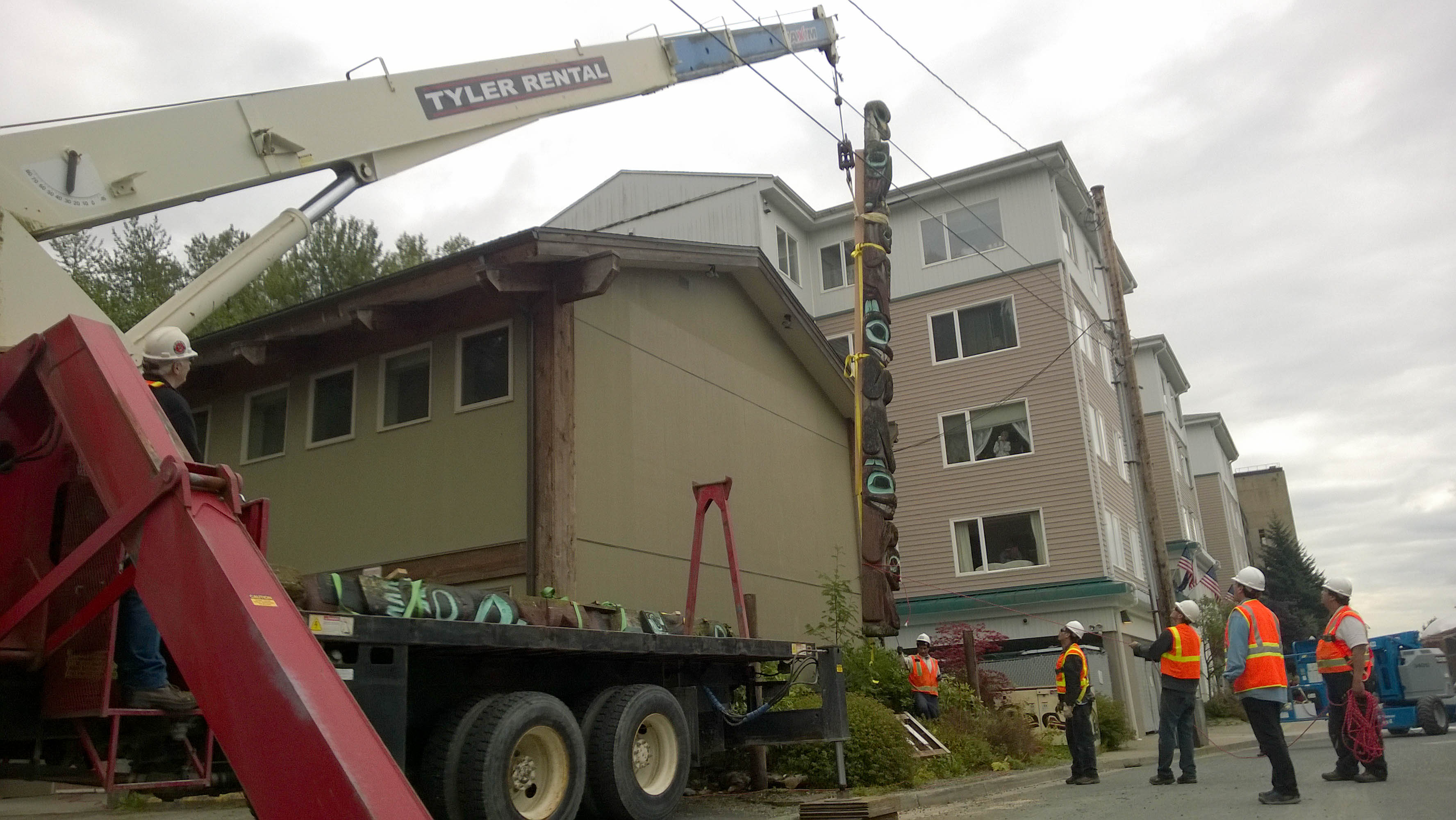
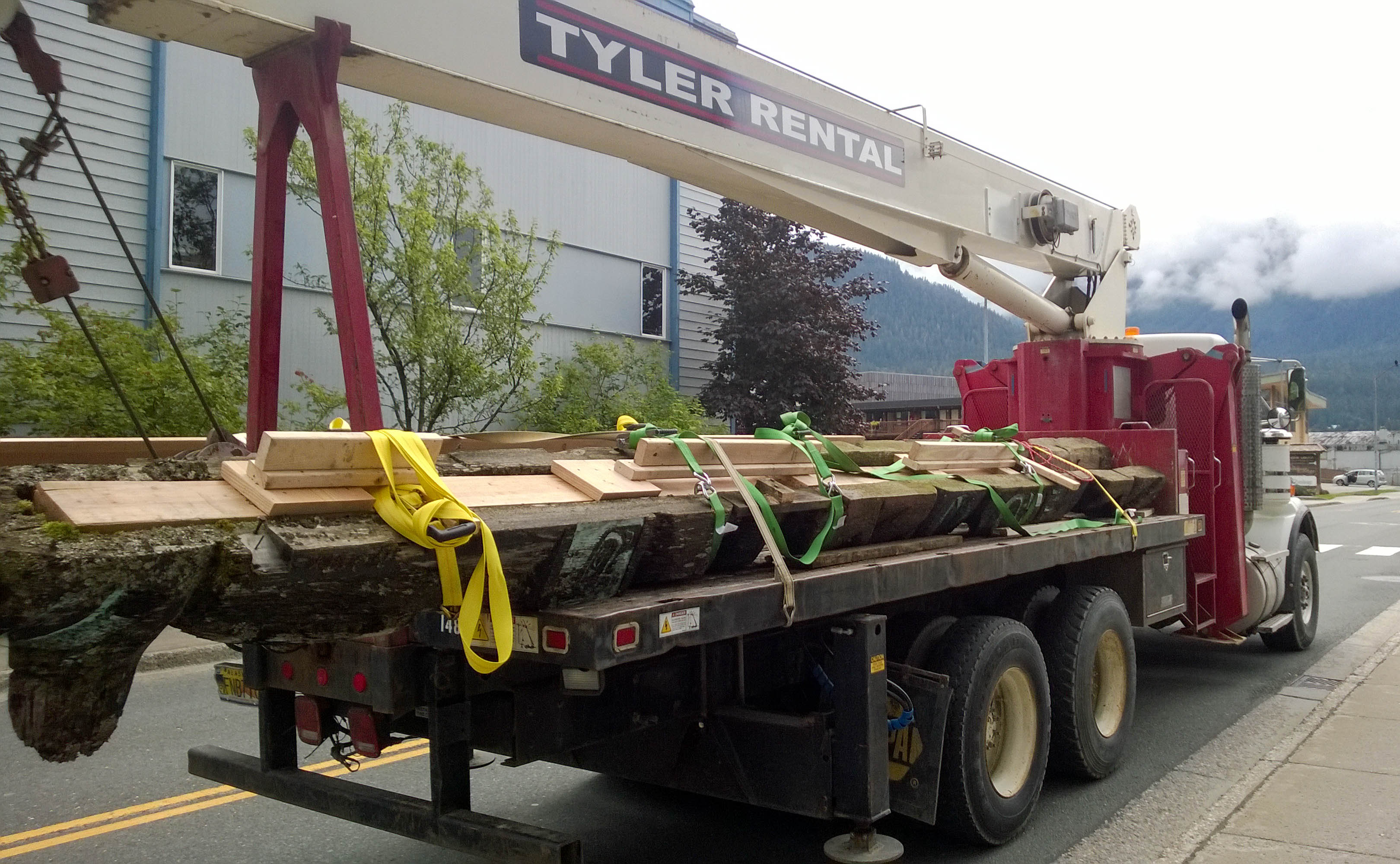
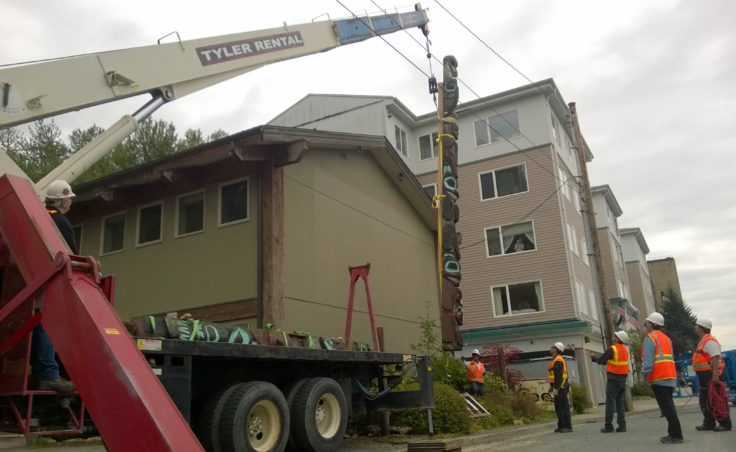
A 12-ton boom truck delicately lifts a weakened Eagle totem pole off its perch at the Gajaa Hit building. (Photo by Jeremy Hsieh/KTOO)
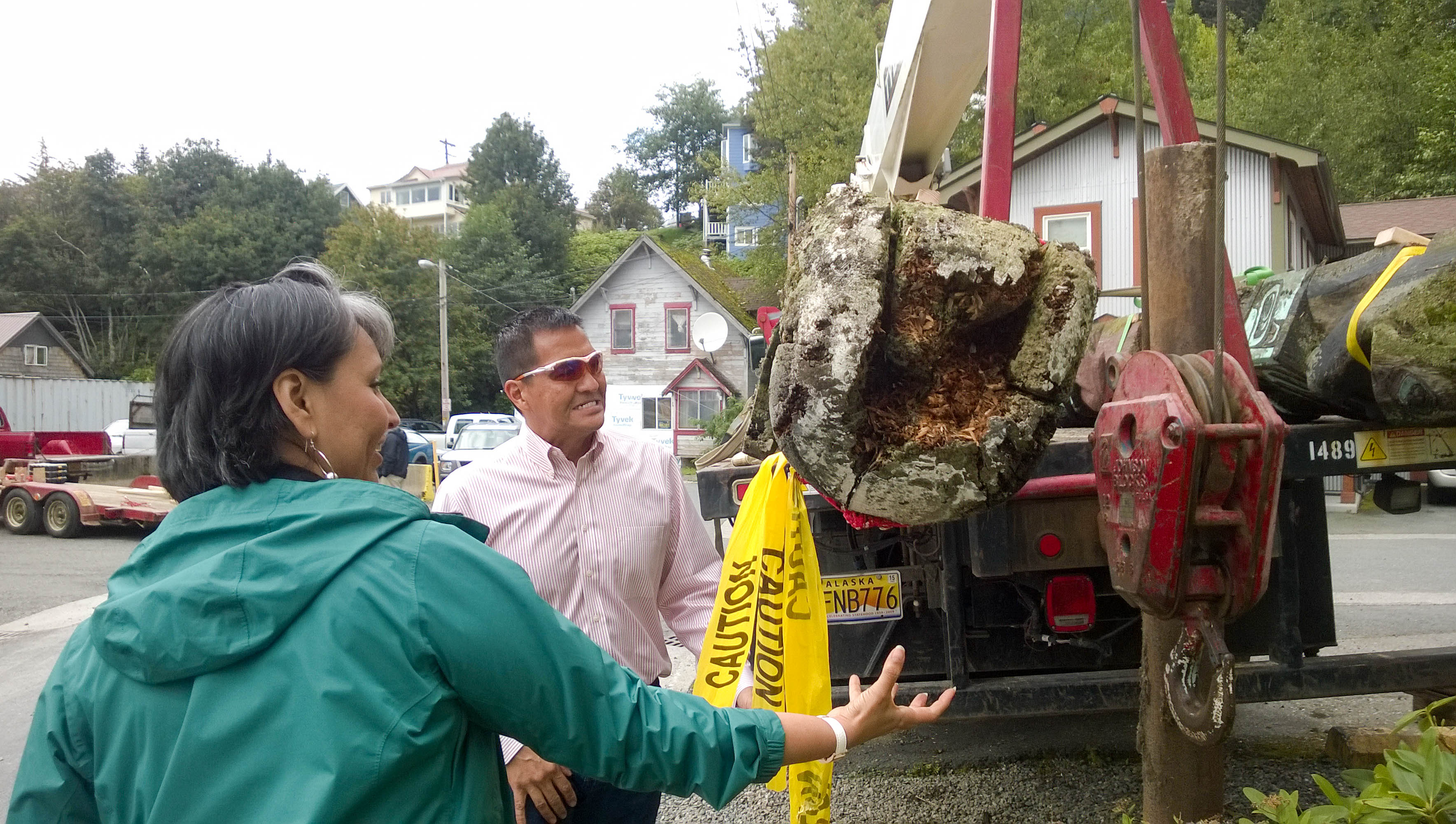
Shaadoo’Haa Gunaaxoo’Kwaan and Ricardo Worl get a closer look at the wear on the totem pole. (Photo by Jeremy Hsieh/KTOO)
The final resting place of the poles has yet to be determined. In the mean time, they'll dry out in a warehouse. (Photo by Jeremy Hsieh/KTOO)
The two totem poles that stood for 36 years in Juneau’s old Indian Village have been hauled off.
A work crew with a 12-ton boom truck pulled the delicate poles and hauled them to a warehouse Tuesday. They had deteriorated badly over the years, but were taken away more or less intact.
Ricardo Worl is the president and CEO of The Tlingit-Haida Regional Housing Authority, which owns the Gajaa Hít building where the totem poles stood.
“There’s a lot of discussion as to what would be the best and most appropriate solution and what we’re going to do with them,” Worl said. “We even talked about letting them lie in state, here in the village.”
Fear of vandalism and concerns that pedestrians wouldn’t properly respect them have cooled that idea, Worl said.
“So for now, we’re going to bring them to the housing authority warehouse, let them dry out inside the warehouse, and then we’ll decide what we’re gonna do with it from there,” he said.
Brian Wallace was a teenager when he watched the late Edward Kunz Sr. carve the poles. Tuesday, Wallace happened to be passing by and stopped to watch.
“It’s mixed emotions, you know? Seeing something like this, and I don’t know how well it can be restored, or if it’s going back to the spirit of the forest,” Wallace said.
Worl said parts may be salvaged for indoor display.
Meanwhile, a pair of Haida carving brothers that Sealaska Heritage Institute commissioned have completed the new totem poles and nearly finished the new screen that will replace the warehoused ones.
Worl said the target date for raising the new poles is Sept. 29.
An 87-year-old cruise ship passenger aboard Holland America’s Oosterdam died Thursday.
Juneau police responded in port and identified the woman as Corrine J. Underwood of Missouri. She was traveling with her daughter.
Lt. David Campbell described her as chronically ill. He couldn’t disclose specifics because of medical privacy laws, but says, “It looks like (a) rather lengthy medical history going back quite a while here, so looks as though it was probably natural causes.”
Authorities working with the U.S. Marshals in California have safely recovered a missing Juneau 2-year-old and arrested her mother on felony charges.
Jessica L. Rodriguez, 27, aka Jessica Barranco, has been wanted since June. According to court records, she’s accused of violating terms of past civil cases with the child’s father and lawful custodian, Bryan M. Ryder of Juneau. Rodriguez was forbidden from taking the child out of town.
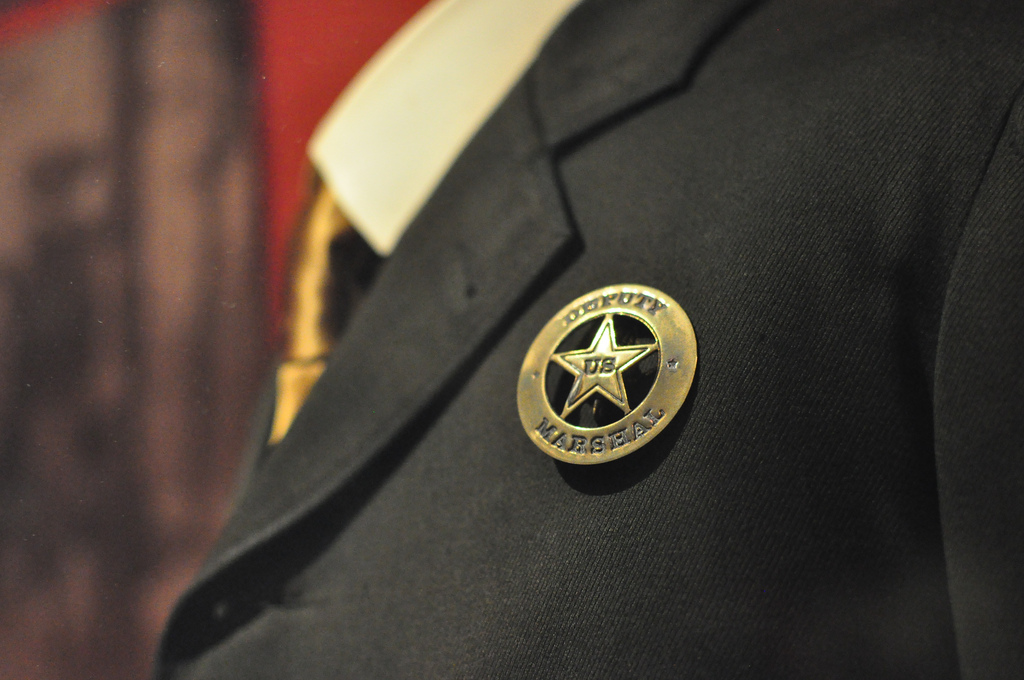
Deputy U.S. Marshal Rochelle Liedike is a spokeswoman for the Anchorage office. She says Rodriguez fled Juneau and was living in the California area.
The marshals say Rodriguez was arrested Wednesday in Temecula, California. The child will be reunited with the father.
Liedike says her agency cannot disclose much else, because the investigation is ongoing and to protect the child.
According to court records, a grand jury indicted Rodriguez in June on two counts of first degree custodial interference. The indictment alleges she took the child out of Juneau in July 2013, and out of state in December. The felony charges each carry a maximum sentence of 5 years in prison and a $50,000 fine.
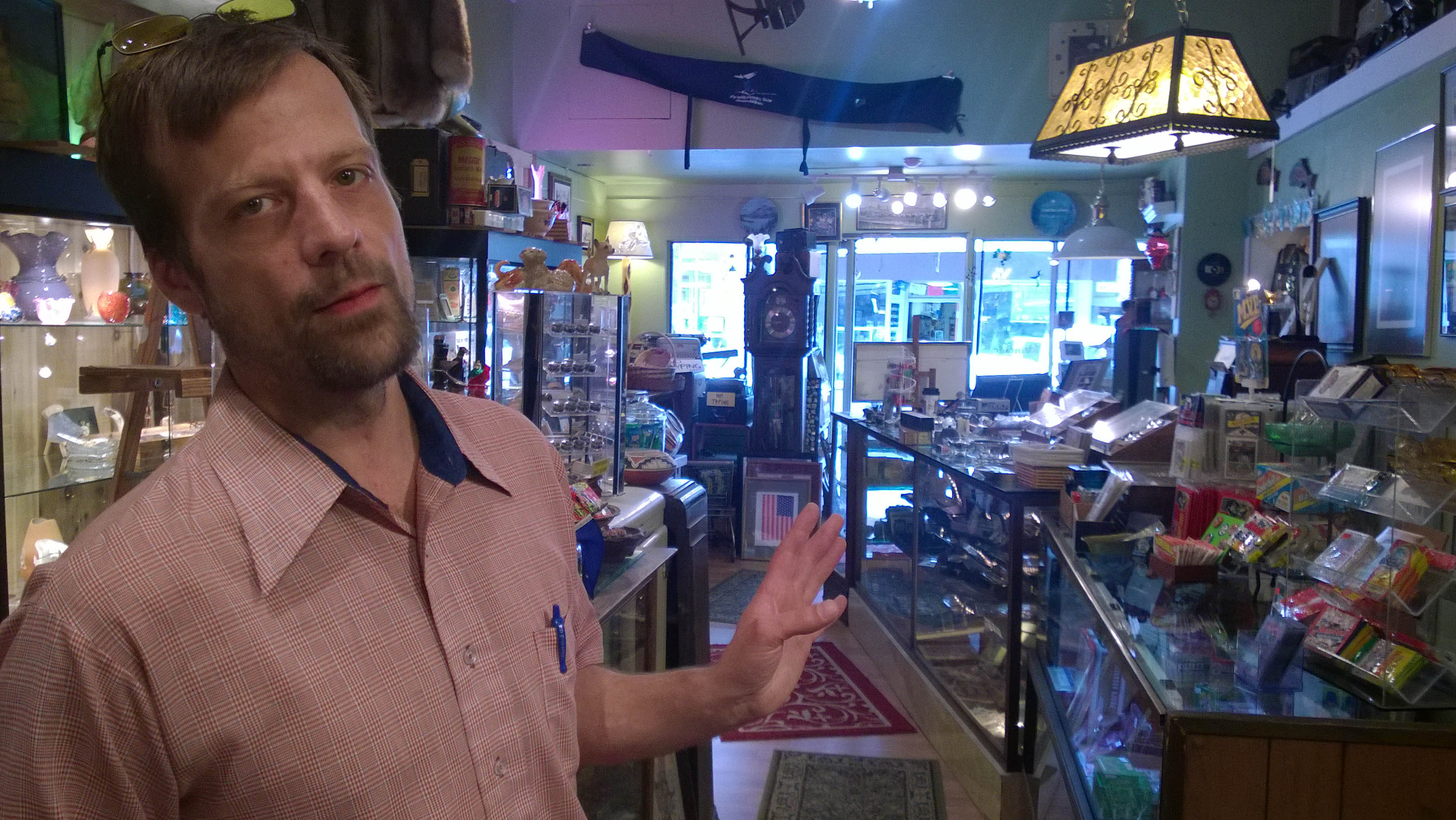
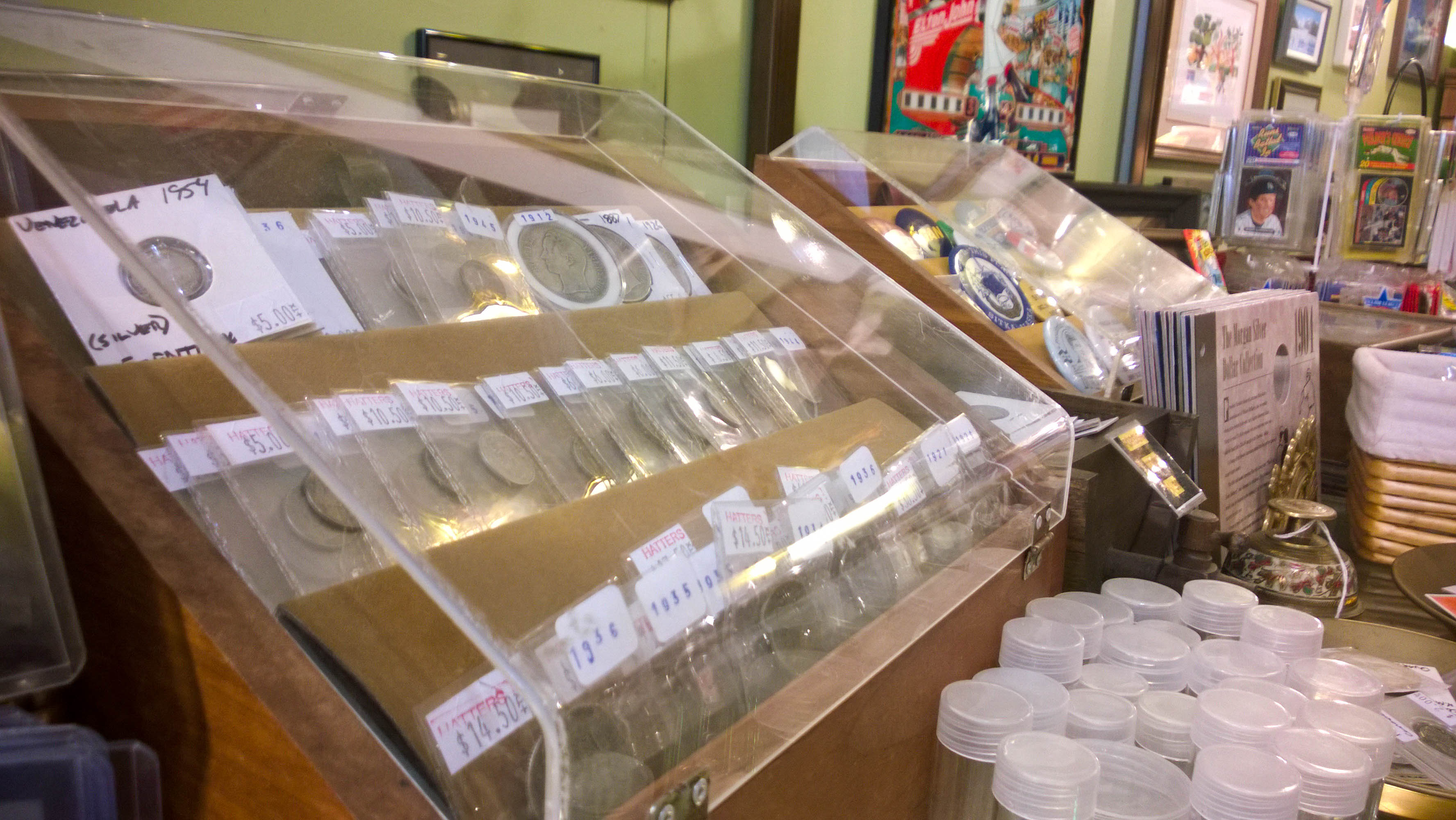
Jayk Kent, owner of Mad Hatters Emporium, says the new electronic record keeping requirements on secondhand coins and jewelry will be too cumbersome for him to comply with. He says he’ll have to shut down. (Photo by Jeremy Hsieh/KTOO)
The Juneau Assembly adopted a measure last night intended to help authorities track and recover stolen goods moving through legitimate businesses.
Police Lt. David Campbell described property crimes as a “massive” problem in Juneau.
“Big enough to the point where at the police department, we have five detectives. And three of them were assigned to property crimes and two of them were assigned to people crimes. So it’s a big enough issue that 60 percent of detectives were working just on property,” Campbell said.
Assemblyman Loren Jones, who served on the committee that worked on the ordinance, cited some numbers:
“JPD statistics over the last three years: (There) has been almost 3,000 thefts and close to 400 what they’re calling burglaries,” Jones said.
The ordinance targets shops that buy and sell secondhand goods. Those are different from pawn shops, which have special licenses and already are covered by similar requirements in state law. Because of those rules, Campbell said pawn shops aren’t much of a problem when it comes to stolen goods.
Juneau’s new ordinance requires secondhand dealers hold certain goods they traffic in for 30 days. It also requires secondhand shopkeepers electronically record and submit records of their transactions to police every week.
Secondhand coins and jewelry make up a lot of the inventory at Mad Hatters Emporium. (Photo by Jeremy Hsieh/KTOO)
The ordinance applies specifically to electronics and tools worth at least $50,precious metals and gems, coins or bullion, and firearms.
Police say thieves frequently target these items.
One of stiffest objections to the ordinance came from Ray Cox, owner of Rayco Sales. Cox buys and sells used firearms, as well as other outdoors gear at his shop. He said record keeping and storage alone would be costly.
“Plus I’m going to sit on that merchandise for 30 days. That’s 30 days of interest that I’ve got to pay for the money that I’m paying for that merchandise,” Cox said.
Again, that’s a big difference from pawn shops, where holding onto someone else’s stuff is part of the business model. At pawn shops, goods can be sold outright, or used to secure short-term loans. When the loan is repaid plus interest, the items are returned.
Assemblyman Jerry Nankervis said he sympathized with the intent of the ordinance, but felt the 30-day holding period, modeled after pawn shop statutes, was a bad fit. He also had concerns about civil liberties.
“I don’t believe that just because a business takes in something secondhand that the bar ought to be lower for them on what the police can and cannot tell them to do. I believe if you believe it’s a stolen item, and you believe who has it, you go see the judge and you get a search warrant to go confiscate that item,” Nankervis said.
The Assembly’s vote was 7-2, with Mayor Merrill Sanford joining Nankervis in dissent. Sanford didn’t speak to his vote.
The ordinance takes effect next month.
Close
Update notification options
Subscribe to notifications
Subscribe
Get notifications about news related to the topics you care about. You can unsubscribe anytime.