I dig into questions about the forces and institutions that shape Juneau, big and small, delightful and outrageous. What stirs you up about how Juneau is built and how the city works?
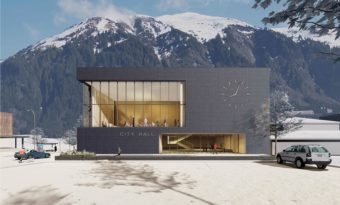
During a public forum in May, the City and Borough of Juneau’s design team shared this rendering of what a new City Hall building could look like on Whittier Street.
On Monday, the Juneau Assembly plans to take public comment and hold its final vote on measures to put questions on the October local election ballot focused on new infrastructure and how to pay for it.
There are three ordinances for three separate questions.
First, an ordinance to ask voters to extend a temporary portion of the city’s sales tax. Without action, 1% of the city’s overall 5% sales tax rate will expire in September 2023. If it is extended another five years, it’s forecast to raise $60 million. As with past renewals, the money is earmarked for several specific infrastructure projects. Here’s the list this time:
Deferred maintenance of city and Juneau School District facilities
Replacement of public safety equipment for the Juneau Police Department and Capital City Fire/Rescue
Redevelopment of Gastineau Avenue, Telephone Hill, and north State Office Building parking garage
Unlike past 1% asks, this year’s list also includes funding for items that aren’t traditional brick-and-mortar infrastructure:
Contributions to the city’s budget reserve
Support for expanding childcare availability
Support for affordable housing and ongoing development of Pederson Hill
Information technology upgrades
A second item would ask voters to authorize $35 million in debt to build a new city hall on Whittier Street. The new facility would let the city centralize its office workers and public-facing services, which are currently spread across four different buildings downtown. Of those four buildings, the city only owns the current City Hall. Watt said the city pays more than $800,000 a year in rent for the extra office space.
“When your business plan is to be in business FOREVER, you should own your own building — it just makes economic sense,” Watt told the Greater Juneau Chamber of Commerce recently.
Watt said he knows that asking the public to OK so much new spending is a big ask.
“I want people to be firmly aware that there is a cost of doing nothing,” Watt said. “And that’s a cost of not deciding. That cost is, we’re going to keep paying that rent forever. You know, we probably could’ve bought several of those buildings — or probably, we bought several buildings for those owners already, by being such a good tenant.”
The existing City Hall building dates back to the 1950s and needs significant repairs. Public Works and Engineering Director Katie Koester said it needs about $12 million of work over the next several years to stay viable.
“Some of it is near term, like painting the facade,” she said. “But you can’t paint the facade without repairing the plaster. You can’t repair the plaster without fixing the windows. Then you need to replace the windows — so it escalates very quickly.”
Turf and track surfacing for sports facilities at Adair-Kennedy Park
A new public use cabin
Areawide trail maintenance
The Assembly is also taking up two other ballot question-related ordinances to let the city manager campaign for the new city hall question, and against a petition-driven referendum to repeal a local mandate to disclose the price of real estate sales to the city assessor’s office. The city manager is asking for $25,000 for each of those campaigns.
The Juneau Assembly meeting begins at 7 p.m. Monday. Members of the public can participate in person or remotely through Zoom. The remote option requires advance notice by 4 p.m. the day of the meeting with the city clerk’s office at 907-586-5278. The Assembly also takes written comments by emailing BoroughAssembly@juneau.org.
KTOO also broadcasts Assembly meetings live at 104.3 FM.
Many Ironman Alaska athletes are scrambling after Alaska Airlines notified them that bicycles shipped through them may not arrive in time for the triathlon in Juneau, which is less than two weeks away.
In an email to customers on Tuesday, Alaska Airlines said that applies to bikes checked as baggage or shipped by Alaska Air Cargo. The airline steered athletes to the Ironman organization to find other shipping options.
Suzanne Rinehart is a college administrator in the Chicago area who’s been doing Ironman races for a decade. Now 51, she said she was looking forward to doing her last, full-length Ironman in Alaska.
“I invested a lot of training — it’s a little frustrating to think of all the training I put in,” she said. “And now I’m this close, and then everything kind of raveled and fell apart at the last minute.”
After she got the email from Alaska Airlines, she looked into last-minute couriers. The options are limited and expensive. Some require disassembling the bike. Alaska Airlines offered her an earlier flight to Juneau to beat the rush, but that would mean spending a lot more on accommodations, taking more time off work, plus extra headaches coordinating with her travel companion.
So she decided to cancel her whole trip.
“The bike thing was the last straw for me,” she said.
Mike Arabia is still headed to the race from southern California. He said he got quotes to ship his bike into Juneau through UPS and FedEx for around $1,000. But he was able to get an assurance in writing from an Alaska Airlines agent that his bike would arrive by Aug. 5 — two days before the race.
“I’m going to have to cross my fingers and hope that this agent that I chatted with … is correct,” he said. “And that my bike makes it there before race day.”
Like Rinehart, Arabia’s unhappy about the last-minute communication for a foreseeable problem. It’s too late now, but affordable, third-party options for shipping bikes are available with more notice.
“Shame on Ironman. Shame on Alaska Airlines for not coordinating early,” he said.
Ironman did not immediately respond to a request for comment.
In a statement, Alaska Airlines said they’ve been communicating with the Ironman organization for the last year with a goal of getting important travel information to athletes. The airline said its email to customers about bike capacity was a backstop, “in the event they had not heard from the Ironman organization.”
Other athletes do appear to be opting for some of those expensive shipping options. Ken Hill owns the shop Juneau Bike Doctor. He saw a thread about the bike issue on Facebook and offered up his shop as a shipping destination and storage spot for athletes sending bikes ahead of their flights.
“The phone’s been going crazy and our Facebook messages as well,” he said. “I literally can’t step away from my computer without it piling up.”
Within 24 hours, he said 30 to 40 people took him up on the offer. He said he expects bikes to start showing up on Monday.
Travel Juneau, Juneau’s destination marketing organization, has been working closely with the race organizers. Executive Director Liz Perry said the race organizers and airline are working together to smooth things out.
Correction: An earlier version of this story incorrectly stated that Alaska Airlines did not respond to a request for comment. The reporter failed to make a request.