
Jeremy Hsieh

Local News Reporter, KTOO

I dig into questions about the forces and institutions that shape Juneau, big and small, delightful and outrageous. What stirs you up about how Juneau is built and how the city works?

Photos from the first Ironman Alaska race in Juneau

Sunday’s race in Juneau was the first Ironman triathlon in Alaska. More than 700 athletes finished the race.

The first across the finish line was Alex Whetman of Riverton, Utah. It took him 9 hours, 11 minutes, 17 seconds to swim 1.2 miles in Auke Lake, bike 112 miles on Glacier Highway and run a full 26-mile marathon through the Mendenhall Valley.

Liz Cullen of Gibson, British Columbia, was the top female finisher with a time of 10 hours, 23 minutes, 3 seconds.

The first person from Juneau to finish was Will Coleman, who was 14th overall. Beth Gollin was Juneau’s first female finisher and 13th female overall.

John Bursell was Juneau’s second finisher. He has completed several Ironman races in the past, and met his goal this time to qualify for the Ironman World Championship event in Hawaii in October.

“It was a great experience overall,” he said. “I think Ironman did a great job. I was super-impressed and proud of Juneau. You know, the way people turned out – the support was incredible, the volunteers were incredible. And we heard that over and over again from people who came from out of town to compete. This was basically the most supportive community they’ve ever raced in.”

Bursell says locals volunteered, loaned out their own personal bikes, opened up their homes to house athletes, even offered free car rides around town. According to a press release from Ironman, more than 1,400 people volunteered.

The event had a lot of challenges. Race officials cut the swim portion in half, due to the cold water temperatures in Auke Lake.

Before the race even began, logistics issues drove down turnout. In a press release, Ironman said “approximately 1,000” athletes came to Juneau for the event. An official list dated from April had identified more than 1,300 participants.

Juneau’s destination marketing organization, Travel Juneau, worked closely with race organizers. Executive Director Liz Perry says there will be a full debrief to work on making the second Ironman Alaska event go smoother. Perry says there’s a three-year contract, meaning Ironman Alaska will be back in Juneau in 2023 and 2024.

Juneau Assembly votes to keep city neutral on October ballot questions

Protect Juneau Homeowners' Privacy July 2022
The group Protect Juneau Homeowners’ Privacy had this entry in Juneau’s 2022 Fourth of July parade. The group wants local voters to repeal a city mandate to disclose real estate sales prices. The Juneau Assembly recently debated if the city government should publicly oppose the repeal, or stay neutral. (Photo courtesy of Ann Sparks)

Is it OK for the City and Borough of Juneau to publicly take sides on local ballot questions? The Juneau Assembly wrestled with two versions of that question on Monday night before deciding “no” on both. Which means that in their official duties, city staff must stay neutral on the ballot questions in the October local election.

State law generally bars state agencies and local governments from using their resources to influence the outcome of elections. A 2018 Alaska Supreme Court opinion maintained that even using a city government’s email system can be a violation.

But using city resources to inform and educate the public is OK, City Attorney Rob Palmer explained.

Deputy Mayor Maria Gladziszewski asked, where is the line between informing the public and influencing the public?

“So it’s not ‘facts’ that are probably the most operative issue,” Palmer said. “It’s how those facts are stitched together and tell a story. So the legal standard is, have we spent money to influence the outcome of election?”

City Manager Rorie Watt explained what that means practically.

“It’s likely that we would have a very muted public involvement, and very limited. I would not want to put my staff in a position of making an APOC violation,” he said.

APOC is the Alaska Public Offices Commission, a state body that receives campaign finance complaints and issues fines for violations.

“It would be a fine line to walk on providing information,” Watt said. “Where and how you cross the line in a debate from providing factual information to expressing an opinion can be challenging.”

For example, there are some commonsense reasons why city officials want to consolidate current city offices spread across multiple buildings into a single, new city hall building. One upcoming ballot question, which the Assembly approved on Monday in a 7-2 vote, will ask voters to authorize the city to borrow up to $35 million to pay for a new city hall. Assembly members Greg Smith and Maria Gladziszewski voted no.

“In making the business case for city hall, some of those arguments are subjective arguments,” Watt said. “So saying things like, ‘Having all the offices in one place would be more convenient and more efficient.’ Are those facts or are those suppositions? I think it’s actually quite tricky.”

State law does leave a pathway for state agencies and local governments to legally campaign on ballot questions — on the condition that state lawmakers or local elected officials pass legislation that sets aside money specifically to influence the outcome of a ballot question.

That’s what prompted the Assembly’s debate on Monday. Watt had asked the Assembly to consider letting him and his staff support the city hall question and oppose a question to repeal a mandate to disclose real estate sales prices.

“To me, it doesn’t seem right that government would get involved in taking an advocacy position in an election, in a political matter like this,” said David Ignell of West Juneau during public testimony. “I think it sets very bad precedent.”

Assembly member Carole Triem was sympathetic to the point but struggled with how to vote on the real estate disclosure advocacy question.

Real estate professionals and developers are leading the repeal effort, which began with the citizen petition process. They say the policy is an invasion of privacy. The Juneau Assembly created the mandate in 2020 and added fines this past February. Most members think mandatory disclosure will lead to more accurate property assessments and more fairness in property taxes between different kinds of property owners.

“The benefits of mandatory disclosure are a lot more diffuse across Juneau, so it’s really unlikely that there’s going to be a competing advocacy group that organizes for the election to support mandatory disclosure,” Triem said.

Even though Assembly member Alicia Hughes-Skandijs called the pro-repeal side a “special interest,” she couldn’t get behind the city stepping in to oppose it.

“When I picture myself in the shoes of a citizen who got together with other citizens and gathered enough signatures, and knew I was getting something on the ballot, I ask myself how I would feel if then the government was spending my funds to work against me,” Hughes-Skandijs said.

The Assembly voted unanimously against having the city staff oppose the real estate disclosure repeal.

Of course, the Assembly members themselves can advocate for their positions on ballot questions without using city resources.

“I think it’s much more appropriate for Assembly members to do that job,” Assembly member Michelle Hale said. “I think that is our job to do. And it’s tricky, because we have a citizens’ ballot initiative. But I think that is our responsibility.”

The vote on having city staff support the city hall question also failed, but with three yes votes. Mayor Beth Weldon, Wade Bryson, and Alicia Hughes-Skandijs voted yes.

Deputy Mayor Maria Gladziszewski said she went around and around on her first vote but felt decisive about her city hall vote.

“This is the exact same thing,” she said. “The first was to defend our decision that we made. And this is also to defend our decision that we made. And I was on the fence on it, but once I finally worked through it, if we’re going to vote no on that one, we have to vote no on this one.”

To Hughes-Skandijs, opposing a citizens’ referendum was a big distinction from supporting the Assembly’s own city hall question.

“That to me is totally different than us saying, ‘We’re going to put this thing on the ballot, we think it’s a good idea,’” Hughes-Skandijs said.

Other ballot questions

Earlier that night, the Assembly held public hearings and final votes to approve two additional ballot questions.

The Assembly voted unanimously to ask voters to renew 1% of the city’s sales tax rate for five more years. The revenue is earmarked for city infrastructure and special projects.

And the Assembly voted 6-3 to ask voters to authorize the city to borrow up to $6.6 million to pay for parks projects. Christine Woll, Alicia Hughes-Skandijs and Michelle Hale voted no.

Affordable housing concerns prompt Juneau Assembly to take stock of short-term rental market

Airbnb sign
(Public domain photo courtesy of Open Grid Scheduler)

If you browse websites like Airbnb and Vrbo for overnight rentals in Juneau, there are dozens and dozens of listings. Many have only a handful of reviews or none at all, suggesting they only recently went on the market as vacation rentals.

City officials are concerned these listings may be eating into Juneau’s already very limited housing stock.

On Monday, the Juneau Assembly approved spending $20,000 to hire a third-party firm to collect data about this market.

“We think of those third-party services principally as reconnaissance,” City Finance Director Jeff Rogers said during an Assembly Finance Committee meeting last month. “They’re snooping, crawling the web, looking at rentals, trying to see how often those rentals are rented, what the approximate rates are. There’s some work that most of those companies do on the backend to line up a rental listing with a parcel and potentially with an owner.”

In the latest business climate survey commissioned by the Southeast Conference, business leaders in the region identified a lack of affordable housing as the top barrier to economic growth. It directly contributes to labor shortages.

The Assembly has also been considering mandating that operators of short-term rentals register their properties with the city. Together, these may be early steps the Assembly is taking toward limiting Airbnbs and similar rentals.

Assembly member Wade Bryson thinks the flurry of new short-term rental listings may be a temporary blip, caused by this weekend’s Ironman Alaska event.

“I think waiting till after Ironman will give us a better understanding of what the community is really going to be like,” he said. “Do people like this? Is it going to be a true problem that just continues to grow? Or do people really be like, ‘Oh my God, that wasn’t as great as I thought. It’s not awesome to bring a stranger into your personal home and let them use your stuff for a week.’”

Bryson urged patience.

First Ukrainian refugees resettle in Juneau

Ukrainian flag
A Ukrainian flag. (Creative Commons photo by Conall)

A pair of refugees from Ukraine have resettled in Juneau.

Mayor Beth Weldon introduced Iryna and Ivan Hyrnchenko during a Juneau Assembly meeting on Monday. Weldon said they are the first Ukrainians to arrive in Juneau through a program that supports regular Americans who volunteer to help resettle refugees.

The U.S. State Department helped create the program after the U.S. pulled out of Afghanistan last year.

Iryna Hyrnchenko thanked Juneau for the warm welcome and spoke about the war in Ukraine.

“What is happening now in my country cannot be put into words,” she said. “There, we have our family and our hearts are with them. … I hope we found our new home here and life without fear. Thank you for all of your support and understanding.”

The Assembly gave them a pool pass and bus pass as welcome gifts.

Newscast – Tuesday, Aug. 2, 2022

In this newscast:

  • U.S. Sen. Dan Sullivan supports House Speaker Nancy Pelosi’s visit to Taiwan
  • Two refugees from Ukraine resettle in Juneau
  • UAF and UAS offer a new graduate degree in marine policy
  • Oath Keepers member and Wasilla Rep. David Eastman gets sued for disloyalty
  • Outdoor deaths in Anchorage spike
  • The National Weather Service says a break in the rain is coming after irregular dumps
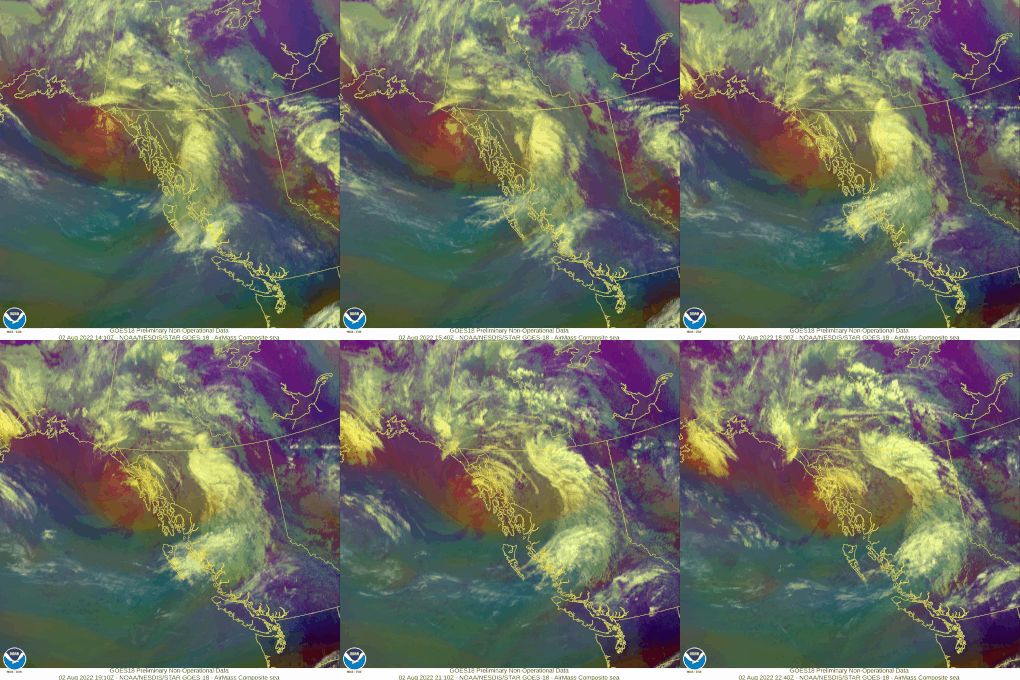
After sporadic dumps of rain, Juneau could get a 2-day break in the weather

This satellite animation from the National Weather Service shows a weather system moving across Southeast Alaska on morning and afternoon of Aug. 2, 2022.

A weather system passing over Juneau today is causing irregular dumps of rain.

“The airport had over .4 inch in one hour. So that’s really, really heavy for precipitation rates,” said senior forecaster Nicole Ferrin with the National Weather Service.

She said she’s been tracking a low pressure system that has bands within it that cause periods of intermittent, heavy precipitation. She said the Weather Service expected the overall precipitation rates but updated the forecast to reflect the rainfall’s on-and-off nature.

Ferrin said weather-related hazards from this event are unlikely.

“Occasionally, when the ground is saturated and there’s a significant wind shift that happens — slides and things can happen,” Ferrin said. “But usually that’s more with a really heavy event that lasts for a longer duration than what we’re seeing right now.”

Looking ahead, she said to expect a break in the rain on Wednesday and Thursday.

“And then we’ve got really heavy rain coming back on Friday night. And so anyone with plans Friday night might need to move things indoors,” she said.

The opening ceremony for the Ironman Alaska is scheduled for Friday night, outdoors at Peratrovich Plaza.

Ahead of this week’s storms, Juneau Docks and Harbors asked all boat owners to make sure their vessels are secure and are not accumulating rainwater.

Site notifications
Update notification options
Subscribe to notifications