KCAW - Sitka

KCAW is our partner station in Sitka. KTOO collaborates with partners across the state to cover important news and to share stories with our audiences.
Scientists look for clues to Mt. Edgecumbe’s next eruption

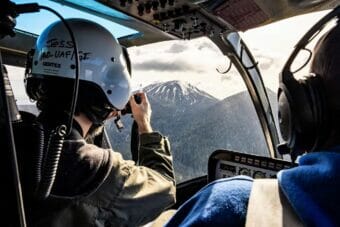
Geophysical Institute research assistant professor Társilo Girona takes video footage while graduate student assistant, Claire Puleio, takes a forward-looking infrared camera video during a reconnaissance flight around Mt. Edgecumbe volcano on Kruzof Island. (UAF/GI photo by JR Ancheta)

While no eruption is imminent, scientists from the Alaska Geophysical Institute in Fairbanks recently spent a few days on the flanks of Mt. Edgecumbe — and on surrounding beaches — collecting information on surface temperatures and gasses they hope will shed light on what’s brewing beneath the surface.

Carbon dioxide can’t be seen or smelled, but a team of scientists from the Alaska Geophysical Institute knows how to detect it. Six of them spent a few days helicoptering between Sitka and Mt. Edgecumbe in early June, testing the soil of Kruzof Island for CO2.

Claire Puleio is a doctoral student at the University of Alaska Fairbanks. Her team was at the Sitka airport, waiting for a break in the weather.

“We’re hoping to measure diffuse CO2 – those same CO2 measurements we’ve been taking along the flanks of the volcano,” she said. “Then, if we could get inside the crater, we’d like to take some measurements there. However, it’s unclear if it’s snow-free right now.”

Puleio studies under Research Assistant Professor Társilo Girona, who thinks that thermal anomalies on Mt. Edgecumbe detected by satellite data might suggest increased magma activity  that could be a precursor to an eruption.

“One of the hypotheses we have to understand those signals,” said Girona, “is that the gas that is moving from the magma source to the surface is producing this warming in the surface.”

The project is funded by NASA as part of a program for early career scientists. The team is tackling the problem on two fronts: in the air and on land.

Carlo Cardellini is from the University Perugia in Italy. He’s helped develop a method for collecting gas from the soil using a device called an accumulation chamber.

“We place a chamber on the top of the soil — it’s like a cooking pot,” said Cardellini. “And we leave  the concentration of carbon dioxide to increase inside the chamber. And the rate of increasing is something that is linked to the amount of gas that is passing from the soil to the atmosphere. So we are catching this increase, and we can compute how much gas is escaping from the soil.”

Graduate student researchers Claire Puleio, left, and Valerie Wasser walk to another location to test for CO2 gas along Mt. Edgecumbe’s summit on Kruzof Island. (UAF/GI photo by JR Ancheta)

Cardellini uses an infrared sensor that continuously measures the concentration of CO2 in the cooking pot. But he also collects samples to take back and study in the lab. CO2 produced by magma will have a different isotopic signature than CO2 produced by organic decomposition — and there is a lot of organic decomposition on the slopes of Mt. Edgecumbe, which are primarily wetlands.

For the bigger picture, you’ve got to be airborne. Taryn Lopez is a volcanologist with the Alaska Volcano Observatory. While the others are sampling the slopes of the crater, she’ll be overhead doing what is called a “gas flight.”

“Some gasses exsolve, which means they form bubbles really deep, such as CO2,” Lopez said. “Where things like water and SO2 (sulfur dioxide), which are common volcanic gasses, exsolve very shallow. So what we’re looking for is the composition of the gasses. If we see gasses, and if we see the composition, we can tell if the magma is deep or shallow.”

Girona says all the data and information collected by the Geophysical Institute team will be published in several papers and shared with the Alaska Volcano Observatory, which is sending its own team to Mt. Edgecumbe later this summer. And hopefully, Girona said, “We can better understand how the volcano works.”

Navigation, communication were factors when cruise ship slammed into Sitka dock, report says

The Radiance of the Seas, pictured here, crashed into the Sitka Sound Cruise Terminal dock last summer, doing over $2 million in damage (NTSB Photo)

Miscommunication and an out-of-date navigational chart were both found to be factors when a Royal Caribbean cruise ship slammed into the dock at the Sitka Sound Cruise Terminal last summer. The National Transportation Safety Board released a 14-page report on the incident late last month.

On the morning of May 9, 2022, the Radiance of the Seas was pulling into port in Sitka, when it struck a mooring dolphin. While no injuries were reported in the accident, damage to the pier was estimated at over $2 million dollars, and that part of the dock was unusable for the first half of the summer season while awaiting repair.

The 14-page NTSB report details communication between the master, pilots, and the bosun of the ship leading up to the accident. It found that the bridge team had relied heavily on electronic navigational charts to dock the vessel, which included incorrect information about the dock’s length.

The Sitka Sound Cruise Terminal dock was extended by nearly 400 feet in 2021. The NTSB found that the new length had not been reported to the National Oceanic and Atmospheric Administration, which led to the navigational chart being out-of-date, and may have been a contributing factor to the accident.

The NTSB also found the master of the ship misunderstood directions and information about the boat’s distance from the pier being called out by a crewmember while the vessel was rotating.

Weather was good and conditions were clear with 10 mile visibility as the ship was approaching the pier, and the report found that the bridge team should have seen the dock extension and maneuvered the boat accordingly. They also had radar technology and cameras available to assist with their approach, but instead, relied too heavily on their electronic charts to determine the vessel’s relative position to the pier.

You can read the full NTSB report here

NOAA says revised analysis could allow Southeast king salmon troll fishing, despite ruling

Trollers wait in Ketchikan’s Thomas Basin on Oct. 8, 2022. (Eric Stone/KRBD)

The National Marine Fisheries Service hasn’t ruled out the possibility of opening the summer troll season for king salmon in Southeast Alaska, despite a federal judge’s recent ruling to the contrary.

The service’s Alaska regional administrator, Jon Kurland, told a roomful of trollers during a June 7 meeting in Sitka that the agency was working hard to correct the problems identified in the federal lawsuit. The Wild Fish Conservancy in Washington state sued to stop the Southeast Alaska troll season, seeking to protect endangered Southern Resident killer whales’ food sources.

If successful, Southeast trollers might be able to harvest king salmon this summer – if not on the traditional date of July 1, then possibly in August.

To get a feel for the impact of the Wild Fish Conservancy lawsuit on Southeast trollers, try sitting in a room filled with them: Grizzled oldsters, seasoned men and women hardened by life on the ocean, well-known fisheries advocates,  young families, and a baby or two.

Kurland says that despite his lengthy title at the National Marine Fisheries Service, an arm of the National Oceanic and Atmospheric Administration, he is a neighbor and he gets it.

“So first off, I know that there’s been just a huge amount of concern about the implications of this suit and the potential for the troll fishery not to be able to open,” Kurland told the room. “I live in Juneau, I have a sense of how important this fishery is for Southeast Alaska for a lot of small businesses, a lot of families, a lot of communities. It’s a big deal.”

The Wild Fish Conservancy sued the National Marine Fisheries Service in 2020, arguing that the service had violated the Endangered Species Act by failing to fully account for the impact of Southeast trolling on Southern Resident whales.

The Conservancy won, and a judge ordered Southeast Alaska king salmon trolling shut down until the problem could be remedied. And it’s just commercial trolling for chinook in Southeast Alaska – no other commercial or sport fishery anywhere from Alaska to California is affected.

Listen to the full audio of Jon Kurland’s update to trollers, Wednesday, June 7 2023, in Sitka.

It’s a baffling strategy, and Kurland is as surprised as anyone that the suit got this far.

“We were all sort of incredulous that this suit is focusing on Southeast Alaska fisheries, when there are a lot bigger threats that Southern Resident killer whales are facing then what’s happening in these fisheries,” Kurland said. “The Southeast Alaska fisheries are a really small contributor to the challenges that Southern Resident killer whales face in their recovery. But anyway, it is what it is.”

Kurland explained the nuts and bolts of the lawsuit, which were already known to many in the standing-room only crowd in Sitka’s Harrigan Centennial Hall: How it stemmed from a 2019 biological opinion prepared by the National Marine Fisheries Service, and the associated incidental take statement required to conduct a fishery that could affect an endangered species.

NOAA Fisheries Alaska Region administrator Jon Kurland (left) speaks to Southeast Alaska trollers during a June 7, 2023 meeting of the North Pacific Fisheries Management Council in Sitka. (Robert Woolsey/KCAW)

He then took questions – some tough questions. Deborah Lyons, the Alaska Trollers Association’s representative to the Pacific Salmon Treaty, wondered how the National Marine Fisheries Service could be outflanked by a nonprofit conservation organization on a question of environmental policy.

“So when I look at what happened in Washington, NMFS, who are the experts on fisheries, issued an opinion that said: The Southeast fishery – yes – take some threatened salmon and take some salmon that are prey of an endangered whale,” Lyons said. “But in the opinion of the National Marine Fisheries Service, it was not a significant threat to any of those species. And yet (the Wild Fish Conservancy) was allowed to appeal to a judge and provide hand-selected bits of data that the judge found more compelling than the opinion of the agency –  the federal agency – that’s supposed to render these decisions. Now, how does that happen?”

Kurland responded that the Endangered Species Act has a provision that allows any citizen to bring suit, and that’s what the Conservancy did.

Although the National Marine Fisheries Service has appealed to the U.S. Ninth Circuit Court of Appeals and asked for a decision in June, it’s unlikely that the court would act so fast.

Instead, Kurland – without giving away too much legal strategy – said the National Marine Fisheries Service had one trump card it could play.

“So the agency has the authority under the Endangered Species Act to issue a new biological opinion and a new incidental take statement,” Kurland said. “It could be reviewed by the court, the court doesn’t need to approve it upfront. But it’s certainly possible that the plaintiffs will take issue with whatever we put out, and will ask the court to review it. But there is no no implicit requirement or explicit requirement for the court to approve it before it takes effect.”

This prompted troller Robert Bateman to drill down.

“It’s my understanding that once the (incidental take statement) and the new (biological opinion) has been written, and correct me if I’m wrong, you can basically put that in effect straight away?” Bateman asked. “Now, if that didn’t happen before July 1, could we maybe go fishing in August still?”

“So your question is, if we are not able to get the new ITS coverage in place by July 1, but we get it in later, could there be an opening later in the season?” Kurland paraphrased. “Yes.”

Kurland was joined at the meeting by an attorney from the U.S. Department of Justice, which is representing the fisheries service. Kurland explained that the the DOJ steps in anytime someone sues the government.

“I get sued all the time,” Kurland said.

Troopers identify victims, recover 2 more bodies from Sitka charter boat sinking

Morgan Robidou poses with his boat in October, 2022. Robidou and one of his passengers, 61-year old Robert Solis, still remain missing following the accident on May 28, 2023. (Facebook image)

Alaska State Troopers on Wednesday recovered the bodies of two of the five victims of last Sunday’s charter boat sinking in Sitka.

One passenger and the boat’s captain have yet to be found.

The victims identified by troopers on Wednesday evening are 53-year old Danielle Agcaoili and her sister, 56-year old Brandi Tyau.

Their bodies have been sent to the State Medical Examiner’s office in Anchorage to confirm their identities.

The body of Danielle Agcaoili’s husband, 57-year old Maury Agcaoili, was recovered on Monday offshore of Low Island, not far from the partially-submerged charter fishing vessel in which the group had been traveling.

A fourth passenger, 61-year old Robert Solis, as well as the boat’s captain, 32-year old Morgan Robidou of Sitka, have not been found, despite an extensive search on Monday that covered over 800 square miles.

Solis and Tyau were visiting Sitka together from California. The Agcaoili’s were visiting from Waipahu, a community on the island of Oahu.

Large swell and heavy surf on the shore of Low Island have impaired efforts to salvage the 30-foot aluminum charter vessel. Sitka-based Hanson Maritime is leading recovery efforts.

Justice Department will appeal court order forcing Southeast Alaska troll fishery closure

(Katherine Rose/KCAW)

The United States Department of Justice will appeal a federal court order forcing the closure of the commercial king salmon troll fishery in Southeast Alaska.

In early May, Washington U.S. District Court Judge Richard Jones upheld an earlier recommendation that the Southeast summer and winter king fisheries were catching too much of the food source of a dwindling population of Puget Sound’s Southern Resident killer whales, in violation of the Endangered Species Act. Judge Jones’s order required the fishery closures and required the National Marine Fisheries Service to vacate and rewrite the rules that allow for the fisheries to happen.

The Justice Department’s notice to appeal was submitted on May 23 on behalf of the Department of Commerce and the National Marine Fisheries Service.

The defendant intervenors in the case, the Alaska Trollers Association and the State of Alaska, filed motions earlier this month calling for a “partial stay” of the order, pending an appeal to allow the fisheries to proceed. The state argued that the court order had failed to account for the economic cultural and social harm to the troll fleet and Southeast Alaska.

The lawsuit was originally filed by the Wild Fish Conservancy to protect an endangered population of Southern Resident Killer Whales in Puget Sound. The Washington-based nonprofit also appealed, and asked for an injunction vacating a prey increase program intended to mitigate the effects of the Southeast troll harvest by rearing king salmon in hatcheries. They argued that the hatchery program doesn’t go far enough to mitigate the risks to both wild king salmon and killer whales.

On May 26, both requests for stays from the state and the Wild Fish Conservancy were denied. Judge Jones wrote that the court extensively reviewed the economic concerns raised by the state and the trollers, but found that the consequences “did not overcome the seriousness of the National Marine Fisheries Service’s violations.” And in his rejection of the Wild Fish Conservancy’s request, Jones wrote that vacating the “prey increase program” would have “cascading impacts” to commercial and recreational fisheries in Washington that aren’t involved in the lawsuit.

In response to the ruling, late Friday, the State of Alaska filed an appeal to the Ninth Circuit Court, requesting the court issue a decision by June 23.

Coast Guard suspends search for remaining victims of charter boat accident near Sitka

Searchers found the boat shortly after 7 p.m. on Sunday, partially submerged near Low Island, on the southern tip of Kruzof Island.

One person is dead, and another four are missing and presumed lost after their charter fishing vessel sank in rough seas near Sitka on Sunday. An extensive air and sea search turned up no sign of the missing individuals. The Coast Guard suspended operations on Monday evening.

On the evening of May 28, Kingfisher Charters notified the Coast Guard that one of its boats was overdue, with five people on board.

The boat had last been seen near Cape Edgecumbe. Coast Guard Public Affairs Officer Ian Gray said an air crew found it on Sunday evening partially submerged near Low Island, about 10 miles southwest of Sitka.

“We launched Air Station Sitka along with Air Station Kodiak to conduct search patterns. We discovered a half submerged vessel at around 6:03 p.m. Sunday night, and conducted search efforts to find the five individuals that were missing,” Gray said. “We located one in the water, an older adult male who was not wearing a personal flotation device, and he was deceased.”

The Coast Guard continued their search throughout the next day for the remaining four people who were missing from the boat, with a helicopter crew, a plane from Kodiak, the fast response cutter Douglas Denman, the Sitka Fire Department emergency response vessel, and several good Samaritan vessels on the scene. Over 20 hours, they scoured a wide area. Gray said the search was called off around 9:30 on Monday evening.

“It’s an unfortunate outcome,” Gray said. “The suspended case is always a hard decision to make…But after searching over 820 square [miles] for over 20 hours, those decisions were made, ultimately…our hearts go out to the families of the victims.”

Names of the victims have not been released to the public. An investigation into the accident is ongoing, but Gray says so far it doesn’t look like the vessel ran aground.

“The initial divers that dove on the boat to examine the vessel [said] it didn’t indicate that the vessel struck anything,” Gray said. “There wasn’t a big hole in the hull of the vessel that indicated that they struck anything to make it sink.”

After the search was called off, local marine salvage company Hanson Maritime took over salvage efforts, and was working to remove the boat from the water on Tuesday afternoon. The loss of five people aboard the charter vessel is the worst maritime tragedy in the area since a chartered float plane went down en route from Sitka to Warm Springs Bay in September, 2004. No sign of the plane, its pilot, or its four passengers has ever been found.

This story has been updated.

Site notifications
Update notification options
Subscribe to notifications