KCAW is our partner station in Sitka. KTOO collaborates with partners across the state to cover important news and to share stories with our audiences.
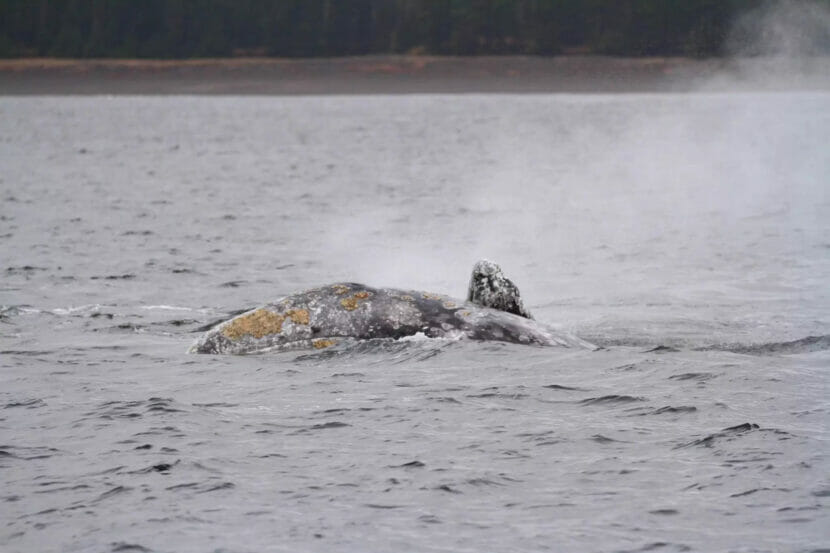
A gray whale surfaces while feeding near Shoal’s Point, west of Sitka. (Photo by Blain Anderson)
While reports of gray whale strandings along the Pacific coast have jumped since 2019, there’s at least one place where these whales seem to be thriving. Hundreds of gray whales migrating from Mexico to their Arctic feeding grounds are stopping in Sitka along their route.
Gray whales have often visited Sitka, but over the past few years, boaters and biologists have seen an unusual increase in gray whale activity.
“I was just talking to somebody up in the parking lot who said at one point last year, he estimated over 700 whales – gray whales,” said Blain Anderson, captain of the sailboat Bob.
Seven hundred might be on the high end, but whale biologist Lauren Wild says the number of gray whales in Sitka Sound used to hover around 10 or 20. Since 2019, it’s been closer to 150. As Wild put it, “it’s whale soup out here.”
Most of the news about gray whales in recent years has been pretty dismal. In May 2019, the National Oceanic and Atmospheric Administration declared an ongoing “unusual mortality event” due to elevated strandings of West-coast gray whales. Before that, a 2015-2016 marine heat wave, sometimes referred to as “the blob,” devastated Pacific-coast fauna from whales, to seabirds.
In Sitka, though?
“If people have been seeing them, they’re seeing whales rolling around and playing with each other,” Wild said. “They’re seeing a lot of feeding behavior, a lot of social behavior. Some people are seeing what looks like mating behavior.”
Like humpbacks, which are commonly seen in Sitka Sound, gray whales use baleen to feed. Unlike humpbacks, gray whales feed in the shallows, filtering silt and sand to get to tiny critters, like shrimp. Gray whales are smaller and often covered in parasitic barnacles and long scars from rolling around on the rocks.
Wild usually studies humpbacks and sperm whales, but the gray whale influx has piqued her interest. While it’s not entirely clear what is bringing this barnacle-covered baleen bonanza to the waters of Sitka Sound, Wild has a few ideas.
“We sort of wondered if the marine heatwave maybe disrupted some of the the reliability of food in the Bering Sea and Chukchi seas in the summer,” Wild said. “And if that possibly, sort of prompted these whales to be looking for more opportunistic places to forage along their migration routes, so they weren’t relying so much on those food sources.”
The food source? Likely herring eggs along the outer coast of Kruzof island.
“If you look at a map, the tip of Cape Edgecumbe is right along the outer coast,” Wild said. “If whales are migrating by and they just happen to be there at the right time, they might sort of start seeing more of that herring spawn, and it might pique their attention.”
Pacific herring spawn each spring in the waters around Sitka, and these fish – and their eggs – are an important food source for marine organisms and humans alike. Herring roe in Sitka is already a hotly contested resource, and now these motivated mysticetes may have joined the competition.
Wild said that the timing and location of gray whale sightings correspond to areas of herring spawn. She also pointed to observations from Alaska Department of Fish and Game spawn surveys:
“They’ll be diving and see gray whales around their dive boat and stuff,” Wild said. “So they’re certainly in the same area that those eggs are. And then they’ve seen a few times, you know, kelp beds that look sort of shredded like, and they’re imagining that is probably gray whales coming through and sucking up eggs off the kelp and rolling around in it.”
Wild hopes to confirm exactly these whales are eating – even if the fieldwork gets messy.
“Obviously you don’t know when they’re going to defecate,” Wild said. “So you kind of have to be at the right place at the right time. And we’ll use a little skim, almost like a fish pond net, that’s fine mesh, to just sort of scoop it up. You can also scoop it up with water in a Nalgene or something.”
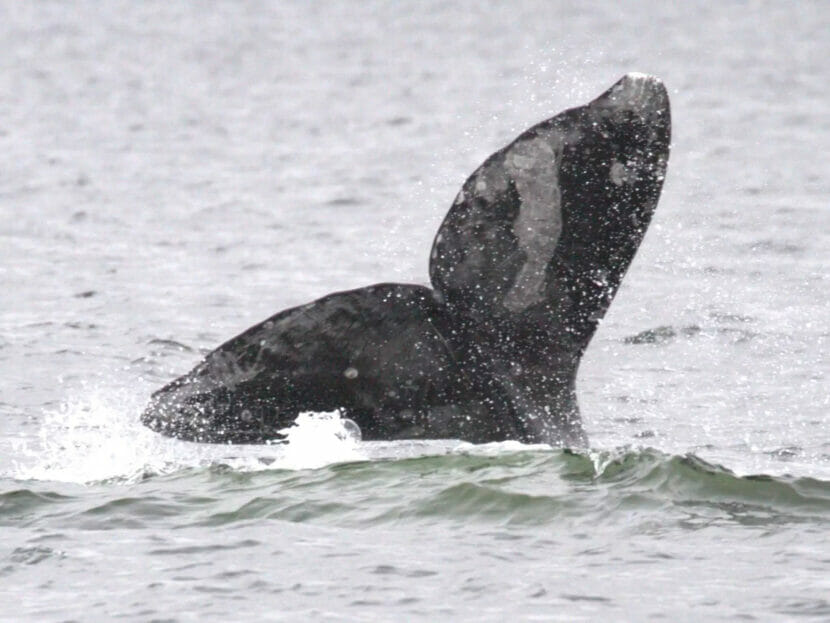
A gray whale shows flukes as it dives. (Photo by Blain Anderson)
Understanding what these whales eat is one part of the puzzle. Wild is also hoping to start building a catalog to identify and track individual whales to figure out which whales are coming to Sitka, and where else they’re going along their migration route.
In the meantime, both Wild and Anderson urge boaters to be cautious around gray whales, which may be more likely to approach humans than the average Sitka humpback. In Mexico, boaters can legally approach – and interact with – gray whales.
“They get chin scratches,” Anderson said. “And you know, I’ve seen pictures of people kissing them. And it’s something that perhaps they’ve gotten used to.”
The whales may ignore political borders, but Alaska boaters are still required to follow the Marine Mammal Protection Act – to avoid harassing whales, NOAA encourages boaters to stay 100 yards away and put engines into neutral if a whale approaches.
We don’t know what will happen in the future with these new visitors, or what the implications are for the West-Coast gray whale population as a whole, but for now, it seems that this struggling population has found a haven in Sitka feeding, socializing, and even — as Anderson has observed a few times — mating.
As Anderson noted, “It was all supposed to happen down to Mexico, but it does seem like they’re continuing their frisky ways up in – as we call it – romantic Sitka Sound.”
To report a stranded, injured, entangled, or dead marine mammal, call the NOAA Fisheries Alaska Statewide 24-hour Stranding Hotline: (877) 925-7773.
Sitka troller Eric Jordan helped found the Alaska Marine Conservation Council, and was on the board of directors of the Sitka Conservation Society for 20 years. (Courtesy Bethany Goodrich/Sitka Conservation Society)
Barring a stay, or a successful appeal, or other eleventh-hour legal action, there will be no troll fishery for king salmon in Southeast Alaska either this summer or winter.
The fisheries have been canceled by order of the U.S. District Court of Western Washington on largely procedural grounds. According to the ruling they stem from a violation of the Endangered Species Act, and the failure of the National Marine Fisheries Service to fully address the impact of Alaska’s king salmon trollers on an endangered population of orcas in Puget Sound called Southern Resident killer whales.
No other salmon species or commercial gear group or sport fishery – anywhere on the entire Pacific Northwest coast – is affected by the order, just commercial trolling for king salmon in Southeast Alaska.
Heading out every July 1 in search of Alaska’s most valuable salmon – also called chinook – has been an annual ritual across the region since before statehood.
Shortly after the court order came down, KCAW’s Robert Woolsey met with trollers Eric Jordan, Jacquie Foss, and Jim Moore to discuss what no king salmon season will mean for them, personally and professionally. This is their conversation, in three parts.
Part 1: The practical implications of a summer without Chinook
Foss: The cost of a boat exists whether or not the king salmon fishery happens or not. You have to pull it out of the water, you have to maintain your zincs. There’s work that you have to have just to make sure your boat stays fishing. And so that’s still happening for us. How we’re gonna pay for it is less certain.
Moore: I’m confident that we’re going to have a season. I’m confident that the king salmon season is going to open July 1st. I feel that we have so much support. Our congressional delegation is working behind the scenes. The State of Alaska is throwing its full weight into the fight. The Alaska Trollers Association are [intervenors and] co-defendants with the National Marine Fisheries Service and the State of Alaska. And everybody’s working pretty hard to make sure that we’re out on the water this summer. I don’t know exactly how it’s going to happen. It’s a legal court case. And so different parties hold their cards close. But I’m confident we’re gonna go ahead. So I’m planning on going ahead.
Foss: I always appreciate sitting next to Jim and his optimism, because I don’t always go there. The decision last week (May 3, 2023) was a gut punch. And fishing is how I can afford to raise my family in Sitka. So it’s really affected me in sort of a more existential way: Who are we if we’re not fishermen? Who are we if we’re not catching king salmon on our boat?
Jordan: It’s already affected boat values. I just had a survey on my boat, on what I would say as a very optimistic estimate. Even though I’ve made improvements since the last survey, [my boat] has lost about 20% of its value. Right away. People can’t sell their boats. I spent a whole week before this latest [court] decision preparing to sell gear at the Fisherman’s Flea Market because I’m getting ready to retire and I have thousands of dollars of really good surplus gear that’s basically worthless right now, except for the chum troll and coho gear. But thousands of dollars of king salmon plugs and spoons are just basically worthless.
Emotionally, I have to call my crew and tell them the situation. Some of them just love fishing king salmon. We do really well chum trolling, and Jim [Moore] and I helped pioneer that, but I’ve had crew members cry when I’ve told them that we’re gonna go chum fishing instead of king salmon fishing.
Foss: You know, it’s more of a spiritual problem than a financial one. Because fishermen are scrappy people. We will always figure out how to make expenses somehow. It’s just…we’d be broken in some way doing that, if that makes sense?
You know, not catching king salmon has a huge, huge impact to our financial bottom line: 40% of our income. And so there’s the argument, “Well, you can find the other 40%.” That 40% allows us to make the other 60%. So it’s not like you can just make up that amount of income somewhere else on the water or in some other fishery. It’s really holistic.
Jordan: There’s a miraculous, wondrous thing about catching king salmon and pursuing them all over the coast, from Dixon Entrance – like Jim’s fished – from Forrester Island to Cape Suckling. And the chum troll fishing is not going to save us. It’s gonna help.
Moore: Having fished a long time, I’ve seen a lot of changes in the fishery. And I have to say that when I bought my first boat, people said, “There’s no future in it. It’s over. It’s had its heyday and it’s going down.” But I’ve seen this cycle of boom and bust, optimism and pessimism several times. And that’s one reason why, you know, if we’re looking at grief over this court case, I’m in the first stage: denial.
Part 2: The importance of king salmon to the identity of trollers
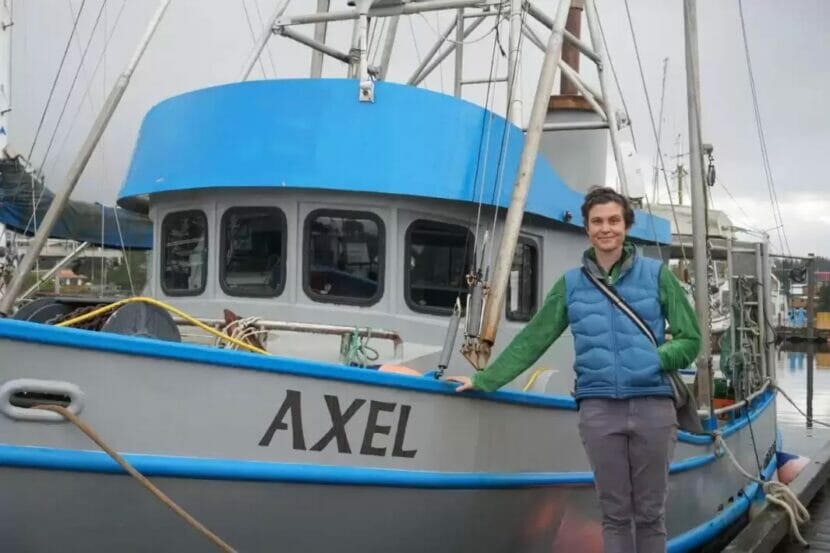
Jacquie Foss trolls with her family aboard the Axel. Fishing for kings is a core part of her family’s identity. (Erin McKinstry/KCAW)
Jim Moore bought his troller in 1970. This summer will mark his fifty-third year as a professional salmon fisherman. Eric Jordan wasn’t born on a troller, but when he was still an infant, his parents rigged a bunk for him in the cabin of their boat, a 32-foot double-ender named “Salty,” and he could watch them fish for king salmon through a porthole. Having fished every year since, Jordan is about to turn 73 years old.
Jacquie Foss doesn’t yet have that kind of seniority, but she might one day. She and her husband fish as a family, with their 8- and 10-year old children on board.
These three Sitka-based trollers are typical of the Southeast Alaska fleet: They have exceptional longevity in a difficult profession, and a multi-generational investment in their businesses.
Foss: Every year the fish – it’s exactly the same and nothing alike. You’re in the water, you’re dragging hooks. But are they going to hit the herring this year? Or is it going to be this spoon? Or is it gonna be the spoon that you have buried in there that worked 10 years ago that might work now? It’s about the puzzle. And it’s about the fact that our entire year really starts July 1. That’s our New Year: our whole life is centered around that July 1 opener.
Moore: I’m just so blessed to have found a livelihood doing something so interesting and creative. Every single day is different. And it presents a whole new set of problems to solve. “You know, I think I’ll try that green thing that I used 15 years ago,” and then have them hit it – that’s a tremendous feeling: success.
Foss: And it’s just this anticipation and joy, and just the puzzle of king salmon, because they could be where they’ve always been, they could not be there, you could have a 10-fish day, you could have a 300-fish day. That’s 300-fish day is a feat. One hundred is a lot – just your arms are tired, but you’re not tired. It’s hard to come up with the words.
Jordan: What I said in my deposition on this Wild Fish Conservancy suit: because we handle each fish individually, our connection with them is strong. And we care about them, we respect them. And that comes from my friend Amy Gulick’s book captures, The Salmon Way in Alaska from the Indigenous origins thousands of years ago, right to the present. We honored these creatures, and in trolling, especially those that offer themselves to us, for us to sustain our bodies with the finest food on Earth. But we also sustain them by fighting to protect their spawning grounds, their passageways, their lives. And that’s what breaks our heart because we are fighting for them. And now we’re being excluded from their harvest.
Foss: It’s hard to not develop a connection, when you are intimately involved with ending a creature’s life. And it’s not something that anyone takes lightly. And you’re right… you’re right there. And it’s not easy, but it’s good. Because you know that you’re taking care of the creature quickly, as painlessly as you can. If you’re going to take life and you’re going to extract a resource and you’re going to eat meat, it’s really important to do that as respectfully to the creature that you’re taking it from as possible.
Jordan: Let me tell you, there’s a lot of grief in the troll fleet. A lot of grief, and families and people need help. So not only do we have to think about making financial arrangements so people can make or delay their payments with the state or CFAB [Alaska Commercial Fishing and Agriculture Bank] or whoever else. Banks. We also need to think about mental health counseling for people who are devastated and don’t know how they’re going to feed their families – literally.
Moore: You know, I’m proud of the product that we produce. This whole battle, this court battle with Wild Fish Conservancy trying to shut down a food-producing industry, without considering: there’s 300 million people right now – not killer whales – 300 million people are starving to death. There are 2 billion people that are “food insecure,” as they say. And I just feel sick about all of the energy being spent, all the resources being spent, just to try to be able to continue to produce food for people.
Part 3: Trollers and conservation
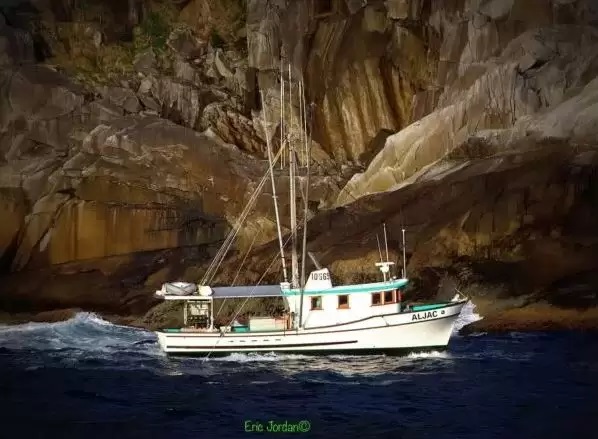
Jim Moore slips by Point Amelia in his troller Aljac. (Courtesy Eric Jordan)
In a state where fish landings are most often measured in the millions of pounds and millions of fish, the Southeast Alaska troll catch of king salmon is a small fraction of the overall harvest. This coming season – if there is a season – Southeast trollers will take just 149,000 chinook salmon.
Those fish are mixed into a salmon pie that is shared by Alaska, Washington, Oregon, and Canada – a pie that is sliced by an international agreement called the Pacific Salmon Treaty. Over the past couple of decades, Southeast trollers have accepted smaller slices of the pie to preserve the health of salmon stocks covered by the treaty, and they’ve even accepted deep cuts in the harvest of kings which originate in Alaska’s rivers – and aren’t subject to the treaty – to make sure that those stocks thrive.
In short, Southeast trollers have nothing to gain and everything to lose if king salmon don’t survive. They are conservationists, whether or not they use the label.
Foss: I want to make it very clear that trolling is (a) 100-year old fishery, and if it was not sustainable for a long period of time, it would be evident. And I have not ever seen another resource extraction group begrudgingly-but-willingly not go fishing to ensure the longevity of the species. Is that the right thing to do? Absolutely. When it became apparent that we were going to take a hit on king salmon in the last (Pacific Salmon) Treaty cycle for political and conservation purposes, we could weather it because the emphasis is making sure there’s fish in the future.
Jordan: Trollers have been the allies of conservationists for decades. Salmon fishermen all over this state fight things like Pebble Mine, things like the borax mine in Misty Fjords. Trollers have worked to protect the salmon habitat throughout the region from mines in British Columbia. I’ve written op-ed editorials on those mines, working with Salmon State and others. We are the greatest allies of people who want to conserve king salmon and other salmon species. And for us to be vilified and attacked is just plain wrong.
Foss: It’s really easy to look at a problem and decide that someone else should pay for it. It’s really, really hard to look internally to see what you’re doing and how you’re contributing to that problem. And I really feel like that’s what’s happening here [with the Wild Fish Conservancy lawsuit].
Moore: This fishery is the poster child for sustainability. There’s never been – that I know of – any run of salmon that’s been wiped out by a hook-and-line fishery. When I first started fishing, there was the criticism that it’s too inefficient. Well, we’re not hearing that much anymore (laughs). But anyway, we’re hearing these narratives that are just outright lies. Like “the increase in greedy corporate fishing.” My kids grew up on the back deck of the boat, you know, this is “greedy corporate fishing,” you know. They learned that they could work hard and produce something tangible. And your success depends on being able to understand and connect with something you can’t see directly. From that standpoint, it’s like science. I can’t decide whether it’s more like art or like science. It’s both.
Jordan: And one of the things that happens, as both Jim and Jacquie have mentioned, is the connection you develop with these places, the ocean, the ecology, the fish that you’re pursuing. It’s really a love affair.
Foss: You just love it. You love everything about it.
Moore: You know, I love the killer whale. I’m connected with the killer whale. This is not about saving the killer whale, this battle. It’s about destroying this industry. That’s the stated agenda: the Wild Fish Conservancy, they want to eliminate ocean fishing, mixed-stock fishing, and they want to eliminate the hatchery program. That’s a small minority viewpoint – a very small minority viewpoint. They had an opportunity to move their agenda, and they took it. But it’s an immoral decision. It makes me sick.
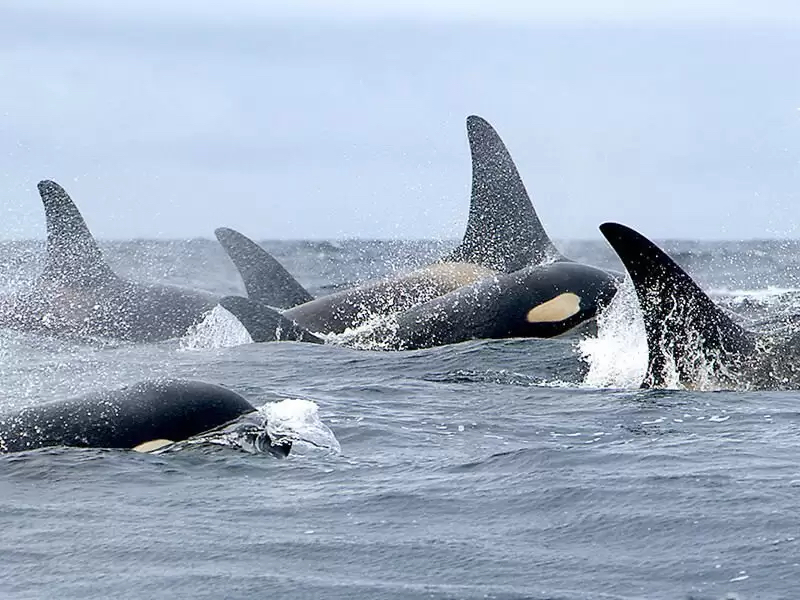
The population of endangered Southern Resident Killer Whales in Puget Sound has dropped to around 70 individuals. Many are skeptical that a judge’s ruling to close commercial trolling for king salmon in Southeast Alaska this winter will have any impact on the long-term survival of these animals. (NOAA photo/Holly Fearnbach)
The state of Alaska is asking for a partial stay of a federal court order forcing the closure of commercial salmon trolling for king in Southeast Alaska this summer, pending an appeal.
The motion for a partial stay was filed on Monday in the U.S. District Court of Western Washington, which ruled that the Southeast Alaska king salmon fisheries in both summer and winter were operating in violation of the Endangered Species Act and depriving a small population of killer whales in Puget Sound of a critical component of their diet.
The state immediately filed notice that it intended to appeal to the U.S. 9th Circuit.
The state was joined by the Alaska Trollers Association in asking for the stay, arguing that “if the summer and winter troll fishery seasons are closed, this will have a direct, immediate, and irreparable impact on the economic, cultural, and social fabric of Southeast Alaska.”
The state and the trollers are intervenors in the lawsuit on behalf of the defendant, the National Marine Fisheries Service, which is responsible for ensuring the compliance of Alaska’s fisheries with federal law. The fisheries service hasn’t indicated any intention to appeal the ruling, and instead issued a statement assuring Southeast trollers that the other species they target — coho and chum — were unaffected by the court’s order. Additionally, the agency was “working expeditiously” to resolve the conflict with the Endangered Species Act.
The lawsuit was originally brought by the Wild Fish Conservancy of Duvall, Washington, to protect the population of Southern Resident killer whales, which has just over 70 animals remaining. Expert opinion differs on whether the closure of king salmon trolling in Southeast will have any effect on their long-term survival.
The Alaska Department of Fish & Game has yet to determine how and when the commercial troll fishery would open this summer if the Court refuses to grant the stay.
Alaska is asking for a decision by May 26.
On May 3, all three members of Alaska’s congressional delegation released statements strongly condemning Tuesday’s ruling from the US District Court of Western Washington which — if left unchallenged — will force the closure of the king salmon troll fishery in Southeast Alaska this summer.
Alaska’s senior senator, Lisa Murkowski, wrote “This is a disastrous decision for Southeast Alaska that will only serve to harm those small boat troll fishermen who are trying to provide for their families. This lawsuit should have been dismissed months ago, but now threatens devastating restrictions that will harm hundreds of Alaskans and dozens of coastal communities—all while doing nothing to actually benefit the Puget Sound orca population.”
Alaska Sen. Dan Sullivan called the judge’s ruling “outrageous,” writing ““What’s most remarkable about this case is that the judge and Wild Fish Conservancy totally ignore much more likely causes of the orca decline, like the toxins, pollution, noise disturbance, and vessel traffic that have undoubtedly wreaked havoc in the Puget Sound region.”
Alaska’s lone member of the US House, Rep. Mary Peltola, joined the senators, writing, “If this order is allowed to stand, Southeast Alaska will suffer a devastating loss, putting thousands of jobs at risk in communities that depend on this sustainably-managed fishery.”
In March of this year, the delegation filed an amicus brief with the US District Court, in support of Southeast troll fisherman. Other interveners in the suit are the Alaska Trollers Association, and the State of Alaska. The Alaska Legislature this spring passed a resolution in support of the fishery; the governor has said he’d appeal the case to the US Supreme Court, if necessary.
Gilbert’s “Chandera” trilogy is actually a five-parter: He’s working on two more books.
An Indigenous Alaskan author is hoping to breakthrough into popular fiction. Matt Gilbert already has a pair of significant nonfiction books under his belt, but he wouldn’t mind crossing over into film work or novels set in a galaxy far, far away – in a genre that might be known one day as Gwich’in Sci-Fi.
Matt Gilbert has written the serious stuff. The 2005 graduate of the University of Alaska in English Literature just published The Gwich’in Climate Report (University of Colorado Press, 2023), a compilation of his interviews with Athabaskan community members, hunters, and trappers on regional adaptation to climate change. An earlier book, Sitting at Their Feet, a memoir of his coming-of-age during a time of cultural transition, was published in 2021 by the Epicenter Press.
Listening to elders is something we all should spend more time doing, but for Gilbert — even growing up in Arctic Village — there was something else.
“I was a big, big, big, huge sci-fi nerd,” said Gilbert. “Totally, a Star Wars fan all the way, a Star Trek fan all the way. Lord of the Rings fan, Willow fan, and as a kid, I would grow up and love these movies. But I always wondered: What about us?”
Star Trek is still celebrated for bringing racial and ethnic diversity to space. For Gilbert, it wasn’t necessarily about the racial makeup of the actors, but their worldviews. He was raised in a culture of storytelling that just wasn’t making its way into contemporary science fiction of any kind.
“As a kid, I was really disappointed, you know, really disappointed,” he said. “A little kid in front of the TV and a bookworm early on. Where’s our stories? You know, where’s the modern Native stories, with sci-fi or fantasy, or with anything? And I waited. And so when I was 15 years old, I was in high school and still nobody – no Native American person wrote anything like it and I got tired of waiting. I was like, ‘Okay, if no Native writers can write the stories I want to hear, I’ll write them, and that’s what I did.”
He did, but not as Matthew Gilbert. You can find his first trilogy under the name Wolf Golan. “Wolf” for his first dog, and “Golan” a tribute to his grandmother’s family name. The series is called Chandera, and Gilbert began writing it in high school. It’s set 300 years in the future, and its protagonist is Maxwell Wilkes, a Gwich’in Athabaskan.
For the novels to work, Gilbert had to project not only the future of civilization as a whole, but the future of his culture. He was pleased to learn that many of his peers believed that people will still identify as Gwich’in three centuries from now.
“When I was writing it, I spoke to Native American people, even to young people like 20-year olds,” he said. “And I asked them, “In 300 years, how do you think we’d be? And they’d be like, ‘Oh, we’d be heavily westernized, our old culture would be gone. Yes, we’d have probably still have a connection, but it would be distant,’ and so I put that in there. They’re still trying to be Gwich’in, but it’s been so long since they were connected to the real culture 300 or 400 years ago.”
Gilbert says he’s been criticized for creating a character who tips too far into western standards of heroism, but he argues that the differences are subtle: In the first book of the Chandera series, for example, Max Wilkes rides into battle quietly, in contrast to Luke Skywalker and Hans Solo and other “Western guys… yelling stuff.” In another nod both cultural and autobiographical, Gilbert says his hero sleeps late.
Since Gilbert first started creating the world of the Chandera trilogy as a high school student, he’s pleased that Native American science fiction is seeing a renaissance, through the works of authors like Rebecca Roanhorse, and scholars like Grace Dillon, a professor at Portland State University whom he considers a mentor. And there are new characters, too, who are pushing the Native American worldview into space. A favorite of Gilbert’s is Camina Drummer, a pivotal figure in the huge sci-fi hit The Expanse.
Gilbert self-published the Chandera series, but he’s hoping a publisher might take the trilogy to the next level, into the world of trade fiction. In the meantime to pay the bills, he and a colleague run a management company, and he works occasionally in construction.
He vividly remembers finishing his English Literature degree, and looking around the university at friends studying to become engineers and other professionals. Eighteen years on, he’s still content with his choice to pursue writing.
“If I could go back and do it all over again, I don’t think I would change anything,” Gilbert said. “I I like being a writer. I like telling stories, you know. But I do actually want to do different things from this time onward.”
Gilbert is hoping to expand his creative range, and possibly move into music. Whatever is ahead, it’s unlikely to be a “normal” job. “I tried to get a normal job and be normal,” he said, “it (writing) just wouldn’t leave me alone.”
Trollers in Sitka. (Photo by Rachel Waldholz/KCAW)
A federal judge in Washington state issued a ruling this week that threatens to shut down trolling for king salmon in Southeast Alaska this summer.
The ruling comes in a lawsuit filed three years ago by a Washington-based conservation group called Wild Fish Conservancy that aims to protect a small population of orcas.
The lawsuit centers ons whether Alaska fishermen should be allowed to harvest king salmon, which are considered essential prey for the Southern Resident killer whales.
KCAW’s Robert Woolsey has been following the lawsuit from Sitka, in the heart of the Southeast salmon troll fishing region, and says whether the king fishery will be closed this summer remains uncertain.
Listen:
The following transcript has been lightly edited for clarity.
Robert Woolsey: If you look at the order, the language of the order says, yes, they’re definitely calling for the end of troll fishing this summer. But both the state and the Alaska Trollers Association, who are intervenors in this lawsuit, filed a notice to appeal to the Ninth Circuit Court. And they’ll probably ask for a stay of the order until the appeal is heard. So it’s possible that fishing might happen this summer. It’s still kind of an open question, though.
Casey Grove: Yeah. And I take it that uncertainty is pretty difficult for fishermen trying to just get ready for the season or to know if they should get ready for the season. I want to talk more about what the impacts might be to the fleet. But first, maybe let’s back up. Where did this lawsuit come from? What does it aim to do?
Robert Woolsey: Well, it all got real back in December of 2022, when another U.S. District Court judge in western Washington named Judge Michelle Peterson issued a report and recommendation that basically went in favor of just about everything the Wild Fish Conservancy was asking for. The Wild Fish Conservancy, in its lawsuit, had argued that the National Marine Fisheries Service had violated sections of the Endangered Species Act and the National Environmental Policy Act in failing to fully account for the impact of the Alaska Chinook fishery on this very seriously threatened population of killer whales in Puget Sound. So that report and recommendation had to be affirmed by another U.S. District Court judge. And that happened this Tuesday, when Judge Richard Jones basically issued a two-page order saying, “This is it. And I’m ordering the National Marine Fisheries Service to fix the flaws. And I’m also vacating this document that’s called an Incidental Take Statement.” And an Incidental Take Statement is essential to open a fishery that might impact an endangered species. And so this Incidental Take Statement that allows Chinook fishing to happen in southeast Alaska in summertime, and in winter, has been vacated.
Casey Grove: So, obviously, this is focused on king salmon off Alaska’s coast. But the orcas also spend a lot of time closer to Seattle, which is a huge city, it continues to grow. There have got to be other environmental factors going on there. So what are people saying about that?
Robert Woolsey: Well, everybody keeps coming back to this, Casey, including our congressional delegation. They all issued statements saying this lawsuit is outrageous, mainly in that it overlooks what probably are the real threats to Southern Resident Killer Whales, which are industrial toxins, population of the Puget Sound area, vessel traffic, all these other sources that probably are creating more harm for these animals than the harvest of what is actually very few fish in Southeast Alaska. I mean, the 2023 troll harvest allocation is only 149,000 kings. We’re not talking millions of fish that are being scooped up in Alaska.
Casey Grove: And I guess whether that sways the judge or the Wild Fish Conservancy, who knows, But I think what’s fair to say is that if that fishery gets shut down, it’s going to have a huge impact on those people, their families. What have you heard from them about that? I mean, what’s the impact going to be on Southeast Alaska in general, if this fishery gets shut down?
Robert Woolsey: Trollers are kind of the iconic Alaska fishing vessel. The fishery has been going on since territorial days. Trollers have these tall poles that extend out and they just cruise along gracefully over the waves catching fish one at a time. Each king salmon, each coho salmon, every fish that they bring aboard, is caught one at a time. Pound for pound, a troll-caught king salmon is the most valuable fish in Alaska. It’s possible that a king salmon is more valuable to Alaska than a barrel of crude oil. And the fishery is quite lucrative at the dock. It’s worth about $15 million. Statewide there are about 1,800 permits for salmon trolling, both power and hand troll. But only half of those permits might be fishing any given season. And once those fish are sold to the processor, and then the processor sells them and they enter sort of the economy, that $15 million is multiplied many times over. So it’s going to be a huge impact. But I don’t think it’s going to be the end of trolling, mainly because chum salmon has become so valuable in recent years. But it’s a loss to the people who have been doing this fishery or participating in this fishery for multiple generations. And it’s kind of a loss for everyone who feels that Alaska has bent over backwards to try and preserve this stock, and it’s being taken away on basically a technicality.
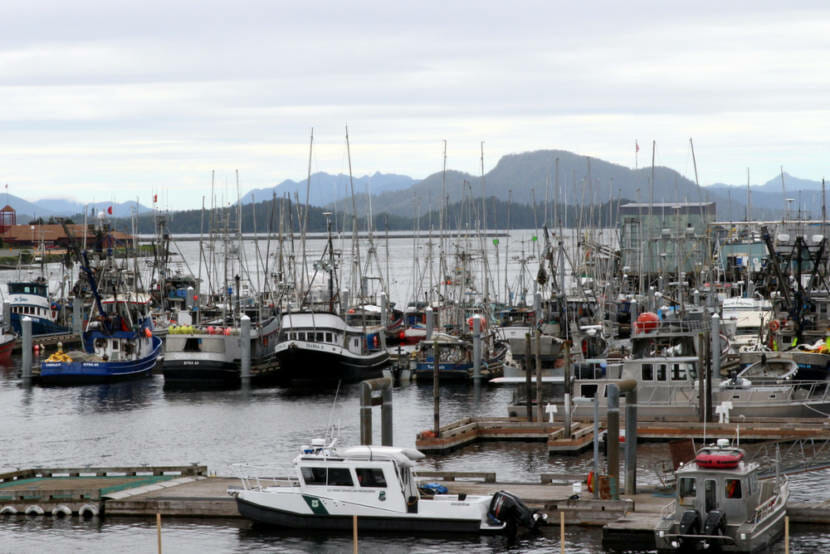
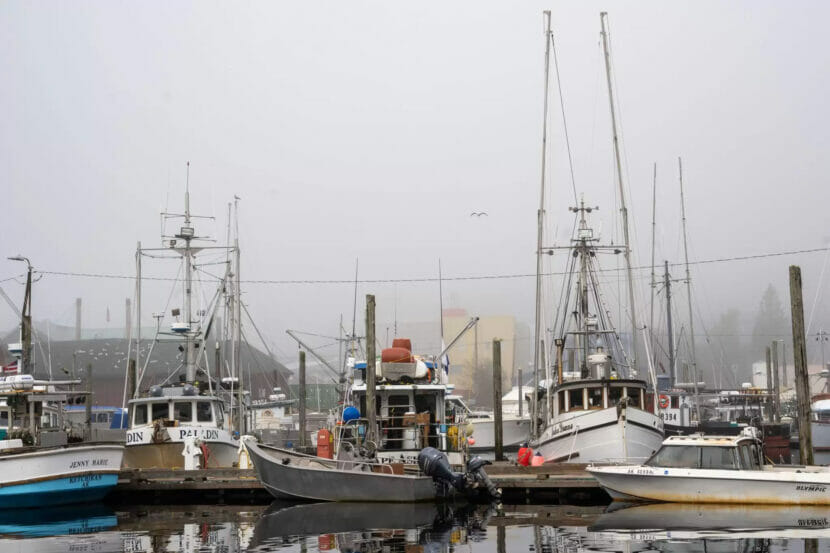
Trollers wait in Ketchikan’s Thomas Basin on Oct. 8, 2022. (Eric Stone/KRBD)
A U.S. district judge in Washington state has affirmed a controversial recommendation that could shut down summer trolling for king salmon in Southeast Alaska this summer.
Judge Richard A. Jones signed the two-page order on Tuesday. It requires the National Marine Fisheries Service to remedy a violation of the Endangered Species Act concerning a threatened population of killer whales in Puget Sound.
The ruling also vacates the “Incidental Take Statement” under which the National Marine Fisheries Service manages the commercial harvest of chinook salmon in Southeast Alaska during the summer.
The Wild Fish Conservancy filed suit against the National Marine Fisheries Service in March of 2020, arguing that the government failed to adequately address the impact of Alaskan king salmon harvests on southern resident killer whales, whose population has dropped to critically low levels.
In a news release, the Alaska Trollers Association — which intervened in the suit on behalf of NMFS — says it will work with the State of Alaska to appeal the ruling to the 9th Circuit Court of Appeals and likely will ask for a stay of the order.
Director Amy Daugherty wrote, “The ATA will continue to fight for the way of life of its members and the communities of Southeast Alaska.”
Close
Update notification options
Subscribe to notifications
Subscribe
Get notifications about news related to the topics you care about. You can unsubscribe anytime.