KCAW - Sitka

KCAW is our partner station in Sitka. KTOO collaborates with partners across the state to cover important news and to share stories with our audiences.

Sitka School District proposes draining reserves to balance budget

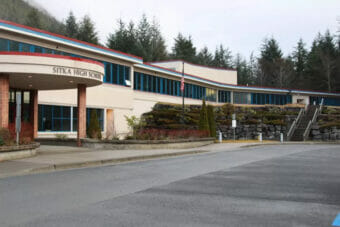
Sitka High School (Karla James/KCAW)

The Sitka School Board has gone out on a limb — maybe the longest limb it’s ever gone out on — in passing a budget for next year.

In a split vote last Thursday, the board voted to keep staffing levels the same as this year and to almost completely drain the district’s reserves.

The most money for education in Alaska comes from the Legislature, and that’s the rub for Sitka, and every other school district in the state.

The Legislature hasn’t decided how much it will spend next year, leaving schools to draft their budgets based on guesswork.

It’s an infuriating and agonizing process for local communities that want to spend as much as they can on schools — keeping good teachers, recruiting new ones, and maintaining sports, music, and other extracurricular programs that incentivize attendance.

Board member Tristan Guevin attributed much of Sitka’s difficult position to a faulty legislative process.

“We’re building a budget without an idea of what our revenues will be because of inaction by the state,” said Guevin. “We’ve talked to death the situation with the BSA, that it hasn’t been increased since July  of 2016. In that same time period, we faced about 25% inflation. So in essence, that flat funding is a budget decrease — a significant budget decrease.”

The BSA stands for Base Student Allocation, or the amount of money the state gives each district for each student. The BSA has been increased once in the last seven years, and been bumped several times with one-time grants, but – as Guevin noted – it’s never been adjusted for inflation. Several bills have been introduced in the Legislature this year that might provide yet another bump, but it’s anyone’s guess where the final number will land.

This left the Sitka School Board to consider only two options: whether to cut three teachers at Keet Gooshi Heen and increase class sizes in fourth and fifth grade, or keep those teachers and take the district savings account to its lowest level ever – just over $10,000. (Note: The district must maintain restricted reserves of about $65,000. The $10,000 balance is in excess of that.)

Board member Todd Gebler wanted to keep the teachers.

“It is an enormous risk,” said Gebler. “And a lot of it, you can put a label on it, the state is not doing what they should for us. And that is the truth: they’re really not doing it. But in order for the teachers to do what they need to do, small class sizes are important. And in order for us to do that, I’m very, very happy to keep those three positions at Keet.”

The risk is that the proposed budget assumes the state will increase the BSA with a one-time shot of $450. Again, it’s just a guess. Bills have been introduced in the Legislature with higher amounts ($680 to over $1,000), but it’s a long road before any of them arrive at the governor’s desk. The final amount could also be lower than $450. In that event, the district couldn’t meet its obligations, as pointed out by Mike Vieira, president of the Sitka Education Association, which represents teachers.

“If you can’t meet payroll – that’s us (teachers),” Vieira said. “I think that puts us all in the same boat.”

Another alternative before the board would be to reduce staff at Keet Gooshi Heen Elementary by two positions, and transfer them to Baranof Elementary School. The resulting draw on district savings would then leave close to $200,000 in the bank. This was the preference of board president Blossom Teal-Olsen, who was uncomfortable with going all the way down to $10,000.

“I cannot. I cannot bring myself to be okay with walking away, knowing that it would jeopardize our whole community, knowing that our fund balance would be left at such a level,” said Teal-Olsen.

In the end, other board members overruled Teal-Olsen, and voted to approve a budget that leaves the teaching staff intact (with the exception of eliminating one teaching position at Raven’s Way, adding a Special Education case manager at Baranof Elementary, a social worker at Pacific High, and a reading specialist), draws on $1.7 million in savings, and assumes the Legislature will allocate at least another $450 per student to education this year which – as yet – it has come to no agreement on.

The district’s $23 million dollar budget for next year now goes to the Sitka Assembly for final adoption.

Not with cars but with cubes, Sitka teen satisfies the need for speed

Rianna Bergman with cubes. (Katherine Rose/KCAW)

Sitka High School Rianna Bergman was showing off her collection of Rubik’s Cubes. She has a few.

“The move that I’m doing — the official cubing term for these moves — is called a ‘Sexy Move.'” Bergman said. She laughed as she turned the cube and its faces over and over in her hands. “It’s just six of them, and it always returns the puzzle to its solved state.”

Moments later, she solved the puzzle. That’s because Bergman is a speedcuber.

“I solve Rubik’s Cubes really fast,” she said. “An average of about 15 seconds, give or take.”

Bergman says she solved her first cube, more than anything out of spite.

“We had an exchange student staying with us from Austria,” Bergman said. “And my brother had this Rubik’s Cube that he would scramble up and leave all over the house. And then the exchange student would just solve it. And then one day, the exchange student left, and my brother just left an unsolved Rubik’s Cube on the counter, in just plain view, and it bothered me so much that I grabbed it.”

She took the cube to school and convinced a friend to teach her how to solve one side. Then she took it home and watched a tutorial. She solved her first cube in about an hour. That’s when Bergman realized she wanted to go fast.

“My brain was like, ‘You could probably do that in less time. And probably without the video. Let’s try that again,'” Bergman said. She started carrying the cube with her everywhere she went.

“I would go on walks with my mom or I’d go on errands around town. I had this little notepad with these algorithms written down in case I forgot them,” Bergman said. “We walked through Totem Park one day, and I was just with my one little notebook just cubing as we walked.”

That was five years ago. Today, she owns 15 cubes and can solve a variety of types. Bergman is competitive, but with herself — it’s all about shaving off seconds to lower her average solve time.

“The more advanced you get, and the faster you get, usually the more algorithms you learn. So right now, I probably know around 30 [or] 40 algorithms,” Bergman said. “But I’m planning to learn another 50 to get through this one portion, and that should take me down to about 12 seconds average, hopefully.”

Like a race car, cubes have to be maintained and tailored to the cuber’s preferences. 

“There’s tons of different speed cubes. The one that I use is called the X- Man Tornado V3. It has adjustable magnets, an adjustable spring system, and a ton of cool stuff like that,” Bergman said. “Yes, there is there a speed cube lube. That is a thing that exists,” she laughs. “The one I use is called ‘Martian’ and helps my cube go faster, [but] there’s different ones that slow the cube down.”

At the beginning of April, Bergman traveled to Anchorage for her first ever speed cubing competition. Nearly 80 cubers, from Alaska, the lower 48 and some international cubers competed in several events. Bergman recalled that only three or four of the competitors were women. Speedcubing is a male-dominated sport.

“I definitely had a lot of stress going into the competition,” Bergman said. “I didn’t know anyone, I didn’t really want to talk to them. But then, I kind of realized these are speedcubers. These are ‘cuber’ people. So it’s not like I’m going up to someone who I don’t know, and we’re not going to have something in common. We’re all there because we have something in common.”

Bergman found the environment to be very welcoming and supportive. She hoped to make it to the second round of competition in the 3×3 cube division. It’s one of the most competitive categories that nearly every cuber entered.

“I had a hoodie on, and for all of my events I had some hand warmers in my pockets,” Bergman said. “Those hand warmers lasted 12 hours, and I was very proud of them. And before all my solves, I just stuck my hands in my pocket, warmed them up a little bit. And then I solved.”

Bergman exceeded her expectations — she made it to the final round of 3×3 and placed 12th overall.

She’ll keep working on her solves, but she’s not sure if she sees professional cubing in her future. But she plans to keep cubing through college and maybe even start a cubing club, and she hopes to encourage people to find joy in the puzzle she’s so enthralled with.

“The inventor of the puzzle himself was an architect. His name was Erno Rubik. It took him a couple months to figure out how to solve the puzzle, because there’s 43 quintillion possible different permutations it can be in,” Bergman said.

“It’s it’s a difficult puzzle,” she said. “But it’s not as scary as it looks.”

At the end of the day, for Bergman, it’s not just about going fast or solving the puzzle.

“If you find something you like, that you enjoy, keep doing it,” Bergman said. “Even if you don’t think you’re as good as other people or where you want to be, still do your best and try, because you’re probably going to have a fun time either way.”

Sitka’s airplane equipment maker moves from prototype to production

Tim Fulton in his “happy place”: His home workshop. TISABAS did not spring into being overnight; Fulton has been prototyping for decades, with a variety of rollers and belts to move heavy items like fish boxes in the bellies of airplanes. His first two TISABAS are headed to an equipment supplier for Malaysian Airlines — for $35,000 a piece. (Robert Woolsey/KCAW)

An airplane equipment manufacturer is setting up shop in Sitka – in the garage where he invented his first device.

Tim Fulton is a “ramper” who spent nearly four decades loading luggage and cargo on Alaska Airlines jets. After weathering the pandemic and several years of demonstrating his product around the world and obtaining various safety certifications, he’ll be shipping his first two orders this month.

Fulton’s shop is still located in his home in a Sitka neighborhood, but it’s evolved far beyond your typical garage workshop. The computer-controlled router and color monitors by the door are a dead giveaway, but so is the device taking shape on the bench: A clean assembly of precision-made aluminum framing, motors, and belts that is less the Rube Goldberg of my last visit, and a bit more Henry Ford. Fulton calls his product TISABAS, which is an acronym for Tim Saves Backs.

Machinist Danon Vest operates a computer-controlled router. While Ramper Innovations has outsourced the fabrication of some precision parts to other firms, the final product is assembled in Sitka. Eventually, CEO Fulton hopes to move into a larger facility with better storage for materials. (Robert Woolsey/KCAW)

“We’re wiring this one up, and it should be assembled by the end of the week,” said Fulton. “Then we’ll start on the second one, and plans are to send it to Malaysia by the end of the month.”

The machine is a folding belt designed to operate in the belly of an aircraft like a Boeing 737 or an Airbus A320. Unfolded, it’s 20 feet long, with eight independent conveyor belts that move your luggage from the loading door toward the center of the plane, where a “ramper” piles it up and secures it with a cargo net. In current practice, your luggage doesn’t move down a belt inside a plane: A ramper working on their knees throws, shoves, or rolls it, and the consequences can be painful – and often chronic – back injuries.

TISABAS is not exactly flying out the door. Fulton had to advocate for his product in a commercial environment where taking care of the people who load planes is a harder sell than passenger amenities, like streaming wi-fi. Still, there are believers, and Fulton has traveled the world to put TISABAS in front of them, and now it’s paying off.

“These are sold to an equipment supplier to airlines,” he said. “So we actually met this guy when we were at the expo in Paris last year. And he was with the purchaser for Malaysian Air, and the purchaser was very impressed and pushed this guy to purchase for them to send it over.”

Fulton has three beta-versions in circulation in various countries. As we spoke, one was being shipped from Brazil to Miami. Another had just been delivered in Sweden.

Surprisingly, the North American market – even his former employer, Alaska Airlines – hasn’t shown much interest. There’s little reason to doubt Fulton, who was a ramper for 38 years, when he says the US airline industry is slow to adopt. If TISABAS succeeds, it will be the international market that makes it happen.

“We were on a call yesterday with Argentina; the day before with Brazil,” Fulton said. “We have IAA, the Israeli Airport Authority is interested. From Sweden, the (beta) unit is going to Spain, England, Thailand, and India. So the international market is where we are close to closing deals on a daily basis.”

Ramper Innovations’ first year of revenue was 2022. Each of these TISABAS sells for $35,000, so they’re putting up numbers for this year too. But it’s still a scrappy operation.

“I do have a corner office, but it’s in my spare bedroom,” said Maury Hackett, laughing.

Hackett is one of four employees in the company, and Ramper’s chief operating officer, tracking everything from the company’s three-to-five year strategy, to how it manages time on the production floor. When I was last here, Hackett was in a jacket and slacks. Today, she’s in work clothes, helping to assemble the product. Her background is in recreational therapy and ergonomics. She wants to position Fulton as a thought leader in ramp safety, and she believes that safety will ultimately sell TISABAS.

“In the receptivity that Tim had in Paris by all these European companies,” Hackett said. “They’re like, ‘Oh, this is incredible.’ And not just like, ‘This is an interesting thing, let me see if I can convince the decision-maker of purchasing this thing.’ Rather, they have the authority as the safety person. And safety is shaping things.”

A crowd-funding campaign for Ramper Innovations raised over $325,000 last year, but now that he’s actually putting TISABAS into production, Fulton believes his company is turning over a new chapter.  He envisions his folding belt technology used in trucking, warehousing, and even cruise ships. Like a lot of entrepreneurs, he did not think it would be this hard, but he’s in it for the duration.

“It does get stressful,” Fulton said, laughing. “But it’s still enjoyable. And I think believing in what we’re doing makes a big difference.”

In the meantime, Fulton will  continue cultivating international sales, and stay focused. “What’s in front of us right now is getting these units built, getting more sold,” he said.

A Sitka-based treatment program for Alaska teenagers is moving to Juneau

Panorama of Sitka in August 2015 (Photo by David Purdy/KTOO)

A Sitka-based residential treatment program for Alaska teenagers is moving to Juneau.

Raven’s Way treats teens who have been diagnosed with substance use or dependence. It’s operated by the Southeast Alaska Regional Health Consortium. But sometime later this year, the program will merge with Juneau Youth Services, which SEARHC is in the process of acquiring.

SEARHC’s communications director Lyndsey Schaefer said the details are still being ironed out, but SEARHC offered jobs to all Raven’s Way staff.

“80% of the current Raven’s Way staff in Sitka, have been offered positions in Sitka as well, because we are going to use the space that’s vacated by Raven’s Way — the buildings there in Sitka — to expand our adult substance use treatment program,” Schaefer said. “The remaining staff that were not offered positions in Sitka have been offered positions at the new Raven’s Way campus in Juneau. So there isn’t anyone that was not offered a position.”

Schaefer said this means Sitka’s adult substance use program will effectively double in size as well.

Like Raven’s Way, Juneau Youth Services provides residential treatment for teens, as well as therapeutic foster care and case management. Schaefer said it’s too soon to say exactly what combination of services will continue to be provided, but once the purchase of Juneau Youth Services is finalized, it will be known as the Raven’s Way campus.

“Regardless of where it is, Raven’s Way has been very important and very impactful. We understand that,” Schaefer said. “Youth outside of Southeast Alaska will have a direct route to get to Juneau, which will allow us to expand the program reach and impact, and I think that’s a great thing.

Raven’s Way was in the news this time last year when SEARHC closed Crossings, a wilderness program for at-risk youth based in Wrangell which was one of the community’s largest private-sector employers. At the time, four of the 16 staff members were offered jobs at Raven’s Way, and the other 12 were offered “commensurate positions” in Wrangell.

Because SEARHC is still in the process of acquiring Juneau Youth Services, the timeline for the move to Juneau hasn’t been nailed down yet. But Schaefer said the class of teens that graduates from Raven’s Way this April will be the last group to complete the program in Sitka.

A millennia-old subsistence fishery replenishes the spirit and the freezer

Tlk’ Un Yeik Paulette Moreno arrives to the Fishermen’s Quay with a boat overflowing with herring eggs on hemlock branches on April 3. (Katherine Rose/KCAW)

Herring season in Sitka is a study in contrasts. Each spring for the last 45 years, large seiners  land tons of herring, whose egg sacs are stripped and sold as a delicacy on the international market, often for millions. But the frenzy and money around the commercial sac roe fishery overshadows a far quieter Indigenous fishing tradition that’s taken place for millennia. KCAW recently accompanied a pair of subsistence harvesters in search of one of Sitka Sound’s most valued food resources – herring eggs on hemlock branches.

It’s a clear Sunday morning in March, and the herring are on the move. Tlk’ Un Yeik Paulette Moreno and Goos’ shu Andrew Roberts are slowly motoring north through Sitka Sound. Their 16-foot yellow boat, nicknamed Tweetybird, is loaded up with five hemlock branches to set today. The traditional Lingít herring egg harvest has begun.

Moreno has been harvesting roe on branches for around 15 years; Roberts has been doing it for most of his life.

“This is usually a pretty good spot, where that boat is, right in that little gut, there,” Roberts points to a rocky area on the western side of Middle Island that has been productive in the past.”

“Traditionally, when they start spawning in here, there’ll be 50 to 100 sets in there,” he adds. “This is real popular place.”

They’re cruising along when an announcement from the Alaska Department of Fish and Game comes over VHF radio. The big story of the morning? The first signs of spawn this spring, around two nautical miles, have been spotted near Shoals Point.

The sun is out, but the water is a bit choppy, so Moreno and Roberts may not make it out to Shoals Point, which is about nine miles of open water away from where we are now, on the southeastern tip of Kruzof Island. But they’re not worried, they’ve already set some trees in that area. Moreno says for the last three years she and the Herring Protectors, a local advocacy group, have been setting “protection trees” to call attention to traditional fishing grounds that should be avoided by commercial seining vessels.

“They’re complete sets, and we put them in strategic locations, and then we call Fish and Game and tell them where they’re at,” Moreno says. “We can set where and when we want, and these protection sets are to remind people who pass that area that there are sets out there. And sometimes those sets do really good, but the idea of a protection tree is to do that, to protect the herring and the area.”

Tlk’ Un Yeik Paulette Moreno and Goos’ shu Andrew Roberts smile as they realize their boat is passing over a school of herring, shown in their sounder radar (Katherine Rose/KCAW)

They slow their boat down in the lee of Middle Island to wait for the wind to die down. Roberts breaks out a rod and reel and begins to troll for salmon. It’s a delicate waiting game. The window to set branches at just the right time has shrunk in recent years.

“Instead of seeing the spawn for three or four days, we literally are seeing it pass through in four hours,” Moreno says. Unheard of. Unheard of.”

Roberts, who was born and raised in Sitka, says it didn’t used to be that way.

“I have witnessed when it spawned, it was on both South and North end, there was just nothing but solid herring, it was so thick,” Roberts says.

“I’ve seen, as a toddler, when the tide went out, herring would be stuck in the tide pools, because…the sound was so full, there was no place to fish to go,” he continues. “I’ve seen, just in my generation, how plentiful the herring were, and it’s not that way anymore.”

He believes that’s due to years of mismanagement of the commercial fishery. 2022 saw the biggest commercial harvest in Sitka’s history– 25,000 tons, which was  just over half of the 45,000 tons the Department of Fish & Game allowed that year. In 2019 and 2020 the market crashed, and there was no commercial fishing at all. Moreno remembers how good those years off were for traditional harvesters.

“It was a year that COVID had just started, and we came through Middle Island. And it was a very calm, beautiful day. It was Native heaven again,” Moreno says. “There were boats and skiffs, and it was calm, it was peaceful. There was spawn everywhere. There was no competition with the commercial fleet, whatsoever. Everybody’s waving and smiling, we’re all putting down our branches.”

Moreno yearns for that undisturbed time on the water. While she’s called for all-out moratoriums of the commercial fishery in the past, and would still like to see that, she suggests a year on and a year off could be a place where traditional harvesters and commercial fishermen could find compromise.

“It would give us as harvesters, a chance to go out undisturbed and be in that Native heaven, you know, that we experience when there are not obstacles and we are closest to our spirit and our way of life. And then it would give the herring a chance to replenish those different years,” Moreno says.

“So yes, every other year I think would be good,” she adds. “But we need help in pursuing it, because the organizations that we have to go to, to try to just bring these things forward, are not always receptive.”

These herring eggs, harvested by Moreno and Roberts on April 2, will be donated to the Yaaw Koo.éex’ Herring Ceremony on Saturday April 15 (Katherine Rose/KCAW)

That time out on the water is important to Moreno because traditional harvesting is much more, much deeper than the word “subsistence” suggests.

“And our core is something that we need as a people to survive in the best way possible, because this feeds our spirits. And not only our spirits…there are Alaska Native and Native Alaskans who share this with us, who are hungry for balance in this world, who are hungry for things that matter the most, and this is one of them,” Moreno says. “We need that to be uninhibited. The closer that we are to less barriers and challenges and obstacles just to get the food that we have always eaten…the closer we are to our core.”

“Every barrier that’s put up, that we need to deal with, brings us further from our very soul and our very way of life. And it’s a sacred, beautiful way of life,” she says. “And that’s all we’re asking is to be able to practice that.”

As Roberts and Moreno troll back towards town, over the VHF radio, commercial fishermen let each other know where they’re going next to look for schools of herring. Roberts and Moreno laugh. They can see a big school of herring on their depth sounder just below the boat. But they’ll keep it to themselves today.

“The herring were right there with us,” Moreno said later, as we got off the boat in Sealing Cove. “That’s communication.”

Sitka herring fishery to go on 2-hour notice Thursday

The Sitka Sac roe herring fishery in 2018. (Heather Bauscher/KCAW)

The Sitka Sound Sac Roe herring fishery will go on two-hour notice on Thursday morning, March 23. That means at any time after that, the Alaska Department of Fish and Game can announce a fishery opening with two hours warning.

The Alaska Department of Fish and Game on Monday conducted aerial surveys of Sitka Sound from Cape Burunof to St. Lazaria Island. According to a press release from the department, no spawn or herring schools were observed during their flights.

Herring predators were widely dispersed, but groups of humpback whales were observed near Inner Point, north of Middle Island, and south of Galankin Island. Groups of sea lions were observed near Inner Point, Mountain Point, and Bieli Rock. Department and industry vessels surveyed from Indian River to Deep Inlet and from Inner Point to Mountain Point.

From boats, several herring schools were observed from Indian River to Deep Inlet and from Inner Point to Mountain Point, as well as southeast of Big Gavanski Island.

Two test sets were conducted from department and industry vessels to assess the maturity of the fish. The fishery targets the herrings’ eggs, known as roe, which are sold internationally. A test set of herring pulled from South Galankin Island showed fish with around 3 and a half percent mature roe, at an average weight of 129 grams. Mature roe for a test set pulled near Mountain Point was much lower, at point two percent, with the fish weighing around 90 grams on average. In order to open the fishery, state managers want to see fish with at least 10 percent mature roe.

The state’s research vessel, the Kestrel, will arrive in Sitka on Wednesday morning and immediately conduct a vessel survey.

Last year, the guideline harvest level for the fishery was 45,000 tons, but fishermen only caught around 25,000. That was still the highest harvest on record. The guideline harvest level for this year’s fishery is set at 30,000 tons.

The fishery and its management have been under scrutiny for years.  In 2018 the Sitka Tribe of Alaska sued the state over management of the fishery. That case was settled in 2021, but in December of last year, attorneys for STA called for a reversal of the superior court’s ruling before the Alaska Supreme Court. The court is expected to issue a written decision on the Tribe’s appeal sometime this year.

The Alaska Department of Fish and Game will hold a fishery meeting from 5 p.m. to 7 p.m. Tuesday on Zoom. The meeting is open to the public. Find a link to attend the meeting here.

Site notifications
Update notification options
Subscribe to notifications