KDLG - Dillingham

KDLG is our partner station in Dillingham. KTOO collaborates with partners across the state to cover important news and to share stories with our audiences.
3 dead in Hageland plane crash en route to Togiak

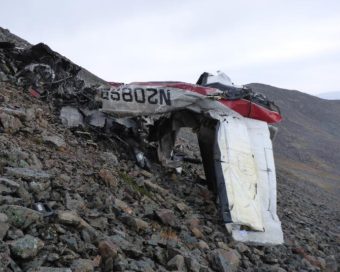
The Cessna 208 caravan that crashed midway between Quinhagak and Togiak (Photo courtesy of Alaska State Troopers)

A Cessna 208 caravan was traveling from Quinhagak to Togiak with two Hageland pilots and one passenger on board when it crashed. An emergency locator signal was received just before 1:30. Two state troopers in Dillingham took a helicopter to the scene shortly after. Sgt.

Luis Nieves supervises the region.

“When our troopers arrived in the area, they immediately noticed that the location was essentially a mountain, that its peak was in the clouds and they noticed what appeared to be the wing of the aircraft,” Nieves said.

The two troopers landed the helicopter and hiked up the mountain for an hour to get to the wreckage. The debris was scattered over a large area and all three onboard were deceased. What caused the crash has not been determined but Nieves said the troopers on scene suspect how it happened.

“The aircraft apparently hit the mountain at high altitude probably in low visibility is what it appears to be right now,” Nieves said.

A company statement Sunday night said the caravan was flying a Ravn connect route operated by Hageland aviation between Quinhagak and Togiak. The company told authorities that had notified next of kin but state troopers were working to verify that before releasing the names of those killed. NTSB investigators are expected on scene today.

UPDATE: 4:20 p.m.

The Ravn Connect flight, operated by Hageland Aviation, was enroute to Togiak from Quinhagak when it lost contact, and an emergency beacon was received just before 1:30.

The passenger and two pilots died on impact, according to troopers. Some of the wreckage burned after the crash. NTSB Alaska Region Chief Clint Johnson said the two investigators who arrived on scene Monday are having a hard time recovering the remains and starting their own investigation:

“As far as the condition of the wreckage, very tough shape, ” Johnson said. “Also the location that the wreckage is in is making our investigator’s job very, very difficult.”

More details about Sunday’s crash, including the weather conditions, will likely come in a preliminary report from NTSB next week.

Hageland and Ravn, part of the same parent company, have had numerous accidents over the past several years, including the recent midair collision outside of Russian Mission. Johnson said NTSB takes each accident case by case:

“We don’t really take into account other accidents, and especially in this case,” Johnson said. “The two accidents that our office is handling right now which would be the mid-air in Russian Mission roughly a month ago and this accident. Both of those accidents are being investigated by two separate investigators and at this point right now, both of them are very much still in the preliminary stages”

Hageland Aviation notified the next of kin of the three men killed Sunday, but state authorities have withheld the names pending a separate notification. The family of Louie John of Manokotak, the passenger onboard, was notified Sunday of his death.

Hundreds of thousands “misappropriated” by former Naknek Electric manager

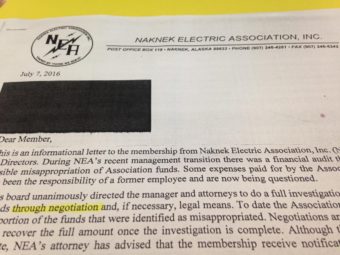
A letter sent to co-op members in July laid out some of the details of suspected embezzlement. This copy was forwarded to KDLG by a member upset by the "negotiations" rather than prosecution.
A letter sent to co-op members in July laid out some of the details of suspected embezzlement. This copy was forwarded to KDLG by a member upset by the “negotiations” rather than prosecution. (Photo by KDLG Staff)

The Naknek Electric Association is working to collect hundreds of thousands of dollars embezzled over several years and repair its reputation with a furious membership. The theft was discovered as new manager Dianne King took the helm from longtime manager Donna Vukich, who retired in March. King and an independent audit turned up the missing money, and NEA’s governing board ordered a forensic audit of the books to at least 2010.

“Some expenses paid for by the Association should have been the responsibility of a former employee and are now being questioned,” board president Nanci Morris Lyon wrote to members in a July letter. “NEA’s board unanimously directed the manager and attorneys to do a full investigation and recover the funds through negotiation, and if necessary, legal means. To date, the Association has been repaid a large portion of the funds that were identified as misappropriated.”

Vukich was the former employee who has since paid back $405,000 to NEA. She has been in her husband’s home country of Croatia for several months.

Twenty or more co-op members turned out for the August 29 meeting of NEA’s governing board, some with stiff comments and questions to deliver.

“This was almost $500,000. How did it get by you guys?” one person asked. Others in the audience called out their disappointment in Vukich, the auditors, and the board members. Some asked the board to go after bonuses and benefits paid to Vukich, and several insisted the board turn the matter over to the state for criminal prosecution.

“Bank robbers would love to have this deal,” another person called out, upset to think the board might put the matter to rest if all the money is paid back.

The board convened with its attorneys in executive session to determine what details of the investigation could be shared at the August meeting.

“It is the advice of our attorney, in the interest in looking out for the board and NEA itself, we don’t want to make claims that we have not been able to prove yet, to stay clear of defamation of character suits in the future,” Morris Lyon said, promising to offer more updates and information after the audit is completed and the attorney advises it prudent to do so.

King said two lump sum payments had been made thus far, the first for $237,000, and the second for $168,000. An audit back to 2014 was complete as of the August board meeting, and work was underway to check the books through 2010.

“And if something is found, will we continue to keep going back?” asked a person in the audience.

“Absolutely,” said Morris Lyon.

The specifics of how the money was taken have not been fully disclosed, but the board and its attorney Andrew Fierro alluded to credit card payments online and over the phone that had pulled purchases away from oversight. Speaking in general terms about “these types of cases,” Fierro said embezzlers evade detection through “mischaracterized expenses, overstated expenses, and multiple reimbursements.”

“It just doesn’t happen by somebody writing themselves a check every month and then it piles up and we have a large amount of money,” he said. “It’s usually never that way at all. It takes various ways and forms, and when it’s not done in-house when something is purchased over the internet, then that takes it even further afield from the office procedures.”

The question of criminal prosecution remains to be determined. Morris Lyon said a federal investigator had already looked at the case and declined to take it on. The board could still turn findings from its internal investigation over to the state, but she said they are moving cautiously for now.

“We’ve been advised against it at this point until we know exactly where we’re at, because if we do move forward with any legal procedures, we again risk NEA, the membership, the board, in defamation lawsuits,” she said. “Once we do decide that we’ve concluded the investigation, have our numbers confirmed, and know what they are, at that point, we will be able to choose to move forward or not.”

About 20 co-op members showed up for the August 29 NEA board meeting to hear the latest about hundreds of thousands of "misappropriated" dollars.
About 20 co-op members showed up for the August 29 NEA board meeting to hear the latest about hundreds of thousands of “misappropriated” dollars. (Photo by KDLG Staff)

That answer rankled the members present at the August meeting. One person said it would not be good for the youth to see the case go unprosecuted, another called for the alleged thief to be “banned from [NEA] membership,” and another wanted her “ostracized from the community.”

Fred Pike, a former manager and mayor of the Bristol Bay Borough, picked careful words to express his disappointment. “Living in the community for as long as we have, and putting the trust in the board and the people that they hire, and having someone that was hired from our community misappropriate that amount of money was a real disservice,” he said after the meeting.

Pike said he and his wife were shocked when they learned that Vukich, who he did not refer to by name, was suspected of stealing money from NEA. She was someone they had known for decades, had had over to the house for dinner, and had seen as a prominent figure in Naknek. Now he wants her prosecuted.

“It’s important that the board do what they can to put this before the state, and hopefully the state will follow through and prosecute this individual so that it sets an example that we don’t tolerate that sort of thing in our small communities,” he said. “If you get caught stealing from a bank, and you give the money back, you still go to jail.”

During her long tenure, Vukich spearheaded the NEA attempt to produce geothermal energy, a costly endeavor she said in a 2012 KDLG interview dated to discussions in the late nineties. The ambitious project failed and NEA settled tens of millions in debts through bankruptcy.

Morris Lyon downplayed the impact of the stolen funds on the electric cooperative’s bottom line.

“The board now feels confident reporting that the amount of misappropriated funds is not enough to affect payroll, benefits, cash flow, credit worthiness, or ongoing operations in any material way,” she wrote in the July letter. “NEA’s annual revenues are nearly $7 million and the Association has a net worth of nearly $10 million. The Association will remain current on all debts incurred as a result of Chapter 11 bankruptcy.”

NEA hopes to answer more questions for its members ahead of the October meeting. So far the Association has not disclosed the exact amount of misappropriated funds, what the money was used for, nor what source of NEA funding was tapped into. NEA says new policies and controls are in place to better prevent this theft from occurring again.

Attempts to reach Donna Vukich for comment have not been successful.

21-year-old enters guilty plea in shooting case involving a friend

Reece David Johnson, 21, of Dillingham pleaded guilty Tuesday in a case that involved his alleged shooting of a friend in the back last May.

Johnson and Isiah Thompson were drinking whiskey late on May 10 when Thompson was shot, perhaps after midnight.

An hours-long standoff with police ensued until Johnson gave himself up peacefully.

Thompson was medevac’d to Anchorage and suffered permanent injury from damage to his spinal cord from the .40-caliber bullet.

Johnson denied he pulled the trigger.

The state’s prosecutor threw out the more serious charges of first-degree assault and weapons misconduct, offering Johnson the chance to plead to fourth-degree assault.

The agreement called for a sentence of time served, which is roughly 140 days in prison since his May 11 arrest.

Assistant District Attorney Andrew Grannik handled the change of plea, and offered few comments about the case. Johnson’s attorney Kate Bargerhuff also had little to say about the case, and Johnson chose not to speak.

Magistrate Judge Tina Reigh said she would “cautiously” accept the terms, though she seemed to do so reluctantly.

“I’ll be frank I’m just having a hard time with this agreement,” she said. “Because it’s such a serious allegation that’s being reduced so significantly.”

The main witness in the case, Isiah Thompson, was not cooperative with investigators or with the prosecution, nor did he participate in any of the bail review hearings.

The state did not offer comment for why the case was pleaded down to misdemeanor assault.

While Reigh commented that the terms seemed light, she said the four and half months in jail would be sufficient and hopefully put Johnson back on a straighter, narrower path.

“My understanding is this was a friend of Mr. Johnson’s, and I would assume that there is some very very serious regret and remorse for what happened, and that alone will hopefully serve as a deterrence from engaging in this kind of activity,” she said. “Because we certainly don’t anyone else to get hurt.”

Reece Johnson was appearing telephonically from Anchorage.

He was expected to be released immediately and the case closed.

36-year-old charged in February 2015 murder

Brian Vane Clark, 36, of Dillingham was arrested in Anchorage for the 2015 murder of Ella Olsen in Dillingham. (CREDIT ALASKA STATE TROOPERS)

Brian Vane Clark, 36, of Dillingham was arrested in Anchorage for the 2015 murder of Ella Olsen in Dillingham.
(CREDIT ALASKA STATE TROOPERS)

Dillingham police say they know who murdered Ella Olsen, 55, in February 2015, and have enough evidence to prove it. U.S. Marshalls had been monitoring the whereabouts of 36-year-old Brian V. Clark in Anchorage, and on Tuesday he was picked up on charges of first degree murder and robbery.

Clark had long been the suspect of Olsen’s murder, but police kept a quiet but aggressive investigation ongoing to gather the evidence to prove it. The crucial testimony was provided by a witness who told police in September that a few months earlier, when he bought heroin from Clark in Anchorage, Clark confessed to the murder. “I didn’t mean to hurt her, I was just dope sick,” the witness claims Clark told him.

U.S. Marshalls began keeping an eye on Clark’s whereabouts, and after an arrest warrant was issued, placed him in custody on Tuesday. He is scheduled to be arraigned in Anchorage Wednesday.

Ella Olsen was beaten to death at her home on Cessna Drive on February 7, 2015. Her body was discovered by an Aleknagik man who called 911 to report it to authorities.

Through their investigation, police determined that Olsen had been selling heroin, and had been around Brian and his wife Darcie Clark the day before, buying alcohol and selling heroin. Brian Clark spent that night getting drunk and playing cards at a Waskey Road home, and lost all his money. One witness said Clark lost $500 playing cards that night.

Police and the prosecution allege Clark then decided he would rob Olsen, who he had seen collecting money from heroin sales for several days. That robbery, which happened sometime on February 7, went bad, and Olsen ended up dead.

At the scene, police and state crime scene investigators collected evidence, but the amounts of various samples needed to verify DNA was low. So low, that the case held for months while the state weighed whether or not to use the small samples for testing, perhaps leaving no additional amounts for further verification or defense challenge. In the summer of 2015, one piece of DNA from a whiskey bottle was sampled but no genetic profile was obtained.

Meanwhile, police continued their efforts, mainly leaning on witnesses, all of whom were involved in buying or selling heroin at one time or another. A few were arrested for selling heroin to police confidential informants. Clark, his wife, and another man were themselves arrested in Anchorage with substantial amounts of heroin, but those cases were only lightly prosecuted. The murder case slowly tightened, but still lacked the testimony of a credible witness that would help prove beyond a reasonable doubt that Clark murdered Olsen.

Ella Olsen was murdered on February 7, 2015. Police allege Brian V. Clark killed her after going to her house on Cessna to rob her of money from heroin sales.
That came in September, when police crossed paths with a man who had crossed paths with Clark months before in Anchorage. According to this witness, he bought heroin from Clark, who told him he knew authorities were closing in. “I just know they’re gonna come get me,” was what Clark supposedly told the witness. Clark, the witness told police, began to cry as he talked about Ella, saying he didn’t mean to do it and had just needed some money.

While police never publicly named Clark as their prime suspect, through their interviews of dozens of potential witnesses, many in town were aware that he was at least a person of interest. Dillingham police have so far not said if Clark had an accomplice, nor have they said how Olsen was killed other than “beaten to death.” An autopsy showed Olsen died of “blunt impacts of her head, trunk, and extremities.”

KDLG News is choosing not to identify the witnesses who spoke with police during their investigation.

If convicted, Clark faces a sentence of up to 99 years in prison. Brian Vane Clark has been charged with first degree murder, two counts of second degree murder, and one count of robbery in the first degree. He is expected to be arraigned in Anchorage on Wednesday.

Did one man scam millions of dollars out of Dillingham residents?

Over four years, Floyd Jay Mann Jr., 54, of Puyallup, Washington, allegedly scammed at least $2.7 million from 15 or more victims, mostly from Alaska, according to an indictment filed in the U.S. District Court of Alaska, following a lengthy investigation by the FBI, IRS and Social Security Administration.

Mann was arrested Sept. 8 in Washington, then released to ankle monitoring a few days later.

Federal investigators say the money was largely gambled away at a casino, though Mann racked up $1 million in winnings. If convicted on the federal charges of wire fraud and money laundering, then Mann could be sentenced to 20 years in jail.

Most of the victims of Mann’s elaborate hoax are from Dillingham, Alaska.

More than a dozen who “invested” in Mann’s scheme have been identified through conversations over several months with police, friends, family and associates of the victims, and speaking with several of the victims themselves.

Federal investigators have not identified the victims, except one with whom Mann was frequently in phone contact, listed only as “P.D.”  The P.D. referred to is Peter Anthony DiMaggio of Anchorage or Palmer, who is now living with friends in Auburn, Washington.

Mann’s connection to Dillingham was brother and sister John and Clara “Tookie” Wren, originally of Dillingham, who lived four doors down from the Manns on 148th Street Court East in Puyallup.

Who is Floyd Jay Mann?

The feds portray Floyd J. Mann Jr. as the mastermind of a shrewd, clever scheme that successfully bilked millions out of his willing victims over several years.

His alleged con involved forged court documents, fictitious lawsuits and disease, and co-conspirators who helped mislead, encourage, or intimate his “investors.” In reality, Mann, who goes by Jay, is a mechanic and auto painter by profession originally from Duluth, Minnesota.

His wife Cheryl D. Mann, 51, has also been indicted on one charge of defrauding the Social Security Administration. They married in 1994 and raised four children in the suburbs on the south side of Puyallup.

“He’s an incredible guy, and a loving dad,” daughter Alisha Mann said. “He’s very trusting and wouldn’t hurt a fly.”

Jay Mann worked in auto repair, detailing, and painting out of several locations around Puyallup.

His daughter said he has not worked “in the trade for a while,” and that exposure to isocyanates had made him very ill. She professed to not know much about her father’s gambling habits.

“I guess we knew he got lucky once in a while at the casino,” she said.

The house on 148th St. Ct E in Puyallup, Washington the Mann’s have rented since 2011. Court records show the landlord has attempted to evict them. (CREDIT GOOGLE MAPS)

That federal agents had searched her parents’ home and charged them both with federal crimes had come as a shock.

Asked about Jay Mann’s connection to Dillingham, Alisha Mann pointed out that John and Tookie Wren had been neighbors and “really close friends” of the family.

John, who died last year, was “friends with Peter DiMaggio,” she said. “When Peter came into our lives we were in a very bad place. He would come around a lot. He didn’t have a good vibe about him,” she said.

Public records suggest Jay and Cheryl Mann had money problems for years.

Numerous landlords, including the Pierce County Housing Authority, sought court-ordered evictions of the Manns more than a dozen times since the 1990s.

One landlord, who asked not to be identified, said the couple “always had a good story” for why they could not pay rent, and had extensively damaged the property.

A few other creditors filed suit to claim small debts, and the state of Washington went after unpaid taxes on several occasions. Beyond that, Jay Mann has a few traffic tickets the local police department had trouble collecting on, and a 2002 charge for forgery of a prescription.

Jay and Cheryl Mann took a limo for a birthday dinner at Harbor Lights in Tacoma, WA, during the summer of 2012, not long after he allegedly began scamming money from victims in Dillingham.

The Scam

To his victims, Mann was a sick, sympathetic figure soon to be a multi-millionaire.

They believed the prescription drug Levaquin, an antibiotic used to treat certain infections, had given Mann cancer.

His ongoing and costly medical treatments were necessary to keep him alive and ensure his massive payout, and theirs, too.

Mann convinced his victims that he was party to a successful $38 million class action lawsuit against pharmaceutical giant Pfizer.

Further, he used a “false and forged” letter from the Supreme Court of Texas to show that “Pfizer Drug Corporation was the initial cause of (Mann’s) severe health complications,” and he stood to collect another $189 million in that settlement.

Even cursory internet searches could have shown victims that Levaquin is associated with Johnson & Johnson, not Pfizer, and “Pfizer Drug Corporation” is never used in reference to Pfizer, Inc., one of the largest pharmaceutical companies in the world.

But Mann worked to preempt his victims from checking in on the facts beyond what he presented to them.

They were told the court had imposed a “gag order” on the case, and they would be penalized if it was discussed or inquiries were made. Pfizer wanted him killed, Mann told them, and a private security firm and the FBI were protecting him.

The Manns posted pictures of some of their 2012 casino winnings on social media.
Adding to the intrigue and further shrouding the scam in secrecy, federal prosecutors allege Mann used co-conspirators to corroborate his hoax. They have not yet been named. According to the feds, one claimed to be Mann’s attorney on the successful class action lawsuit.
Another claimed to be an FBI agent providing Mann’s security. A third pretended to be the judge overseeing the case, and a fourth was supposedly the lieutenant governor of Texas. Through phone calls and possibly in-person meetings, each spoke to the legitimacy of the case and the multi-million dollar settlement.

Mann’s “investors” believed it was their job to pay for the remaining medical bills and legal fees, as the cash settlement would not be released by the court until he had a “clean bill of health.”

They were promised a significant return on their money.

None of this was true, according to findings from a lengthy federal investigation.

Mann did not have cancer, there was no lawsuit, he was not awarded any settlement, nor did the money he received from his victims over at least four years go towards paying any related bills.

Instead, he used his victims like an ATM, text messaging when he needed cash supposedly for legal fees and medical bills.

Fearful of penalties for delays, the victims quickly pooled money and wired it to Mann.

He gambled $2.7 million of his victims’ money at a casino, winning $1 million in jackpots over the years.

The Victims

John and Clara “Tookie” Wren, originally from Dillingham, lived just a few doors down from the Manns on 148th Street Court East in Puyallup. The Manns moved to that house in 2011 and became close friends with the Wrens. John Wren, who died late in 2015, likely introduced Peter DiMaggio to Jay Mann. The Wrens and DiMaggio may have been Mann’s earliest victims, and all three appear to have lost significant amounts of money.

The Seventh-day Adventist Church in Dillingham, where many of Jay Mann’s scam victims attend.
Tookie Wren is a faithful member of the Seventh-day Adventist Church, as are most of the other victims in Dillingham, some of whom are Tookie’s relatives.

“Many, if not most of them, thought they were helping this individual who was supposedly in dire health,” said Howard Williams, the pastor of Dillingham’s Seventh-day Adventist church.

Williams said he and other church members struggled with how to counsel fellow members of the congregation as they watched them contribute enormous sums over several years.

Now that Mann has been indicted, the church is embracing them as they recover.

“I’d say their attitudes right now are probably better than would be expected, though some are certainly angry,” Williams said.

A few individuals made one- or two-time contributions, described as similar to a gambler’s bet where a loss could be anticipated but a win might pay big.

Another core group of probably less than ten invested heavily over the course of the scam.

The toll it has taken on their lives and finances may never be fully unraveled, nor is it necessarily possible to untangle prior money problems from those incurred over years of “investing” in Mann.

However, of the core group, since 2012 several have now closed small businesses, several have been in arrears on city taxes, one lost all his rental properties to foreclosure, and another was fired from his employers for suspected embezzlement.

Friends and associates of the victims say they have watched as their attitudes changed over four years.

First, there was an early optimism, and the offer to get in on the investment was extended to others. As money problems mounted, victims promised their debtors that a big payday was right around the corner. In the face of growing skepticism and voiced concerns, victims became increasingly secretive and defensive. In the end, as police and FBI began to intervene, a deflated hopelessness took root. One friend said of a victim, “She told me she was in so far, she might as well just ride it out to the end, just in case it might still be true.”

Dillingham Police Chief Dan Pasquariello made rounds with the victims in the summer of 2014, after a person emailed a lengthy complaint to police, suspecting her friends were being scammed.

“Some people were cooperative and explained what they believed was an investment opportunity. Some people were downright hostile to us when we were questioning them about this scheme. And other people feigned ignorance,” Pasquariello said . “We talked to all those people, and we informed them it was probably not a legitimate investment, and they were most likely being scammed.”

The money kept flowing from Dillingham through the spring of 2016, despite the police intervention and two visits by FBI agents who were, by 2015 at least, investigating Mann for wire fraud and money laundering.

Assistant U.S. attorney Aunnie Steward presented the case to the grand jury in Anchorage.

She believes Mann was successful in his multi-million dollar scam on account of his victims’ ties to one another and their inclinations to help a person like Jay Mann.

“When someone who is perpetrating a scheme like this is able to appeal for charitable purposes, in this case it was to help somebody with medical bills, also if it’s your neighbors and friends that are involved in it, you’re going to trust that more than if a stranger comes and asks you.”

Cheryl D. Mann posts many pictures of herself driving her blue Mustang on social media. Federal investigators allege she was claiming tens of thousands of dollars in need-based Social Security payments while winning hundreds of thousands at a casino.

Catching the crook

As mentioned, Dillingham police were tipped off to the suspected scam by email in 2014.

The details provided by the cooperative victims were scant, though Chief Pasquariello says he heard the name “Jay Mann of Washington” mentioned.

The Department had neither the resources nor the jurisdiction to pursue the matter beyond his advice to the victims to back away.

The FBI, IRS and Social Security Administration began a separate, lengthy investigation into Jay and Cheryl Mann.

It seems likely the income from gambling, coupled with need-based Social Security claims, may have caught the attention of the feds sooner than any tips about defrauded victims in Alaska.

But as for details about when the investigation began or what triggered it, so far they are keeping their cards close to the chest.

“What I can say is that it took a lot of effort by the IRS, the FBI, and the Social Security Administration to put all the pieces together,” Steward said . “They did a very good job of that to present this case to the grand jury and return an indictment.”

As the net tightened around the Manns this spring, FBI agents made at least their second trip to Dillingham to interview known victims and seek out others.

They informed a village corporation that its bookkeeper was a victim and warned about his access to the corporation’s funds.

The Mann’s home was raided by agents who seized their phones and other evidence.

The case against Jay Mann was presented to an Anchorage grand jury, and the case against Cheryl Mann to a grand jury in Western Washington.

“He’s been charged with eleven counts of wire fraud and eight counts of money laundering. The maximum penalty is 20 years in jail and a $500,000 fine,” Steward said.

Cheryl Mann has been charged with one count of Social Security fraud and could be sentenced to five years in prison and fined up to $250,000. The indictment claims she collected $56,000 in need-based Social Security payments during a period of time she won $125,000 at an area casino.

Steward says her office is not prepared to offer any more information, yet. If the case is presented at trial or the Manns take a plea deal, then more facts will emerge.

If Mann is convicted, then restitution for his victims will likely be a part of the judgement, though Steward acknowledges actual payments may be unlikely.

“If there is any money to recover, we will make our best efforts to do so,” she said.

Even before this case goes to trial, now that it has emerged publicly it at least serves as yet another cautionary tale that people are always looking for new ways to scam others out of their money.

“If it sounds too good to be true, it likely is,” said Steward. “And if there’s any suspicion that that’s the case, then make sure lots of questions are asked, research is done. If you have friends or family that you think might be involved in something like this, really dig in and help look at what’s going on and make sure that people aren’t being taken advantage of.”

Floyd Jay Mann Jr. is due in Anchorage for a court hearing Sept. 22.

Jay and Cheryl Mann did not respond to requests for comment for this story.

Troopers release details of rural police officer shooting

A rural Alaska police officer shot Wednesday night was struck three times but managed to escape and help another witness.

Alaska State Trooper investigators say Chevak (CHEE-vak) Police Chief Derrick McDonald continues to receive treatment for life-threatening injuries at an Anchorage hospital.

The shooter, 24-year-old Harold Paniyak, later killed himself.

Chevak is on the Yukon-Kuskokwim Delta.

McDonald responded to a call of an intoxicated man with a gun and spotted Paniyak on a boardwalk.

Troopers say Paniyak immediately fired a .357-caliber handgun at McDonald, and when the chief fell, shot him two more times.

McDonald and a witness were able to take shelter in the village Head Start building.

Troopers say Paniyak unsuccessfully attempted to get in the building, walked off and shot himself in front of another community member.

Site notifications
Update notification options
Subscribe to notifications