KDLG - Dillingham

KDLG is our partner station in Dillingham. KTOO collaborates with partners across the state to cover important news and to share stories with our audiences.

Heroin laced with fentanyl in Bristol Bay, law enforcement says

Heroin powder
Heroin powder. (Photo courtesy Drug Enforcement Administration)

Last month in Quinahagak four people overdosed — one of them, a young woman, fatally — after using heroin that contained a large amount of fentanyl.

The heroin supply in other parts of Western Alaska is likely laced with the powerful, often deadly, added drug, and they’re putting the word out that things could soon get worse in the region, authorities said.

“Oh absolutely. I have no doubts at this point,” Alaska State Troopers Sgt. Luis Nieves said Monday.

“We’re waiting on lab results to confirm what we believe is that the heroin that’s coming into this area is the same heroin that’s being distributed around the state, especially throughout Western Alaska,” Nieves said “It’s all coming from the same source, which is in Anchorage.”

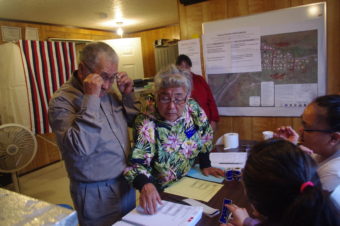
Quinhagak Native Village vice president Mary Hill spoke with KDLG on Aug. 19, just days after a series of overdoses rocked the village.

The state crime lab put out the warning after the overdoses in Quinahagak that there was more fentanyl in the sampled drugs than heroin.

According to the Drug Enforcement Administration,the prescription pain killer “is the most potent opioid available for use in medical treatment – 50 to 100 times more potent than morphine and 30 to 50 times more potent than heroin. Fentanyl is potentially lethal, even at very low levels.”

That means a user’s regular dose, perhaps unbeknownst to them, can be deadly.

“This is probably one of the most dangerous drugs ever to hit this state,” Nieves said. “There are many dangerous drugs that are dangerous, alcohol, meth, but heroin right now with this fentanyl, it’s a hazard to everyone.”

He explained how the residue can be absorbed through the skin, leaving non-users, police, and others vulnerable to exposure.

Suppliers are cutting the heroin with fentanyl, Nieves said, to extend the supply, and extend the high.

“Remember, heroin addicts are doing what they call ‘chasing the dragon,’which is they’re trying to replicate that very first experience with heroin. That’s why they have to increase their dosages over time,” Nieves said. “So as they’re chasing this dragon, they’re always looking for the next stronger supplement. The fentanyl is meeting that demand, but it’s also killing people.”

Speaking broadly, Nieves alluded to information that enforcement has received suggesting significant amounts of heroin are inbound to the region soon.

He suspects suppliers are targeting recent fishing income and the Bristol Bay Native Corporation shareholder dividend checks scheduled to be paid out Friday.

“These wolves that prey on innocent people know that there’s going to be plenty of money in the Bristol Bay region,” Nieves said. “Everyone here has been working their tails off fishing, and now they’re getting ready to get their checks and their dividends, and they are easy prey. People have put Dillingham on the map but they put it on the map for a negative reason: it’s a great place to sell this type of product because people here have the money to pay for it.”

A recent EMS call in Dillingham Nieves responded to as backup was likely a fentanyl-related overdose, he said. The person was hallucinating and displaying other strange behavior not normally associated with heroin alone. Nieves believes that person would have died had emergency room care not been so close, a luxury not afforded most living outside of the city.

“I think our ER is going to start filling up with these people. Especially now that these checks are going to be here, and these predators from Anchorage are going to be here,” Nieves said. “I would not be surprised if there are locals who are going to Anchorage right now to pick this product up and bring it here. If they can hear me, well, shame on them, and know that we’re going to be looking for you, and we’re going to doing everything we can to stop you from bringing this stuff into our community.”

Solutions to stopping the drugs trafficked to the region may be few, but local authorities work closely with the Anchorage-based Western Alaska Alcohol and Narcotics Team. Police and troopers say that is working to complicate shipments from the main hub, but Nieves believes the state should prioritize putting a WAANT investigator back in the region.

Beyond police work to intercept the supply, he has good advice for parents and said he’s available to speak with schools, parents, and other groups anytime. The veteran law enforcement officer believes beating heroin will be a battle fought and won “one household at a time.”

Twin Hills man arrested for harassment of young children

A 53-year-old Twin Hills man was arrested Sunday following allegations he molested three young children.
According to a charging document, state troopers had been investigating Robert Charles Nicholai since an August 10 report involving two children. A parent of a third victim called two weeks later to ask why no one had interviewed another child. All three are under 10 years old.

State assistant district attorney Pamela Dale took a hard line at Nicholai’s arraignment Monday morning in Dillingham.

“This individual, he’s a pedophile, and he’s a predator,” she told the court. “We have at least three victims in this case, and of tender years. The defendant’s previously been convicted of sexual abuse of a minor second degree – contact three other times, once in 1990, and one case in 1998 with two counts.”

Troopers allege he lured at least two of the children into this home where over-the-clothes molestations occurred. Nicholai was arrested Sunday, charged with three counts of first degree harassment. Dale said this case may get more serious as the evidence is further investigated.

“We might be talking about sexual abuse of a minor in the second or third degree here,” she said. “At a minimum this is the harassment one, and with his prior criminal history there would be the aggravators for a year in jail for each one of these counts.”

The magistrate judge ordered Nicholai held on $10,000 bail and he’ll need a third party custodian to be released.

Report catalogs contaminated land conveyed to Native corporations

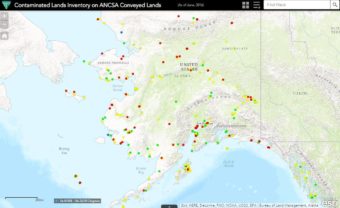
The BLM put together an inventory of 920 contaminated sites conveyed to Alaska Native Corporations, color-coded to indicate sites that have already been cleaned up, and those with work still to be done.

The BLM put together an inventory of 920 contaminated sites conveyed to Alaska Native Corporations, color-coded to indicate sites that have already been cleaned up, and those with work still to be done.

Scattered throughout Alaska are hundreds of pieces of land that have been transferred to Alaska Native Corporations by the federal government.

Some of it is the land of Alaska dreams: forests, tundra, river banks – largely untouched. Other parcels are less picturesque, but chosen for an economic development purpose.

And some, for whatever reason they were chosen, came with contamination: old schools, tank farms, other structures and even some spills.

Getting them cleaned up has been a decades long process, and a new report catalogs those contaminated sites, but leaves some questions about who will orchestrate cleanup – and when.
About 1,000 sites considered contaminated were transferred from federal entities to Alaska Native Corporations, including storage tanks at the post office site in Iliamna; soil issues at the Katmai National Park Headquarters; a tank farm in Newhalen; and the former school in Pedro Bay.

Since the Alaska Native Claims Settlement Act was signed in 1971 as part of the effort to extinguish aboriginal title to lands, the Bureau of Land Management has acted as the government’s real estate agent, and been responsible for transferring each parcel to corporations.

At Congress’ direction, the agency published its report on where those conveyances stand this summer, including an inventory of the sites with a map available and searchable online to discover where the parcels are and what is happening on them – or needs to happen in the future.

The BLM looked at each of 6,000 sites thought to be conveyed under the settlement act, and determined who the landowner was before transfer, to whom it was transferred and when that happened.

Doing so drew on databases and information from several agencies, both state and federal, and BLM deputy state director Erika Reed said it was the first effort of its kind.

“It took dozens of people, literally going through every one of those sites, all 6,000 of them, overlaid against our land status records and the survey records,” she said. “Since we are the ones that dispose of the lands, we conveyed them out of federal ownership, we have the legal descriptions for all the lands that are conveyed, everything that was issued in a conveyance document, in a survey record.”

Much of the push for the report came from an ongoing concern over whether land was being cleaned up.

The preliminary inventory offers information about the land’s current status, though it makes no promises as to future work.

Bristol Bay Native Corporation Associate General Counsel Daniel Cheyette said that the process, which stakeholders see as slow, has been frustrating.

“As the landowners, as participants in ANCSA who believed that their land claims, that the land grants were in satisfaction of their land claims, it’s really frustrating that decades later we still have contaminated sites, and that the federal government is really moving very slowly in terms of correcting problems they created,” he said. “It’s a step, it’s a start, but it’s taking way too long and it’s very frustrating for the landowner.”

It’s also frustrating that the BLM does not have ownership over the next steps beyond the report, Cheyette said.

“It’s a great start, but we’re taking baby steps, and this is baby steps on a problem that has persisted for decades,” he said. “It is both a source of optimism and continued frustration that the main recommendation is a working group. We need concrete steps at this point.”

The Alaska Native Village Corporation Association has worked on the issue for decades, and spokesman Brennan Cain, who is vice president and general counsel for The Eyak Corporation, said the slow process has been frustrating to stakeholders.

“It is unacceptable that 45 years after the passage of ANCSA to settle aboriginal land claims, Alaska Native Corporations continue to face legal exposure for contaminated lands conveyed to them by the Federal government,” he said, adding that the corporations want to see a clear path to cleanup.

“We urge the federal government to acknowledge its responsibility to remediate the contaminated sites and to facilitate the remediation of the sites.”

While the BLM can do an inventory, it has said it doesn’t have the authority to do the cleanup, said Maureen Clark, a BLM public affairs official.

“Once lands are no longer owned by the United States, the Department of Interior doesn’t have the authority to expend appropriated funds to cleanup private land,” Clark said. “It’s the entity that made the mess, if you will, that’s responsible for actually cleaning it up.”

The BLM transferred some of the parcels from its own lands, but those are not thought to be contaminated.

Instead, the U.S. Army Corps of Engineers, the U.S. Air Force, the Federal Aviation Administration and other entities all played a role in causing the contamination, and are likely to be responsible for some sites. But the BLM can’t make them clean them up, said project manager Paul Krabacher.

“We don’t have the authority to compel action for any of this from here on,” he said. “These are not federal lands anymore, they’re private lands. Obviously corporation lands in this case.”

Instead, the BLM report makes some recommendations: finalize the inventory, so that there is a complete picture of the lands’ status right now, and put together a working group to develop the next steps. And, it hands over much of the responsibility for coordinating the work that is left to the Alaska Department of Environmental Conservation.

DEC contaminated sites manager John Halverson said his agency can do some of the work outlined in the recommendations, but not necessarily all of it.

“There hasn’t really been final decisions made on specifically what’s going to happen in response to the report, but DEC’s mission does include making sure that contaminated sites are investigated and managed properly and cleaned up appropriately,” he said.

For instance, the state’s on-going budget concerns might make it particularly difficult for the agency to manage the new inventory database that the BLM put together, or take on other new work, Halverson said.

“We are taking a look at the orphan sites in this report and trying to figure out if any of those are high priority sites to make sure we can move those along as soon as possible, but trying to work out agreements between multiple parties that may be responsible or liable for contamination can take quite a bit of time,” he said.

The agency is looking at funding sources, such as state and Tribal brownfields program resources and other federal programs, to help with the work, Halverson said.

Longtime business manager ousted from three village corporations

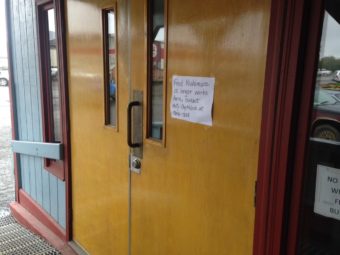
A sign posted on the door of the Aleknagik building in downtown Dillingham, where the ANL office is located. (Photo by KDLG)
A sign posted on the door of the Aleknagik building in downtown Dillingham, where the ANL office is located. (Photo by KDLG)

The business manager for three different corporations has been fired and an independent investigation is underway amid accusations the employee had embezzled money.

Aleknagik Natives Ltd. board president Molly Chythlook confirmed Tuesday that Fred Nishimura had been fired.

Court documents from a lawsuit filed against Nishimura this year show a judgment for Panarqukuk Inc. in the amount of $56,682, which includes $52,900 from 39 checks the corporation said Nishimura wrote to himself over the course of 10 months in 2014.

Chythlook and Jim Vollintine, an attorney representing all three for-profit corporations, said an internal review of records is underway.

Other details of embezzled funds may be made public when that is complete, they said.

The lawsuit said Nishimura was an “independent contractor who performed bookkeeping services … under an oral contract.”

Nishimura denied accusations that he had taken any money beyond what he was owed for services reached by phone Wednesday morning.

He said he may seek legal help to clear up the matters he described as misunderstandings.

Nishiumura has been the business manager for Aleknagik Native Ltd. since “the early ’80s,” according to Chythlook.

Language assistance provisions enacted in western Alaska and the Arctic

When Alaskans went to the polls this week, some had new options for language assistance.

Expanded help for Yup’ik, Gwich’in and Inupiaq speakers was the result of a lawsuit brought against the state in 2013.

A team of state elections officials and those involved in the lawsuit traveled to three Bristol Bay communities to see how the provisions worked out on primary day.

Before choosing a primary ballot at polling place set up at the Manokotak City Office this week, Mike Toyukak glanced at two sample ballots offering Yup’ik translations of the English ballots available for voters to chose from.

From signing for his ballot to depositing it into the ballot box, it only took Toyukak a few minutes to vote.

The Yup’ik language sample ballots, a translator on hand had he needed one, and even a Yup’ik glossary of terms available for the poll workers to which to refer were years in the making.

Toyukak was at the heart of the change. His first language was Yup’ik.

Shooting at beach bonfire party in Chignik Bay lands man in custody

A man who allegedly fired a shotgun at party-goers during a beach bonfire in late July is scheduled to return to court later this week.

Harry Leland Halsey, 40, who said he lives in Chignik Bay but keeps a Fairbanks mailing address, faces charges on four felony counts of third-degree assault, according to court records. He also faces misdemeanor charges including five counts of reckless endangerment and misconduct involving a weapon.

Halsey had pre-indictment hearing on Wednesday, Aug. 10. That hearing was continued to Friday, Aug. 12

State troopers in King Salmon were notified on Friday, July 29, that a bonfire in Chignik Bay the night before had gotten out of hand, and that a heavily intoxicated Halsey had brandished a knife and even fired a shotgun at others.

Witnesses said Halsey was getting rough with his girlfriend, according to the troopers’ sworn affidavit, and when others intervened he pulled the large knife and lunged at them.

He later sped off in a vehicle after saying he was going to get a gun. When he returned, he pulled a .12-gauge shotgun out and racked the action.

Troopers say the gun went off, perhaps while other men were trying to subdue Halsey.

No one else was injured. Halsey was treated for injuries to his face and head that night by medical personnel in Chignik Bay, and was arrested the following day.

He was ordered held on $10,000 bail at his arraignment.

According to Alaska Department of Corrections, Halsey currently in custody in Anchorage Correctional Complex.

Site notifications
Update notification options
Subscribe to notifications