KDLG is our partner station in Dillingham. KTOO collaborates with partners across the state to cover important news and to share stories with our audiences.
Four people were seriously injured after a de Havilland Beaver float plane crashed Monday afternoon on Mirror Lake, south of Kokhanok, 35 miles south of Iliamna.
There were no fatalities.
The Beaver had six passengers and a pilot and taking off after a day’s fishing on Moraine Creek.
The crash “occurred during the airplane’s takeoff run,” said Mitchell Gallo, a senior air safety investigator with the National Transportation Safety Board. “It ended up on shore, that’s where it impacted, not too far in. We’re going to be talking to the pilot and passengers at some later point.”
The Beaver crashed upright, Gallo said
“We’re going to be looking at the wreckage and hopefully we’ll get some good data if any, if there was a GPS available on board, so we can use that for any performance calculations,” he said.
The Rescue Coordination Center launched an HH 60 Pave Hawk helicopter and an HC-130 fixed wing aircraft out of Joint Base Elmendorf-Richardson, which arrived on scene a little after 8 p.m., about four hours after the crash.
One of the four injured passengers was flown directly to Providence Hospital in Anchorage, and the other three taken back to the joint base.
A representative of Rapids Creek Lodge in King Salmon said the crash happened after guests were being picked up from a standard day of sport fishing on Moraine Creek.
The lodge said they believed one of the four injured had already been released, and the others were listed in stable or better condition.
Mirror Lake is in a remote area of Katmai on the Alaska Peninsula in between Iliamna Lake and King Salmon.
Earlier story: ILIAMNA — A floatplane crash 35 miles south of Iliamna left four people seriously injured.
Staff Sgt. Ed Eagerton of the Alaska Air National Guard says the airplane with seven on board crashed as it attempted to take off from a body of water near Mirror Lake.
The airplane was a de Havilland Beaver owned by Rapids Camp Lodge Inc. of King Salmon.
The Air Guard sent a helicopter and airplane to assist the injured. The airplane refueled the helicopter in the air and the aircraft reached Iliamna at 8:20 p.m.
The helicopter transported the injured people to Iliamna. Three were transferred to the Air Guard’s HC130 King airplane and flown to Anchorage. The helicopter flew the fourth directly to Providence Hospital in Anchorage.
Across the state, Alaskans will celebrate Wednesday the first official Wild Salmon Day.
Dillingham representative Bryce Edgemon introduced a resolution this year to officially set aside a day to recognize one of the state’s tastier resources.
A number of organizations are pitching in to sponsor activities across the region, BBEDC CEO Norm Van Vactor said.
“Here in Dillingham I would refer to it as the BB’s. Everybody from Bristol Bay Native Association to the Bristol Bay Housing Authority, Health Corporation, BBEDC are getting involved,” he said. “This year in particular, BBEDC is kind of taking the lead on facilitating the activities, although I’m quite hopeful that in the future it will be a rotating responsibility.”
A number of events and activities throughout the afternoon will honor the fish, the highlight of which is the salmon delicacy competition.
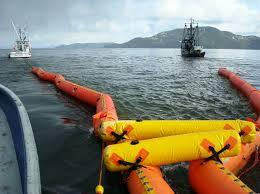
Officials from the Department of Environmental Conservation will explain how to use spill response equipment like oil booms. (Department of Energy Conservation)
State officials will be in Dillingham next week to demonstrate oil cleanup equipment and techniques.
A two-hour presentation will be Tuesday at the Bingo Hall, Dillingham, with more hands-on activities at the Harbor afterward.
Rick Bernhardt, the scientific support unit manager at the Department of Environmental Conservation, will discuss spill response and demonstrate how to use items in containers of cleanup materials.
“On average, we have about 2,000 spills reported to the Department of Environmental Conservation every year, and most of those are just teeny-tiny spills.”
A recent spill occurred at the Drift River Terminal on the West Side of Cook Inlet.
Most spills are small, but compounded a couple thousand times, they add up to a lot of environmental damage. DEC has shipping containers across the state stocked with cleanup materials ready to respond to spills. The containers contain absorbent and containment booms, storage tanks and the implements.
“We have 56 of these containers throughout the state,” Bernhardt said. “We like to consider them regional resources. We have two in Dillingham, but if a neighboring community had an oil spill, they are available for regional use.”
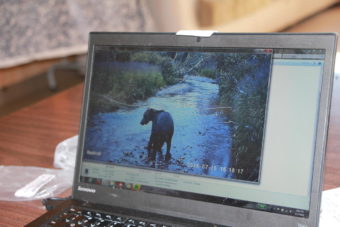
Motion-activated cameras set up by researchers working with the University of Washington's Alaska Salmon Program catch bears in action on Lake Aleknagik streams. (Molly Dischner/KDLG)
Researcher Anne Hilborn removes a memory card from a motion-activated camera set up at Happy Creek on July 17, 2016. (Molly Dischner/KDLG)
Alaska Salmon Program researchers remove bear hair caught on a barbed-wire and put it into an envelope to send in for genetic testing as part of an effort to study how many bears are on Lake Aleknagik streams, how they move around during salmon season, and what exactly they do when humans aren't watching. (Molly Dischner/KDLG)
Motion-activated cameras set up by researchers working with the University of Washington's Alaska Salmon Program catch bears in action on Lake Aleknagik streams. (Molly Dischner/KDLG)
Researcher Anne Hilborn removes a memory card from a motion-activated camera set up at Happy Creek on July 17, 2016. (Molly Dischner/KDLG)
Alaska Salmon Program researchers remove bear hair caught on a barbed-wire and put it into an envelope to send in for genetic testing as part of an effort to study how many bears are on Lake Aleknagik streams, how they move around during salmon season, and what exactly they do when humans aren't watching. (Molly Dischner/KDLG)
Motion-activated cameras set up by researchers working with the University of Washington's Alaska Salmon Program catch bears in action on Lake Aleknagik streams. (Molly Dischner/KDLG)
For the past several years, University of Washington’s Fisheries Research Institute researchers have been studying what happens upstream from a slightly different perspective as part of a multi-decade study of Bristol Bay salmon: the bears’.
The goal is to figure out how many bears there are, and what impact they have on the salmon swimming back upstream – based on when, where and even how they’re eating them – and how bears move throughout the region.
The set-up is relatively simple, if a little time-intensive. Six streams, each with barbed wire stretched across it in two spots to snag bear hair as they go by. Researcher Aaron Wirsing said the set-up plays on the natural behavior of bears.
“The stream is the path of least resistance and has all their food in it, so … they move up and down the streams, which means if we span a string of barbed wire across, we have a good chance of snagging hair for most of the bears that are on these streams,” he said.
That hair is used for genetics testing to ID the bears. At each of the wires, there’s a motion-activated camera. Some of the streams also have an extra camera, to see more of the bear action.
Wirsing is a researcher based for the summer at UW’s Fisheries Research Institute. The group has studied bear predation and its impacts on salmon for more than a decade. In 2010, they decided to use cameras to see what bears were up to when humans weren’t around. Since then, they’ve added genetics, to get a unique ID for the bears.
“Since 2012, not including this year, we’ve detected over 120 different bears, just on six streams,” he said. “That’s just detected, so we can use those numbers to actually estimate how many bears actually use these streams.”
It takes an hour or so to check the traps on Happy Creek and marvel at the sheer number of salmon swimming upstream to spawn. On a normal day, the team checks traps on three of the six streams they’re studying.
The protocol is relatively simple: any hair caught by the barbed-wire is carefully removed with sterilized equipment, and put into a labeled bag with the number of the wire it was caught on. On one July day, while Wirsing and a research technician work on collecting those, colleague Anne Hilborn checks the camera part of the trap.
“One of the nice things about being able to match up the wires and the cameras is the cameras are kind of an independent check of whether the wires work,” Wirsing said. “So if we photograph a bear near the wire, does it leave hair? In most cases it does. So I think the wires do a very good job of detecting a bear, if you will, if it’s in the area.”
The cameras are adjustable, and Hilborn has changed how sensitive they are and how long they record to try and get the best bear imagery. Sometimes, other animals show up: moose, porcupines, fox, a mink, and lots of birds. But mostly, there are lots of clips to go through of just the stream, Hilborn said.
“A heavy day will be several hundred clips, of which maybe four or five will have bears on them, and the rest is branches and grass and things,” Hilborn said. “And we actually found on this creek that the salmon are setting off the camera, so we’ve got 600 clips of salmon going up the creek as well. Which actually could provide a bunch of interesting information about when the salmon actually first come in, what direction they go, ‘cause sometimes they go back out for a while.”
Despite those potential salmon studies, the project remains focused on bears for now, although it is expanding in area – the Alaska Salmon Program has sites at Lake Nerka, too – and collaborators with the Fish and Wildlife Service and Alaska Department of Fish and Game are working on other sites in Wood Tikchik and Dillingham, as well.
Each day after the traps are checked, the cameras are watched back at the FRI Bunkhouse on Lake Aleknagik. When a bear shows up in a clip, it provides an array of information: the research team can figure out when a barbed wire went down, and watch bears go fishing. Some of the bears are repeat visitors that Hilborn said the team recognizes. Other vary more. The clips also offer another glimpse into the reality of Bristol Bay’s salmon streams, Hilborn said.
“One of the things about the camera traps, is it shows you exactly how many bears are here, in the exact same places we’re walking,” she said. “It’s a little sobering sometimes. Because the photos are time-stamped, you can see the bears, and then you see us come out, and then you see more bears come in.”
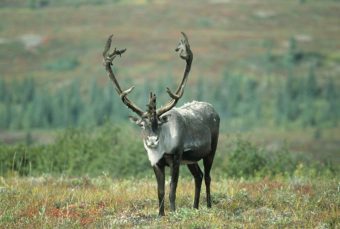
Thousands of caribou like this one traditionally cross the Kobuk River near Onion Portage in the fall. People have been harvesting caribou near this spot for about 9000 years. (Public Domain photo by the National Park Service)
The federal hunt, which is only on federal lands, is open through the end of March and has a bag limit of five caribou per person. That’s open to residents of several Bristol Bay-area communities, said wildlife biologist Andy Aderman, who works at the Togiak National Wildlife Refuge.
“The federal permit is for people living in any of the Unit 17 communities, or 9B communities, or Lime Village and Stony River,” he said.
Game Management Unit 17 includes most of western Bristol Bay, from Togiak to Dillingham, as well as much of the Nushagak River. Unit 9B includes much of the Lake Iliamna region.
The state of Alaska also has opened up a hunt of its own. Aderman said that will take place in a wider area than the federal hunt, and is open to all Alaska residents.
That hunt is open on all Nushagak Peninsula lands through the end of September. The bag limit for that hunt is just two animals, and permits are available online or at the Dillingham Fish and Game office.
Fall hunting does not allow hunters to travel by plane the same day they shoot a caribou, although that will be allowed next January for the federal hunt.
The increased hunting opportunity is meant to try to decrease the size of the herd.
Last year, hunters took 64 caribou on the Nushagak Peninsula, including 42 during the August and September and the rest in March and April. The March and April harvest included 10 taken in the special state hunt that was opened up. That’s not enough, Aderman said.
“Our herd is too big,” he explained. “And with the lack of snow the last couple of winters, we’ve been very ineffective in harvesting caribou and we have probably in the neighborhood of 1,300 caribou down on the Peninsula right now, and we think ideally that number should be around 750. We fear the herd may crash.”
Close
Update notification options
Subscribe to notifications
Subscribe
Get notifications about news related to the topics you care about. You can unsubscribe anytime.