KFSK - Petersburg

KFSK is our partner station in Petersburg. KTOO collaborates with partners across the state to cover important news and to share stories with our audiences.
Board of Fish moves Southeast’s commercial pot shrimp fishery from fall to spring

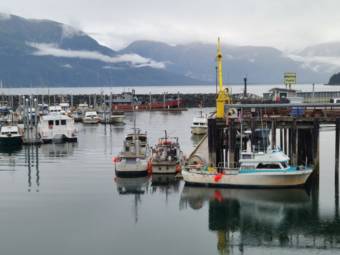
Fishing vessels fuel up for the crab and shrimp openers at the Haines harbor. (Photo by Corinne Smith/KHNS)

Alaska’s Board of Fisheries voted to change a shrimp fishery in Southeast Alaska from the fall to the spring.

The board made that change to the commercial pot fishery during its meeting in Anchorage in March.

Advisory committees from Sitka and eastern Prince of Wales Island submitted proposals seeking the change away from an October start. Shrimper and Sitka committee member Stacey Wayne told the board there are conservation concerns with shrimp.

“In October the shrimp are heavy with eggs,” Wayne said. “They usually start laying their eggs in February.  It can go through even early May that, depending on the year, they’re still laying their eggs — but definitely the time when we’re fishing them, there’s a lot of eggs. And that just went contrary to kind of a conservation approach.”

Proposals sought to change the start date to May 15, or later.

The Alaska Department of Fish and Game has no population estimate for the shrimp caught in the fishery but has concluded that numbers are declining in many parts of Southeast. Fishery managers supported the change because of the potential to boost numbers.

While some supported the change, other shrimpers opposed it.

“All of these guys as well as another processor that approached us felt that the quality of the product in the spring was inferior to the quality of the product in the fall,” said Chris Guggenbickler, president of Wrangell’s advisory committee. “It doesn’t freeze well, it gets spots, there’s leftover egg residue on there that’s got mud stuck in it that’s hard to wash out. So they feel that it’s going to be a lesser valuable product in the end.”

Guggenbickler said he’d developed a wintertime domestic market based on the fall season. In addition, Alaska shrimp caught in the spring would be going to market around the same time as catches in British Columbia and Prince William Sound potentially impacting prices. And a spring season may conflict with subsistence harvest.

The region-wide catch in recent years has been around half a million pounds by around 100 permit holders. Over the past two decades, it’s averaged $2,071,100 in ex-vessel value.

Like permit holders, the board was split on the change.

Board member Israel Payton of Wasilla was convinced that the potential benefit for shrimp populations was worth it.

“Let’s play the long game on this one,” Payton said. “I know it’s disruptive. I could be wrong on my vote on this, but I’m going to be in support of it. I think it’ll lead potentially to increased GHLs in the future and that’s a good thing.”

Managers set guideline harvest levels for different parts of the region based on survey fishing and the performance of the commercial fishery.

Board member John Wood of Willow ultimately was not swayed by possible improvement in shrimp numbers.

“More likely than not I would imagine you would see some enhancement,” Wood said. “How much? Open for guessing. That does not outweigh almost a total disruption of a shrimp fishery that’s existed for a long, long time, has created its own niche and has created its own expertise in harvesting that product.”

The vote was 4-2 to approve the season shift, with Wood and John Jensen of Petersburg voting no.

The department could still open a fall season by emergency order if the fleet hasn’t completed its catch in the springtime.

Board votes to continue conservation measures for weak Southeast Alaska king salmon stocks

A king salmon is weighed in at Petersburg’s Memorial Day weekend salmon derby in 2015. The 2018 derby has been canceled. (Photo by Joe Viechnicki/KFSK)
A king salmon is weighed in at Petersburg’s Memorial Day weekend salmon derby in 2015. (Photo by Joe Viechnicki/KFSK)

Alaska’s Board of Fisheries this week voted to continue with conservation measures for chronically low returns of king salmon in Southeast Alaska. Some stocks are forecast to be at their lowest levels on record this year and others have rebounded a little under fishery closures.

The region has 34 stocks of king salmon and the board has listed seven as stocks of concern. That means for four years or more, those runs have not had enough fish making it back to spawn, or what managers call an escapement goal.

Ed Jones is an Alaska Department of Fish and Game coordinator specializing in king salmon research. He outlined to the board the measures taken to reduce harvest of those fish.

“Through the actions taken beginning in 2018 with the action plans, we have taken good steps towards achieving the escapement goals,” Jones said. “The problem is the production of these stocks has just continued to be low. And so right now we’ve not been able to provide a harvestable yield annually. The hopes are that that production will change, escapement goals will be met and we’ll also be able to identify yield.”

In 2017, the board named three rivers as stocks of concern: the Chilkat River near Haines; the King Salmon River, the region’s only naturally-occurring island stock on Admiralty Island; and the Unuk River near Ketchikan. In 2020, it added another four: the Stikine River near Wrangell along with one of its tributaries Andrew Creek; the Taku River near Juneau and the Chickamin near Ketchikan.

To reduce harvest of those fish, the winter and spring seasons for the commercial troll fishery have been curtailed. Net fisheries have lost time and area as well. And springtime sport fishing has been shut down on the inside waters of Southeast.

Some of the rivers originate in British Columbia, and the salmon runs are managed under the Pacific Salmon Treaty between the U.S. and Canada. Managers say the restrictions would be likely under that agreement, whether or not Alaska has listed the runs as stocks of concern.

Staffers with Fish and Game sought board direction on the existing conservation measures, as well as additional steps that could curtail harvest further.

During discussion on the Stikine, Max Worhatch of Petersburg, executive director of the United Southeast Alaska Gillnetters, thought the net fishery on the inside waters had lost the most to conservation measures.

“It’s pretty difficult to look at it and hear now from the department they’re considering more restrictions for us in district 6 when right over that line, just west of our line, we have a full-fledged sport fishery going on from Jan. 1 to June 15,” Worhatch said. “We won’t start until after June 15, we’re behind that but we see more restrictions. Pretty hard to take.”

Some fishermen sought a partial reopening of the shortened commercial winter troll season or other lifting of restrictions where fish are rebounding. But many thought conservation measures should continue. Ron Somerville of Juneau is with the Territorial Sportsmen, a sportfishing organization and made that case for the Taku and Stikine rivers.

“I mean when you got stocks that are seven years below the minimum escapement goal, every fish counts,” Somerville said.

Returns for the Taku River near Juneau and Stikine River near Wrangell are forecast to be their lowest on record this year, 6,600 for the Taku and 7,400 for the Stikine. Harvests have been reduced and fishery managers say they’re nearing the limits of what they can do to cut back the catch. Sport and commercial fisheries intercepted 12 percent of the Stikine River run last year and nearly seven percent for the Taku. A small portion of that harvest occurred in Canada.

Some of the other runs are showing improvement. The Chilkat near Haines has met the lower end of its escapement goal for three years although it’s not forecast to make that mark this year. The Unuk has reached that level in three of the past four years and is forecast to again this year. The Situk River near Yakutat is forecast to surpass its escapement goal range.

Board members, like chair Mӓrit Carlson-Van Dort of Anchorage, supported the managers’ efforts.

“I think the department has been doing an excellent job of managing to the conservation concern and at this time I don’t see the need to be more restrictive, I think we’re pretty darn restrictive at this point and I think that the cost to further restriction is very high for what may be not a lot of impact in terms of the conservation,” Carlson-Van Dort said.

The board approved action plans for king salmon stocks of concern. They voted to direct managers to continue with the status quo for fishery conservation measures while allowing managers to use more stringent measures as they see fit.

Board member John Wood of Willow agreed with that direction.

“That is my intent and I don’t consider it punitive madam chairman to the harvesters,” Wood said. “I’m looking more at as much restriction as I can implement, with reasonable on protection of the fish. I mean they’re on their lips already they wouldn’t be in this status if they weren’t in trouble. So, if there’s some economic harm that comes out of that I understand that but I don’t want to be punitive in nature and impose a whole list of different things when it’s not necessary.”

Those action plans have meant sport anglers can’t keep a king salmon starting April 1 on the inside waters and the winter troll fishery ended early March 15.

Board of Fish approves compromise for Southeast king salmon management

""
King salmon landed in the commercial troll fishery in the summer of 2019 (Photo courtesy of Matt Lichtenstein)

Alaska’s Board of Fisheries on Sunday agreed to a compromise for king salmon in Southeast that would leave sport fishing bag limits unchanged throughout the season. It’s an attempt to balance the needs of charter fishing businesses and the commercial troll fleet while setting a priority for resident anglers.

At issue is a new provision of the 2019 Pacific Salmon Treaty agreement that requires Alaska to pay back the following year when the commercial and sport fleets catch more king salmon than they’ve been allocated. The Department of Fish and Game has used in-season management to stay below that number, and that’s meant reducing the resident bag limit on sport-caught kings over the summer or even prohibiting non-residents from catching them at all.

Charter and lodge operators said clients book trips well in advance and want to be able to keep a king salmon. Many, like Ketchikan charter fishing captain Jeff Wedekind, asked the board for a new approach to keeping Alaska’s harvest on target.

“If we have an allocation that doesn’t even allow us to fish or closes us down in the middle, then we can’t run our businesses, people aren’t going to come,” Wedekind said.

Lodge and charter businesses said their packages are based on a minimum of three days of fishing, with the opportunity to catch a king on all three days.

Charter business owner Joel Steenstra of Craig was among those opposing the state’s current strategy of lowering the total that non-residents can keep in a year in response to concerns over low abundance.

“It would kill that fishery for us, and we just basically would lose probably a third of our income if we were forced to just have a one or two annual limit there in June because there’s no cohos around typically until about the 10th or 15th of July,” Steenstra said.

Alaska’s annual share of king salmon is split 80% and 20% between commercial trollers and sport anglers, after a small portion is taken out for commercial seiners and gillnetters. That number changes from year to year based on the abundance of kings in the previous winter’s troll fishery.  To keep bag limits stable, the charter industry proposed a higher sport percentage when king numbers are down and a lower percentage in times of abundance, but still meeting that 80/20 split over time.

The idea didn’t go over well.

“The sport charter sector is now making the claim that they of all harvesting groups should not be held to the agreement they themselves helped negotiate. Where does this elitist sense of entitlement end?” asked Alaska Trollers Association president Matt Donohoe of Sitka.

He and other commercial fishermen, like Brett Stillwaugh of Wrangell, didn’t see any logic in one side getting a greater share of kings when fewer fish are around.

“I’m opposed to any borrowing of king salmon quota from other user groups in years of low abundance,” Stillwaugh said. “I for one on lower abundance years need more fish, not less. Giving up fish when the troll fleet needs them the most is counterproductive to our fishery.”

Alaska has seen reductions in its king catch under the treaty negotiated between U.S. states and British Columbia. Sport and commercial fleets catch a mix of chinook, but the bulk of those come from rivers in British Columbia, Washington and Oregon. Since 2018, some local runs have been listed as stocks of concern because of low numbers.

That’s meant sport fishing closures throughout the inside waters and closures or reduced areas for commercial fishing.

“So far, commercial trollers have carried the weight of king salmon conservation in Southeast Alaska,” said Sitka troller Jacquie Foss. “We have had more than a 60% reduction in king salmon from several treaty negotiation. We lost six weeks of winter troll fishery, and non-resident charters are allowed to fish.”

But there was an opening for compromise. Prior to the meeting, the trollers association and sport fishing group Territorial Sportsmen issued a joint statement asking for a resident preference in king salmon management.

“As you have heard, the major threat to the resident king salmon sport fishery is the non-resident sport fishery in outside waters,” said Larry Edfelt of Juneau, representing the Territorial Sportsmen. “The non-resident fleet now takes two-thirds or more of the sport chinook quota, and its catching power is so great that it could take the entire sport quota before the end of June, thus closing both the resident and non-resident chinook fishery for the entire summer.”

Ultimately stakeholders hammered out a compromise that maintains the current 80/20 split but won’t lead to in-season closures. Non-residents will still see annual limits drop in summertime. Residents will have a higher bag limit than non-residents, and uncaught kings later in the summer could go to commercial trollers.

Patrick Fowler is the Division of Sportfish’s area management biologist for Petersburg and Wrangell and explained the provisions of that agreement.

“This would manage the sport fishery with no in-season management,” Fowler said. “So these bag and possession limits that I’ve announced would be maintained throughout the season even if the department projects that the allocation of the sport fishery would be exceeded or if there’d be remaining allocation on the table, and that would be transferred to the troll fishery.”

Fowler believed that the compromise would achieve the 80/20 split over time.

The commercial troll season in late summer ends up acting as a buffer. If the sport fishery goes over its allocation, the department can cut back time for commercial fishing. If the combined catch exceeds Alaska’s share, the overage will be paid back the following year by subtracting it from the total, regardless of which gear group was responsible for going over.

Board member Gerad Godfrey of Eagle River thanked the stakeholders for arriving at a compromise.

“I know this was very complicated, very difficult to navigate,” Godfrey said.

The board voted 5-0 to approve that compromise language, with John Jensen of Petersburg sitting out the vote. Willow board member John Wood voted against a companion proposal on allocation and payback of overages but it still passed 4-1.

Based on winter troll catch rates, Alaska’s share of kings is actually up this year, 261,300 fish for all gear groups, up 44,700 from last year.

Board of Fish votes down proposal to allow limited red king crab harvest in Southeast Alaska

Three different kinds of crab pots stacked up on land
Crab pots stacked in Petersburg. (Photo by Angela Denning/KFSK)

The Alaska Board of Fisheries has voted down a proposal that would have allowed for a limited harvest of red king crab in Southeast Alaska, where the fishery hasn’t been open for years.

The proposal was supported by both the Alaska Department of Fish and Game and fishermen.

Over the last decade, there’s been just one red king crab fishery in Southeast. That’s because the state’s estimations of crab stocks have repeatedly fallen short of the 200,000 pounds threshold. That number comes from surveys the state conducts in some areas.

The board was asked to consider a proposal that would create equal crab quota shares when the state’s harvest levels were too low for a regular competitive fishery, similar to equal share fisheries for sablefish in the region.

State managers and industry groups wrote the proposal together over several meetings.

Andrew Olsen coordinates the state’s crab management in Southeast. He presented the proposal to the board, saying it would allow for a limited harvest and give managers crab data they need. He said they could limit the fishery to areas where they don’t survey.

“We have no stock assessment survey in those non-surveyed areas, and [it would] allow us to see where other populations of red king crab and blue kind crab are, to get more informed on what the fishermen are seeing out in the field,” Olsen said. “Then we can integrate that into our stock assessment model to be more informed.”

Fishermen have repeatedly said there are more red king crab than managers are estimating.

The proposal would have lowered the harvest threshold to 88,000 pounds, giving permit holders equal amounts of crab to catch. That amount would change depending on the state’s yearly estimation. If the harvest level was above 200,000 pounds, management would return to a competitive fishery. The proposal would have expired in three years, unless renewed by the board.

It also would have allowed multiple permit holders on a vessel fishing together. And it would limit the amount of harvest per trip and how long trips last.

The crab proposal was backed by several regional industry groups: the Southeast Alaska Fishermen’s Alliance, the King and Tanner Task Force and the Petersburg Vessel Owners Association, which together represent hundreds of fishermen.

The price of red king crab has gone up in recent years, and fishermen say it’s worth fishing for a small set harvest. The last opening paid over $10 per pound.

Max Worhatch is a fisherman from Petersburg.

“I think it’s a good idea to do this. I think it’s going to give some economic activity, and it will be warranted,” Worhatch said. “It’s a slow fishery — it shouldn’t do any harm.”

The current management plan has different harvest goals for different areas, and fishermen can choose where they want to go.

Fish and Game’s Olsen told the board it’s hard to manage that way because of the bays and inlets that make up Southeast.

“The fishery goes very fast,” Olsen said. “Our past fisheries in those survey areas have been 24 hours, which makes it very fast. So, at a lower level, to slow it down, equal quota share will allow us to manage more effectively and precise by being able to have that tool in place.”

He said the bays and inlets have genetically distinct populations of crab, and they need more data on them.

Slowing the fishery down was a sticking point for some board members, who said it could be gained by other means, like reducing gear.

Board member Israel Payton of Wasilla suggested they limit permits to 10 pots, for example. He spoke against the idea of quota shares like those used in the federal managed halibut fishery.

“I think the board is defaulting, turning some of these fisheries into basically, setting policy, and turning them into a quasi-IFQ fishery,” Payton said.

Board member Gerad Godfrey of Eagle River spoke in favor of a free market and against quota shares, in general.

“I personally believe in the spirit of competition and not necessarily the egalitarian approach of ‘let’s just equalize it,’” Godfrey said.

Board Chair Märit Carlson Von-Dort of Anchorage said she didn’t like the idea of quota shares but could support the proposal because it was temporary and the state could gain data.

“I do think that information gathered through the fleet for a discreet amount of time — that being a period of three years — may be useful to the department,” she said.

The proposal was ultimately voted down, 3-2. Payton, Godfrey and John Wood voted against it, while Carlson Von-Dort and McKenzie Mitchell supported it. One Board of Fish member, John Jensen of Petersburg, recused himself, and one board seat is vacant.

Petersburg residents worry about family and friends in Ukraine

A mother and daughter embrace in a field of sunflowers
Oksana Tolkachova and her daughter, Alisa Tolkachova, stand near a sunflower field in Ukraine. (Photo courtesy of Oksana Tolkachova)

Russia’s invasion of Ukraine has been going on for nearly two weeks, and over a million refugees have fled the country. Two women in Petersburg are keeping a close watch because their family and friends are there. At the same time, they’re helping to educate their neighbors about the situation.

When Oksana Tolkachova first heard of the war, she thought of her older sister. She’s a teacher in Kyiv, Ukraine’s capital of three million people.

“It’s scary, it’s scary. She says sometimes, ‘I’m panicking inside,’” said Tolkachova, who talks to her sister and others in Ukraine every day. “Everything is closed. I mean, normal life stopped and it’s just sounds of bombing, of sirens.”

Her sister spent a few days in the nearest shelter, which is a subway, but mostly she’s been at home. Her family goes to bed every night fully dressed, ready to leave at a moment’s notice.

Tolkachova has another relative living close to Ukraine’s northern border who has blankets on all of her windows after they were blown out by explosions. And it’s cold winter weather there.

Tolkachova’s been in Southeast Alaska for five years after marrying a Petersburg man, Jeff Hupp. She works at the elementary school and spends her summers back in Ukraine.

She says people in Petersburg have been kind, approaching her about how they can help. They bring her flowers at work and at home, and she’s very grateful. One special ally is Ola Richards.

“Ukrainians were a huge part of my life growing up in Poland,” Richards said.

Richards grew up in Chelm, about 20 miles from Ukraine. She’d regularly cross the border, shopping with her friends to buy clothes or other goods.

The country was communist when she was young. She only remembers a few things, like everyone had jobs, but there was little to buy.

“We didn’t have options like we have now. I remember standing for hours with my mom, being a kid, for toilet paper,” Richards said. “Can you imagine? Now, people are like freaking out during COVID and buying toilet paper, which — we didn’t have toilet paper.”

She heard a lot about how things used to be from her grandparents: the destruction of World War II followed by Russian influences.

“Just, my family talking about those times, they were unhappy,” Richards said. “They wanted them out, they wanted to be their own people.”

Tolkachova has relatives in Russia. Her brother-in-law is from there. And she speaks the language.

But she doesn’t trust Russian President Vladimir Putin or what he says — like that he’s saving the Ukrainians from Nazi leadership.  Richards doesn’t buy it either.

“It looks like he’s really working his propaganda,” Richards said, “controlling the media, spreading lies.”

“Yeah, lies, it’s only lies,” Tolkachova agrees.

But some do believe Putin — like Tolkachova’s family member who listen only to Russia state media.

She and Richards say it’s not their fault. And they also feel sorry for the Russian soldiers, who are young.

“You can’t even imagine how powerful Russian government is,” Richards said. “It’s not that easy to just go and face the government.”

“It’s dangerous for them,” Tolkachova agreed. “So, I think some people [in Russia] don’t understand, some people are protesting, and some people maybe understand but they are afraid to do anything.”

The women say that Americans also don’t always get it.

“Someone the other day asks me, ‘Well, just get your guns and fight,’” Richards said. “And I’m like, ‘In Poland we don’t have guns.’”

And Tolkachova’s 13-year-old daughter, Alisa, has heard some misunderstanding at her middle school. A few kids were joking about being on Russia’s side.

Alisa wishes people would be more sensitive.

“When you’re talking about the war, I know you don’t understand how it feels because you’re not affected by it,” Alisa Tolkachova said. “But you have to think about the people who are affected by it; the lives that are being lost right now.”

Being so far away is hard. But OksanaTolkachova brightens up when she thinks of all the Ukrainians coming together to fight.

“People are united so much, they have such a spirit right now, even those who are quarreling on different topics or whatever, they are just united now,” she said.

The future is uncertain. Tolkachova has tickets for Ukraine for the end of May, but that’s up in the air.

In the meantime, she and Richards hope their family and friends stay safe and that an end to the war comes soon.

Interior Department suggests name changes for racial slurs used for Prince of Wales creek and mountain

""
Screen shot from U.S. Geological Survey interactive map

A creek and a mountain in southern Southeast Alaska are on the Department of Interior’s list of candidates for removing derogatory names.

On Feb. 22, the department released a list of possible replacements for more than 660 place names around the country that contain the word “squaw.”

“Squaw” is a racist and sexist term used against Indigenous women.

In November 2021, Interior secretary Deb Haaland officially declared the word derogatory and has said racist terms have no place on federal lands. Haaland set up a task force to find alternatives and accelerate name changes.

A creek just outside Whale Pass on the northeastern side of Prince of Wales Island is one such candidate. Suggestions for replacements are Ragged Cove, Exchange Cove, or Exchange, West or Thorne Island.

There’s also a nearly 2600-foot mountain on the western side of Dall Island that could be renamed. Possibilities for that are Manhattan Lake, Sakie Bay, Middle Island, Sakie Point or Table Rock.

The Interior Department is seeking public comment on replacement names and consulting with tribes. In total, there are 27 places proposed for renaming on federal land in Alaska.

Site notifications
Update notification options
Subscribe to notifications