KHNS - Haines

KHNS is our partner station in Haines. KTOO collaborates with partners across the state to cover important news and to share stories with our audiences.
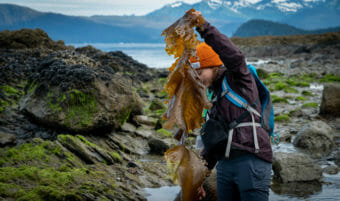
Skagway gets $20M FEMA grant to protect cruise ship dock from rockslides

The cruise ship berth directly below the rockslide is empty for the rest of the 2022 season. August 3, 2022. (Claire Stremple/KTOO)

Skagway has been awarded a $19.9 million dollar grant from the Federal Emergency Management Agency for rockslide mitigation above the White Pass and Yukon Route Railroad dock. Rockslides from the mountain beside the dock have disrupted the community’s last two cruise seasons.

“Success is always welcome,” Mayor Andrew Cremata said. “This is huge for Skagway, this is huge for the cruise industry.”

A year ago, the rockslides forced Cremata to declare a state of emergency, limit dockings, and forgo much tourism revenue.

Cremata says the municipality has spent $4 million this year on rockslide mitigation and monitoring. Crews strung nets across the hazardous zone, but that fix is temporary.

Cremata says the grant brings a more permanent solution in sight, but he says the project will be complex.

“It’s not just bringing down a rock,” he said. “One of the key parts of the project is protecting the infrastructure below the rock. There is a dock down there that we need to protect, there is our small boat harbor, there are fuel tanks, public restrooms, so hundreds of millions of dollars in infrastructure that need to be protected. So it’s a little bit more of a delicate job than simply blasting a rock.”

Delicate, and very costly. The nearly $20 million grant will cover three quarters of the cost. Cremata says the municipality is working to find the rest.

The FEMA website indicates that the money will go toward everything from rock excavation and hauling to traffic control and environmental protection.

Skagway Borough Manager Brad Ryan gives a more detailed description.

“The basis of that work is to pin back where the mountains is unraveling behind the primary slide there, so that’s drilling some long holes up there, and putting some long sections of rebar in there, grout and pin it back so it’s stabilized,” he said. “And then we start removing rock that’s up there that’s going to slide, and that’s about 30,000 yards of material. And then putting attenuation measures that would prevent minor rockslides from coming down and being a problem.”

Ryan says the aim is to allow foot traffic on the dock again, instead of the costly shuttling of crowds by bus and boats to avoid the danger zone.

Cremata says obtaining the grant is the reward of a substantial lobbying effort the municipality engaged in. Back in October, he and the town’s lobbyist took a trip to Washington, D.C.

“I remember going to Sen. Sullivan’s office, and talking to his staff, and showing them a video, and they thought it was just one rock slide. They didn’t realize that this had been an ongoing issue last year and had threatened life, limb and property,” he said. “So familiarizing them with the magnitude of this issue and what it was going to take to solve it was very important.”

Cremata says the cruise ship industry lobbied as well. He says there are a few more hoops to jump through, but that the grant has essentially been awarded.

Details emerge about Haines canoe accident that left guiding clients critically hypothermic

Chilkoot Lake (Alain d’Epremesnil/KHNS)

Two weekends ago, a canoe from a Haines guiding company took on water at Chilkoot lake. Its seven passengers and two guides spent a substantial amount of time in the lake’s cold water as they swam to shore before being rescued. We spoke with Haines Fire Chief Brian Clay about the incident, and the department’s response.

The accident happened on a windy Sunday afternoon at the far end of Chilkoot lake. The group was on a canoe tour with Haines guiding company Alaska Mountain Guides.

It was blowing probably 15, gusts to 25 up there,” said Haines Fire Chief Brian Clay, who was at the lake fishing with his granddaughter. “My understanding is they started taking on water and as it swamped, they couldn’t bail fast enough and it just swamped itself.”

As the canoe took on water, seven elderly passengers and two guides found themselves swimming for shore. All reportedly were wearing floatation devices, but they spent about half and hour in the glacier-fed lake before reaching shore.

Another boat front the guiding company reportedly picked them up from the beach and brought them to the parking lot, where Chief Clay met them.

“They all had hypothermia, and three were critical,” he said. “Three were walking, or green as we say in our business.”

The three critical patients were sent by private vehicles to meet with ambulances on their way from town. The other four were escorted to the clinic in fire and police department vehicles.

At least five of the patients were later medevaced, according to Clay, and ambulance volunteers were busy late into the night shuttling those patients between the clinic and the airport.

Clay says once activated, the emergency response went smoothly. But the first call to 911 was directed to the wrong dispatcher.

“I believe the initial 911 call went to Fairbanks regional office for the sat phones, and they didn’t know where Chilkoot Lake was,” Clay said.

KHNS could not check directly on the health of the patients. Alaska Mountain Guide owner Sean Gaffney did not respond to multiple requests for comments.

Mine project upstream of Haines gets permit for seismic exploration

The Palmer mineral deposit is contained within the ridge in the left foreground. Viewpoint is looking northeast, up the Klehini River Valley and across the Canadian border. (Photo by Connor Gallagher/courtesy of Takshanuk Watershed Council)

The Palmer Project is a copper, zinc, gold and silver exploration project upstream from Haines and Klukwan. Constantine Metals, which owns the Palmer Project, has received permission from the Alaska Department of Natural Resources to proceed with seismic exploration at two sites above the Klehini River.

The new activities will include building miles of trails 25 feet wide, some shallow drilling, operation of heavy equipment and helicopters, and detonation of close to one thousand sticks of dynamite.

The permitting process came under public scrutiny earlier this summer. Environmental groups claimed the process was rushed, and many residents submitted public comments to DNR.

DNR issued a public notice announcing the new permit. The document states DNR received almost 200 letters from individuals, and that around 13,000 people submitted a comment opposing the permit through the Audubon Alaska website.

The state department offered its response to the comments. The response systematically addresses 30 concerns that were brought up by residents. The issues addressed range from the technical to the bureaucratic, the political to the recreational.

To comments generally opposing the project because of the risk to fish, the agency responded it is working closely with the Department of Fish and Game, and consider the activities impacts will be negligible. It further states the Palmer Project is participating in a statewide bond pool. This is a fund mining companies contribute to – the funds would be made available should the company fail to pay for damages incurred during the work.

To comments opposing the use of explosives, the agency said that the noise of the explosions would be comparable to that of a hunting rifle. It further says that “these intermittent shots are unlikely to cause a civil nuisance or have adverse impacts on wildlife or other nearby land uses.”

The agency states the gelatin based dynamite sticks authorized under the permit will not present any environmental concerns.

Several commenters remarked that the new activities require going through an Environmental Impact Statement (EIS). To this, the agency responded this is a federal requirement that does not apply in this case.

Some comments pointed to restricted access on the public land affected by the activities. The agency said that access will only be restricted when blasting activities are occurring. In an email ,  Constantine said the borough will be notified, and signage will be used when active work is taking place.

Several commenters, including the Chilkat Indian Village indicated that a formal tribal consultation should occur. They stated that to date, DNR has declined to engage in tribal consultation, and it has failed to arrange any public meetings. The Tribe asked for, quote: “*at least one Tribal consultation on a government-to-government basis that is respectful of the Tribe’s sovereignty and expertise.”

The agency said there is quote “no existing legal obligation warranting government-to-government consultation for the issued authorization.” It went on to say that the state has no legal obligation to provide a sovereign government with greater consideration than the rest of the public, and that the 30 day comment period provided sufficient opportunity for the Tribe to voice its concerns.

The exploration work could set the stage for a tailings storage area, a place to hold toxic mine waste. Some commenters asked that DNR consider the big picture and deny the permit on that basis. The agency‘s response followed a different logic. It stated that the permit is part of an incremental process that will allow for better decision making as more data is collected during the exploration.

Some public comments mentioned a climate of impunity that allows developers to initiate work before obtaining the proper permits. In early June, Constantine did just that, and cleared some seismic trails at one of the sites.

Lorraine Henry, a spokesperson for DNR, said in an email that corrective action has been taken, she wrote: “To ensure compliance with the terms of the permit, the Division is requiring Constantine to provide an additional $5,000 bond.” According to a press release from American Pacific, which owns Constantine, this season’s budget for the operations at the Palmer Project is over 25 million dollars.

In its response the agency invoked the “De minimis non curat lex” principle. This is Latin for “the law is not concerned with insignificant  matters”.

Methodically, the agency responded to the 30 points raised during public comments, and justified why it issued the permit.

Environmental advocates who read through the document were not convinced.

“Technically I suppose they addressed the comments, in that they wrote out written responses,” said Shannon Donnahue, who works for Rivers Without Borders.

“Once you get into the nitty gritty of these permitting processes, the process is so lenient that Constantine/American Pacific went ahead and started work before the public comment period was over,” she said. “That doesn’t give me much confidence in the regulations and that they will comply with the permit now that it is awarded.”

The U.S. Fish and Wildlife Service also submitted a comment, praising the rich life of the valley. It said the Chilkat watershed provides some of the best salmon habitat in Southeast Alaska. Is said that given the “area’s rich biodiversity and relative lack of legislative and administrative protection”, the Service encourages DNR to implement strict conservation measures.

In its response, DNR defended its protocols and said the accusation “is unfounded and promotes an unwarranted narrative.”

In an e-mail, a Constantine said it is working with their contractor to finalize the work’s timeline. In a press release, American Pacific announced good progress with its drilling program, and stated that a priority of  its environmental team is to “ensure Palmer’s environmental studies and monitoring provide community confidence  in the project above and beyond regulatory compliance.”

DNR’s decision can be appealed for up to 20 days after its issuance. No entity contacted for this story has committed to doing so.

A potentially endangered bee species may be hiding in plain sight in the upper Lynn Canal

A western bumblebee. (Creative Commons photo by Liz Osborn)

A special denizen of the upper Lynn Canal might be hiding in plain sight, undocumented by science. Derek Sikes, a professor of entomology in Fairbanks, wants to know if the western bumblebees are in Haines.

Sikes is looking for a bee with one feature. The western bumblebee has that fuzzy bumblebee look. It has some yellow on its thorax, but its abdomen is all black, except for a splash of white at its very end.

“It has this very distinctive white butt,” he said.

Western bumblebees were once common throughout Western North America. As global warming progresses, Sikes says the bees are disappearing from the southern part of their range. But so far, biologists are not seeing them move north to follow their preferred temperatures. This means their range is shrinking.

Sikes says if current trends continue, they could go extinct by the end of the century. The US Fish and Wildlife Service is considering listing the species as endangered.

To determine if these bees occur in Alaska, biologists are modeling their current habitat.

“Looking at all the parameters like temperature, precipitation, and a whole lot of other things. And then seeing, ok, this is where it occurs, where might it also occur?” he said. “What other parts of the world have the same niche, the same basic habitat?”

This is what has led Sikes to Skagway and Haines. He says currently the western bumblebee population peters out in British Columbia, at the latitude of Southern Southeast. Much of the panhandle is too wet for the species. Hoping to find them, Sikes went to Haines last summer, and a colleague went to Skagway. They headed for the flower patches to collect some specimens.

“The basic method is we go around, we look for flowers, we net them, we move on to another site, and we try to cover as much of the road system as possible in the short time that we are there,” he said.

To assist in the search, the biologists have enrolled some local volunteers. Haines resident Patty Kermoian is one of them.

“He came down to Haines, and I met with him briefly, and he set me up with a bee net and some collecting vials and told me what to do, and gave me paperwork,” she said.

So far, no luck.

“Mostly, it’s when I’m out, I look at all the bees, I’ve caught a few in my net but they weren’t the right ones, so I let them go,” she said.

Sikes says after searching for two summers in a row, he is confident he has a representative sample of the upper Lynn Canal bee population. He says so far he has identified six different species of local bees, but found no western bumblebees.

He says if those bees do occur in Skagway or Haines, they probably came through the Interior and traveled along the road system.

“In our surveys, virtually all the bees were found feeding on introduced plants like ox eye daisies, and clover, and orange hawkweed and all these other non-native plants that grow along the roads,” he said.

Sikes says the roads probably help the bees by mimicking their original meadowland habitat.

Because they don’t occur in the dark, cold forest. They like it sunny and warm,” he said. “And the road system, as artificial as they are, is like an incredible advantage to these bumblebees. And all these invasive plants. We tend to think negatively of invasive plants, but they are providing a lot of food for these bumblebees.”

To assist Sikes in his search, anyone can take a picture of a bee and upload it to iNaturalist, a free app. A good image of the abdomen is crucial.

Sikes says if the bee was caught in a net, put it in a cooler. When it comes out, the bee will move slowly for a moment while it warms up. This allows you to get a better picture. He’d like to see it. You can send the picture to dssikes@alaska.edu

Skagway rail workers sign agreement with White Pass, averting possible strike

A White Pass and Yukon Route train on June 11, 2023. (Katie Anastas/KTOO)

A labor dispute in Skagway between the White Pass and Yukon Route Railway and its workers has ended. On Wednesday both parties signed an agreement that will keep the trains going and the workers on the job.

Rail workers for the White Pass & Yukon Route sought a wage increase to keep up with the cost of living in Skagway.

“Negotiations began six years ago,” said Jason Guiler, who chairs the local chapter of the union that represents White Pass’s 27 Alaska-based engineers, conductors and brakemen. “It started at the end of 2017, and with such a change that has happened in our environment, with COVID, and with the sale of the organization in 2018, and obviously there have been several factors that have allowed for that delay all the way until now.”

Guiler works on the company’s trains, taking tourists through the mountains and into Canada. He switches between positions — sometimes he is the engineer, sometimes the brakeman, or the conductor. He says workers like him had not gotten a raise in over six years.

But there was another sticking point. Tyler Rose, the executive director at White Pass and Yukon Route, said the company considered phasing out the brakeman position on the train. He says that position could have been automated.

“What we were looking at was with technology, into the future, the potential of something through attrition,” he said.

Guiler says the workers disagreed.

“That brakeman role, that third individual on board the train, that is a critical one,” he said.

He said with only three people responsible for the safety of up to 600 passengers, employees didn’t want to see that position eliminated.

“Though automation works in some areas and has in some capacity been used in a freight line to success, [it] just doesn’t work when you add the human factor into it,” he said.

Rose says the company conceded.

“It really is that balance between efficiencies and what makes sense, and managing the workforce in a positive way,” he said.

Eventually the parties drafted an agreement. The brakeman position would remain, health benefits be maintained, and workers would see a wage increase. Rose says he is pleased with the agreement.

“It’s a substantial wage increase that we are pleased with, and our employees are pleased with. We are just really happy to be moving forward with this,” he said.

Guiler says an overwhelming majority of the workers voted in support of the agreement. It was signed and went into effect on July 26.

“We look forward to being able to work together and move into the future, resting assured knowing that we are going to be able to enjoy those successes together with the organization,” he said.

The agreement will be up for review in 2027.

Skagway’s music festival has a special guest this year: a giant fiberglass potato.

The giant potato has traveled the country for 11 years, and this will be its first trip to Alaska. (Big Idaho Potato Truck)

A giant potato has been traveling around the country for 11 years, and is coming to Alaska for the first time this weekend, heading to Skagway in Southeast Alaska. The outsized tater may be a promotional scheme by the Idaho Potato Commission, but Skagway is embracing the weirdness and rolling out the red carpet.

There is a classic Idaho postcard. It has a tractor trailer on it.

“And on the back is a giant potato, and it’s all made up. And it’s like, ‘They grow them big in Idaho!’” said Sue Kennedy who has spent her career with the Idaho Potato Commission’s marketing department.

In 2012, for its 75th anniversary, the commission decided to bring the postcard to life. The group built a fiberglass potato the size of a humpback whale, loaded it on a bright red semi truck and sent it on a yearlong tour to promote the local crop.

“And people loved it,” said Kennedy. “It was only supposed to be on the road for one year, so now, we are 11 years. And we’ve been to every city so many times. So we thought, ‘Let’s go someplace new!’”

That place is Skagway.

“They should be here hopefully — barring no more trouble with the truck — they’ll be here on Friday,” said Skagway tourism director Jamie Bricker.

A good cruise season brings up to a million visitors to Skagway, population roughly 1,000. August 3, 2022. (Stremple/KTOO)

Bricker said when the Idaho Potato Commission called her earlier this year to inquire about visiting, she saw an opportunity to add color and weirdness to a local yearly event.

“We are doing a parade through town, and then the potato truck will go out to Dedman’s stage for Skagway Arts Council’s Blues, Brews and Barbecues,” she said.

The music festival has taken on a spud theme. Local bands are getting a makeover.

“The Ma Tater Delia band will make a showing, and Dick Tater and the Tots will be there,” said Bricker.

The mayor is expected to read a proclamation at the next borough assembly meeting, declaring July 22, 2023 as Idaho Potato Day in Skagway. Two locals with Idaho roots will be crowned Queen and King of Potatoes for the day. And local restaurants will serve a variety of potato dishes.

Under the whimsical outreach, potatoes are big business. Kennedy said about 13 billion pounds of the vegetable are grown every year in Idaho. That’s one of every three potatoes grown in the U.S. Kennedy said another giant potato was built before.

“Have you heard of the potato hotel?” she said. “Because we had another version of this but it just couldn’t travel anymore because it was made of steel and some concrete. So now we planted it in Idaho and it’s an AirBnB.”

Kennedy said her potato travels about 25,000 miles a year. When asked how much the operation costs, she said she can’t disclose the numbers, but her answer opens a small window into the world of traveling food effigies.

“I’ll tell you what,” she said, “our budget is small potatoes compared to some of the other traveling mobiles that are out there. Like the Oscar Meyer Wiener mobile. I think they’ve been up to Alaska. And the Planter’s peanut mobile, the Peanutters. Yeah, they’ve got bigger budgets.”

Kennedy said the giant potato will travel to Hawaii soon, too.

Site notifications
Update notification options
Subscribe to notifications