KHNS - Haines

KHNS is our partner station in Haines. KTOO collaborates with partners across the state to cover important news and to share stories with our audiences.
Skagway files suit against redistricting board over map placing it with Mendenhall Valley

Quiet streets in Skagway in September, 2020. (Claire Stremple/KHNS)

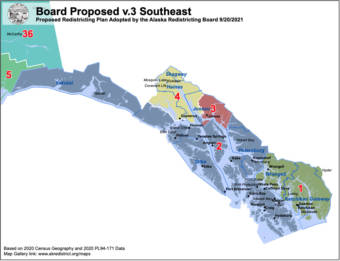
Skagway officials have filed a legal challenge against the state redistricting board claiming that it didn’t follow state constitutional guidelines when it put the borough in a House district with Juneau’s Mendenhall Valley. Skagway takes issue with upper Lynn Canal communities being detached from their current house district that includes downtown Juneau, Douglas Island and the community of Gustavus.

The redistricting board opted to change Skagway’s house district on their final redistricting map in early November. For about a decade Skagway, Haines, and Klukwan have been aligned with downtown Juneau, Douglas Island, and Gustavus. But if the board’s final decision holds, Skagway’s house district will include Auke Bay and the Mendenhall Valley instead.

Mayor Andrew Cremata says the redistricting board ignored testimony from Skagway residents.

“It was relatively obvious that the redistricting board did not listen to the overwhelming majority in this community to remain in the district we’ve been in along with downtown Juneau. And not only that, but we had a unanimous assembly, who were very clear that they wanted to remain in the district,” Cremata said.

According to Cremata, Skagway has far more in common with downtown Juneau than the Mendenhall Valley.

“Not only do we have, you know, an economy based on cruise ships, just like downtown Juneau, but we’re also linked historically with downtown Juneau. A lot of the buildings were built during the Gold Rush, and you know, historical buildings and our histories are shared. We don’t have any of that with the valley,” Cremata said.

In October, Skagway’s assembly sent a letter to the redistricting board asking for a town hall meeting so that the concerns of residents could be heard. The board didn’t come to Skagway but set up a Zoom meeting online. Skagway Assemblymember Deb Potter was on that video call.

“Every single person basically said the same thing agreed with you know, we have a socio-economic common interests with downtown Juneau, only one person spoke in favor of grouping us with the valley and Auke Bay,” said Potter.

But when she went to look on the redistricting website for the minutes of that meeting, she said that after hours of searching, she couldn’t find any mention of those concerns.

“I could not find one single bit of evidence that Skagway even ever gave testimony,” Potter said.

Under the direction of the borough manager, municipal staff and municipal lawyers of Brena Bell & Walker crafted a lawsuit alleging multiple violations of redistricting code.

Filed last Friday, the 10-page legal complaint alleges the map chosen by the board was never made available for public review or comment. It also calls the redistricting board’s decision to change Skagway’s district arbitrary and irrational.

It goes on to list several common interests between Skagway and downtown Juneau that aren’t shared by Mendenhall Valley and Auke Bay.

Skagway is not alone in its legal challenge of the redistricting board’s final map. The city of Valdez, the Matanuska-Susitna Borough, and individual plaintiffs in Anchorage are challenging the new maps in court. Historically, legal challenges to redistricting maps are commonplace.

The redistricting board will hold a meeting on Dec. 15, with legal challenges being addressed in a closed executive session.

State Sen. Kiehl calls for using the idled Tazlina to fill gaps in ferry service

The M/V Tazlina ties up in Haines during its maiden voyage on May 7, 2019. (Jacob Resneck/CoastAlaska)

State Sen. Jesse Kiehl visited Haines this week to meet with constituents about issues facing the region. At a town hall last Wednesday, the Juneau Democrat’s conversation focused on addressing gaps in winter ferry service, the governor’s anticipated budget, state spending and more.

Kiehl says the Alaska Marine Highway system and gaps in winter ferry service were top of mind for Haines residents during his recent visit.

“Well, folks have come out to talk to me about ferry service, road plow service, ferry service… some broadband issues, ferry service, education and ferries,” he said.

Kiehl echoed the community’s frustration with the lack of travel options and called it a predictable crisis given the last three years’ failures in reliable service. He said he supports activating the $60 million Alaska class ferry tied up in Juneau as a backup.

“The Tazlina is sitting tight up to the dock. There are in fact enough folks to run it, if they just call the Inlandboatmen’s Union, and the Masters, Mates and Pilots and ask them,” Kiehl said. “But instead they’re telling me well, we just don’t have the crew. That’s unacceptable.”

Senator Jesse Kiehl (Corinne Smith/KHNS)

On a brighter note, Kiehl says the ferry system’s long term outlook is positive as there will be federal funding through the $1 trillion infrastructure bill passed by Congress.

“The good news is we have opportunities for next year, thanks to the infrastructure bill, to get more of our ferries in working order and to increase our wintertime service. So that we have the chance to actually have more vessels running, and there’s a possibility of a backup. And beyond a backup, just have something closer to adequate service for communities to connect to one another in the wintertime,” he said.

Kiehl said he expects the next legislative session, which begins Jan. 18, will focus on how Alaska will spend its windfall of infrastructure funding.

“We’ll be working on how to dole out the money for broadband, transportation infrastructure and several other categories,” he said. “We’re all scrambling to read that bill and understand it as fast as we can.”

Upper Lynn Canal communities will have a new state representative as a result of the Alaska redistricting process, according to 2020 Census data, but Kiehl’s senate district remains unchanged.

At the town hall on Wednesday, Haines residents also asked about state education spending, as Klukwan fights possible school closure due to low enrollment and the Haines district grapples with budgeting year-to-year among the state’s financial uncertainty.

About half a dozen Haines residents turned out to a town hall with Senator Kiehl held at the Haines school (Corinne Smith/KHNS)

Kiehl said he’s consistently fought budget cuts, and this year opposed the governor’s proposal to continue to cut $50-200 million in spending each year.

“Over the last six years, we have cut the operating budget. And I’m just trying to be, you know, fair here and talk about our recurrent annual expenses, the operating budget. From about five and a half billion to about four and a half billion,” he said. “And I’m here to tell you, you see it in the marine highway system, you see it in our schools. We can go on through the list of services the state provides. We’re having a hard time serving Alaskans needs at this point. I don’t think there’s a lot left to cut.”

The governor’s budget is due out on Dec. 15.

Kiehl says Dunleavy’s oil price projections are too high and thus unrealistic for predicting incoming revenue. He wants to see the state develop new sources of income, including an income tax.

“One of the problems we have is that economic growth doesn’t pay any of the state’s bills, and people in my line of work have a tendency not to pay attention to it because it doesn’t pay the state’s bills,” he said. “I got to tell you, most states you will see the legislature pay all kinds of attention, have hearings on job growth on small business formation and creation, small business growth, household creation. Demographics, right, how many working age people do we have, are we gaining, are we losing. I’ve never seen the Alaska State Legislature do that. That’s upside down and backwards.”

Kiehl was elected in 2018. He’s filed an intent to run for re-election in 2022 for a two-year term. So far, no challengers have emerged for the senate district, which encompasses much of the upper panhandle.

Some bears are still out in Haines. Biologists say that’s not so unusual

A black bear walking across a snow-covered roof
A black bear on the roof of a home mid-day (Courtesy of Nick Schlosstein)

Recent bear activity around Haines — including bears peering into shop windows and lumbering down Main Street — caught many by surprise. But a state wildlife biologist says it’s not so unusual, as some bears are still out foraging at this time of year.

On a Saturday night in November, Haines book store owner Amy Kane was enjoying a drink at the Three Northmen tasting room.

“And we had gotten a seat by the window, and we were sitting there chatting,” Kane said. “And I hear what sounded to me like maybe somebody’s dog jumping up on the window, like the little click of the nails on the window.”

Kane says it was a small black bear looking into the crowded Main Street bar. She jumped up and alerted the owners.

“It was sniffing the air, looking through the window. I mean there were plenty of people in there, it was lit up, it was surprising he was being that forward. But he was a little guy,” she said. “So we were all worried about him, maybe not being well fed or, he’s not in his den.”

Kane thinks it’s the same black bear that’s been seen around town numerous times recently.

Alaska Department of Fish and Game wildlife biologist Carl Koch says it’s certainly bolder behavior than he’s used to hearing about. But he says  it’s not totally unusual for this time of year.

“Typically by now, some — but certainly not all — have started to den up. What usually happens in the fall is they’re in a period of hyperphagia, where they’re eating a lot trying to pack on those lists of calories before they go in the den,” Koch said.

Koch says for bears in the wild, once they start to burn more calories foraging in the winter conditions than they’re eating, they’ll start to den up. But bears who have access to human sources of food may stay out.

“In populated areas, where their territory overlaps with humans, if they can get rewards, they often will stay out longer. And, some of this depends on the individual bear and the age class of the bear and things like that,” Koch said.

The Haines Police Department has issued several alerts for bears seen walking down Main Street. One was seen there on First Friday.

And it’s not just bar patrons reporting bold bear behavior in Haines. Nick Schlosstein was home with his wife Leah and their baby on Mt. Riley Rd. He says it was around 11 a.m. when a black bear strolled up to their house.

“My wife looked out our dining room window, and the snow is piled up so high that the bear was actually above the window, kind of looking down into it,” he said. “By the time I made it across the house, it was climbing up on top of the roof.”

He said neighbors had put the alert out that the medium-sized black bear was around. He yelled to move it along and grabbed some bear spray just in case.

“So I went outside and watched it for probably 20 minutes,” he said. “And was yelling at it, kind of trying to get it to leave. But it was mostly just on the roof and actually pushed all the snow off of the upper part of our roof and just stared at me before coming down on its own.”

Schlosstein says there didn’t seem to be any garbage or other attractants around but has since made sure to keep their vehicles and buildings  locked and secure.

Koch, the state wildlife biologist, says the bold bears could have learned that people’s property means there could be food to be had. He says that this time of year, bears will be more sluggish and less likely to run off when challenged.

“When you’re hazing bears this time of year, they are just not wanting to burn as many calories,” he said. “They can be a little more lethargic.”

Koch advised securing garbage or anything that smells like food as well as hazing bears by banging pots and pans or other noise-makers — or using bear spray.

”Now that we know they’re still bears around people, use headlamps or bring flashlights when you’re moving around in the dark,” he said. “Bear spray will work down to some pretty cold temperatures if folks still have it from the summer. Not a bad idea to keep it with you or some other deterrent.”

According to police logs, the local police department received 50 bear-related calls since the beginning of November. But officers have only encountered one actual bear. The majority of calls were handled by reports taken or information relayed to other agencies such as the Alaska Wildlife Troopers or Alaska Department of Fish and Game.

As of Wednesday, the police report receiving 174 bear calls this year; that’s significantly less than last year’s 450 calls for all of 2020.

Skagway left out in scramble to accommodate ferry-riding lawmakers

An Alaska Marine Highway ferry docked in Skagway. (Photo by Emily Files/KHNS)
An Alaska Marine Highway ferry docked in Skagway. (Emily Files/KHNS)

The state Department of Transportation quietly removed sailings of their lone ferry to the Upper Lynn Canal next month after discovering additional steelwork is needed on the vessel. One sailing to Haines was added to accommodate lawmakers traveling to Juneau for the January legislative session, but the plan left Skagway high and dry. And questions remain about whether the state prioritized lawmakers over taxpayers.

Late last week, the Alaska Marine Highway removed the Matanuska from its calendar for several weeks after the new year. This week they announced the Kennicott will sail as far north as Haines on Jan. 12 to cover the early January mainliner duties that the Matanuska will miss, but it will not call on Skagway. The marine highway also announced that the LeConte will add three sailings to Haines and Skagway during the first week of January, but nothing past Jan. 8.

Alaska Marine Highway spokesperson Sam Dapcevich cited a crew shortage for the reason not to activate the Tazlina, which has been sitting idle in Juneau’s Auke Bay terminal.

But union representatives for the Alaska Marine Highway crew say they do have members ready to work.

“I’m not sure why you were told that there’s a lack of crew. I mean, the Matanuska is tied up, people are laid off, they’re sitting on the beach,” said Earling Walli, regional director of the Inland Boatmen’s Union of the Pacific, the largest of the three unions representing state ferry workers.

Walli says there are workarounds available that would shorten the winter gap between sailings to Skagway.

“Our other question to the state was, well, why can’t we just keep the LeConte running until the Matanuska can come out?” Walli said.

Shannon Adamson is the regional representative for Masters, Mates and Pilots, which represents deck officers on the marine highway. She says it’s curious that DOT is claiming a shortage of crew since her union wasn’t consulted about its members’ availability.

“We haven’t been contacted by the state about any of the issues that are currently occurring in the villages and north Lynn Canal,” Adamson said.

The LeConte is certified until April, ferry union reps argue, and it already has a crew. But calls to Dapcevich with follow-up questions went unanswered on Tuesday.

Meanwhile, more questions remain about the use of the Kennicott to fill in for the Matanuska on the mainliner run that reaches as far north as Haines on Jan. 12.

Skagway Mayor Andrew Cremata says it appears there’s a double standard at work, with the state prioritizing elected officials over ordinary people.

“Why is it so easy to pivot quickly to get a ferry up to Haines for legislators and impossible to get a ferry to Skagway that services the needs of a community that are desperate to be able to get where they need to go? Whether it be the doctor or a grocery store visit, or for a much-needed vacation?” Cremata said.

And yet there are other possible solutions, Meanwhile the Alaska Class ferry Tazlina and the mainliner Columbia are both tied up for cost-cutting or lack of certificates.

Over the weekend, Gov. Dunleavy’s office announced a plan it says would re-energize the Alaska Marine Highway System.

The report says the Tustumena would be replaced in five years to serve Southwest routes. And an idle Alaska Class Ferry, the Hubbard — built for $60 million as a solution for northern Lynn Canal communities, but never used — would be outfitted with crew quarters to extend its range at a cost of more than $15 million.

The governor’s report says the Hubbard will be deployed to Prince William Sound and possibly some Southeast Alaska communities. But there was no mention of the Upper Lynn Canal.

Skagway works to pioneer one of the first electric ferry programs in the country

An Alaska Marine Highway ferry docked in Skagway. (Photo by Emily Files/KHNS)

Last week Skagway’s assembly passed a resolution establishing an electric ferry pilot program. The resolution comes on the heels of a major announcement by the federal government that $250 million of the roughly $1 trillion federal infrastructure bill would be earmarked for such programs with at least one of them in Alaska.

Jan Wrentmore, chair of Skagway’s ad hoc ferry committee, says Skagway is in a strong position to receive some of those funds.

“We’ve been studying the concept of ferry independence for 10 years. The committee’s worked we have four reports. We’ve documented traffic, we’ve documented revenue in Lynn Canal. Now we’ve looked at the legalities of a ferry authority, we have looked at whether certain vessels would work for Skagway or not. So there’s a huge body of work, which is why I think we’re in a great place to be a pilot project under the infrastructure bill,” said Wrentmore.

Skagway Assembly member Orion Hanson told the assembly last week that he drafted the resolution to make it clear that the community wants to continue to work on developing lower emission options in its marine transportation sector.

“What we’re trying to establish is a less pollutive ferry alternative that works in conjunction with AMHS. If we pass this tonight, we will be able to go forth and lobby to have this happen here in our community in the upper Lynn Canal. I think it’s a very exciting time. And we’re at the forefront,” Hanson said.

The assembly approved the resolution unanimously. On Monday, Hanson told KHNS that the municipality will need to continue pursuing the federal infrastructure dollars and working with state partners.

“We need to come up with a really good business plan that is in conjunction with the Alaska Marine Highway System, and the Department of Transportation because we need to work underneath their umbrella,” Hanson said.

The Skagway Assembly recently drafted a memorandum of understanding with Yukon Energy to bring renewable electricity to Skagway during the summer months for cruise ships to plug into while in port. If that deal goes through, it would also mean the port would have the necessary electrical infrastructure to power an electric ferry.

Skagway’s ferry committee has looked at two options to augment service. One, an electric model that could run between Skagway and Haines, and could be powered by Skagway’s existing hydroelectric grid even if a deal with Yukon Energy doesn’t go through. The other is a hybrid-electric option for a boat that could reach as far south as Juneau, though designs for that vessel are still in the conceptual stage.

Earlier this fall the municipality also signed an agreement with the state Department of Transportation and Public Facilities to work toward the acquisition of the state ferry peninsula and ferry terminal property.

With Skagway taking over its port from the current leaseholder White Pass and Yukon Route Railroad in 2023 and making agreements to take over the state ferry terminal and electrify the port, Skagway is actively pursuing green energy solutions to combat unreliable ferry service in the upper Lynn Canal.

Repairs to the Matanuska could leave a huge gap in Southeast ferry service

The Matanuska docked on Friday, Feb. 7, 2020 at the Auke Bay ferry terminal in Juneau, Alaska. (Rashah McChesney/KTOO)

Delays in a state ferry’s return to service could cause Southeast Alaska communities to go without ferries for several weeks after New Year’s Eve. The Matanuska was supposed to return to service in late December after its scheduled overhaul, but state officials now say they’re not sure when it’ll be ready.

The marine highway ticketing website shows no sailings to the Upper Lynn Canal for all of January and most of February while its other main vessel, the LeConte is being overhauled.

Alaska Marine Highway System spokesperson Sam Dapcevich told KHNS in an email that additional steelwork has to be done on the Matanuska before it can go back into service. But he didn’t say when that would be done.

Meanwhile, ticket agents have been phoning passengers to reschedule their trips. Liz Lavoie had a reservation for a new vehicle to be shipped to Skagway from Bellingham on Dec. 22. But on Friday morning, she got a call from a reservation agent.

“She said, well, I’m sorry to give you bad news, but the Matanuska has been held longer in the shipyard,” Lavoie said. “But we’re just going to move you to the Jan. 8, which is the next available sailing. And it only goes as far as Haines, but you will get a $14 refund.”

Meanwhile, in Haines, Matt Jillson says that he’d booked a holiday trip down south. He was planning to take the ferry from Haines to Auke Bay and fly out of Juneau the same day. But about three weeks ago, he got a call from the Haines Ferry Terminal saying his trip had to be rescheduled.

“Since we’re bringing our dogs down to board in Juneau, Seaplanes wasn’t a very good option. So we decided to take the LaConte, meaning that we’re going to have to travel down two days before our flight, pay for two nights in a hotel, and all the meals and extra stuff that you get when you have to spend time in Juneau,” Jillson said.

Other Upper Lynn Canal residents, like Skagway’s Melinda Munson, found out on Thursday that trips on the Matanuska had been canceled for January. That’s when she was planning to ferry to Juneau for dentist and doctor visits for her children. But with no ferry, she’ll have to cancel those appointments.

“I’ve got one kid who can’t go on a small plane because he’s got autism, and he rocks back and forth. So it’s a safety issue for him and for everybody on the plane. And we were going to do some doctor’s appointments. And so that’s not going to happen either,” Munson said.

As of Friday afternoon, there was still no official word from the state Department of Transportation about the cancelations. Questions posed to Gov. Dunleavy’s office asking why there is no backup in place for the Upper Lynn Canal were left unanswered Friday afternoon.

Skagway Mayor Andrew Cremata says he’s been in contact with his counterpart in Haines to see if the boroughs could work together to charter private vessels, especially for traveling high school athletic teams. But he says Upper Lynn Canal communities have been burned before. Last year, Cremata says Skagway chartered a private catamaran with the understanding that the state would help pay, but they’ve yet to receive anything.

“So you know, we’re in a situation where we’re literally left holding the bill for something we were promised we would get reimbursed for from the state,” Cremata said.

Meanwhile the Tazlina, one of the Alaska Marine Highway’s newest vessels built for servicing the Upper Lynn Canal, remains tied up in Juneau. CoastAlaska reported earlier this week that the Alaska Marine Highway says it will not activate the $60 million ferry for a short-term fill-in.

Site notifications
Update notification options
Subscribe to notifications