KNBA - Anchorage

KNBA is one of our partner stations in Anchorage. KTOO collaborates with partners across the state to cover important news and to share stories with our audiences.

Tazlina tribe hopes to buy traditional land from Archdiocese for Copper River access

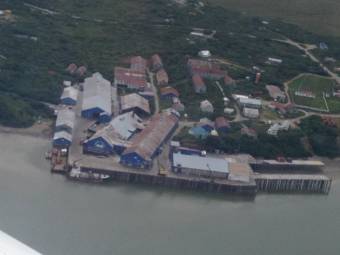
The property boundaries are illustrated in solid lines over an aerial photo of the general area of Tazlina and the property currently owned by the Archdiocese of Anchorage. (Photo courtesy of Native Village of Tazlina/from the “Homeland Recovery Report” (2020) by the University of Minnesota School of Architecture)

A federally recognized tribe in the Ahtna region of the Copper River area hopes to buy more than 450 acres of its traditional homeland and return it to the tribe.

A permanent village of Tazlina was established in the early 1900s near the confluence of Tsedi Na, or Copper River, and Tezdlen Na, or Tazlina River.

Tezdlen or Tazlina is one of eight villages in the Ahtna region. It’s about 70 miles north-northeast of Valdez and about 150 miles northeast of Anchorage.

And now the Native Village of Tazlina hopes to buy back 462 acres of land east of the village from the Catholic Church and return it to traditional and cultural use.

Village Council President Gloria Stickwan said the land would give the tribe better access to traditional fish camp and fish wheel sites.

Stickwan also works for Ahtna Incorporated as its customary and traditional environmental coordinator, where she reviews proposed state and federal hunting and fishing regulations and brings comments to the Cultural and Traditional Use Committee.

“We don’t have any other place to fish to use a fish wheel, because … we just don’t go to someone’s fishing site and start fishing there,” Stickwan said. “We really don’t have a place to fish unless we go to Chitina,” which is about 60 miles southeast of the village, about an hour and 15 minutes of driving. Stickwan said a lack of roads to the fish wheel site limits access to the Copper River.

The 460 acres equates to just shy of three-quarters of a square mile. But the land has historical and cultural significance to the tribe.

Tribal Administrator Marce Simeon started her position in May 2020 but has worked with the tribe for about 15 years.

“The families of Tazlina tribal members in our community have been utilizing that land right there specifically for generations to harvest salmon,” she said. “It’s such an incredible part of people’s diet day-to-day, even through the winter season.”

The Catholic Church bought the property from the federal government in the early 1950s so that the church could open a boarding school.

The Copper Valley School operated in the area for 15 years. But the school closed in 1971, and five years later a fire destroyed its main building. Over the years the remaining structures deteriorated.

“That land was essentially left vacant from the 70s until some years, I believe it was 2011, the Native village of Tazlina had a strategic planning process where we had identified that there were contaminants on that site because of the old school,” Simeon said. “Through our village, we were able to secure funding under the Environmental Protection Agency. Our brownfield program was a response program that identified that as a contaminated site in our community.”

A brownfield is a property or site that potentially is contaminated with hazardous substances or pollutants.

According to Alaska Division of Spill Prevention and Response, potential contaminants included asbestos, underground fuel storage tanks, lead-based paint and other pollutants.

“With the assistance of EPA, we reached out to the Catholic Church to clean up the debris that was left on that property, and they did,” Simeon said. “That was the last action that had taken place. And it’s my understanding that the archdiocese had incurred incredible expense in remediating that contaminated site.”

The Archdiocese completed the EPA- and DEC-mandated cleanup in 2014.

Now the federally recognized tribe is dedicated to buying back the land for cultural use, conservation and restoration.

Simeon says the church has since decided to liquidate the property to cover its costs. Since the church and the village had worked together previously, particularly to grant certain access to a fish wheel site, the Archdiocese reached out to the village.

“They wanted to see if we were interested in purchasing that lot, and we definitely were,” he said.

In 2011, tribal members prioritized a fish research center, a new meeting hall and open spaces for recreation and a community garden — for use of the property.

Simeon says the village currently works with the Catholic Church to monitor limited authorized use of fish wheels on the property.

Plans for the parcel would include turning it into a cultural gathering place, a tribal college, a place to host subsistence use fish wheels, as well as contribute to fisheries research.

“The process of harvesting salmon and consuming salmon is a lot more than just food,” Simeon said. “It’s such a huge part of a lifestyle here that individuals it’s really imperative to how hard it is to be a person in the Copper River.”

The Archdiocese of Anchorage declined to comment, other than an email response from chancellor John Harmon: “The Archdiocese of Anchorage-Juneau generally does not discuss details of its business transactions,” the email says. “The Archdiocese has established a very good working relationship with the Village of Tazlina and looks forward to the sale of the property.”

While the total asking price is $1,856,000, the village says the archdiocese will knock off $50,000 if the tribe can raise $50,000 by June 1, 2021.

While Tazlina has until next year to purchase the land, it is trying to get funding committed by this fall and secure one of its largest sources of funding to this point.

“We are pursuing some larger-scale funding sources because if you’re trying to come up with almost 2 million dollars, it’s nice to be able to get them in as big chunks as possible,” said Kristin Carpenter, who working as a fundraising consultant for the village on the project. Carpenter also served as the executive director of the Copper River Watershed project for a little more than 20 years. “But we also there’s a piece of that that is going to have to come from individuals and donors and, you know, smaller-scale sources.”

Interested donors can find more information on the tribe’s GoFundMe page or call the Native Village of Tazlina.

(Special recognition: Thanks to Phillip Sabon for pronunciation and translation help on the Ahtna river names.)

Anchorage man sentenced for falsely marketing goods as made by an Alaska Native

Lee Screnock was sentenced to pay $2,500 in restitution and serve five years probation for falsely marketing arts and crafts as being made by an Alaska Native artist. (Courtesy of Indian Arts and Crafts Board)

An Anchorage man was sentenced to five years of probation after being found guilty of illegally marketing items he sold as being made by an Alaska Native artist.

On March 10, a U.S. district judge also sentenced Lee Screnock, 60, to pay $2,500 in restitution and surrender more than $125,000 in retail product.

According to a joint news release from the U.S. Fish and Wildlife Service and the Indian Arts and Crafts Board, Screnock was charged with a felony violation of the Indian Arts and Crafts Act.

The law makes it illegal to falsely market products as Native-made. Screnock was also charged with a misdemeanor violation of the Marine Mammal Protection Act.

According to the release, the charges stem from 2015, when Screnock owned the Arctic Treasures gift shop in downtown Anchorage. He sold a polar bear skull to an undercover agent of the  U.S. Fish and Wildlife Service in violation of the Marine Mammal Protection Act.

In 2017, undercover agents visited Screnock’s store again and asked about carvings. Screnock told the agents that an Alaska Native artist from Point Hope made them, but the carvings were actually made by Screnock.

During his probation, Screnock will be prohibited from working with animal products.

Mat-Su Borough submits bid to host 2024 Arctic Winter Games

An Arctic Winter Games athlete in Nome. (Laura Kraegel/KNOM)

Matanuska-Susitna Borough has submitted a bid to host the 2024 Arctic Winter Games.

The Arctic Winter Games happen every two years. It’s a multi-sport event and Indigenous cultural celebration involving communities and participants from around the Circumpolar North.

This is the Matanuska-Susitna Borough’s first real shot at hosting the convention. The borough’s purchasing officer, Russ Kraft, says the borough has bid on previous games but never made it this far into the process.

“We’re hoping that at the end of March, first of April we’ll receive notification from the international committee that our bid has been accepted,” Kraft said. “Once that happens, we have to work out a few details in terms of the contract that is signed between the borough and the international committee to go ahead and get moving forward.”

Alaska typically hosts the games every eight to 10 years — and it had already been decided that the 2024 games would return to the state. But it’s up to individual municipalities and regions to bid on hosting the games.

Kraft believes the borough is the only entity that’s made it this far in the process.

Shawn Maltby is Chef de Mission for Team Alaska. That’s a fancy term that means he’s in charge of the team that picks and organizes the youth athletes from Alaska to compete in the winter games.

In the game’s 50-year history, Alaska has hosted the event six times, most recently in Fairbanks in 2014. Maltby says that competing in Alaska gives an edge to athletes from the state.

“It just gives them the upper advantage of being in their home turf to be able to play their sport and perform their art, whatever it may be,” he said. “We still play a part in being able to showcase our state, our culture and everything else.”

On the borough’s website, a Feb. 22 news release says the submission was mailed to the games operations coordinator on February 19th.

The review process takes about three weeks to complete before a decision will be made. And Mat-Su Borough’s Russ Kraft says the region has a lot to gain.

“This provides not only a direct economic impact from just holding the games here and having 2000-plus visitors coming to the area during a time of the year that traditionally has very little tourism,” Kraft said. “It also puts us out there for the world to see so that they can see what the Valley has to offer.”

While the borough would simply provide oversight into planning the project, a nonprofit society will handle putting on the games. But they haven’t formed yet and a lot of work still needs to be done to prepare in the meantime.

“This would provide us with an opportunity to start highlighting everything that we’ve been doing over the past 10, 20 years, the networks of ski trails, the infrastructure that we built, far as all of these different facilities,” Kraft said. “It’s going to allow them to be on center stage to the world as all of these athletes are coming in from the different northern nations.”

Kraft says a number of people, organizations and nonprofits have already started to reach out to the borough with offers to help.

“We’re starting to see that kind of upwelling of support a little bit earlier than we anticipated we were going to see it,” he said. “That really makes us more and more confident that we’re going to be able to do this and that what we’re going to put out there is going to be a world-class event and the borough is going to be center stage.”

The Mat-Su Borough may have a lot of work still to do, but the 2024 games are still a ways out. The 2022 Arctic Winter Games are scheduled to take place in Wood Buffalo, Alberta, Canada.

Organizers canceled the 2020 games in Whitehorse, Yukon, out of COVID-19 concerns. The decision to cancel was the first since 1970 when the games began.

According to the release, the borough voted to the move the bid forward during a February 2nd regular Assembly meeting. According to borough estimates, the games need between $4 million to $6 million to operate – which will be covered largely through grant funding, sponsorships and in-kind donations.

The borough agreed to appropriate about $250,000 for start-up and organizational costs. The state of Alaska also verbally committed, saying it would contribute $2 million. And the Arctic Winter Games International Committee has about $50,000 from the previous games in Fairbanks that will be donated to host the 2024 games.

Latest music project with Nicholas Galanin signs with Sub Pop Records, to release album in April

Yeil Ya-Tseen Nicholas Galanin poses for this promotional image released around his band Ya Tseen’s debut album, Indian Yard, due out on April 30th on the Sub Pop label. (Photo by Merritt Johnson/Used with permission)

A new musical project led by Sitka-based Nicholas Galanin has signed with legendary Sub Pop Records.

“Close the Distance” is the first single off the debut album for Ya Tseen, the latest project from Otis Calvin III, Zak D. Wass and Yéil Ya-Tseen Nicholas Galanin.

Ya-Tseen is a nod to Galanin’s name.

“The Tlingit title Ya Tseen, which means to be alive translation,” Galanin said. “Using language … it’s such a core of our ways of being and thinking. I am always trying to implement or engage in language when I can even though I’m not really the speaker of the language. But I’m always a student.”

Galanin, who is Tlingit and Unangax̂, also works as a carver, engraver and visual artist.  He is based in Sitka, Alaska.

Like Galanin, musician and guitarist Wass also lives and works in Sitka. Wass works summers commercial fishing with his father and works on music and projects in the off-season.

“We’re excited about this new album, and it’s been a long time coming,” he said. “Nick really put a lot of work in on the album this time around. And it’s really above and beyond anything that we’ve ever done before.”

On February 10th, Sub Pop announced the label had signed Ya Tseen.

Formed in 1986, the label gained a reputation for signing keystone Seattle grunge bands like Nirvana and Soundgarden. Its current roster includes Fleet Foxes and The Postal Service.

Though the two didn’t know it at the time, Wass and Galanin had personal relationships with Sub Pop co-founder Jonathan Poneman — and those connections sparked the project that would eventually become the studio album, Galanin says.

“Jonathan, who is co-founder of the label, who’s been working very closely with me on this project from the very beginning has really been wonderful to work with and provide us with quite an opportunity.” Galanin said of his work with Sub Pop. “They’ll always have a deep-rooted history in music history. To have Indigenous artists in the space, even, I think is incredible and necessary.

The group worked previously under the name Indian Agent. Work on the latest album began about three years ago while Galanin was carving a pole in Juneau. For Galanin, the change from Indian Agent to Ya Tseen was intentional.

“Project dynamics are always changing, process is always changing. Intentions for Indian Agent as the title at the time were to bring light to a history, the conversation that’s often overlooked,” Galanin said. “It’s served its purpose and its intent.”

Galanin says that with joining Sub Pop, they wanted to step away from the context of Indian Agent, and establish a new platform for their music as Ya Tseen.

“Often times Indigenous communities are so dehumanized intentionally … in order to inflict so much violence on our communities, dehumanizing a group of people is part of that process oftentimes to make it easier for the perpetrator of that violence to carry it and continue to believe that they can do so,” he said. “Humanizing our experiences in life is what a lot of some of these songs are, too, and that includes love and joy, so many different aspects of where we really come from, you know. We’re just not built and based in trauma.”

Beside his frequent bandmates Wass and Calvin, the full-length album “Indian Yard” features a number of collaborations, including two names that might be familiar to Alaskans – Qacung of Pamyua and Portugal. The Man.

Album art for the release Indian Yard by Ya Tseen.

Other collaborators include Tunia, Shabazz Palaces and Nick Hakim, among others.

Wass says the collaborations help keep playing with the band fresh.

“I like that about working with Nick. It’s never like the same thing again and again,” he said. “What we do to bring in these other people and it’s like we’re always evolving and changing. So it always feels fresh and it’s fun.”

Galanin says that normally the band would likely be planning for a tour with the release, but a global pandemic has halted most live performances and touring.

“It’s definitely a learning process and. I think the industry has changed so much, it continually does, but all industries and all creative fields and stuff have been deeply impacted by COVID times,” he said. “We’re learning what it looks like as we go in a lot of ways.”

The album is scheduled to release April 30th. The single “Close the Distance” is available to stream on a number of platforms.

Federal judge temporarily halts sale of National Archives building in Seattle

The National Archives and Records Administration facility in Seattle is earmarked for closure and to be sold in an effort to cut federal spending. The Office of Washington state’s Attorney General filed a motion to seek a preliminary injunction to block the sale. (Photo courtesy of the National Archives and Records Administration)

A federal judge temporarily stopped the sale of a National Archives building in Seattle, Washington.

In a written order filed Tuesday morning, U.S. District Court Judge John C. Coughenour ordered a halt to the imminent sale of the National Archives building — and removal of an immense archival collection.

In a news release, Washington Attorney General Bob Ferguson said, “Today’s legal victory blocks the federal government’s unlawful plan to sell the Archives and scatter the DNA of our region thousands of miles away.”

In January 2020, a five-person panel identified the archives building in Seattle — and 11 other facilities — as excess properties and opportunities for the federal government to cut costs.

The archives building houses a collection that includes historical documents and records for 272 federally recognized tribes in Alaska, Idaho, Oregon and Washington.

A sale of the building could move the archive’s records as far away as Kansas City, Missouri and Riverside, California.

In January 2021, Washington state’s attorney general and 40 tribes, states and community organizations filed a motion to block the sale of the building.

The building also houses documents regarding the Chinese Exclusion Act and the Japanese internment camps of World War II.

It would be the second time that Alaska documents and records have been moved from a National Archives facility.

In 2014, a building in Anchorage was closed, and the materials transferred to Seattle.

Coalition of Tribes and states seeks to block sale of National Archives building in Seattle

The National Archives and Records Administration facility in Seattle is earmarked for closure and to be sold in an effort to cut federal spending. Washington state’s Attorney General filed a motion to seek a preliminary injunction to block the sale. (Photo courtesy of the National Archives and Records Administration)

Washington state’s attorney general and a legal coalition of 40 Tribes, states and community organizations filed a motion Thursday to block the sale of the National Archives building in Seattle.

The facility houses an immense collection of historical documents and records, including records about Alaska and the Indigenous peoples of the area. The museum also contains documents related to the Chinese Exclusion Act and the Japanese internment camps of World War II.

Last January, a five-person panel earmarked the facility and 11 others for liquidation to help cut federal costs.

This is the second time the collection of Alaska archives and records has been moved in recent years. In 2014, these records were located at a National Archives facility in Anchorage, which closed. The current sale would split the collection between Missouri and California.

In a separate suit, Washington State’s Office of the Attorney General argues that the federal government failed to give Tribes and Tribal organizations prior notice of the sale and provided no consultation.

Site notifications
Update notification options
Subscribe to notifications