KUAC is our partner station in Fairbanks. KTOO collaborates with partners across the state to cover important news and to share stories with our audiences.
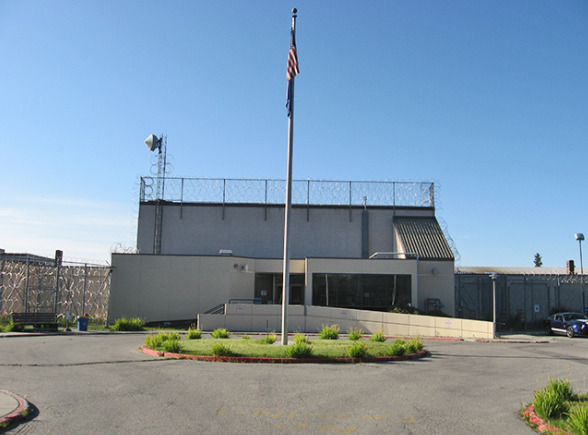
The Fairbanks Correctional Center (Photo from Department of Corrections)
An Anchorage man is being held at Fairbanks Correctional Center after he was denied entry into Canada and arrested on both sides of the U.S.-Canada border over the weekend.
Alaska State Troopers say 61-year-old Terry Sharkey was first arrested by Royal Canadian Mounted Police after he was denied entry into Canada due to COVID-19 travel restrictions. An Alaska State Troopers spokesperson didn’t have any information about the incident Monday morning and couldn’t say whether Sharkey was charged by Canadian authorities.
The Royal Canadian Mounted Police did not return phone calls Monday morning.
A trooper report says RCMP officers transported Sharkey from the Canadian customs port of entry at Beaver Creek, Yukon Territory, to the U.S. Customs facility about 20 miles away at Port Alcan, in Alaska, about 300 miles south of Fairbanks.
There, Sharkey refused to identify himself to the customs officers and was detained. The report says the officers offered to release him because they had no facilities to hold him. But the report says he again refused to leave.
Troopers responded to a call from customs at around 9:30 a.m. about a “hostile subject” and arrested Sharkey for second-degree trespassing. He was taken to the Tok trooper post, where officers again offered to release him, but he again refused. Troopers then transported him to Fairbanks Correctional Center.
A Fairbanks Correctional booking office staffer said on Monday that Sharkey was still being held but was scheduled to be released on his own recognizance, possibly later in the day.
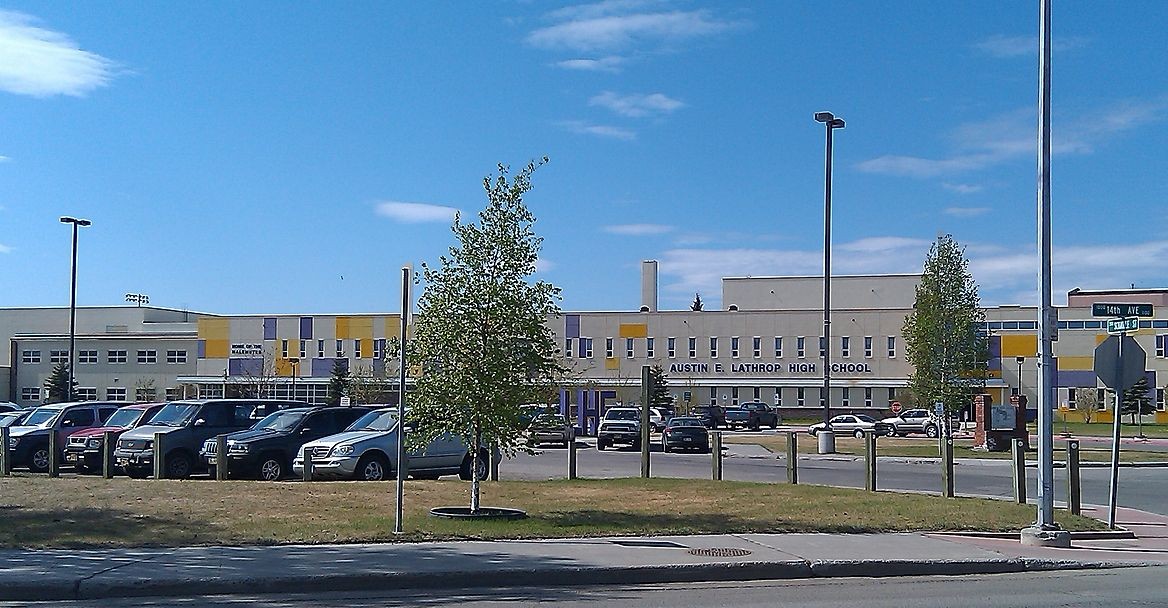
Lathrop High School in Fairbanks, Alaska. (Wikimedia Commons)
A Fairbanks teacher has been put on administrative leave after comments she made during a discussion about George Floyd in her class at Lathrop High School, according school officials.
A parent notified the school of the comments last Wednesday. In a letter to parents on Friday, Lathrop High School Principal Carly Sween described the comments as “racially insensitive.”
The Fairbanks North Star Borough School District has not publicly named the teacher, but a 15-minute video of the class posted online shows a teacher identified as Ms. Gardner. Connie Gardner is a special education teacher at Lathrop High.
Gardner did not respond to an email requesting comment.
The video posted to YouTube shows her leading a conversation about police killing Black people, including the murder of George Floyd by Minneapolis police officer Derek Chauvin. Gardner does not defend Chauvin, but says Floyd would be alive if he had complied with police orders.
“I’m an old white lady and if the cops came up to me and said, ‘Ma’am, put your hands behind your back, you’re going to jail,’” she said. “I’m putting my hands behind my back.”
Referring to her students, Gardner also commented on how to dress to avoid trouble with police.
“Look at how you guys are dressed. You’re dressed nicely. You don’t look like thugs. You don’t have your pants down around your knees,” she said.
Later in the conversation, one of the students’ parents watching the online class interjected and challenged Gardner.
“I just disagree with the conversation in whole. I feel like this is something that, you know, like, Ms. Gardner, I don’t feel like you’re really able to address with you being a white woman. You know I am a woman of color,” the parent said.
“That’s where you’re wrong,” Gardner said.
“I am a woman of color,” the parent said.
Principal Sween and Assistant Principal Clarice Mingo met with students in the class to discuss what happened, according to the letter to parents.
“Through ongoing inclusivity training for staff, we continually improve our ability to identify concerns and respond quickly to situations that do not uphold our commitment to a safe, equitable environment,” she wrote.
Yumi McCulloch, a district spokesperson, said Sween notified the district about the comments last week.
“Following that, an investigation was opened and the teacher was placed on paid administrative leave,” McCulloch said.
McCulloch said the high school will continue to communicate with the students while the HR Department conducts an investigation.
“Lathrop administration continues to meet with students and parents regarding these types of issues and to provide support for parents and students alike,” McCulloch said.
Under their contract with the district, teachers are protected while an investigation is ongoing, said Sandra Ryan, president of Fairbanks Education Association teachers union.
“We’ll follow the investigative procedure, so there is an advocate assigned by FEA, and that advocate will meet with the member, and making sure that their rights in the contract are followed at all times,” Ryan said.
Fairbanks Memorial Hospital in May 2011. (Creative Commons photo by RadioKAOS)
Medical workers at Fairbanks Memorial Hospital say the hospital’s capacity is being strained by high COVID-19 rates, and the community should be more alarmed.
The hospital is receiving a surge in patients from the Fairbanks North Star Borough but also from Delta Junction and those diverted from Bassett Hospital on Fort Wainwright.
Medical executives gave a report to the Greater Fairbanks Community Hospital Foundation Board on Friday, saying they are feeling demoralized by the lack of community response even as the disease becomes more preventable.
The hospital is reporting record high admissions of coronavirus disease — even more than the surge last November. About 18% of the admissions at Fairbanks Memorial Hospital have COVID-19.
Dr. Barbara Creighton, who has been attending to many of them, said the surge is preventable.
“There is the disconnect. You know, we have businesses opening, school buses flying, restaurants are going, and we have visitors happening, yet we have our highest case rates. And so, we’re like does anybody see this? This place is on fire with COVID,” she said.
People hospitalized for COVID-19 in the last year were generally elderly. But that demographic is nearly 70% immunized in the state, so fewer elderly Alaskans are getting sick. The patients admitted in the last weeks are younger, and they are not fully vaccinated.
“It’s really coming fast now. And that is the most worrisome thing for me, because this is a different demographic; these are young people cardiac-arresting before they come into the hospital. These are middle-aged white guys,” she said. “Sorry to say that, but it really is that demographic that hasn’t gotten around to getting vaccinated or doesn’t really feel like they need vaccination, and they really want to see what the vaccine is going to do before they take it.”
Shelley Ebenal, CEO of Foundation Health Partners, the non-profit that runs the hospital, said the staff is working through a change in patient response.
“This new group of patients, some of these folks, some — these are generalizations, so be careful with that — are folks that are anti-vaxxers, anti-maskers, and they don’t believe that they have COVID or are sick because of it, and our staff is getting some very angry folks,” she said.
Creighton said treatments have changed. The “workhorse therapy” has become high-flow oxygen, a non-invasive ventilation where there is no tube down the patient’s airway, and they can eat and talk.
But treatment is still only supportive – there is no cure for COVID-19. There is just a long wait while each patient’s lungs recover.
“And we’re seeing them stay longer, because they are not dying. They are actually staying for two, three weeks and turning around, which I’ve never been more proud of. You know, this could be our finest hour,” she said.
She said the hospital is running out of non-invasive ventilators as patients fill up the COVID wing.
Angelique Ramirez, chief medical officer for Foundation Health Partners, said a month ago the hospital had several days with no COVID-19 patients at all. Now the urgent care walk-in at Tanana Valley Clinic, as well as the FMH Emergency Department, are seeing several COVID patients each day, and at the hospital 10 to 12 patients are in COVID-19 beds each night — the entire second floor of the south wing is only COVID-19 patients.
“I don’t know that we’ve had such a dramatic change in one month before,” she said.
Ramirez reported to the Foundation Board how younger people are spreading the disease faster. She said right now the borough has a testing positivity rate of almost 10%.
“This is the highest it’s ever been. You can see that it’s a sharp uptick. And what this tells us is that we are not capturing, by testing, everybody who is positive,” she said. “The challenge is, if they don’t know that they’re sick, they are out in the community spreading it.”
Ramirez said 70% of the hospital’s staff is vaccinated, unlike last November and December when many were sick at home or quarantining because they had been exposed to someone with COVID-19. Also different, is other Alaska hospitals can take patients from the Interior if FMH becomes overwhelmed.
“So we are in a hotspot. It’s nice to know that other places have capacity. But the reality is still we are the only hospital in the Interior,” she said.
CEO Shelley Ebenal said the hospital staff is deflated by the surge in patients and the community not taking easy measures to fend off what has become preventable.
“They are still in full COVID mode. I know our community is tired, I know they don’t want to mask. They want this to be over, but it’s not. When you see our staff members, please tell them ‘thank you.’ They really need that right now. Our morale is really low. They feel like they are not being appreciated for their work, because they are in the thick of it right now,” she said.
Fairbanks Memorial Hospital in May 2011. (Creative Commons photo by RadioKAOS)
COVID-19 cases surged in Interior Alaska last week, and hospital staff were busy with a corresponding surge of patients. Fairbanks doctors are pointing to a direct relationship between the high case rate and the Interior’s low vaccination rate.
While the statewide case rate stayed stable last week, the numbers in Fairbanks and North Pole shot up. On Wednesday, 111 new cases were reported between the two cities. Outside the Fairbanks North Star Borough, other Interior communities surged as well.
Dr. Mark Simon works in the emergency department at Fairbanks Memorial Hospital.
“I can tell you that everyone who works in the emergency department is saying ‘Wow, there’s a lot of Covid coming in,’” Simon said. “Everyone who is working in the hospital taking care of patients is saying, ‘Wow, we have a lot of Covid in the hospital right now.’ This is at the level we had at our highest peak in the past.”
With 13 people admitted to the hospital with COVID-19, the hospital’s intensive care unit is reporting its highest rates of the disease since January.
The area is a long way from herd immunity. The state reports only 33% of eligible folks in the FNSB are fully vaccinated – much less than the rest of the state.
Simon sees a straight line between low vaccination rates and high disease rates.
“The Interior is near the bottom on vaccination rates, and near the top on COVID-19 cases. Communities with the lowest vaccination rate have the highest disease burden of COVID-19,” he said.
Simon says the surge is so bad, doctors are reaching out and calling contacts to encourage people to get vaccinated — and to get their friends to get vaccinated.
“Talk to your family members, talk to your friends, talk to your coworkers, talk to your neighbors. Ask them about vaccination and then share your story of you getting vaccinated,” Simon said.
The state is trying to recover its tourist, fishing and summer jobs economy. Public health officials want Alaskans to be vaccinated now, before June. Simon says vaccinated workers and customers can help businesses stay open and the economy recover.
But first, the community transmission of the disease must be stopped.
“We know that the more cases of COVID-19 you have, the more people will have to stay in the hospital, the more people will get long COVID — debilitating symptoms for weeks and months — the more people die,” Simon said.
Last month, Alaska became the first state to open vaccine eligibility to anyone 16 and older. The Unified Command for Interior Alaska is holding weekly free vaccination clinics on Tuesdays at the Carlson Center in Fairbanks. The next one is tomorrow from 9 a.m. to 4 p.m., with slots for walk-in appointments.
People can visit covidvax.alaska.gov or call 907-646-3322 to sign up for a vaccine appointment. The phone line is staffed 9 a.m. to 6:30 p.m. on weekdays and 9 a.m. to 4:30 p.m. on weekends.
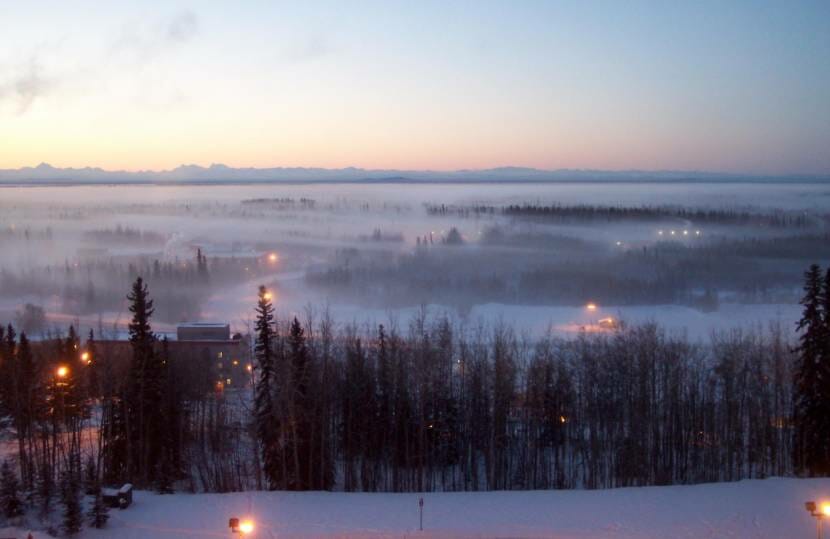
Ice fog that sets in during inversions on cold winter days in the Fairbanks area typically accumulate high levels of fine-particulate matter generated by wood-burning heating systems and other sources. The area’s levels of PM2.5 sometimes are the highest in the nation. (KUAC file photo)
The Fairbanks-North Pole area air pollution problem is slowly getting better, according to a state report released last week. The report covers a year that had more days of stagnant air, more no-burn days and a lot of people staying at home.
But the report shows the Fairbanks North Star Borough still exceeds the national ambient air quality standard of 35 micrograms/cubic meter.
Alaska Department of Environmental Conservation program manager Cindy Heil says there is reason for optimism about the progress the area is making toward the Clean Air Act standard.
“Absolutely, we have a lot of work to do. But we look at it the way the standard was built, which is a three-year design, and the three-year design value in Fairbanks did go down,” she said.
Although a monitor on Hurst Road in North Pole measured more PM 2.5 particulate pollution this year, Heil says the overall trend is toward cleaner air.
“The standard is 35 and we are at 63. That’s, you know, twice the amount. So, it is high. But if you look at the design value from 2014, it used to be 139.”
Heil says a three-year average smooths out year-to-year weather variability.
Another monitor, on A Street in the Hamilton Acres neighborhood on the east side of Fairbanks, also showed more pollution in 2020 than the previous year.
Nick Czarnecki, the Fairbanks North Star Borough’s air quality manager says he doesn’t have enough data to know why more particulate matter was recorded there.
“2020 was like no other year,” he said. “With the pandemic, we really don’t have any idea what change that had on people’s wood burning habits. Did more people stay home and use their wood stove more?”
The Borough and DEC collaborated on the 25-page report, which shows that local emissions from wood stoves, fuel oil, industrial sources and vehicle emissions directly contribute to particulate pollution. PM2.5 is primarily a concern during the winter months, when an inversion over the Tanana Valley keeps cold air still.
Heil says there were more air-stagnant days in 2020. Those air-stagnant days means DEC issued more burn bans last winter: 55 air quality alerts for Fairbanks and 58 for North Pole. The report shows that although DEC issued three notices of violation, the number of air pollution warning letters was 133, down a little bit from the previous year.
“Because people are trying,” Heil said. “I really think the community is, as a whole is making an effort. We are seeing a lot more conversations, or seeing a lot more willingness to be helpful.”
Czarnecki says the Borough was able to start a targeted airshed grant over last winter that helped implement recommendations that came out of the 2019 local stakeholder process. One piece is a new change-out program aimed at replacing oil-fired furnaces with natural gas, which was so popular with the community that all of the $1 million so far allocated has been used up. But there is more.
“We have three active grants right now through the targeted airshed program,” Czarnecki said. ‘And then that big one, $9.4 million, that we are getting ready to appropriate through the Assembly. You know, what that means is that the wood stove change out program is going to be fully funded through 2025.”
Borough air quality staff also completed an electrostatic precipitator testing program for wood stoves and continued outreach with ads about clean wood burning, played on multiple media platforms.
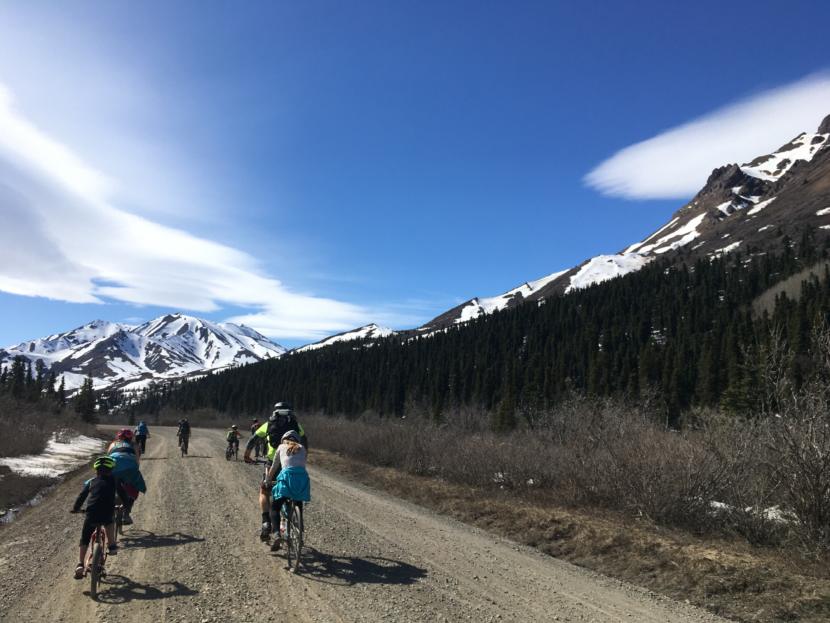
Bicyclists pedal up toward Sable Pass on the Denali Park Road on a Saturday in May, 2020. (Nat Herz/Alaska Public Media)
With warmer temperatures and abundant daylight, many Alaskans are looking to hit the road on new bicycles to celebrate. But there might not be a wide selection to choose from.
In Fairbanks, Beaver Sports owner Greg Whisenhant says he wasn’t prepared for what he calls the tidal wave of demand from customers a year ago. Everyone, it seemed, wanted a new bike. But as bikes rolled out of the shop, replacing them wasn’t easy.
“All the other bike shops in the Lower 48, who had their spring hit them a little earlier, had already ordered everything that was left in the warehouses,” he said.
Whisenhant wasn’t alone. Stephen Frothingham, editor of Bicycle Retailer Industry News, says most U.S. retailers were caught off-guard by the spike in demand. In hindsight, it made sense. Biking is a way to get outdoor exercise and remain socially distant.
But 2019 tariffs imposed by Trump on China, a major manufacturer, had already soured supply lines, and China’s effort to battle COVID-19 sometimes shuttered factories for weeks.
Fast forward to this spring, with its shipping delays and continued high demand, and Frothingham sees a repeat of last year coming.
“It seems a lot of the bikes are going to a handful of the largest brands, and then the brands are selling them to a handful of the largest retailers,” he said.
Besides the scarcity of bikes, Frothingham says expect higher prices.
“It’s supply and demand, but it’s also hugely increased shipping costs — higher costs coming out of Asia, even exchange rates are unfavorable, commodity costs like aluminum, steel have gone up — so there’s a lot of factors contributing to it,” he said.
Frothingham adds that these issues also affect bike parts, with major manufacturers and retailers scooping up the majority of components.
At Beavers Sports, Greg Whisenhant says they’re doing their best to meet another tidal wave of biking enthusiasts, but stocks are low. He anticipates delays in supplies, so he’s looking forward.
“We’re trying to look way ahead down the road,” he said. “We already have bicycles ordered for the year 2022.”
Close
Update notification options
Subscribe to notifications
Subscribe
Get notifications about news related to the topics you care about. You can unsubscribe anytime.