KUAC is our partner station in Fairbanks. KTOO collaborates with partners across the state to cover important news and to share stories with our audiences.
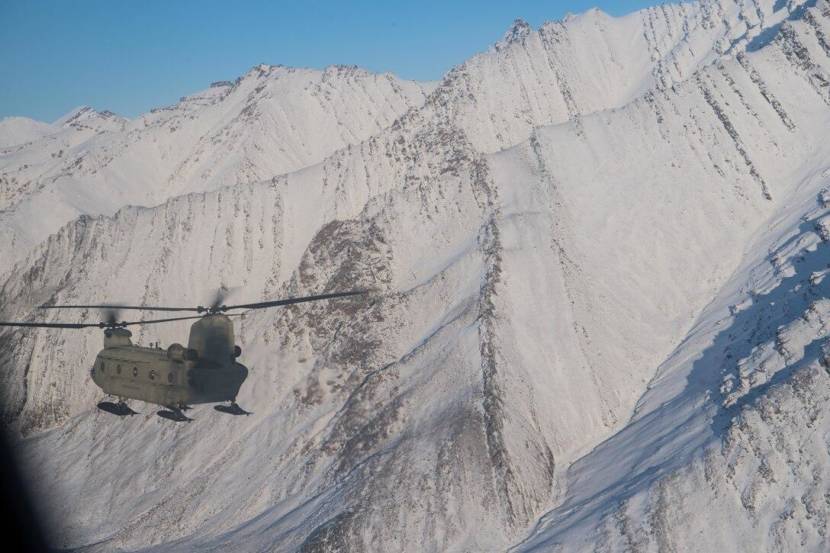
Chinook helicopter (courtesy Tech. Sgt. Amy Picard/Alaska National Guard)
A group of 12 mountaineers were rescued Tuesday from a glacier in Wrangell-St. Elias National Park by the Alaska National Guard.
Alaska Rescue Coordination Center Director Lt. Colonel Keenan Zerkel said the St. Elias Guides climbing party initially called for help Saturday, reporting two of the mountaineers were suffering altitude sickness.
Zerkel said the party had hunkered down at about 10,000 feet, after abandoning an attempt to summit 16,000-foot Mt. Bona due to bad weather.
“Continuous snowfall, high winds, you know, all the conditions conducive to hypothermia and everything else,” he said.
Zerkel says the extreme conditions thwarted repeated efforts to reach the climbers until late Tuesday, when a high-altitude Chinook helicopter team was able to make it in.
“The winds died down enough that they thought an attempt was possible, so they took off and were able to get in and pick up all 12 individuals in one lift,” he said.
Zerkel said three of the climbers had minor injuries including one with frostbite.
“It became an issue of, get them out of there now before there are serious injuries that will develop, so I guess a bit of preventative medicine if you want to think of it like that,” he said.
Zerkel says the three injured were transported on to Anchorage for care, and the other climbers were dropped off in McCarthy.
He described a drawn-out rescue operation that included 80 hours of flight time involving Air and Army National Guard planes and helicopters and crews, supported by the National Park Service, local businesses and individuals.
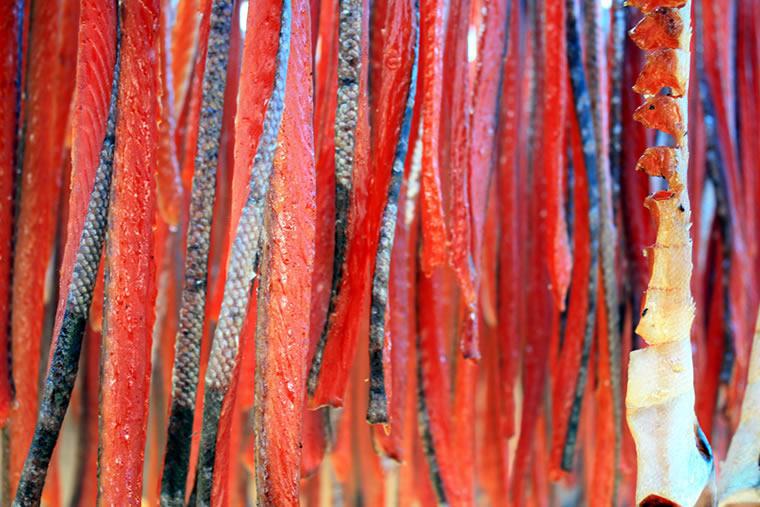
The 2021 Yukon River chinook salmon run is expected to be poor.
A forecast based on past years’ run sizes and age classes, as well as on sea salmon surveys, points to a run of between 102,000 and 189,000 chinook. That may put it in line with some of the weakest runs in the past 20 years, said Deena Jallen, Yukon River summer season manager with the Alaska Department of Fish and Game.
“We have concerns that we’re not going to meet escapement goals, primarily in Canada, but we’re also concerned about meeting escapement goals in the Alaska drainages as well,” Jallen said.
Yukon River subsistence fishing will be closed until the return size is clearer.
“One of the strategies in our management plans is to close fishing on the first pulse, which allows chinook salmon to get upriver,” Jallen said. “We’re also going to be closed on that trickle of fish before the first pulse is detected, so this could translate to a closure that’s two to three weeks long in the the lower Yukon.”
The first chinook are expected to enter the river in early June. The prospect for this season’s summer chum run is below average, but Jallen said that there should be enough to allow decent fishing opportunities.
“We’re looking at a run size of about 1.2 million. It should be enough to meet escapement and subsistence and provide for some commercial fishing,” Jallen said.
The generally smaller fall chum run is also forecast to be below average.
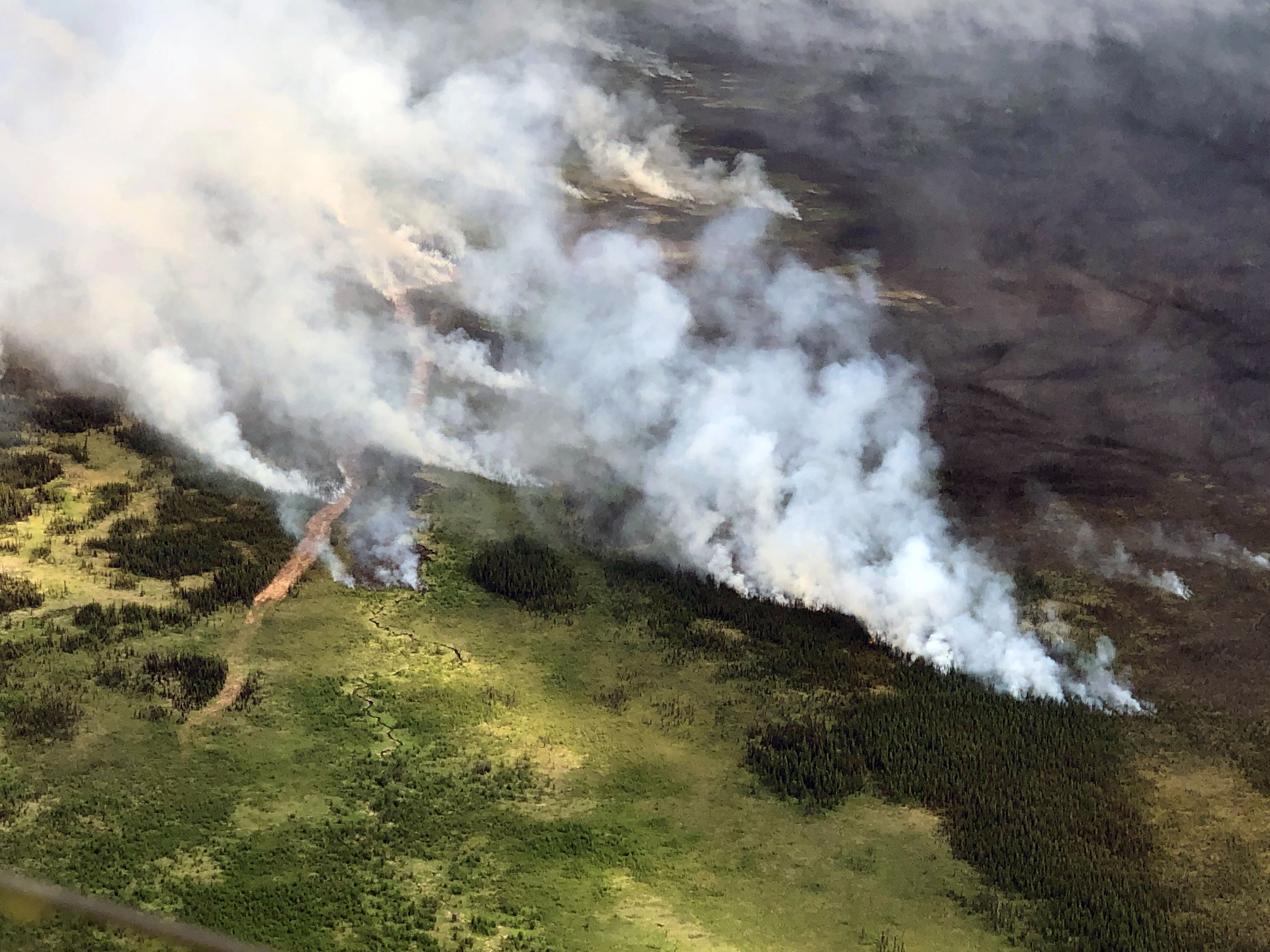
The Swan Lake Fire on Wednesday, June 12, 2019. (Photo by Kale Casey/Alaska Division of Forestry)
A recently published study examines the phenomenon of holdover or “Zombie wildfires” in Alaska and Canada. The fires, which smolder underground through the winter and flare up the following spring, appear to be increasing, due to climate change.
The study published in the journal Nature was led by researchers at a university in Amsterdam, aided by University of Alaska Fairbanks scientists. Randi Jandt is a UAF fire ecologist and co-author of the paper. She says holdover wildfires weren’t historically tracked until the last 20 years, but appear to be increasing.
“Everyone I’ve talked to — all these long-time field people in the fire business up there — kind of think it is increasing in frequency and now we’re starting to expect these things after some of our bigger fire seasons,” she said.
The study points to more than 40 overwintering wildfires reported in Alaska since 2005, and Jandt says climate change is suspected to be a key factor.
She says when Alaska’s peat rich soils dry out, they can provide an environment where fire can smolder through the winter.
“It penetrates down into the lower parts of that duff,” she said. “Or, if it can get under the roots of some trees and be protected from moisture, it can hold that fire.”
Overwintering fires pose challenges for firefighters.
“That smoldering overwinter can leave a bit pit of ash or maybe even a finger of fire that creeps out from an area that looks green on top,” she said. “But it’s kind of underground, so they have to root these things out and it takes a lot of water.”
Jandt says holdover fires typically crop up in the spring, and that requires firefighting agencies to be ready to respond earlier in the season.
The Fireweed Dance Theatre held their annual company performance in Sitka, but remained fully masked and allowed only a limited audience. April 24, 2021. (Photo courtesy of Berett Wilber)
The Alaska Small Business Administration is helping Alaska concert promoters apply for a new pandemic relief fund.
Throughout the pandemic, Alaska theaters and concert halls have remained empty. Orchestras, choirs, storytellers and actors did not take the stage — or if they did, it was without a live audience. For the Fairbanks Concert Association, there have been no live performances for more than a year.
The concert association hosts music and dance events in Hering Auditorium, a 1,200-seat theater in Fairbanks. Anne Biberman is the executive director.
“Live is different. You hunger for it. Come together, hear it, you know, feel it, experience it, share it. All together. It is not something you can get from a virtual event,” she said. “As long as there’s social distancing measures, I can’t present.”
The concert association has been a non-profit subscription service for 73 years.
“We are really reliant on people buying tickets in advance,” she said. “You can’t offer a season if you don’t know if any of the components of that season will happen or not.”
The concert association cancelled the last concert of spring 2020, then its entire 2020 to 2021 season.
“In the midst of 2020 we had about four months when we had negative numbers, because we were doing ticket refunds. You know, one month we refunded $13,000,” Biberman said.
The grant comes from a pot of $16.2 billion in the Economic Aid to Hard-Hit Small Businesses, Nonprofits and Venues Act and the American Rescue Plan Act.
The Small Business Administration is distributing the grants. Applicants may qualify for funds equal to 45% of their gross earned revenue.
If the Fairbanks Concert Association gets the relief money, it will be the biggest grant they have ever received.
“We’ll get about $84,000 if we get it,” Biberman said.
The following can apply for the Shuttered Venue Operators Grant:
Biberman says the grant would prevent the organization from closing.
“We get to keep existing,” she said. “We have a very, very small operational footprint. Most of the money we put out goes into the shows we put on. This money will really shore us up.”
She says the organization may try some outdoor performances this summer, if they can arrange the artists and venues around Fairbanks’ finicky summer weather.
But with only half of Alaskans vaccinated, she still does not know if she will be selling tickets for concerts in Fairbanks’ largest auditorium this fall.
“I don’t think our patrons are going to be ready to file into Hering and sit cheek by jowl, even with a mask on,” she said.
For now, she and other concert and dance agencies are frustrated and waiting for more people to be vaccinated.
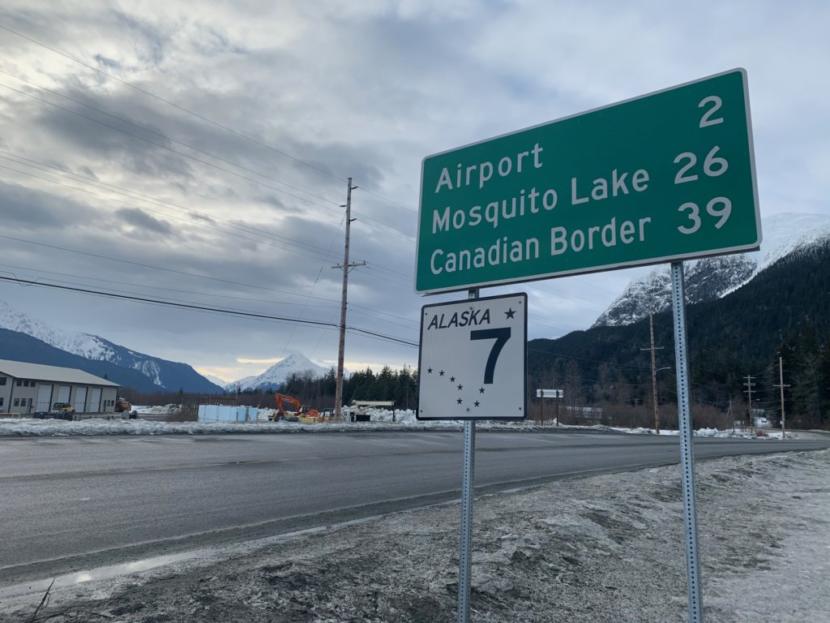
A highway sign in Haines shows the distance to the Canadian Border. (Henry Leasia/KHNS)
An Anchorage man who was arrested over a week ago for refusing to leave a checkpoint on the Alaska side of the U.S.-Canada border remains at the Fairbanks Correctional Center.
Authorities say 61-year-old Terry Sharkey is now refusing to leave the jail.
It’s a twist to a story that began Saturday morning when Sharkey entered Yukon Territory at the Beaver Creek border crossing on the Alaska Highway, about 300 miles south of Fairbanks.
Sharkey was turned back because of Canada’s pandemic-related travel restrictions, but he reportedly refused to leave the checkpoint. According to a Canadian Border Services Agency spokesperson, he was arrested by Royal Canadian Mounted Police.
An RCMP spokesperson said Sharkey wasn’t charged with any offense but was brought back across the border with his vehicle to the U.S. checkpoint at Port Alcan.
Alaska State Troopers spokesperson Austin McDaniel said soon thereafter, troopers got a call from customs officers at the port of entry asking for help with a “hostile subject.”
“Fairbanks dispatch was contacted by the United States Customs and Border Protection at the Alcan port of entry, asking for Trooper assistance removing somebody who did not want to leave their premises,” McDaniel said.
A Trooper report said Sharkey refused to identify himself to Customs officers and refused orders to leave the facility.
“Once Troopers responded, they again asked Mr. Sharkey to leave. He refused, so he was arrested for trespassing,” McDaniel said.
McDaniel said Sharkey was taken to the Tok Trooper post, then transported to Fairbanks Correctional Center and jailed on a charge of second-degree trespassing. Under normal circumstances, a person charged with a similarly minor offense likely would be released the next day.
But a Fairbanks Correctional Center booking office staffer said Thursday that Sharkey is still behind bars because he’s refused to sign paperwork that would allow him to leave the jail. The staffer said he’ll continue to be held unless he signs the documents or is ordered released by a judge.
Attempts to contact Sharkey have been unsuccessful. Officials on either side of the border have not provided information on why he’s refusing to cooperate with authorities.
Internet users in Alaska who are low income or who lost wages during the pandemic are eligible for an internet subsidy of up to $75 per month under a new federal program.
A household is eligible if someone qualifies for the Lifeline program, receives assistance such as free and reduced-price school lunches or a Pell Grant, or experienced a substantial loss of income due to pandemic. Households that make less than 135% of the federal poverty designation and those living on tribal lands or have household members participating in certain tribal programs are also eligible.
Additional eligibility information can be found on the program’s website. The program is set up to give eligible households a $50 per month discount but some Alaskans could get $75.
“I think that’s one important thing for Alaska listeners to know, the benefit is up to $75 a month for those households as opposed to the $50 a month discount,” said Ed Bartholme, the Deputy Chief of the Federal Communications Commission’s Consumer & Governmental Affairs Bureau.
It’s called the Emergency Broadband Benefit Program, but it’s not just broadband.
“There’s a variety of service types that are included in the program — there’s fixed wireless, there’s wired for homes that have wired connectivity as an option, there is mobile which is much more akin to cellphone service,” Bartholme said.
The money came out of the huge Consolidated Appropriations Act passed by Congress in December. One aspect was focused on how much families relied on internet connectivity while staying apart from others to prevent from spreading disease.
Bartholme said it took a while to stand up the program, but it was record time for his agency.
“Congress instructed the FCC to stand up a completely new program that is critically important, critically timely to the current environment and the current situation, but making it live and real where people can actually start to collect benefits from it,” he said.
It won’t pay fees that are already owed, but discounts start this week.
The pandemic-related program will continue until the $3.2 billion in federal funding runs out or six months after the Department of Health and Human Services declares an end to the pandemic.
The website shows all of the providers participating across the state, including larger providers like GCI, Alaska Communications and MTA. People can search for their zip code or city to see which providers are in their area.
Bartholme says there are consumer protections built into the program.
“One of the big things we wanted to prevent and make sure it didn’t happen, was that people who needed this sort of assistance weren’t stuck with sort of an episode of ‘bill shock’ when the money runs out,” he said.
Customers can sign up by contacting a participating provider, enrolling online, mailing an application or calling 833-511-0311.
Close
Update notification options
Subscribe to notifications
Subscribe
Get notifications about news related to the topics you care about. You can unsubscribe anytime.