KUAC - Fairbanks

KUAC is our partner station in Fairbanks. KTOO collaborates with partners across the state to cover important news and to share stories with our audiences.
Wildfires pop up near Chisana and Tanana

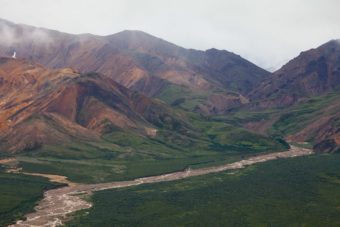
Red Hill Fire continues to burn Saturday evening. The fire, estimated at 1 acre, is approximately 100 miles northeast of Glennallen and 1.8 miles northeast of Chisana. (Photo courtesy Luke Wassick/National Park Service)

Recent warm, dry weather in the Interior has resulted in two late season wildfires.

Alaska Division of Forestry reports sending fire fighters last night to a 1-acre blaze, located about a hundred miles northeast of Glennallen, near Chisana.

The department said the fire, burning in Wrangle St. Elias National Park and Preserve, was observed to be creeping and smoldering with light rain falling on it last night. The fire is not accessible by road, and weather prevented firefighters from getting to it last night.

The other new fire was reported last week by a boater along the Tanana River, on a Native land allotment about 15 miles downstream from Nenana.

The Alaska Fire Service said two firefighters went to the site Friday to work the fire, which was estimated at less than an acre, with activity again described as smoldering and creeping.

Both fires are suspected to be human-caused.

State and federal agencies say Alaska has minimal staff on hand to fight fires in Alaska right now, as most are deployed to the battle major blazes in the western Lower 48.

The Alaska Fire Service said nearly 653,000 acres have burned in Alaska so far this year, well below the normal average of 1 million to 2 million acres.

Arctic climate change researchers still conflicted over UAF’s coal-fired powerplant

Work on University of Alaska Fairbanks' new 17-megawatt combined heat and power plant is about half done. University officials say it’s scheduled to go online in December 2018. (Photo by Tim Ellis/KUAC)
Work on University of Alaska Fairbanks’ new 17-megawatt combined heat and power plant is about half done. University officials say it’s scheduled to go online in December 2018. (Photo by Tim Ellis/KUAC)

The University of Alaska Fairbanks is building a heat and power plant to replace the old facility that went into service in 1964.

The new $245 million powerplant, scheduled to come online next year, will feature updated technology that’ll reduce most pollutants – but it will continue to emit greenhouse gases blamed for warming the planet.

Many on campus say that conflicts with UAF’s leadership in Arctic climate-change research.

The work on university’s 17-megawatt combined heat and power plant is about halfway done.

when the state-of-the-art facility goes online around December of next year, Senior Project Manager Mike Ruckhaus said it’ll be among the most environmentally friendly coal-fired power plants in the country.

“From an environmental standpoint, this meets all the current regulations and criteria,” Ruckhaus said during a tour last week around the construction site.

That includes regulations related to the tiny particles called PM 2.5, produced by combustion, which can foul Fairbanks’s air during winter inversions.

“It’s about as clean as you can get on PM 2.5,” Ruckhaus said.

But the plant will emit nearly 132,000 tons of carbon dioxide equivalent annually, about 3 percent less than the old facility, but still roughly the amount of CO2 generated by 26,000 cars annually.

Coal-fired power plants are the main source of atmospheric CO2.

The new power plant still bothers some university researchers who study climate change and its impact on the Arctic even though it’s a done deal and construction is well under way.

“From a scientific perspective, I understand the consequences of burning fossil fuels – and particularly for people who live in the Arctic and the subarctic,” said Scott Rupp, a professor of forestry and deputy director of UAF’s International Arctic Research Center.

He said when UAF officials were debating a decade ago over what kind of power plant to build to replace the old one, he and others favored renewable-energy options like hydro and solar.

“It’s disappointing,” Rupp said in a recent interview. “My personal preference would be to have been able to continue to be a showcase of not only great science on climate change but be able to put some of our innovation into how we power the Arctic university that we are.”

Rupp and others acknowledge that locally mined coal, from the Usibelli operation in Healy, was the only practical option for fueling power plants in Fairbanks.

“We still don’t have natural gas in town, so obviously you can’t rely on that,” University Regent John Davies said.

Davies favored that type of fuel for the new power plant.

And because the need to replace the old facility was urgent, Davies added, “you have to at some point have a plan and move forward on it.”

Davies said UAF’s old plant was well past its design life and that university officials had to make a decision.

“We had replace the power plant because it was 50 years old and it was failing,” Davies said. “It could’ve been a major catastrophe if that plant had gone down in the middle of winter.”

Davies is a longtime advocate for clean air and energy efficiency, and he said he still feels conflicted over the university’s decision to build another coal-fired power plant.

“There certainly remains the irony that this is the only coal-fired power plant in the nation that’s being built – and we’re also the leading group on understanding climate change and the need to reduce the emissions of fossil fuels to reduce the amount of greenhouse warming,” Davies said.

Davies referred to reports from two media outlets, ClimateWire and Alaska Dispatch News, that pointed out the UAF power plant is the only one under construction in the United States.

Davies said he hopes university officials will be able to choose natural gas, or renewable energy, when UAF replaces the power plant again a half-century from now.

Most University of Alaska campuses see lower enrollment

Fall enrollment is down at most University of Alaska campuses. Early numbers show the university headcount off 4.5 percent, or over 1,000 students, from last fall.

The highest declines are at Southeast and Fairbanks campuses.

UAF’s Institutional Research Director Ian Olson said enrollment is dropping at the Fairbanks campus as student retention and graduation rates rise.

”We’re graduating fairly large classes and we’re getting fewer incoming students, so our replacement rate is down,” Olson said. “Our first-time freshmen enrollment numbers are down.”

Olson said it’s natural for enrollment to level back coming off a recessionary bump, but the university system is seeing the decline continue and even increase.

”To some degree we have to recognize that it is linked to uncertainty related to Alaska’s economy and really the budget circles coming out of Juneau and the Legislature,” Olson said. “That uncertainty, we think, is causing some student to consider enrollment elsewhere.”

Olson said the decline runs counter to assessments that continue to show the University of Alaska to be a good value compared with Lower 48 institutions.

“We frequently get lifted on best value in the West type of rankings from various ranking agencies that are out there,” Olson said. “UAF and UAA in general are recognized a great deal for those seeking higher education.”

Olson said there are some bright spots in University of Alaska enrollment including an increase in the number of UAF community and technical college students this fall, something he said may correspond with a slight uptick in local unemployment.

State to pave 52-mile stretch of Dalton Highway

Sagavanirktok River flooding halted trucks en route to the North Slope oil complex several times in spring and summer 2015, creating long backups at points along the Dalton Highway. (File photo by KUAC)

Work is wrapping on a project to rebuild the northernmost stretch of the Dalton Highway that was badly damaged two-and-a-half years ago by flooding from the overflowing Sagavanirktok River.

Once that and two other road-improvement projects on that part of the Dalton are all complete, the state plans to pave the 52-mile stretch of the road.

The contractor hired to reconstruct the 17-mile stretch of the Dalton Highway south of Deadhorse raised the level of the roadway by nearly 5 feet in areas damaged by flooding in the spring of 2015 by the Sagavanirktok River, also called the Sag River.

“What happened was the Sag River overflowed its banks, after several days of icing. There were some very quick-warming temperatures, and some flooding that shut down the roadway,” said Mike Lund, the Alaska Department of Transportation’s construction manager.

Lund said the project contractor, Anchorage-based Brice Incorporated, had to haul in some 2.4 million tons of gravel needed to build-up that stretch of Dalton. That’s enough to fill some 120,000 side-dumper trucks.

It’s one of three projects worth a total of $109 million that are under way on the Dalton from Pump Station 2 to Deadhorse.

“Eventually, over the next few years, we intend to actually pave this roadway,” Lund said in an interview this week.

Lund says paving the last 52 miles of the Dalton would save the state millions of dollars that it regularly pays to resurface the roadway that’s pounded by some 200 semi-tractor trailer rigs headed to or from Prudhoe Bay every day.

“The biggest thing that these projects do over the short and long term is reduce maintenance and operations costs,” Lund said.

Lund said the federal government pays for 91 percent of the cost of road projects like this.

He said the state tries to take advantage of that by including measures that will cut future road-maintenance costs.

Lund said the gravel added to the roadbed will help insulate the permafrost on which the highway was built.

The projects also call for a 4-inch layer of insulation to be buried at or near grade to further protect the permafrost from thawing.

Militia leader appeal draws split ruling

A federal appeals court has thrown out one of the convictions of former Fairbanks militia leader Schaeffer Cox.

A Ninth Circuit Court of Appeals decision filed Tuesday vacates Cox’s conviction of solicitation to murder federal officials.

The six-page ruling upholds a conspiracy to murder conviction and remands the case back to district court for re-sentencing.

Schaeffer Cox was convicted of both murder conspiracy and solicitation as well as weapons violations in 2012, and later sentenced to nearly 26 years in federal prison.

His appeal argued before a three judge Ninth Circuit panel in Anchorage on August 15 took issue with how the jury was instructed in the case. It contends there’s no evidence of agreements or requests to kill specific government officials. Cox’s federal public defender declined to immediately comment, but Cox advocate Rudy Davis says he recently received a letter from Cox, in which he anticipated the split appeal ruling.

His appeal argued before a three judge Ninth Circuit panel in Anchorage on August 15 took issue with how the jury was instructed in the case. It contends there’s no evidence of agreements or requests to kill specific government officials.

Cox’s federal public defender declined to immediately comment, but Cox advocate Rudy Davis said he recently received a letter from Cox, in which he anticipated the spilt appeal ruling. Davis read a portion of the letter to a KUAC reporter:

“Asking my friends to agree to go murder with me. The asking is the solicitation count. The agreeing is the conspiracy count. What are the judges saying? My friends agreed to do what I never asked them to do? That’s silly,” Davis read.

The case prosecutor, Assistant US Attorney Steven Skrocki, said the conspiracy and solicitation charges involved separate actions. Skrocki said the solicitation charge involved Cox’s use of a militia security team outside a North Pole radio station, while the conspiracy charge was related to Cox and fellow militia members agreeing to a plan targeting a list of government officials.

“So to try to argue that because one fails that the other necessarily has to fail– in other words, the solicitation failed, therefore, the conspiracy failed– completely disregards that there were two separate offenses charged for two separate acts involving seperate victims,” Skrocki explained. “So that arguement really doesn’t make any sense.”

Skrocki said it’s unclear if the appeal ruling ordering re-sentencing will effect Cox’s jail time because the murder conspiracy and solicitation sentences are being served concurrently. Cox is jailed at a federal Communications Management Unit in Marion, Illinois. Davis said Cox intends to challenge the appeal ruling.

According to Davis, Cox wrote in a letter that another challenge is justified “because the evidence that still has never made it in front of a court proves my one hundred percent innocence.”

Davis and other Cox supporters have post excerpts from FBI informant recorded interviews in which Cox professed non-violence, but prosecutor Skrocki said such proclamations were interspersed with violent rhetoric.

“For every claim of a Gandhi, there was a claim of a Rambo,” he said.

Skrocki said the next step in the legal process for the Cox case is re-sentencing date, prior to which both sides will provide input.


With F-35 squads set for Eielson, thousands of people may come up with them

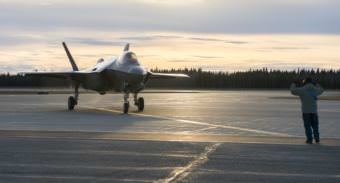
The economic benefits that will come with two squadrons of F-35s scheduled to be based at Eielson beginning in 2021 are now expected to draw more than 5,000 people to the area, a consultant said Monday. (U.S. Air Force photo by Staff Sgt. Alex Fox Echols III/Released)

More than 5,000 people may come to the Fairbanks area over the next four years as part of the move to base two squadrons of F-35 fighters at Eielson Air Force Base.

The latest estimate announced Monday is well above the previous estimate of 3,500. The bigger population increase is expected to place a greater burden on local services.

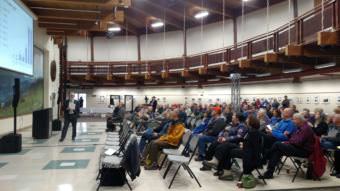
Consultants hired by the Fairbanks North Star Borough to study how the area can accommodate Eielson’s expansion announced the new population-growth projections at a meeting Monday in Salcha.

A member of the Arcadis project team that’s conducting the study, Shelly Wade said the higher projections include 400 or so additional personnel that the Air Force will likely bring to Eielson, along with their family members.

“It’s highly likely the additional positions that’ve been requested by the Air Force will be approved,” Wade said.

Wade said the higher projections also include the number of people who would be drawn to the Fairbanks area by the jobs and other economic opportunities that would be generated by all the new personnel coming to Eielson.

“Those folks needs services,” Wade said. “They need food services, retail services, mechanics, child care – all of these things.”

Arcadis’ studies suggest the numbers of those who would move here for jobs related to the expansion range from about 1,700 to just more than 2,000.

Wade told about two dozen people at the meeting that those are preliminary numbers that’ll be revised.

The meeting in Salcha was the first of seven the consultants will hold around Fairbanks this week to identify shortages of housing, schools and other resources that may occur with the influx of new residents drawn by the expansion.

Special assistant to borough Mayor Karl Kassel, Jeff Stepp is working with the Arcadis community outreach that’s being conducted to get public input on gaps in services that need to be filled before the new personnel arrive.

“I think both Eielson Air Force Base and the Fairbanks North Star Borough have a shared interest in making sure the expansion accommodates the needs of the current residents and the future residents,”  Stepp said. “We got a lot of really good ideas, and good input, from these folks from Salcha who showed up to talk with us.”

Many of the comments concerned the sluggish economy and its effect on the local housing market.

Others talked about a lack of medical facilities near Eielson and inadequate internet and cellphone service in and around the base.

Shelly Curtis, an administrative aide at Salcha School, said enforcement of speed limits and improved intersections are badly needed along the Richardson Highway.

“Our suggestion is turn lanes,” Curtis said. “Some turn lanes at some of the higher-traffic (areas), such as near the school, where we’re on a curve.”

Curtis said turn lanes would help buses and other school-related traffic get on and off highway more safely at the school, located about 35 miles south of Fairbanks.

Salcha Fire Chief Ernie Misewicz said turn lanes also are needed for several busy intersections along the Richardson just south of Eielson.

“There’s an increase in commercial truck traffic – semi’s and what-not delivering goods back and forth,” Misewicz said. “We also have a tremendous amount of military traffic that comes through that are either going down to Greely for some maneuvers or they’re going to go up on the Johnson Road.”

The chief also said the 10 local fire departments that have a mutual-aid agreement with Eielson’s will need to train more before the F-35s arrive, so they’ll all be better-prepared to respond to emergencies, including those involving aircraft, that occur off-base.

Site notifications
Update notification options
Subscribe to notifications