KUAC - Fairbanks

KUAC is our partner station in Fairbanks. KTOO collaborates with partners across the state to cover important news and to share stories with our audiences.
Bans on game harvest techniques currently under review

Black bear. (Alaska Department of Fish and Game)

The Trump administration has directed the National Park Service in Alaska and the Kenai National Wildlife Refuge to reconsider bans on certain state allowed game harvest techniques.

July 14 memos to the directors of the two Alaska entities from Virginia Johnson, acting assistant secretary for Fish and Wildlife and Parks, tell them to initiate a new rule making process, in light of effects on sport and commercial hunting and trapping.

In an email response to a request for comment, Interior Department press secretary Heather Swift said there is no predetermined outcome of the reviews and that “the Department is committed to working with the people of Alaska on how to best manage their wildlife and habitat.”

The reviews mean second looks at regulations banning a range of state allowed harvest practices, including taking black bears with artificial light at den sites, killing of brown and black bears over bait, use of dogs to hunt black bears, harvest of wolves and coyotes during denning season and killing swimming caribou, or taking them from a motorboat while under power.

National Park Service Alaska Region spokesman John Quinley said the agency will have to do over, the rule making process used for development of the current regulations.

“To go back out to the public, I can’t speculate on what any new proposed rule might include,” Quinley said. “But public input’s gonna be a key part of the process.”

Quinley said the majority of comments received during the first go round were in favor of the regulations banning the harvest practices.

“But rule making is not a voting contest,” Quinley said.

Pat Lavin is the Alaska representative for the group Defenders of Wildlife.

“Targeting predators and managing them to scarcity is not consistent with the purpose of the refuge and preserve lands,” Lavin said. ”It’s troubling to see that we’re reopening this whole issue so shortly after the regulations were completed on this front. But well participate again and I’m sure the public will as well. I hope that the new administration will be open to outcomes that are inconsistent with their own statutory obligations and with what the public wants.”

Defenders of Wildlife is one of several environmental groups fighting a state of Alaska filed suit aimed at turning back the regulations.

The state constitution calls for managing fish and game for sustained yield, while the park service mission is to provide for natural diversity — conflicting mandates central to a broader debate over state’s rights.

Alaska Outdoor Council executive director Rod Arno referred to guarantees included in the Alaska National Interest Lands Conservation Act that created many of Alaska’s federal preserves and refuges.

“To make sure that the state of Alaska would remain the authority on management of Fish and Game on federal lands,” Arno said. “what the Department of Interior did in the last eight years through policy is directly contrary to what the federal legislation says.”

Arno said hunting trapping is common on federal lands in Alaska especially road accessible portions of the 70 million acres set aside in national preserves.

Earlier this year, Congress repealed harvest technique bans in other U.S. Fish and Wildlife refuges in Alaska, using the Congressional Review Act, but the Park Service and Kenai Refuge rules fall outside the action time-frame allowed under that law.

Fish & Game: Black bear appeared predatory in fatal Pogo Mine attack

Experts with the state Department of Fish and Game say the black bear that attacked two workers last month near the Pogo Mine was hungry and showing predator-like behavior.

“It was a healthy adult male that hadn’t eaten in some time,” Doreen Parker McNeill said. She’s a Fairbanks Fish and Game coordinator. “It was not defending a kill. And the nature of the attack appears to have been predatory.”

McNeill said it’s rare for bears to exhibit that kind of behavior. She says the attack on two Pogo Mine contractors who were conducting field work at a remote site about 5 miles from the main camp on June 19 is only the fourth such report of such behavior among 208 bear attacks reported between 1980 and 2014.

“It’s not very common for predatory attacks to happen,” McNeill said, “but they do happen.”

One of the workers, 27-year-old Erin Johnson, of Anchorage, died of injuries she sustained in the attack. The other, 39-year-old Ellen Trainor, of Fairbanks, was treated and released from Fairbanks Memorial Hospital on that evening. The bear was shot dead by an employee of the mine, located about 38 miles northeast of Delta Junction.

The attack was the second in as many days. On June 18, a 16-year-old competing in a race on an Anchorage-area trail was killed by a black bear as the runner made his way back after the race had ended.

Competition seeks solutions for remote communities’ high energy costs

The Alaska Center for Energy and Power is reaching out to inventors and entrepreneurs to help find ways to reduce the high cost of generating electricity in remote communities around the state, located far off the grid. Officials with the University of Alaska Fairbanks-based center hope those solutions will come with proposals they’re soliciting for its second annual Microgrid Technology Competition.

“They do have to demonstrate that there is a benefit – as in, it’ll actually reduce the cost of power, if it works, or increase the stability and reliability of the grid,” says Marc Mueller-Stoffels, a research assistant professor who’s heading up the project. He says the competition is focused on reducing the cost of electricity distributed in small, isolated communities through so-called microgrids.

“Eligible is anyone that has a product that is clearly of use in a microgrid,” he said, “from developing a new grid, adding renewables or better diesels or energy storage.”

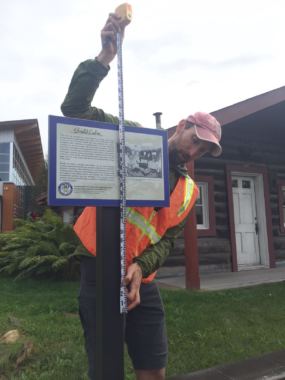
Marc Mueller-Stoffels directs ACEP's Power Systems Integration Lab, where winners of the Microgrid Technology Competition will be able to test their technologies.
Marc Mueller-Stoffels directs ACEP’s Power Systems Integration Lab, where winners of the Microgrid Technology Competition will be able to test their technologies. (Photo by Tim Ellis/KUAC)

Mueller-Stoffels says the proposals must include a business plan that will among other things outline how the technologies could be commercialized. That is, leveraging the technology’s value to generate revenue – standard practice among the high-tech startups that he expects will be submitting proposals.

“This is not necessarily geared toward the guy in a garage,” he said, “but more to companies that have the money to move forward on the commercialization trajectory.”

A panel of experts will evaluate the proposals and select winners later this year. The prizes will come in the form of research and development time in the center’s Power Systems Integration Lab. Mueller-Stoffels, who directs the lab, says the center is offering a total of $308,000 worth of staff and facility time in the high-tech R&D test bed, located on the UAF campus.

“The grand prize is to get to come and have your equipment hooked up to this lab and see how it performs,” he said in an interview earlier this week.

The competition is being coordinated through the Alaska Center for Microgrid Technologies Commercialization, which UAF established last year with a federal grant, and is augmented this year with funding from the Office of Naval Research.

UAF is collaborating on the project with the University of Alaska Anchorage’s Business Enterprise Institute, Center for Economic Development and Small Business Development Center.

Editor’s note: This Changing Arctic episode is the last of the weekly reports KUAC has been producing for the past two years to coincide with the U.S. chairmanship of the Arctic Council. KUAC will continue to cover the changes under way in this increasingly important region with reports in our weekday newscasts.

Study: ‘weak’ correlation between warming, Southcentral lightning strikes

Lightning sparked about a quarter of the 218 wildfires reported in Alaska as of Monday. But those fires account for 97 percent of the more than 151,000 acres that have been burned by fire so far this year. And more than half of those acres were blackened by five fires around Galena and southwestern Alaska.

“The top five fires for this year so far have been lightning-started,” says Matt Clay, a meteorologist with the National Weather Service in Anchorage. During a webinar hosted this week by the Alaska Center for Climate Assessment and Policy, Clay talked about a five-year study on lightning activity around Southcentral Alaska that he and another meteorologist put together.

“Just last week, for instance, the East Fork Fire was likely started by a lightning strike on the Kenai Peninsula, and has burned over 1,300 acres so far.”

Lightning-sparked wildfires in the Central Interior and southwestern Alaska account for nearly all the acreage burned in the state so far this year.
Lightning-sparked wildfires in the Central Interior and southwestern Alaska account for nearly all the acreage burned in the state so far this year. (Courtesy Rebecca Duell and Matt Clay/NWS Anchorage)

Clay’s study shows average high temperatures are increasing around Southcentral, as are the number of days in which thunderstorms occur. But he says there’s only a weak correlation because those increases are at least partly due to the network of new and much more accurate lightning sensors that were activated statewide in 2012. Rick Thoman, with the weather service’s Fairbanks office, agrees the new sensors skew the data, making it difficult to discern whether warming is affecting the length of Alaska’s lightning season.

“While you can get rogue thunderstorms as early as the last days of April through May, it’s really only the last week of May that the occurrence really starts to ramps up,” he said. “And we haven’t seen much change in that yet.”

Two southcentral regions with the most lightning activity seem to show a correlation between warming and the number of days thunderstorms occur. But, Clay and study coauthor Rebecca Duell say the use of a new, more sensitive sensor array skews comparisons with surveys conducted before the Alaska Lightning Detection Network was activated in 2012.
Two Southcentral regions with the most lightning activity seem to show a correlation between warming and the number of days thunderstorms occur. But, Clay and study coauthor Rebecca Duell say the use of a new, more sensitive sensor array skews comparisons with surveys conducted before the Alaska Lightning Detection Network was activated in 2012. (Courtesy Rebecca Duell and Matt Clay/NWS Anchorage)

Thoman, a climate science and services manager, says studies show that the eastern Interior of Alaska is likely to get more moisture, earlier, in the years ahead. And he says that suggests the possibility that the lightning season there could eventually get longer.

“Especially if snow melts earlier and the land is able to warm up sooner, that will push the start of the season to earlier dates, as well.”

Thoman and Clay both say there’s not enough data yet to support that assertion. Clay says more studies, and more data collected by the updated sensor network should help climatologists determine whether Alaska’s lightning season will be getting longer.

Former Kenai city manager dies after motorcycle crash

A former Kenai city manager died Sunday of injuries he sustained when he wrecked his motorcycle earlier that day on the Dalton Highway.

Ricky Koch, 60, was pronounced dead by medics who’d flown to Livengood, Alaska State Troopers said.

Koch was riding with several friends when he lost control and wrecked at mile 39, near the Hess Creek bridge about 15 miles south of the Yukon River, according to a trooper report posted Monday morning.

Koch’s friends brought him to Livengood, about 50 miles north of Fairbanks, where they were able to contact a resident by phone to call for help.

Koch served as Kenai’s city manager for 10 years until he left the office last year for an unsuccessful run at the Legislature.

Koch not wearing a helmet when he crashed, troopers said. An autopsy will be conducted in the near future.

This was the second motorcycle-related death of a prominent Alaskan official in recent weeks.

On June 11, former Fairbanks district attorney Michael Gray died after crashing his motorcycle in Canada — while driving from Alaska to a family gathering in Montana.

Alleged Fairbanks gunman was ‘prepared for armed confrontation,’ police say of officer-involved shooting

Updated | 9:45 a.m. Wednesday

Fairbanks Police Department has released details about an officer-involved shooting in the city Monday.

Mathew Colton Stover, 21, of Northway was killed in a shootout with four Fairbanks police officers.

Chief Eric Jewkes explained during a news conference Tuesday that officers responded to a snow dump next to Fairbanks Correctional Center about 4 a.m. Monday, after receiving reports of a masked man with a rifle.

“Two officers approached in their vehicles, stopping a considerable distance away” Jewkes said. “They activated their lights and made contact with the suspect over the PA. As soon as that PA announcement started, the suspect exited the vehicle, immediately turned, started running towards the officers, raised an AR-style rifle and began firing as he ran towards the patrol cars.”

The officers were not injured, and returned fire, killing Stoverm, Jewkes said. Stover was armed with an assault rifle and a 9 mm pistol, and was prepared for confrontation.

“He had numerous loaded magazines both on him and in his vehicle, both for the rifle and the handgun, which counted to about 400 rounds of ammunition,” Jewkes said. “He also was wearing body armor that covered a significant part of his body. We’re still looking into exactly how much of his body was covered by that body armor, but it did include a ballistic face mask.”

Chief Jewkes said an armored Alaska State Trooper vehicle and a robot were used to approach Stover’s body and his truck.

“He had modified his vehicle to conceal both its make and to change its original appearance,” Jewkes said. “They also noticed a large bag sitting beside the vehicle and noticed a fuel-type smell or some type of accelerant.”

“Given all the preparations that he made, the smell and the things that went with that, there were some concerns about explosive materials — some other kind of secondary hazard to the officers,” he said.

An Army explosive ordinance detection team from Fort Wainwright was called in, but no explosives were found.

An unmanned aerial vehicle from the University of Alaska Fairbanks was used to survey and map the shooting scene.

A nearby medical center, movie theatre and other businesses were evacuated or locked down during the hours-long clearing and processing of the scene.

Chief Jewkes said police have had no prior dealings with Stover, and he would not speculate on his motivation.

“What I can say is after reviewing the information we have so far, I stand here very proud of the officers that were involved,” Jewkes said. “The way they conducted themselves, the way they confronted and armed gunman who had spent considerable time preparing for an armed confrontation. I have full appreciation for the significance of Mr. Stover and his loss of life, and my sympathy goes out to his family. He’s a person, he has a family and I sympathize with what they must be going through.”

Stover’s hometown of Northway is located about 50 miles south of Tok on the Alaska Highway. The population was 71 people in the 2010 census.

The four Fairbanks officers involved in the shooting are on administrative leave, and their names will be released after 72 hours. It was the second officer involved shooting in Fairbanks in a month.


Original story 9:34 a.m. Tuesday

Alleged masked gunman dead after officer-involved shooting in Fairbanks

One person is dead after being shot Monday by Fairbanks Police.

The shooting happened at about 4 a.m., police spokeswoman Yumi McCullough said, when officers received two calls about a masked man wielding a rifle.

”The man was located at an undisclosed location,” McCullough said. “There were four FPD officers that were involved and the gunman approached them and the officers fired and the gunman died on the scene.”

McCullogh says police have delayed releasing the location of the shooting because of safety concerns that prompted calling in a military explosive ordinance detection team.

“The scene itself was secure from the public, but it did appear to have some hazards,” McCullough said. “Out of concern for the safety of the officers and the investigators, their process, the Fort Wainwright (explosive ordnance disposal) was called out to assist.”

McCullough said the name of the suspect killed is being withheld pending notification of next of kin.

The four officers involved were placed on administrative leave and their names will be released after 72 hours.

It was the second officer-involved shooting in Fairbanks in a month.

Site notifications
Update notification options
Subscribe to notifications