KUAC is our partner station in Fairbanks. KTOO collaborates with partners across the state to cover important news and to share stories with our audiences.
Flags are at half-staff in honor of former Alaska attorney general and lifelong University of Alaska advocate, Grace Schaible of Fairbanks.
Schaible died Saturday at the age of 91.
Schaible grew up in Juneau, graduated from the University of Alaska Fairbanks, George Washington University and Yale Law School. Returning to Alaska, she practiced law in Fairbanks, and in 1987 became Alaska’s first woman attorney general under former Governor Steve Cowper.
In a news release announcing Schaible’s passing, Gov. Bill Walker refers to her as “giant of Alaska history,” who “shattered the glass ceiling” as Alaska’s first woman attorney general.
Current Attorney General Jahna Lindemuth, the second woman to serve in the Alaska attorney general post, called Schaible “a pioneer who inspired her and other strong female leaders.”
Schaible also served as a University of Alaska regent, on the Permanent Fund Board and the UA Foundation, helping raise money for the Museum of the North and UAF Geophysical Institute. Proceeds from the sale of a home she donated to the University are the basis of an endowment at the University of Alaska Southeast.
Schiable also donated an extensive collection of art to the UA museum.
Flags will fly at half-staff in honor of Grace Schaible through Tuesday.
The Copper River king salmon return is coming in better than forecast.
Predicted to be the weakest on record, at about 29,000 kings, Alaska Department of Fish and Game Upper Copper River management biologist Mark Somerville said the forecast is being questioned – given recent week’s king harvest by commercial fishers on the river’s delta.
“Even under a restricted area and time the commercial fishery has caught over 8,000 king salmon, which is unexpected and indicates that the return may be higher than we anticipated,” Somerville said.
According to Somerville, the better-than-expected commercial king harvest is supported by data from a mark and recapture project.
The information has resulted in the state beginning to peel back sport and subsistence king harvest restrictions.
“We have rescinded the limits in the subsistence fisheries so that there is currently no limit on king salmon for fish wheels, and we are back to the five fish limit for dip-netting in the subsistence fishery,” Somerville said. “We have also re-opened the sport fishery to an annual limit of two king salmon with only one allowed from each tributary. And we’ve allowed the use of bait in selected waters, say the Klutina, Tonsina and portions of the Gulkana River.”
Somerville said the state has delayed easing a king harvest ban in the personal use dip net fishery at Chitina because of remaining uncertainly about the strength of the run and the fisheries popularity.
“We’re holding off about a week or so because that fishery is a very powerful fishery and can harvest upwards of a thousand king salmon in a week.”
Somerville said if it continues to appear the king run is better than forecast, and that escapement can be met, the state will open the personal use dip net fishery at Chitina to limited king catch.
The personal use fishery opened this morning for sockeye harvest.
The Copper River sockeye return is forecast to come in at about 1.8 million fish, a slightly below average return.
Alaska Air National Guardsman Staff Sgt. Brett Wilson traverses lower Kahiltna Glacier in this file photo while conducting winter rescue and glacier training on Mount McKinley. Denali climber Martin Takak fell into a crevasse on Monday, spending 14 hours wedged deep in the ice.(Photo courtesy of the Alaska Air National Guard)
A Denali climber was rescued Monday after spending 14 hours wedged deep in a crevasse.
Martin Takak, 38, of Slovakia, fell un-roped into the crevasse while descending the peak before 1:30 a.m. Monday, National Park Service spokeswoman Maureen Gaultieri said.
“Mr. Takak fell through the snow bridge and came to a rest about 40 feet below the glacier surface and was pretty tightly embedded in the ice,” Gaultieri said.
Other climbers saw Takak fall and began trying to rescue him, Gaultieri said. The accident occurred at the mountain’s 7,800 foot level of the Kahiltna Glacier — along the West Buttress route.
More than two dozen people participated in the rescue, Gaulteri said, some taking turns lowering themselves into the crevasse to chip away at the ice.
“After a lot of manual labor and a final hour of some mechanical advantage in the end with a pneumatic chisel, they were able to free him from the ice and get him, onward, into medical care,” Gaultieri said.
Takak was severely hypothermic, Gaultieri said, and suffering from critical injuries when he was flow to the hospital in Fairbanks.
“I would have to say that he has a tremendous will to survive,” Gaultieri said. “He certainly was probably helped by the fact that he knew right away that there was a team of people working to get him out.”
It was the second major crevasse rescue operation to retrieve an un-roped climber this spring on Denali, Gaultieri said.
“This year the lower glacier has had quite a bit of crevasse danger: weaker snow bridges than usual, not a lot of winter snow pack,” Gaultieri said.
The National Park Service cautions climbers to always travel roped, and to wear skis or snowshoes to increase flotation while crossing soft or thin snow packs.
Fort Greely senior officers and invited dignitaries applaud after Leonard Larkins receives a proclamation and key to the city of Delta Junction at the end of Saturday’s ceremony on Fort Greely. From left, Chaplain Maj. Ernest Ibanga, Gov. Bill Walker, First Lady Donna Walker, Larkins, Greely Garrison Commander Lt. Col. Michael Foote, Delta Mayor Pete Hallgren, state Sen. Mike Dunleavy and state Rep. George Rauscher. (Photo by Tim Ellis/KUAC)
Fort Greely and Delta Junction celebrated the Alaska Highway’s 75th anniversary Saturday – and one of the soldiers who helped build it.
Gov. Bill Walker and other state and local leaders attended a tribute to Leonard Larkins, 96, one of more than 3,000 African-American soldiers who helped build the highway.
Leonard Larkins says most of his memories from the eight months he spent helping build the Alaska Highway involve clouds of mosquitos, miles of mud and “The cold … that was the biggest thing, the cold weather.” (Photo by Tim Ellis/KUAC)
Larkins vowed to never return to Alaska 70-some years ago, he said, after serving two grueling tours of duty up here.
“I can’t remember way back when, because I actually tried to put all this behind me at one time, after I left the service,” he said in an interview after Saturday’s ceremony. “It was pretty rough here.”
Rough, because he and 11,000 other soldiers had to carve a 1,500-mile road out of wilderness in just over eight months, to open an overland supply route to deter or repel Japanese invasion.
Even rougher, because Larkins and about 3,500 African-American soldiers serving in segregated units had to build their sections of the road with little support and under hardships like enduring months of winter weather while living in tents.
“The cold – y’know, that was the biggest thing, the cold weather,” he said.
But after a five-day whirlwind tour of Fairbanks and the Delta-Greely area over the past week, Larkins’ son, Bert, said his dad was feeling a lot better about coming back to Alaska.
“The people here in Alaska – I mean, it’s so nice,” Bert Larkins said. “They have been so wonderful here.”
Owners of World War II-era Army trucks from Delta, Fairbanks and Anchorage brought their rigs and parked them in front of Fort Greely’s Community Activity Center, where Saturday’s ceremony was held, to lend an historically appropriate feel to the event. (Photo by Tim Ellis/KUAC)
Among those offering tributes to Larkins at Saturday’s ceremony on Fort Greely was Walker, who felt personal connections with him based on his parents having shared related wartime experiences.
“Meeting Mr. Larkins is like meeting a member of my family,” Walker said in his remarks during the ceremony. “My mother came to Alaska to work with the (Army) Corps of Engineers on building the Alcan Highway.”
Alcan is a contraction of Alaska and Canada, through which the highway passes, and it’s the name by which many refer to the Alaska Highway.
Walker said his father also served in the Aleutian Islands during World War II, as did Larkins, who was sent there with his unit after they’d completed work on the highway in October 1942.
“Building the Alcan Highway was not enough for Mr. Larkins,” Walker said. “He stayed in Alaska, went on to the Aleutians, in Attu and Kiska. And my father was in the Aleutian Islands at Attu and Kiska, as part of the Alaskan Scouts, part of Castner’s Cutthroats.”
The Alaskan Scouts, aka Castner’s Cutthroats, were a small covert unit of Army intelligence soldiers whose reconnaissance and guerrilla tactics helped forced the Japanese to retreat from the Aleutians in 1943, a year after they’d invaded and occupied three islands.
Walker said the Alaska Highway promoted development of Big Delta Army Airfield, later re-named Allen Army Airfield, and Fort Greely itself, where Walker went to grade school for several years while his family lived in the area.
“Thank you very much for your service to our country and certainly to this state,” he said, leading the crowd in applause.
Greely garrison commander Lt. Col. Michael Foote said the service rendered by Larkins and his fellow African-American soldiers not only helped win the war; it also helped end segregation in the U.S. military and promoted civil rights nationwide in the years that followed.
“We don’t have African-American regiments, or Mexican-American units, or all-white battalions,” Foote said. “We don’t have those anymore because men like Mr. Larkins served their country and demonstrated the value of every American fighting man.
At the end of the ceremony, Foote and Delta Mayor Pete Hallgren presented Larkins with a key to the city and framed proclamation thanking him for his service.
The North Robertson Fire burning about 2 miles west of the Alaska Highway near milepost 1350 is now estimated at 800 acres. (Photo by Tim Whitesell/Alaska Division of Forestry)
The season’s first major wildfire response is underway near Tok.
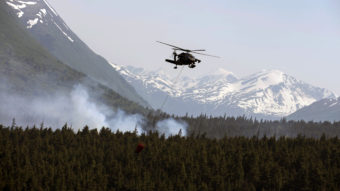
The North Robertson Fire, about 30 miles northwest of Tok is being fought from the air and on the ground.
The North Robertson Fire has grown from just a few acres to 800 in less than a day.
Alaska Division of Forestry spokesman Tim Mowry said the blaze started Thursday morning near a trail and is suspected to be human caused.
Flames moved quickly through black spruce forest, a couple miles from the Alaska Highway, and the blaze was hit hard with air drops, he said.
“Aggressive aerial assault right off the bat with a couple of air tankers and a couple of water scoopers,” Mowry said. “They were able to get a retardant line around the whole fire.”
Mowry said that’s allowed smokejumpers, aided by six ground crews to get in and start pinching the fire off, and checking structures in the area.
“Going out and trying to locate the structures, assess them, what needs are for structure protection if it comes to that.”
Wind has been pushing the fire toward the Robertson River, away from the Alcan, Mowry said.
“Traffic has not been impacted on the highway both from the fire or smoke,” he said.
Mowry stresses that there is potential for more activity.
“Really dry down in Tok and in Delta. They’ve had burn suspensions on almost daily for almost a week and a week and a half,” he said. “There was 80 degree temperature down in the Kenai yesterday and things are really drying out so we’re thinking there’s going to be some more fire activity around the state.”
This year’s fire season in Alaska is ramping up weeks later than normal, Mowry notes, and that state and federal firefighting agencies are fully geared up to respond.
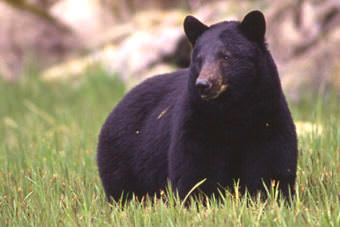
The Alaska Board of Game has refused to reinstate a no-wolf kill area, since scrapping a previous buffer zone in 2010.
Bill sponsor Rep. Andy Josephson of Anchorage told lawmakers before a floor vote Wednesday, the lack of protection has corresponded with a decline in Denali wolf viewing.
”It used to be, around 2010 and before, you had a 50 percent chance, nearly, of seeing a wolf, and that number has fallen to 6 percent,” Josephson said.
Some other lawmakers said the small harvest along the park’s northeastern edge is just one factor in a broader decline of Denali National Park wolves.
District 9 Rep. George Rauscher pointed to another issue.
”One thing about wolves is we know they follow a food source,” Rauscher said. “When a food source is gone, they don’t necessarily stay in that area because of legislation.”
The bill narrowly passed the House 22-18 Wednesday before the regular legislative session ended. It’s fate in the Senate is uncertain.
Legislators are in Juneau for a special session called by Gov. Bill Walker to address state spending and revenue measures.
Close
Update notification options
Subscribe to notifications
Subscribe
Get notifications about news related to the topics you care about. You can unsubscribe anytime.