Lakeidra Chavis, KTOO

From election sidelines, Mayor Koelsch campaigns against assembly member Troll

Juneau Mayor-elect Ken Koelsch addresses his supporters on election night at City Hall, March 15, 2015.
Mayor-elect Ken Koelsch addresses his supporters on election night at Juneau City Hall, March 15, 2015. (Photo by Jeremy Hsieh/KTOO)

Candidates for the Juneau Assembly raise thousands of dollars for a chance to win or maintain a seat in office.

While Mayor Ken Koelsch isn’t up for reelection this year, he is actively working to unseat incumbent assemblymember Kate Troll.

Koelsch has shared more than 80 photos from assembly incumbent Mary Becker and candidate Norton Gregory’s campaigns on his personal, but public, Facebook page. Until recently, his cover photo was a campaign poster from his mayoral run.

In one photo, Gregory is running the Klondike Road Relay. Koelsch comments, “good luck on the Klondike & the race for the assembly.” Gregory is running against incumbent Kate Troll.

Koelsch’s support for these candidates is financial, as well. He’s personally donated $500 to Becker, the maximum allowed under state law. He and his wife have donated a combined $500 to Gregory, too.

As mayor, Koelsch said he’s still entitled to his rights as a private citizen.  He says there isn’t a conflict.

“I don’t think so,” he said. “Because when I ran for office the last time, several of the assembly people supported me and supported my opponent.”

Which campaign finance disclosures verify. In fact, Kate Troll donated to Koelsch’s mayoral opponent.

Sitting assembly members at the time also tried to overtly influence who the next mayor would be, which played out through endorsements and disagreements over a campaign flyer.

Koelsch said Gregory had helped him campaign. This time around, Koelsch said he’s supporting Gregory.

“He is very passionate about affordable housing, and serving the community, great runner, (he) would bring diversity to the community, and bring youth,” Koelsch said.

Gregory, who is 37, serves on the Juneau Affordable Housing Commission. Troll is the assembly’s liaison to the commission.

There’s no legal problem with a mayor picking favorites, but, former four-term Mayor Bruce Botelho said it may be bad form.

Bruce Botelho. Photo courtesy Alaska Municipal League.
Bruce Botelho
Kate-Troll_250
Kate Troll

“It is a better practice for elected officials to minimize their role in campaigning for possible colleagues,” he said.

Botelho is the campaign chair for Kate Troll, who declined to comment.

He said he heard about the issue, and that his opinions shouldn’t be taken as a personal attack against Koelsch.

Botelho said he made financial contributions to an assembly member’s campaign while mayor, too. But he didn’t overtly assist them with campaigning.

“The greater dissonance is that, particularly with Ken who ran on a campaign of wanting to unify the community, that being partisan in a broad sense, of aligning with one side (of) candidates versus another, makes it more difficult to have that working relationship,” Botelho said.

Koelsch is a Republican, Gregory is undeclared and Troll is a Democrat. Juneau’s municipal elections are nonpartisan. Election day is Oct. 4.

Correction: An earlier version of this story misstated Kate Troll’s role on the Juneau Affordable Housing Commission. Troll is the Juneau Assembly’s liaison on the commission, not the commission’s chair. 

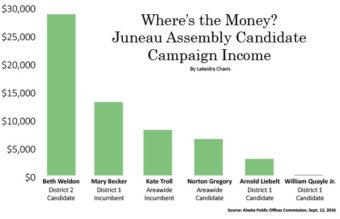
Who’s raised the most in the Juneau Assembly race, so far?

artboard-1
Graph showing the amount of income each Assembly candidate’s campaign has received during the City and Borough of Juneau municipal election. (Illustration by Lakeidra Chavis/ KTOO)

Juneau Assembly candidates have raised a combined $57,000 so far this election season, according to campaign finance records.

Much of that money — $28,000 — belongs to District 2 candidate Beth Weldon’s campaign, who’s running unopposed.

Weldon says most of that money came from two big fundraisers earlier this year. She says when her campaign first started, she didn’t know who she’d be running against.

“I threw my name in the hat when Karen Crane vacated her seat to run for mayor, and as soon as people heard that, I had lots of people say ‘you should run for the assembly,’ Crane says, “so I filed my APOC reports and started collecting money after that. It was in spring sometime.”

She says her campaign will continue to hold events to get her name out and encourage people to vote.

“We’re looking at conducting a door to door survey just to see what people care about,” she said, “and we are able to keep some money in case I decide to run again.”

District 1 incumbent Mary Becker has raised $13,000. She’s out-raised her two opponents by more than 6 times.

Opponent Arnold Liebelt raised a little more than $2,000. William Quayle Jr. hasn’t reported raising any money.

Area-wide Assembly incumbent Kate Troll has raised more than $8,000. Opponent Norton Gregory has raised more than $6,000.

Candidates can use the money they raise to cover the campaign expenses, such advertisements.

The municipal election is Oct. 4.’

Editor’s note: This article was updated on Sept. 15, at 12:47 p.m. to include an interview with Beth Weldon. 


Grant funds expansion of 3-year language revitalization program — and ‘a whole different worldview’

Sealaska Heritage Institute President Rosita Worl sits in her office. (Photo by Lakeidra/ KTOO)
Sealaska Heritage Institute President Rosita Worl sits in her office. (Photo by Lakeidra/KTOO)

The Sealaska Heritage Institute has received a roughly $930,000 federal grant from the Administration for Native Americans to establish a three-year language revitalization program.

Rosita Worl, the nonprofit’s president, said the new program will be an extension of an existing one.

“We just completed three years of a master-apprentice program, which we viewed as very successful,” Worl said. “We really wanted to continue it, and also expand it to Haida and Tsimshian.”

Tlingit, Haida and Tsimshian are endangered languages, according to linguists. Worl said that while the number of fluent speakers is declining, the number of people wanting to learn the language is increasing.

The institute hopes to have eight participants who will become proficient in one of the three languages over three years. Four mentors will each be paired with two apprentices.

The grant will serve people in Metlakatla, Hydaburg, Sitka and Juneau.

She said learning a language is about more than words.

“Native languages embody a whole different worldview than what we’re used to when we speak English,” World said. “Along with that worldview comes values, values to their environment, values to one another and that’s embodied in our language.”

Worl said she’s not fluent in an Alaska Native language, citing decades of systemic assimilation forced onto Alaska Natives.

“I mean, there was a whole generation where I come from where children were removed from their home and forced to learn another language,” World said, “and (they) tried to beat our culture out of us, but fortunately we survived.”

That’s why the program is all the more important, she said.

As a part of the program, SHI will also create a regional language committee to help establish future programs, according to the news release.

Finance committee addresses city’s budget deficit, delays action on school district

City officials are one step closer to solving this year’s budget deficit after a city finance committee meeting Thursday evening.

The City and Borough of Juneau is facing a roughly $4.8 million dollar deficit during the current fiscal year because of budget cuts at the state level.

In an effort to fix the deficit before the fiscal year ends in June, the committee agreed to use the part of the city’s sales tax revenue, deferred maintenance funds, budget reserves and savings.

But these funds won’t help the school district’s current deficit.

The district is short $450,000, because of cuts in school transportation and the per-pupil-formula funding it receives from the state.

The finance committee decided to delay any decisions on the district’s budget until enrollment numbers are finalized in late October. If the school’s high enrollment trends stick, then it may be able to cover the deficit.

Any proposed solutions will still need to be approved by the Juneau Assembly.

The finance committee will meet again on Nov. 9.

Walker praises local government during Juneau Assembly visit

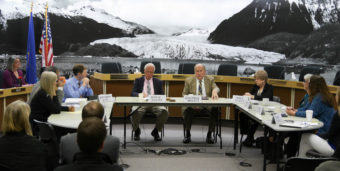
Walker discusses his fiscal plan during a recent visit to the Juneau Assembly at the City Hall Assembly Chambers. (Photo by Lakeidra Chavis/ KTOO)
Walker discusses his fiscal plan during a Thursday visit to the Juneau Assembly at the City Hall Assembly Chambers. (Photo by Lakeidra Chavis/KTOO)

Gov. Bill Walker praised local government and commented on his fiscal plan at a Juneau Assembly meeting Thursday.

Addressing about three dozen people at City Hall, Walker said it’s important for state officials to change how they view oil revenue in the state.
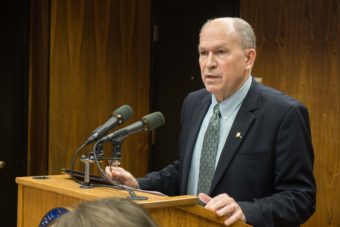
“It takes about a $110 oil to balance to the budget this year, and we just need to get off of that mindset that if we wait long enough, the price of oil will come back like a rising tide, the price of oil is going to come back and save (us),” Walker said. “I don’t think it’s going to happen.”

This is the sixth community Walker has traveled to this year to address a local assembly.

The goal isn’t to apologize for his budget vetoes, he said.

“I make lots of decisions every day, and not many of them are really pleasant, but I have to make these decisions,” he said. “So if we don’t make some changes, these will be the good ol’ days.”

All of the assembly members expressed their concerns about how the state’s future budget decisions will affect Juneau’s local budget, especially over cuts to school funding and the decrease expected in sales tax revenue due to reduced Permanent Fund dividends.

Walker said those cuts were tough decisions to make.

Although Walker would not make any promises on future budget cuts, he said he remains hopeful about finding solutions for the state’s fiscal future.

Walker to discuss fiscal plan at Juneau Assembly meeting Thursday

Gov. Bill Walker is stopping by City Hall on Thursday to meet with the Juneau Assembly to discuss his fiscal plan amid the state’s multi-billion dollar budget deficit.

Walker’s budget vetoes have begun to trickle down to local governments, including Juneau’s.

Last month, city officials began to address the city’s nearly $5 million budget deficit, which also affects the school district’s transportation and the per-pupil formula funding it receives from the state.

In July, Walker phoned into an Anchorage Assembly meeting to apologize for his vetoes’ effects on local government. He also spoke about his fiscal plan at a Fairbanks North Star Borough Assembly meeting this spring.

The Juneau Assembly’s meeting starts at noon in Assembly Chambers. The meeting will be broadcast live on KTOO-FM and streamed on our website.

Site notifications
Update notification options
Subscribe to notifications