Lakeidra Chavis, KTOO

Alaska ranks high nationally for nursing homes deficiencies, but why?

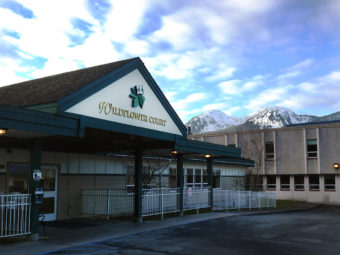
Wildflower Court is a non-profit, 57-resident long-term-care facility in Juneau. (Photo by Ed Schoenfeld/CoastAlaska)
Wildflower Court is a non-profit, 57-resident long-term-care facility in Juneau. Inspectors in December documented five deficiencies there with potential for minimal harm. (Photo by Ed Schoenfeld/CoastAlaska)

So far this year, 10 nursing homes in Alaska have been cited more than 100 times for health or safety shortfalls, according to state and federal inspection reports.

The state has some of the highest rates of nursing home deficiencies in the nation, according to ProPublica, an investigative reporting outlet. But Alaska inspectors say context is important.

Alaska nursing homes are inspected on the state and federal level annually to make sure they’re meeting regulations.

Brenda Vincent runs the state’s program that oversees health facilities’ licensing compliance, which includes nursing homes.

She says the inspections are unannounced, and that over a few days, a small team of surveyors analyze everything from the fire safety code to treating residents respectfully.

Nursing Home Inspect

Lookup inspection reports from nursing homes in your community or elsewhere on ProPublica’s Nursing Home Inspect site at ProPublica.org.

“We use tools of observation, interviews, record reviews,” Vincent says,”all just to ensure that they’re being compliant and following state and federal regulations, and ensuring that the best care is delivered to residents in those facilities.”

Angela Rick has been inspecting nursing homes for eight years.  She says that over time, there are some things that nursing homes are repeatedly cited for.

“Our most common ones would be dignity of the resident, so making sure that it’s a homelike environment and the resident is treated in the manner that you would want to be treated or your family member treated,” Rick said. “Infection control would be a common deficiency (as well).”

Rick says high turnover among nursing home staffers can contribute to some of the inconsistencies.

“We used to say that you’re only as good as your worst performer,” she said. “So it’s very difficult sometimes to monitor what the staff is doing, and so one person could make a mistake or could have a practice and that would cause you do a get a deficiency in that area.”

According to data from the Centers for Medicare & Medicaid Services, inspectors logged 147 deficiencies at the 10 Alaska nursing homes visited so far this year. Alaska has a total of 18.


Source: Centers for Medicare & Medicaid Services. (Graph by Lakeidra Chavis/KTOO)

Most of the deficiencies are categorized as causing minimum to no harm. Some incidents are isolated, some are repeated. There are serious deficiencies, too.

At the nursing home in Petersburg, for example, deficiencies included administering the wrong medication dose and not returning a resident’s money after the person died.

In Wrangell, a resident with a condition requiring a “nectar consistency” diet to reduce choking risk, reportedly used a spoon to drink over thickened coffee because a staffer added thickener without measuring. Other residents reported similar problems.

Vincent says although the number of citations is high, the goal is to keep these institutions accountable.

After each inspection, nursing home administrators are required to submit a plan of correction, which surveyors review.

“And if we find a deficiency, we need to bring that forward to the facility and let them know,” Vincent said. “You know, if you don’t, then change isn’t going to be made and that’s important. I mean, if you see something wrong, it needs to be corrected. If you don’t bring it to the light, then it just stays uncorrected.”

Nursing homes with severe deficiencies can rack up penalties. Since 2013, the agencies have fined nursing homes more than $100,000, or denied Medicare and Medicaid payments.


Source: Centers for Medicare & Medicaid Services. (Graph by Lakeidra Chavis/KTOO)

For the Prestige Care & Rehabilitation Center in Anchorage, the problems were so bad that the state took control of the facility last year to address the issues.

After a national investigation into nursing home safety, ProPublica, ranked the states with the most severe deficiencies in nursing homes. Their most recent data ranks Alaska as the fourth worst.

“Number-wise, we’ve heard that and I don’t know why,” she said. “I just think that we have a really good team.”

Vincent says that compared to the Lower 48, the turnover for Alaska inspectors is low and the nursing homes are a lot smaller.

She says in about a year, the state will switch to a newer model of surveying, following a national trend. It will combine the traditional boots-on-the-ground method with a computer-based survey.

Vincent says that it’s important for people to know that there is oversight. She worked as a registered nurse in Alaska before switching to the inspection side five years ago.

“I’m on the other side ensuring the care that you are getting is quality, and safe, and complies with best practices and standards that have been set,” she said. “So I really think that what I do and what my team does, makes a difference.”

Becky Hultberg is the president of the Alaska State Hospital and Nursing Home Association, which lobbies for its members.

She says inspection reports are just one of the ways to measure nursing home care.

Becky Hultberg, president and CEO of the Alaska State Hospital and Nursing Home Association, gives a presentation about Medicaid expansion at the Alaska Capitol, March 19, 2015. The event was sponsored by Sen. Berta Gardner, D-Anchorage, Rep. Paul Seaton, R- Homer, and Sen. Donny Olson, D-Nome. (Photo by Skip Gray/360 North)
Becky Hultberg, president and CEO of the Alaska State Hospital and Nursing Home Association, gives a presentation about Medicaid expansion at the Alaska Capitol, March 19, 2015. (Photo by Skip Gray/360 North)

“As an example, there are several CMS quality measures where Alaska skilled nursing facilities have better outcomes than most facilities in other states,” Hultberg said. “Specifically, Alaska does very well in preventing falls, reducing the use of antipsychotics and successfully managing the use of physical restraints.”

She says Alaska is a small state with a small number of nursing homes, and that calls the attention of federal regulators.

“I would note that there are times where we have more surveyors in a facility than we have residents…the ProPublica data was not a huge surprise to me,” she said.

Hultberg says a lot it has to do with a federal law she calls the minimum of five.

“The federal government is required to survey five percent of facilities in a state a year, or a minimum of five facilities,” Hultberg said. “Well if you’re a state that has hundreds of facilities, obviously you’re going to be getting fewer federal surveys, than a state like Alaska where we only have 18 facilities.”

Based on inspection reports alone, of the 10 nursing homes inspected so far this year, Alaska’s most deficient are the Prestige Care and Rehabilitation Center of Anchorage, Wrangell Medical Center and the Yukon Kuskokwim Elders Home in Bethel.

In neck-to-neck race, Gregory ousts incumbent Troll

Nearly 6,500 ballots were casts in the Juneau municipal election on Tuesday. More than 60 people crowded into the assembly chambers to watch as the results trickled in.

According to unofficial results, Norton Gregory won the area-wide seat, beating incumbent Kate Troll by more than 300 votes.

Cheering burst out as results from last outstanding polling place were tabulated.

“Oh my gosh, I’m super excited and also super humbled by the support that I’ve received tonight and that the community of Juneau has shown throughout this election season,” Gregory said. “It’s been a fun six weeks and I’ve learned a lot about our community.”

Gregory was wearing a sticker that was a bit different than others.

“The sticker that I’m wearing says ‘I’m Tlingit and I vote.’ I think that was a great campaign to get started, I hope that the numbers are up for Native voters,” he said. “I want to encourage all Native voters to get back out there again, (for) the upcoming election in November and for every election, really. Their vote is important, it does matter, and it does make a difference.”

Gregory is the housing manager for Tlingit-Haida Regional Housing Authority. He is the first person of color to serve on the Juneau Assembly since 2014.

A large part of his campaign focused on affordable housing. He was critical of his opponent, Kate Troll, for her support of reducing the senior sales tax break. City officials projected it would save the city about $1 million a year.

Incumbent Mary Becker was reelected for a third term on the assembly in a three-way race for District 1.

“I’m happy,” she said, “I’m very thankful that the community decided to put me back on the assembly.”

William Quayle Jr. had the fewest votes, at 244. But Becker was neck and neck with Arnold Liebelt for most of the evening.

“I was watching it and listening to it and thinking, ‘Wow, this is very close,’” Becker said.” But he was a worthy opponent and so it was good.”

Becker won by more than 300 votes.

Beth Weldon ran unopposed for the District 2 seat. Weldon also won the most votes of the night, nearly 5,000.

After absentee and questioned ballots are counted, voter turnout is expected to be about 33 percent — the highest it’s been in several years.

The election results are unofficial. The Canvass Review Board will meet to certify the results next Tuesday, Oct. 11.

Juneau Assembly candidate reflects on old DWI and DUI

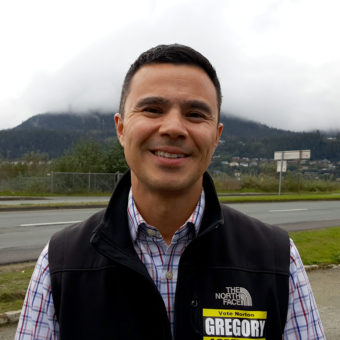
Norton Gregory
Norton Gregory. (Photo by Tripp J. Crouse/ KTOO)

Juneau Assembly candidate Norton Gregory was convicted of a misdemeanor DWI in 2001 and a misdemeanor DUI in 2005.

According to charging documents, Gregory was driving while intoxicated on Egan Drive near Fred Meyer in 2001. He was 22.

Four years later, he pleaded guilty to a charge of driving under the influence on Egan Drive. Charging documents say he was driving about 85 mph. He was fined $3,000.

Gregory responded to a request for an interview with a written statement:

“I took the consequences of that poor judgment, and in the process learned a lot about myself. Looking back, I have to be grateful for the additional compassion these circumstances lent me toward those who struggle with addiction/alcohol abuse and those who go through our criminal justice system. Impaired driving is a community safety concern, and I feel fortunate/blessed no one was injured.

“As I reflect on the matter and what I have learned as a result of the DUIs, it became clear to me that we are all in control of how we affect our community. I made a conscious decision to take control of my own trajectory, and whether it will have a positive or negative effect on me, my family, and my community. Every day I am learning and am always working to make better choices, to become a more responsible person, and to try to be a positive role model in my community. I have learned from my mistakes, have learned to forgive myself, and work every day to be the best person that I can be.

“In closing, please let this serve as a reminder to those in our community to always have a plan to get home safely if you chose to consume alcohol. Remember that you have the ability to make choices that will have a negative or positive effect in your own life and the life of others. I choose the latter.”

Gregory is running for the area-wide seat on the Juneau Assembly against incumbent Kate Troll.

The assembly oversees the head of the city’s law department, which generally handles misdemeanor DUI prosecutions. The assembly also oversees the city manager, to whom the chief of police answers.

The municipal election is Tuesday, Oct. 4.

With assembly approval, Central Council expands plans for 3-acre Immersion Park

Central Council of Tlingit and Haida Indian Tribes of Alaska Business and Economic Development Manager Mryna Gardner explains the plans for the immersion park. (Photo by Lakeidra Chavis/ KTOO)
Central Council of Tlingit and Haida Indian Tribes of Alaska Business and Economic Development Manager Myrna Gardner explains the plans for the immersion park. (Photo by Lakeidra Chavis/ KTOO)

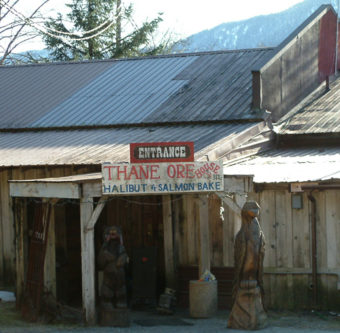
The Central Council of Tlingit and Haida Indian Tribes of Alaska has a new target date for opening its cultural immersion park at the old Thane Ore House.

Last year, Central Council officials had hoped it would open this summer. Now, they’re shooting for 2018, after the Juneau Assembly approved a 1.2-acre land lease making it possible Monday evening.
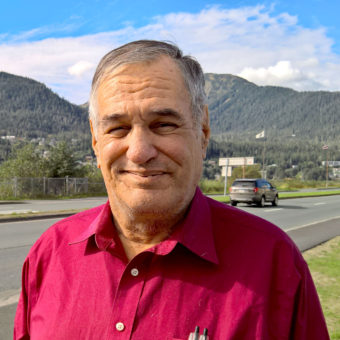
Myrna Gardner is spearheading the Tlingit and Haida Immersion Park project.

She said the Central Council wants to put Juneau’s Native culture at the forefront when cruise passengers visit — literally. The cruise ships must pass the nearly 3-acre waterfront site before they arrive in port.

“When they come to Juneau, you have gifts shops and you have art galleries,” she said. “We want to tie the living culture effect of who we are, with it.”

Gardner said that the park will include classes on totem pole and canoe carving, as well as basic language skills. She said it’s important to remember that Southeast Alaska Native cultures are living cultures.

There will also be a restaurant, gift shop and showcases for Alaska Native artists and dance performances.

“When you think about places you’ve gone or traveled, and you read about the history of people and they talk about them in the past tense, our people have been here for 10,000 years,” Gardner said. “However, today we want people to know that we’re still here and you see it and you get to talk to people in other communities.”

Plans for the park are constantly changing.

Over time, Gardner said they plan to line the road up to the property with totem poles from each of the Southeast tribes. The park will use the two large buildings on the property for cultural activities.

“Our plan is to have a huge Haida style longhouse cover it that shows the Haida heritage side,” she said. This side, we’re going to put a façade of Tlingit longhouses in front of it, so you almost get the image you’re walking through a village.”

Gardner says the estimated $3 million park – plans have expanded since it was pitched as a $1.3 million park last year — will be paid for using a collection of federal grants and Central Council funds. She said while the focus is on culture, the park is intended to create jobs and be a revenue source for the Central Council.

“This is about workforce development and job creation,” she said. “We understand that as a business, as a tribe and as a government, we see from the federal state, especially the state, the budget cuts, and the need for creating jobs and employment within our community.”

The lease terms say the city will be also eventually be paid a $1 per park customer.

If the buildings need to be rebuilt, Gardner says then the park could open in 2018.

Assembly candidate’s Twitter account has years of tweets about breast fixation

William Quayle poses for a photo outside KTOO, Sept. 2, 2016. Quayle is a candidate for Juneau Assembly. (Photo by Jeremy Hsieh/KTOO)

William Quayle Jr. is running for the Juneau Assembly District 1 seat and he’s listed first on the ballot this year.

Among the places he announced his run was Twitter – where for years he’s also publicly shared a fixation with very large breasts.

Since 2009, @wquayle2009 has tweeted more than 400 times about a fixation with women with very large breasts. The user also promoted his pedicab business and announced a run for Juneau Assembly.

The women are professional adult models who post revealing photos of their surgically enhanced breasts — sometimes as big as a P cup.

In one incident, after a woman publishes a revealing photo of her breasts, Quayle replies, “will you ever breast feed babies?”

Quayle’s tweets sometimes ask the models where they live and to visit Juneau. In one exchange, a model tells him she’s not interested, and he stopped engaging her publicly.

Quayle declined an interview request, but said in an email:

“I do not wish to discuss about my fetishes, I am a heterosexual male and that is that. I do have original ideas that my competition does not have. All they want to do is tax and cut budget.”

Quayle did not explicitly confirm or deny that the account was his.

Quayle is running for the District 1 assembly seat against Arnold Liebelt and incumbent Mary Becker.

The municipal election is next Tuesday, Oct. 4.

Other assembly candidates’ social media posts appear tame.

Juneau Assembly ups licensing price per pooch

Dogs playing. (Creative Commons photo by Sean Dustman)

Dog licensing fees at the Gastineau Humane Society and Southeast Alaska Animal Medical Center have been increased for the first time in 15 years.

The Humane Society and Juneau Police Department requested the fee increase to cover animal control services. The Juneau Assembly approved a resolution raising the fees Monday evening.

The licensing fee for dogs that are not spayed or neutered will increase from $35 to $45. The fee for spayed and neutered dogs will go up from $15 to $20.

City Manager Rorie Watt reported that the Humane Society and Animal Medical Center collects about $73,000 in licensing and impound fees each year. Most of the impound fees come from dogs.

For dog licenses, the fees are used to track dogs within city limits if they go missing and return the dogs to their owners when found.

The new rates went into immediate effect.

Humane Society director Matt Musslewhite says the shelter licenses about 4,000 dogs annually.

Site notifications
Update notification options
Subscribe to notifications