Lisa Phu

Managing Editor, KTOO

"As Managing Editor, I work with the KTOO news team to develop and shape news and information for the Juneau community that's accurate and digestible."
High school sleep-out raises $3,000 for homeless youth

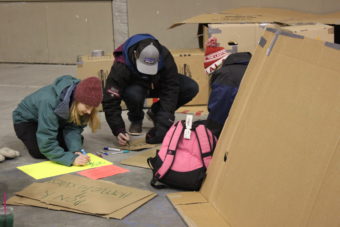
During the sleep out, students made signs about youth homelessness that they waved outside Mendenhall Mall and Safeway. (Photo by Lisa Phu/KTOO)
During the sleep-out, students made signs about youth homelessness that they waved outside Mendenhall Mall and Safeway. (Photo by Lisa Phu/KTOO)

About 200 kids and teenagers in Juneau are homeless. There are students without adequate or regular housing in every school in the district.
This past weekend, high school students slept out in the cold to raise awareness of the mostly invisible issue.

Between Saturday night and Sunday morning, temperatures dropped to the low to mid-30s. Two dozen high school students participating in the sleep-out were prepared with sleeping bags, big winter coats, blankets and extra layers.

Reilly Walsh, 17, is a senior at Juneau-Douglas High School. She and other students built makeshift shelters out of cardboard boxes and duct tape under the outdoor covered area at Riverbend Elementary School. The goal was to bring attention to their friends and fellow students who are homeless.

“Because it’s something that you can’t really tell always if someone is struggling with homelessness, so we’re just trying to spread the word that it does occur and you might not be aware of it.”

Students slept in makeshift shelters under the outdoor covered area at Riverbend Elementary School. (Photo by Lisa Phu/KTOO)

The cardboard structures are largely symbolic. Kids in Juneau who don’t have permanent housing aren’t typically sleeping outside. Gabi Kito, a 16-year-old junior, said they’re more likely to be hopping from couch to couch.

“People – when they think of homeless(ness) – they think of them sleeping outside and in boxes rather than sleeping in a house and different houses each night.”

Some homeless youth stay with families at shelters through St. Vincent de Paul or AWARE. Others turn to Juneau Youth Services, which offers a 10-bed emergency shelter at Cornerstone Residential Facility.

JYS offers counseling for mental health, substance abuse and family reunification.

The organization plans to reopen its transitional living program early next year, executive director Walter Majoros said. It’ll house six individuals ages 16-21.

Majoros said some kids and teens are homeless due to family discord and instability.

“There may be family violence going on. There may be sexual abuse. There may be alcoholism or drug abuse in the family. There may be a single-parent family that creates some instability. Oftentimes there’s a parent that is incarcerated.”

Another resource is the Zach Gordon Youth Center in downtown Juneau. It’s open every day except Sunday. Manager Jorden Nigro said homeless kids come regularly.

“We have showers here so they can take showers, and we help connect them to resources and we feed a lot of kids here,” Nigro said. “We have kids that come and get their after-school snack here and lots of kids who stay for dinner.”

Besides offering activities and services — such as basketball, tutoring and arts and crafts — Nigro said staff members work hard to build relationships.

“If kids have meaningful connections with adults, they do better in every aspect of their life and that impacts kids whether they’re homeless, whether they’re not homeless and also can help kids who are on the cusp,” Nigro said.

At school, homeless students are offered help with transportation, free meals and snacks, clothing and shoes, toiletries and assistance with activities fees.

Dixie Weiss is the faculty adviser of the service club Interact at Juneau-Douglas High School. Interact has helped organize the annual sleep-out since 2004. Besides raising awareness, the sleep-out also raises money. Weiss has seen first-hand how the funds help.

“Time and time again these kids are giving you these big bear hugs because they never imagined they’d get that yearbook or that senior hoodie or the support,” Weiss said.

The sleep-out also teaches an important lesson, “that sitting next to them in a class, day in and day out, there’s this kid that is, against all odds, making it; that they have courageous peers and this is a way to support that courage,” Weiss said.

So far, the students have raised about $3,000 and are accepting donations through the end of November. Half of the proceeds will go to the school district and the other half to the Zach Gordon Youth Center.

Youth experiencing homelessness can contact Juneau Youth Services at 789-7654, 24 hours a day, seven days a week.

Recovering from addiction: We are the solution

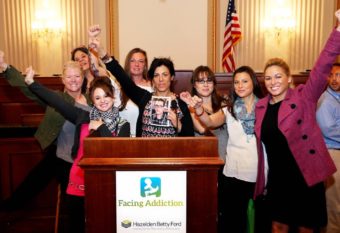
Alaskans were part of the UNITE to Face Addiction Rally in Washington, D.C.: Kim Whitaker, Julee Douglas, Samantha Garton, Terria Walters, Kara Nelson, Delia Williams, Jennifer Mcallister and Christina Love inside a congressional office building in D.C. in October. Nelson is holding a picture of Christopher Seaman, the son of Walters who was murdered in Mat-Su in June. (Photo courtesy Kara Nelson)
Alaskans were part of the UNITE to Face Addiction Rally in Washington, D.C.: (left to right) Kim Whitaker, Julee Douglas, Samantha Garton, Terria Walters, Kara Nelson, Delia Williams, Jennifer Mcallister and Christina Love inside a congressional office building in D.C. in October. Nelson is holding a picture of Christopher Seaman, the son of Walters who was murdered in Mat-Su in June. (Photo courtesy Kara Nelson)

Alaska’s capital city is battling addiction. The Juneau community continues to face substance-related deaths and near deaths.

Three women came to KTOO recently to talk about addiction, long-term recovery and a rally that gave them hope.
Christina Love, Kara Nelson and Julee Douglas are all in recovery. At different times in their lives, they’ve been addicted to different substances.

Love is an advocate at the AWARE shelter in Juneau. She said her addiction started out with Adderall in college. Cocaine was next.

“Then we went to crack cocaine, and alcohol is always there. The hangovers were bad, so we went to pills, then we went to oxys, and then we went to heroine, and then benzos. And really it’s anything that’s in front of you at any given point,” Love said.

Love detoxed in Fairbanks and became sober. Then she started treatment and is in long-term recovery.

“Once you have this disease, you suffer it for the rest of your life, and it can’t be stopped,”  Love said. “But it can be arrested.”

Love and Kara Nelson met on the recovery journey about four years ago. They’d been anonymous in meetings held in churches and basements before they started speaking and advocating publicly.

Last month, they and six other women from Juneau and Anchorage represented Alaska in the UNITE to Face Addiction Rally in Washington, D.C. They marched in the National Mall with close to 30,000 people involved in the recovery movement, including other recovering addicts and those who’ve lost people to addiction.

Nelson is the director of Haven House, a faith-based transitional home for women recently paroled or released from prison. Haven House provides peer-to-peer support for women who’ve faced addiction and incarceration. She organized the trip to D.C.

“As a person in long-term recovery and as someone who has an extensive history in our criminal justice system and continuously sees my friends, our neighbors, our people incarcerated and then the effects of that and then getting out and having even more issues than being in prison itself, this was a very personal thing for myself to be a part of,” Nelson said.

The rally was aimed at changing the conversation around addiction and treating it as a health crisis. Nelson said recovery is a lifelong journey, not aftercare for a month.

“If you have any other kind of illness or disease, you’re going to have these check-ups and you’re going to continuously be checking in to every symptom, right? That’s exactly how substance use and mental health should be treated as well,” she said.

At one of the rally events, people wore T-shirts and carried posters with photos of loved ones who had passed away from addiction. Julee Douglas said being surrounded by that helped her and the others come to terms with the wreckage of their past.

“Any one of us could have been a poster or a T-shirt for sure,” Douglas said.

Douglas also works at Haven House as the house manager. She said offering peer support to the residents gives her support to heal from her alcohol addiction.

During the rally, the group visited Alaska’s congressional delegation to lobby for bills related to the recovery movement, like the Comprehensive Addiction and Recovery Act. The CARA bill will help bring money to grassroots recovery organizations.

Love said it was empowering to be at the D.C. rally and advocate with people who share experiences of feeling rejected, discriminated against and suicidal.

“I’ve said a million times over and over, ‘I’m a person in long-term recovery.’ That’s one of my favorite things about myself and it’s one of my favorite things about the people that I help because it stands for something so completely opposite from what the rest of the world thinks,” Love said. “They see an addict, but I see a person who’s resilient and a fighter.”

Nelson helped form the Juneau Recover Community two years ago. It’s people in recovery helping others through support and social events, like Recovery Fest. But she says more needs to be done.

“We’ve been able to educate ourselves to really be in a position where we are the ones that are the solution.”

Nelson and Love, both recovery coaches, plan to work with local agencies to form a community plan focused on recovery, and are actively meeting with Juneau organizations to try to establish a detox facility.

12 to 18 inches of snow expected in Juneau

Recent snowfall in downtown Juneau (Photo by David Purdy/KTOO)

Juneau could receive up to 18 inches of snow by Wednesday afternoon. The National Weather Service issued a winter storm warning for the borough, which is in effect until 4 p.m. Wednesday.
Jonathan Garner with the National Weather Service office in Juneau says snow showers will move east across Juneau.

“Heavy snow showers with a short period of lighter snow or even maybe no snow, and then another shower will move across and we’ll get another period of heavy snow,” Garner said. “We’re expecting 12 to 18 inches of total snow fall accumulation through Wednesday afternoon.”

Garner says Juneau could get another snow event on Thursday.

Eaglecrest Ski Area is reporting 40 inches of snow accumulation to date.

Editor’s Note: A previous version of this story overstated the amount of snow at Eaglecrest.

Report reveals prison staff failures in death of Juneau man

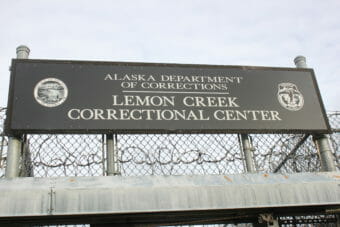
(Photo by Lisa Phu/KTOO)

A just released state report on the state’s prison system details disturbing events related to the death of Juneau resident Joseph Murphy.

In August, the 49-year old Iraq veteran died of an apparent heart attack in a holding cell at Lemon Creek Correctional Center. He was being held there on noncriminal charges. At the time, Department of Corrections released scant information about the death.

Dean Williams calls Joseph Murphy’s death at the Juneau prison an “incident gone wrong.” Williams is special assistant to Gov. Bill Walker. He spearheaded the three-month review of the Department of Corrections.

Murphy died at Lemon Creek Correctional Center the morning of Aug. 14. The night before, he was intoxicated and had been brought to the prison on a protective hold, not on criminal charges. Around 7 p.m. on Aug. 13, Murphy was put in a cell that had a video camera. Williams watched the footage.

“It’s compelling video, very, very disturbing,” Williams said.

Williams and the review team used the video, which had no audio, and interviews with prison employees to piece together what happened.

Murphy is seen awake at 5:20 the morning he died and doesn’t appear to be intoxicated anymore, according to the report. About a half hour later, Murphy complains of chest pains to two different staff members. Both say they offered to call for medical help, but Murphy declined.

Ten minutes later, a third staff member responded to Murphy banging on his cell door and yelling for medical care. A fourth staff member overheard what Willams calls a “callous” exchange.

“Staff 4 hears the quote between Staff 3 and the inmate as essentially saying, ‘I don’t care if you live or die.’ It’s basically, ‘I don’t really care,'” Williams said. “Staff 4 is clear that’s what he overheard. It’s a credible report and it’s not refuted either.”

The staff member and Murphy also said “f— you” to each other.

Within 20 minutes of that exchange, the report indicates Murphy was sweating, paced the cell and banged on the cell door. At one point he’s on his hands and knees. He stands and walks while patting his chest, then collapses and dies. He’s not discovered in that condition for another 10 minutes.

“I wouldn’t want anyone, I wouldn’t want a relative of mine – my father, my brother – or anyone dying in prison who’s complaining of chest pain and not having someone call for help, let alone an exchange that occurred between a staff person and Mr. Murphy the way it did,” Williams said. “I don’t know if he would’ve lived otherwise, but I can tell you that it’s unacceptable what happened in terms of the interaction and the fact that help wasn’t called.”

Williams says that third staff member was sanctioned, though not to the level Williams deemed appropriate.

The report also finds fault with why Murphy was put prison in the first place. State law allows for an individual who is incapacitated by alcohol or drugs in a public place to be put in temporary protective custody.

Williams said it doesn’t make sense to put medically unstable people in jail, “Just the whole practice of taking highly intoxicated individuals, some that are detoxing, and placing them in a prison where they are going to receive far less attention is not a good plan.”

The report shows incidents where people with a blood alcohol concentration six times the legal limit for driving under the influence are being dropped off at prisons. Murphy’s that night was .165, about double the limit.

Williams said the practice puts the prison system and the individuals at risk, and it’s something that needs to change.

“Protective custody was originally designed to be a last stop place for individuals and somewhere along the line in the history of our state, it’s become more of a middle of the road stop,” Williams said.

It’s also misinterpreted by corrections, he said. Instead of keeping an individual until they’re no longer incapacitated or for a maximum of 12 hours, corrections treats the 12 hours as mandatory.

Williams said the state may release the video footage of Murphy’s death and three others the review team examined. Williams will be in Juneau this week to meet with Murphy’s ex-wife and walk her through the footage. Her reaction and other family members’ will help inform the decision to release the videos.

There isn’t anything, Williams said, he or the state can do to bring Murphy back, but he’s dedicating himself to make sure what happened to Murphy doesn’t happen to anyone else.

How Juneau students stack up in new state assessment

(Modified Creative Commons photo by Horia Varlan)
(Creative Commons photo by Horia Varlan)

Juneau students performed second best among the state’s five biggest school districts in Alaska’s new standardized test. Alaska Measures of Progress evaluates third through 10th grade students on math and English language arts.

About 40 percent of Juneau students that were tested meet the standards, while roughly 60 percent partially meet the standards. That’s better than how the state did as a whole. Sixth grade math is the only area where Juneau students fell behind state averages, according to the superintendent.

Results of Alaska Measures of Progress were released Nov. 9.

The test was administered this past April. It’s based on state standards revised in 2012 and replaces a test based on 2006 standards.

Phil Loseby, assessment evaluation coordinator for the Juneau School District, said the new standards are more rigorous.

“Alaska is not a Common Core state, but roughly 90 percent or more of our state standards align either very closely or exactly with the national Common Core,” Loseby said.

Old standards wanted fourth graders to know their multiplication tables. New standards have that expectation and more of third graders.

Students are scored on four levels. Students who score on the 1 or 2 level only partially meet the standards, while students who score on the 3 or 4 level meet the standards.

“The ‘meet’ and ‘partially meet,’ it’s really you meet the standard or you’re below the standard,” Loseby said.

Of all Juneau schools, Auke Bay Elementary had the top English scores with close to 55 percent of its students meeting the standards. Gastineau Elementary topped the district in math scores with close to 50 percent meeting standards.

Loseby says the test provides only one measure of assessment and shouldn’t be used in isolation. The district also administers the nationally-normed Measures of Academic Progress test three times a year. He says that assessment allows parents and teachers to track performance throughout the year and helps identify instructional targets.

The new Alaska Measures of Progress test has critics that include many superintendents, and a state lawmaker is drafting a bill to repeal it.

Juneau superintendent Mark Miller said the district is still trying to figure out what the test means.

“The test itself has some quirks and some flaws that we’re going to be working with the state around to figure out what exactly it means. It’s not very good to help us inform instruction. It doesn’t help us get much better at what we do,” Miller said.

Individual student scores will be sent out around Thanksgiving.

Community remembers Native leader for 2nd annual Dr. Walter Soboleff Day

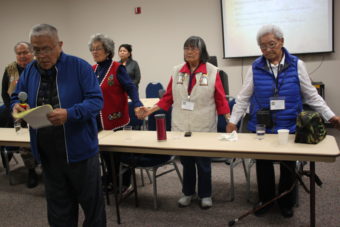
Sealaska Corporation CEO Anthony Mallott remembers Dr. Walter Soboleff. SHI board chair Marlene Johnson and Sealaska board chair Joe Nelson stand by a portrait of Soboleff. (Photo by Lisa Phu/KTOO)
Sealaska CEO Anthony Mallott remembers Walter Soboleff. SHI board chair Marlene Johnson and Sealaska board chair Joe Nelson stand by a portrait of Soboleff. (Photo by Lisa Phu/KTOO)

Family members and community leaders shared anecdotes of the late Walter Soboleff on Friday. Sealaska Heritage Institute and Sealaska Corp. hosted the event inside the clan house of the building named in his honor.

Dr. Walter Soboleff (Photo courtesy Sealaska Heritage Institute)
Walter Soboleff (Photo courtesy Sealaska Heritage Institute)

The Tlingit cultural and spiritual leader died in 2011 at the age of 102. Three years later, the Alaska Legislature passed a bill naming his birthday Nov. 14 as Dr. Walter Soboleff Day.

Soboleff’s son Sasha Soboleff recalled praying before each meal growing up. When no one volunteered to say the prayer, “Dad said, OK. He prayed for the governor and his cabinet by name, for the senators and representatives and their staffs by name, for all the fishermen who were on the fishing grounds and their boats and their captains by name. So the next night when there was a time to give a prayer, boy, hands went up right away.”

During the event, Sealaska transferred a portrait of Soboleff commissioned on his 95th birthday to Sealaska Heritage Institute. Sealaska CEO Anthony Mallott says it was the only individual portrait of any leader that was in the Sealaska building.

“He took the power of values, the power of kindness and the power of caring to improve people’s lives. I think the fact that we have a building like this, that we have Dr. Walter Soboleff Day in Alaska, that we have people that are willing to share their stories about him, he’s going to continue to touch people’s lives,” Mallott said.

The portrait will hang in the conference room of the Walter Soboleff Building.

There will be a reception for Dr. Walter Soboleff Day at the Tlingit-Haida Community Center on Saturday from 1 to 3 p.m.

Soboleff was known for sending handwritten letters. The Juneau-Douglas City Museum invites the public to send a note of encouragement to someone. Note cards and postage will be provided.

Site notifications
Update notification options
Subscribe to notifications