Lisa Phu

Managing Editor, KTOO

"As Managing Editor, I work with the KTOO news team to develop and shape news and information for the Juneau community that's accurate and digestible."
Short plays on climate change to be read at Mendenhall Glacier

Six short plays on climate change will be read at the Mendenhall Glacier pavilion. (Photo by Lisa Phu/KTOO)
Six short plays on climate change will be read at the Mendenhall Glacier pavilion Dec. 3. (Photo by Lisa Phu/KTOO)

As world leaders discuss climate change in Paris this week, Juneau residents get a chance Thursday night to explore what climate change means on a local level.
In “A Pain in the Crevasse,” performers such as Juneau playwright Frank Katasse and assemblymember Maria Gladziszewski will read six short plays on climate change at the Mendenhall Glacier pavilion.

(Image courtesy Perseverance Theatre)

The free event is being organized by Perseverance Theatre and University of Alaska Southeast.

Perseverance Theatre’s Shona Osterhout said the plays will provide an interesting angle on a serious issue.

“These are all plays that have been written all over the world, but you can really take it in and have your own thoughts about it,” Osterhout said. “I think art is really great to talk about issues like these.”

The theater event is one of many taking place around the world through the initiative Climate Change Theatre Action. Short plays on climate change are being performed in cities throughout the U.S. and in more than 20 countries.

One of Thursday night’s plays is called, “An Average Guy Thinking Thoughts on Global Warming.”

“You get an average guy who doesn’t know a lot and he’s being honest and he’s showing himself to the audience for what he is and it’s hilarious and at the same time, it’s very poignant and you take something away after you read it,” said UAS student Bryan Crowder.

Following the six short play readings, the audience is invited to the Mendenhall Glacier Visitor Center for a panel discussion with glaciologists and local climate change experts. Panelists include UAS professors Eran Hood and Cathy Connor, UAS assistant professor Glenn Wright and Mendenhall Glacier Visitor Center Director John Neary.

“A Pain in the Crevasse” begins at 7 p.m. Thursday.

No foul play suspected in Juneau mayor’s death

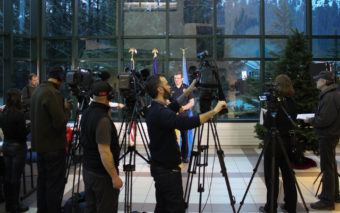
JPD Chief Bryce Johnson at a briefing announcing the preliminary autopsy results for Mayor Greg Fisk (Photo by David Purdy/KTOO)

Update | 4:50 p.m. 

Preliminary autopsy results indicate Juneau’s mayor died Monday morning from natural causes, likely a heart issue. Based on that information, Juneau police do not suspect any foul play.

Greg Fisk was discovered dead inside his Kennedy Street home Monday afternoon.

At a press briefing in Juneau on Wednesday afternoon, Juneau Police Chief Bryce Johnson said the 70-year-old was found with some bruises and injuries on his face that were bleeding.

“People fall and faces get injured. It could look like there was an assault that took place and that’s why the first looks and people thought an assault took place, but it’s consistent with the fall and that’s the information we got back from the medical examiner as well,” Johnson said.

Johnson said the department has evidence that corroborates the medical examiners finding, which indicate facial injuries were not the cause of death. Johnson said it’s likely Fisk fell against a counter after experiencing a heart issue. Fisk had a history of heart problems, Johnson said.

Because the death was unattended and Fisk was found with injuries, Johnson said police had an obligation to investigate in case something potentially criminal did show up in the autopsy.

After Fisk’s body was found Monday afternoon, rumors quickly spread about the cause. His death has attracted national attention.

“There was a time period in which we just didn’t have any answers and, people being people, they run with the unknown for that couple of days. It’s Juneau, Alaska. It’s an exotic location. It’s a newly elected mayor so it was an intriguing story. It’s a tragic story for Juneau because we still lost our mayor, a tragic story for the family,” Johnson said.

Juneau police have notified Fisk’s family of the preliminary autopsy results. A final report is due in 2-8 weeks.


Update | 3:21 p.m. 

The Juneau Police Department said Mayor Greg Fisk’s bruising was consistent with the location of where objects were in the scene. The injuries he sustained were not ultimately the cause of his death. Heart problems likely caused him to fall. Fisk’s body was found in the front room of his home, which is next to the kitchen.

Update | 3:02 p.m.  

The state medical examiner’s office says mayor Greg Fisk died of natural causes. An autopsy was performed today and suggests that external injuries sustained by Fisk were consistent with an “injury due to falling or stumbling onto objects.” The final toxicology report is expected to be complete in 2-8 weeks.
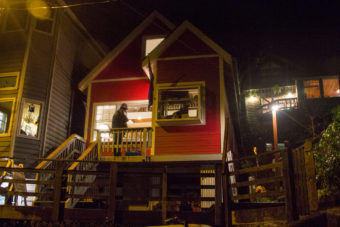
Fisk was found dead at his Juneau home on Monday evening.

UPDATE: Fisk’s preliminary autopsy results expected today

Juneau Police investigate the house of Juneau Mayor Greg Fisk on the evening of Monday November 30th. Photo by: Mikko Wilson / KTOO
Juneau Police investigated the house of Juneau Mayor Greg Fisk on the evening of Monday November 30. The investigation continued through Tuesday. (Photo by Mikko Wilson/KTOO)

Update | 12:26 p.m.

Juneau Police could receive information from today’s autopsy of late Juneau mayor Greg Fisk as early as this afternoon.

“The medical examiner’s office has said they would be communicating with the Juneau Police today with some preliminary results,” said Dawnell Smith, spokesperson for the Alaska Department of Health and Social Services.

The state medical examiner’s office will also release some of its findings to family members. A final autopsy report will not be finalized for another couple of weeks.

A Juneau Police spokesperson says the department will have an update on its investigation into Fisk’s death at 3 p.m. Wednesday.

Original story

An autopsy for the late Juneau mayor is scheduled for Wednesday. Juneau Police have said they can’t determine a cause of death for 70-year-old Greg Fisk without those results.

Fisk was discovered dead inside his Kennedy Street home Monday afternoon.

Juneau police spokesperson Erann Kalwara said the mayor’s son, Ian Fisk, had gone to the house because Fisk had missed several appointments that day. He saw his father’s body through a window.

“Ian approached the residence and noticed from the outside of the residence what had happened. And his father, the mayor, was in the front room,” Kalwara said.

Kalwara said Fisk sustained injuries. Juneau police do not know if the injuries were a result of an accident or other trauma.

Soon after Fisk was found, rumors about how he died started to circulate.

“We’re unable to share a lot of information about where those injuries were or what they involved,” Kalwara said. “However, they were not consistent with a gunshot wound or anything of that nature. It’s not out of question that the injuries could’ve been caused by a natural event or an accident. We don’t know that it’s definitely criminal in nature.”

Kalwara said Fisk’s home is still an active investigation scene. Police plan on again keeping an officer there overnight.

After the autopsy is conducted, Kalwara said police will know more about the cause of death. Preliminary information is expected later this week. Kalwara said Juneau Police Department remains the sole investigator on the death despite offers for assistance.

City meetings scheduled for Monday night were canceled. Deputy Mayor Mary Becker has assumed the mayor’s role and added the missed agenda items to the assembly’s Dec. 21 meeting.

Prior to his death, Fisk was scheduled to be out of the office from Nov. 30 until Dec. 4.

Petition to allow Syrian refugees in Alaska gets more than 1K Juneau supporters

Refugee at Public Market
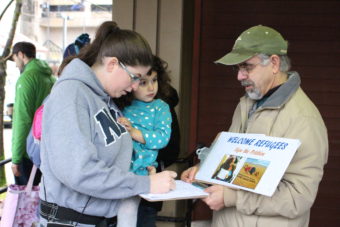
Rich Moniak with Juneau People for Peace and Justice gathers signatures outside Centennial Hall on Sunday. (Photo by Elizabeth Jenkins/KTOO)

More than a thousand people in Juneau signed a petition this weekend to allow Syrian refugees in Alaska.

Volunteers with the groups Veterans for Peace and Juneau People for Peace and Justice stood outside Centennial Hall during the popular Juneau Public Market to gather signatures.

The petition is addressed, “To Alaska’s Elected Officials” and will be sent to the state’s congressional delegation in Washington, D.C. It reads:

“We, the undersigned, will not allow fear-mongering to drown out our compassion for those seeking refuge from war or violent conflict or our humanitarian obligation to ease their circumstances. Therefore, we urge our elected representatives to work toward resettlement of refugees to Alaska in a manner that is inclusive, humane, and expeditious.”

Volunteer Sarah Niecko said gathering signatures means talking to people of all opinions on the issue.

“We’ve had a lot of support which is nice to see and, more importantly, getting the dialogue started for even those people that maybe don’t support it. Just hearing their side, because we have to bring them all to the discussion table if we’re ever going to come up with creative solutions,” Niecko said.

About 120 refugees from around the world settle in Alaska every year. Catholic Social Services, which oversees the state’s refugee resettlement program, says there are no current plans to receive Syrian refugees.

Following the attacks in Paris a few weeks ago, Alaska congressman Don Young and U.S. Senators Lisa Murkowski and Dan Sullivan joined many other political leaders in calling on the president to suspend his plan to admit 10,000 Syrian refugees. Gov. Bill Walker did not take that stance.

Volunteers in Juneau will continue to gather signatures this week. Veterans for Peace and Juneau People for Peace and Justice plan to place an ad in the Juneau Empire that lists as many names of people who signed the petition as can fit.

Forced to flee: Juneau residents recall refugee beginning

Persecuted her whole life as a Bahá’í in Iran, Parisa Elahian came to Juneau as a refugee in 2005. (Photo by Lisa Phu/KTOO)

Alaska receives about 120 refugees from all over the world each year.

About 10,000 Syrian refugees will come to the United States. While none are expected to end up in Alaska, the state still has a significant refugee population based mostly in Anchorage. However, some have made Juneau their home.

As a child in Iran, Parisa Elahian was told by school officials she wasn’t equal with other children.

“They called us dirty, so they had to separate us from the other kids, so I was in the corner of the class,” Elahian said. “Imagine: I was a 7-year-old and going home crying most of the time because other students would say bad words to us.”

Her classmates were scolded for speaking to her. Neighbors told her to stay away from their homes.

Elahian, now 34, is a Bahá’í. In Iran, Bahá’ís have long been persecuted by the government. They aren’t allowed to practice their faith, are denied government jobs and admission to universities, and experience other forms of discrimination. Many have been arbitrarily arrested.

Elahian left her home country when she was 24.

“I had nothing to do professionally, getting higher education, so that’s why I decided, ‘OK, it’s time for me to go,'” Elahian said.

Many Bahá’ís leave Iran as refugees via Turkey. Elahian was there for 10 months while she waited for a visa. She says she had a choice between Texas and Alaska. She chose Alaska and was sponsored in 2005 by a Bahá’í in Juneau. Today, about 20 Iranian Bahá’ís live in the capital city.

Back home, Elahian said she used to worship in people’s homes in groups no bigger than 15. In Juneau, Bahá’ís still practice their faith in houses, “but of course, there is no fear here,” Elahian said. “Back home, even though when we get together in very small group of people, still you would think as soon as you hear the doorbell — you would say, ‘Uh-oh, they could be here to get us.'”

Vũ Schroeder left his home country of Vietnam in 1983. He was 11 and had never gone to school.

“After the war, things got crazy and lots of political issues going on, lots of violence. People kind of get confused and a lot (were) struggling to survive,” Schroeder said.

He witnessed bombings, public beatings and executions.

Like hundreds of thousands of other Southeast Asians of that era, Schroeder escaped Vietnam in the middle of the night by boat.

“When it’s dark, you gotta go,” Schroeder said. “It’s not easy to leave the country because if you get caught, you either end up in jail or you’re gonna get killed.”

Schroeder spent about two weeks going across the South China Sea on a small wooden boat with about 20 others, half of them children.

“There was some rain – we could get rain water – but I didn’t eat for, like, five or six days. I was skinny. And then when we got to the land, we barely could walk because you’re so weak,” Schroeder said.

Vũ Schroeder holds daughter Katelyn. His wife, Myle, stands next to their two sons, Erik and Robbie. They live in Renton, Wash. (Photo courtesy Vũ Schroeder)

Somehow, everyone on his boat survived the journey.

He spent three years in a refugee camp in Indonesia. Schroeder said people were given food once a week and slept in rows on a long wooden bench where you couldn’t move.

Finally, in 1986, Schroeder and some relatives were sponsored by a group in Juneau. He was scared when he arrived, but his sponsor parents – Elaine and Bob Schroeder – were there.

“I remember they took me to the salmon bake and we had some really nice salmon, like the best meal ever,” Schroeder said.

His relatives moved to California within a year of arriving in Juneau. Schroeder, 13 at the time, didn’t want to start over again. The Schroeders let him stay in their home and eventually adopted him. He got a bachelor’s degree from the University of Alaska Southeast and worked for the Alaska Marine Highway system for years.

In 2007, Schroeder moved to the Seattle area. He’s earned his captain’s license and works for the Washington State Ferries. He’s married with three kids.

Parisa Elahian is still in Juneau. She’s married and works for the state. She says if she could have the same rights in Iran as she does in the U.S., she’d go back.

“But I’m so happy here, don’t get me wrong. I am so blessed. I’ve been here for 10 years. I just get emotional thinking about it. Even at the beginning when I didn’t speak English that well and people probably didn’t understand me that well, I never faced any kind of racism toward me,” Elahian said.

When she arrived in Juneau as a refugee, Elahian never wanted to be a burden, and she was never treated as one.

Tlingit elders write boarding school history for future generations

Tlingit elder Della Cheney talks during a panel discussion on boarding schools at the "Sharing Our Knowledge; A Conference of Tlingit Tribes & Clans." In the 1920s and 1930s, Cheney's parents attended Sheldon Jackson School in Sitka. (Photo by Lisa Phu/KTOO)
Tlingit elder Della Cheney talks during a panel discussion on boarding schools at the “Sharing Our Knowledge; A Conference of Tlingit Tribes & Clans.” In the 1920s and 1930s, Cheney’s parents attended Sheldon Jackson School in Sitka. (Photo by Lisa Phu/KTOO)

By talking about boarding school experiences, Tlingit elders in Juneau are turning painful memories into sources of healing – healing for themselves and generations still living with the consequences.

The nonprofit arm of the local urban Native corporation is using those stories to create a K-12 curriculum that will focus on the impacts of colonization on the Tlingit people.

Della Cheney and other elders have been meeting once a month at Goldbelt Heritage Foundation since August.

“We’re helping to write down the story of how boarding schools are affecting us and our families today, so that our children and grandchildren will know the history and realize the changes our families, our people faced,” said Cheney, who’s originally from Kake. She was part of panel of Tlingit elders during the recent clan conference in Juneau.

From the late 1800s to the mid-1900s, the federal government split up families and forced Native children into boarding schools to assimilate. Many were also raised in orphanages.

“That time is still walking with us today,” Cheney said. “The people who were raised with no love or affection in a very hostile environment also raised their children without much nurturing or affection. So today we see some of our families suffering from abuse.”

Cheney said both her parents attended Sheldon Jackson School in Sitka. Her mother was only 10 when she was brought there in 1923.

“It just breaks my heart to think that I was raised in such a loving family and to know that my mother and father weren’t,” Cheney said.

But those who went to boarding schools persevered, Cheney said. In Kake, they fought to make the village a first class city in 1951, allowing the community to operate its own school system.

Emma Shorty is from Teslin, Yukon. She was 4 years old when she was taken away from her home in 1937 to go to residential school in Carcross.

“We were never allowed to go anywhere,” Shorty said. “We had to stay in one yard. They put a fence around the school. They used to lock the fence and when we went to bed, they would lock our doors and there were no bathrooms to go to, so we got into trouble for wetting our beds.”

Shorty said she was molested at the school.

“I learned to forgive. I wasn’t always kind. Residential school just about killed my spirit. Today I forgive them,” Short said.

She fought hard to have her first daughter go to public school, even though she was turned away again and again for being Tlingit.

Tlingit elder John Martin said boarding schools "was a form of prison." (Photo by Lisa Phu/KTOO)
Tlingit elder John Martin said boarding schools “was a form of prison.” (Photo by Lisa Phu/KTOO)

John Martin went to boarding school in Eklutna and then to the St. Pius X Mission in Skagway, “but instead of Christianity, there were some ugly things that went on.” Martin said he would not speak about it.

Martin said many of the elders are still hurt.

“By putting us in boarding schools, it was a form of prison,” Martin said. “They disrupted our learning process of the language. They actually took a way of life from us when our elders were teaching us how to gather food.”

Martin said telling the stories from that time and identifying the hurt is the beginning of healing.

Developing the new Goldbelt Heritage curriculum is a multi-year process. Besides boarding schools, it will also share the history of the Douglas Indian Village burning and the Douglas Indian cemetery relocation.

The curriculum will be used during summer academic programs at Goldbelt Heritage and will be available for the Juneau School District.

Site notifications
Update notification options
Subscribe to notifications