"As Managing Editor, I work with the KTOO news team to develop and shape news and information for the Juneau community that's accurate and digestible."
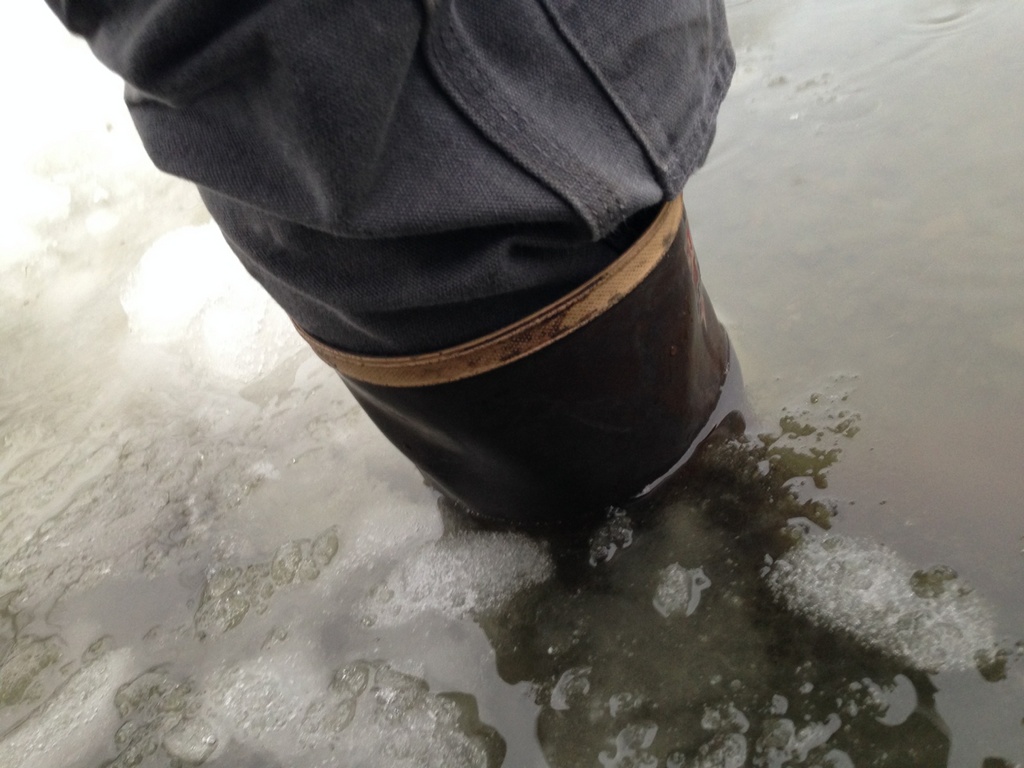
Juneau’s previous wettest January occurred in 1985 with 10.13 inches of rain. (Photo courtesy of Frank Rogers)
This month is Juneau’s wettest January on record, according to the National Weather Service. The capital city received 10.15 inches of rain, barely breaking the previous record set in 1985.
Juneau normally receives about five and a half inches of rain in January. On the 14th alone, two inches of rain fell.
But Juneau’s record breaking wetness pales in comparison to Yakutat’s 25 inches of rain. The northern Southeast community usually receives 13.7 inches in January. The most rain that has fallen in Yakutat on record was 32 inches.
This month also goes down as Juneau’s second warmest January with an average of 37 degrees. Normal average is 27 degrees. Jan. 18 reached the highest temperature of 50 degrees. Around Southeast, Metlakatla reached the warmest at 58 degrees earlier this month.
A record certainly not broken in Juneau was snowiest. Instead of receiving 28 inches of snow, which is normal for January, the city saw just under five inches.
Next month will likely be more wintry, says meteorologist Aaron Jacobs, “The pattern that we had all January, which gave us all these very warm temperatures and high precipitation, is finally breaking down and we’re kind of in a state of flux where we’re going to get back to more of a normal climate, be back to the colder and a little bit drier but at the same time, if any weather systems come in, we might see a little bit more frozen precipitation.”
For the last day of January, Jacobs says the forecast is dry with mostly clear, sunny skies.
Màhâ Abdulrâzzàq mingles with the crowd after a talk at University of Alaska Southeast, "Translocal Muslim Identities around the World." (Photo by Lisa Phu/KTOO)
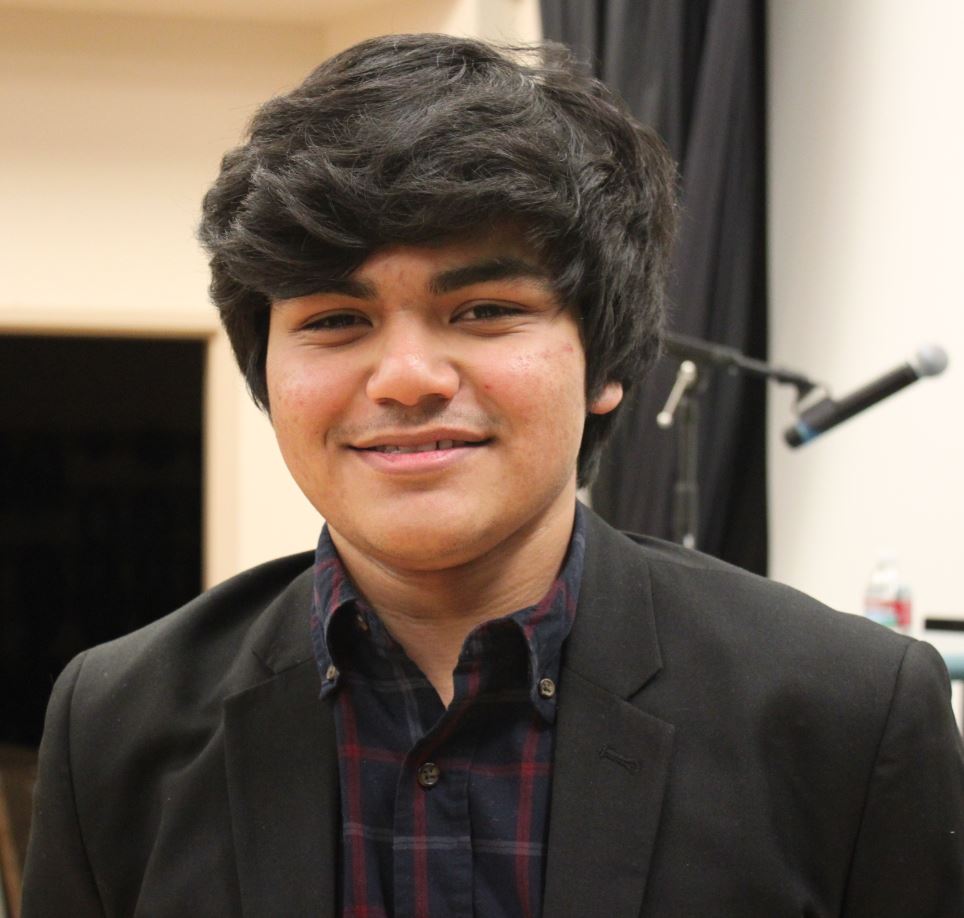
Màhâ Abdulrâzzàq is from Yemen. She's attending Thunder Mountain High School. (Photo by Lisa Phu/KTOO)
Abdulla Husain, from Bahrain, goes to Juneau-Douglas High School. (Photo by Lisa Phu/KTOO)
Haytham Mohanna attended Haines High School during the last school year. (Photo by Lisa Phu/KTOO)
Difference between his country and America: weather and freedom, says Haytham Mohanna. (Photo by Lisa Phu/KTOO)
Abdulla Husain shares a laugh with UAS professor Robin Walz. (Photo by Lisa Phu/KTOO)
Haytham Mohanna likes teaching others about Gaza Strip. He's given various presentations in Haines. (Photo by Lisa Phu/KTOO)
Three Middle Eastern high school students are experiencing life in Southeast Alaska. They are here through a U.S. State Department program established in response to the September 11th attacks. The program’s goal is to bring students from Muslim countries to the U.S. to learn about American values and culture. In turn, the students teach Americans about life and culture in the Middle East.
When 16-year-old Abdulla Husain from Bahrain learned he was coming to Alaska, he had visions of endless snow. So did his fellow exchange students.
Màhâ Abdulrâzzàq, 18, says she was excited to be accepted into the competitive U.S. exchange program, which meant leaving her home country of Yemen and going to school in America for one year. “I went to my family, I was like, ‘I got a host family.’ I was so excited and they were, ‘Where?’ I was like, ‘In Alaska.’ And my dad was, ‘What!? You don’t have to go.'”
16-year-old Haytham Mohanna from Gaza Strip says he didn’t even know people existed in Alaska.
In the same way the exchange students and their families had preconceived notions about Alaska, the students found that Alaskans had preconceived notions about them. Abdulla says more than once a friend has introduced him like this, “This is Abdulla, the terrorist.”
Another student recently asked him these questions:
“‘Would you ever bomb America?’ And I told him, ‘No.’ And he was like, ‘Do you know anyone in your family who would bomb America?’ And I was like, ‘No.’ And he goes, ‘Do you know anyone from your country who would bomb America?’ And then I just got pissed and then I was like, ‘What’s up with the third degree?’”
Despite these incidences, experiencing America and Alaska has been positive for all of them. Aside from attending high school, making friends, and living with a host family, the students get to travel to other parts of the country, try new activities, and have classic Alaska experiences.
“I have tried cross-country skiing for the first time and I fell 15 times! That was crazy. I was counting,” says Màhâ, who’s attending Thunder Mountain High School. She also can’t wait to tell her friends in Yemen about homecoming:
“And I will tell them, I danced. I danced like crazy. I have never danced in my life.”
Abdulla recounts a run in with a bear. “I was texting and looking down and listening to music and so all of a sudden I looked up and maybe twenty feet away, there was this big bear looking through this garbage. And he looked at me and I looked at him and I know they say don’t run, but I couldn’t help it. I didn’t run; I walked backwards faster than running maybe,” he says laughing.
While in America, Màhâ doesn’t wear a traditional long black abaya that covers her whole body. Instead, she wears dresses with leggings. But she still wears a hijab, a religious head scarf. “I can’t show my hair for guys, except for my father, brother, future husband, future kids, and uncles and grandfather,” she explains.
Màhâ says it has been a culture shock to see so much interaction between boys and girls. In her home country, schools aren’t mixed. “So, like, in Yemen, we’re not allowed to have girlfriends or boyfriends and we are not allowed walking and holding hands with guys and hugging them and stuff. That’s crazy.”
Haytham says the biggest difference between living in America and living in conflict-ridden Gaza Strip is, by far, the weather. And freedom:
“Like being here in America, it’s very different, having your freedom, having your choices, do whatever you want to. I can’t explain it. Like from a siege, or under siege, to having many choices and many stuff to do, it’s so different.”
He says the program is affecting his life in more ways than he ever imagined, “This program opened many doors and many choices for me. Also it will do many things for me even in the future, for my future job, for my college, for my life, how to react, how to deal with many people, how to communicate.”
Haytham, Màhâ, and Abdulla have a tip for Americans – if you want to know about another country’s culture, travel there, meet people, and talk to them.
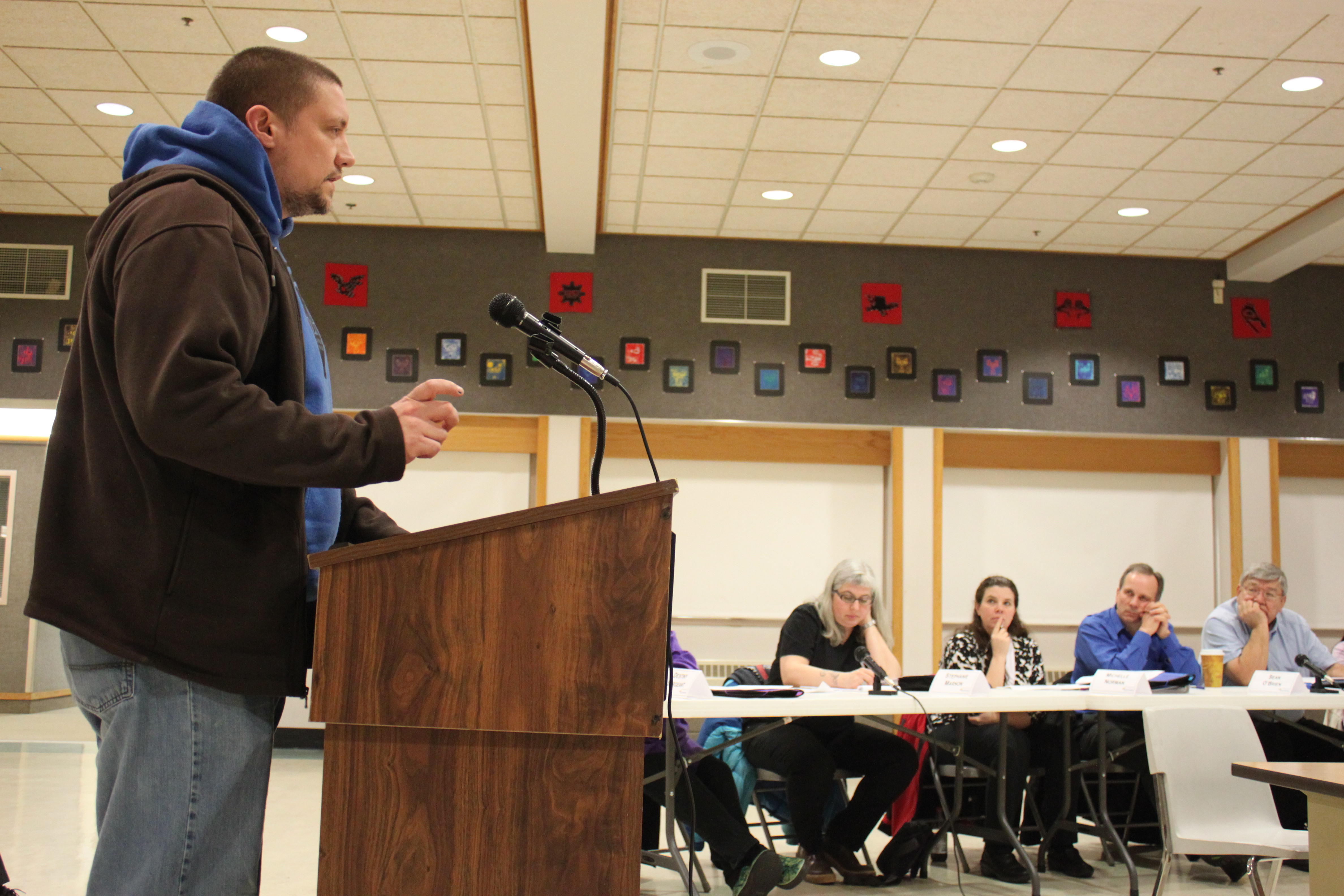
Teacher Adam Berkey tells the budget committee that money for a new language arts curriculum should go to teachers directly to buy their own new books for the classroom. (Photo by Lisa Phu/KTOO)
Public comment at Tuesday night’s meeting of the school district budget committee was mostly against a new elementary language arts curriculum, a $600,000 line item.
Elementary teacher Paula Kalbrener says the district already has a large amount of language arts materials that meet the common core standards:
“A lot of them are the same materials that we’re finding in the new curriculum adoption, which is pretty and shiny, but you still have to have the basics of teaching down to teach reading, and I think that the most effective way for us to improve our literacy in the district is to have experienced teachers helping new teachers with the methods that have worked.”
Juneau School District Superintendent Glenn Gelbrich says a new elementary language arts curriculum would add consistency. Currently, not all the schools use the same curriculum. “The different approaches from one school to another, one classroom to another isn’t producing the kind of success for kids across the board,” he says. “Our effort here is to honor that teachers are going to make decisions about which things they use or don’t use on a day-to-day basis, but that our instructional strategies would be familiar enough from one classroom to another, whether it’s across the hall or across town, that a student would recognize it.”
Gelbrich says 35 to 40 percent of students are not meeting standards.
Budget committee member Jennifer Lindley says with such a huge budget shortfall, the district should be investing in teachers, not curriculum:
“How many teacher positions can we afford to keep in lieu of spending that money on curriculum? I believe in our teachers and I feel if we spend this money on curriculum and reduce the amount of teachers in Juneau, we’re taking a real gamble. And what happens if the curriculum doesn’t give us the results that we’re seeking?”
Despite overwhelming testimony from the public and budget committee members against a new elementary language arts curriculum, Gelbrich says support for it does exist:
“There are a remarkable number of educators in our school district who are clamoring for this kind of support for their instruction. We haven’t heard from them.”
Juneau teachers get the first look at their tentative agreement Wednesday.
On Tuesday, Juneau Education Association and school district negotiators signed the tentative decision reached a week ago.
JEA spokesman Dirk Miller says a meeting to ratify the contract has been scheduled for next Wednesday. Then the proposed contract will go to the school board for approval.
Miller says it’s disappointing the term of the contract is only two years.
“Even if we ratify this, the school board ratifies it, we’re going to have to go back into negotiations pretty soon for the next contract, so it would have been nice to get a three-year deal,” Miller says. “There is a cost of living increase. We give up one personal leave day, we get some help with health insurance, but not nearly enough to offset the rising cost of health insurance. So there are some pluses and minuses, and members will have to take a really close look at it and come up with a decision.”
Miller says the JEA negotiating team is glad to finally have an agreement both sides could sign.
I think what they’re saying is ‘this is what we can get in this economic climate.’
Juneau teachers have been working without a contract since June. Negotiations on the tentative agreement began a year ago.
Cost of the agreement
The school district faces about $4.5 million dollars in budget cuts. Superintendent Glen Gelbrich told the budget committee Tuesday night the district would need to find a little more than a quarter-million dollars to cover the cost of the teachers’ agreement.
“It comes with implications, not just for JEA members but for other employee groups to the tune of $230,000, so the figure that we now have is 4.78 million,” Gelbrich said. “So there’s an increase to our commitments that are assumed for next year.”
If the legislature were to adopt Gov. Sean Parnell’s proposal to increase the Base Student Allocation by $58 dollars per student next year, Gelbrich says it would bring the district about $740,000 in additional revenue.
United Way Navigator Crystal Bourland says the website is now easier to use. (Photo by Lisa Phu/KTOO)
A Juneau woman says getting insurance under the Affordable Care Act means she’ll take better care of herself.
Prior to January 1, Bonnie Berg was paying up to $1000 a month for health insurance. Now, she’s paying less than $100.
Bonnie Berg spent most of her professional career working in social services. She always had insurance through her job and when she retired in August 2010, she kept it through COBRA.
“I was paying about a $1000 a month, and about $250 each quarter for my basic meds. So in other words, it was costing me $13,000 a year just for the dead basics,” she explains.
Bonnie Berg (Photo by Lisa Phu/KTOO)
After 18 months on COBRA, Berg switched to a catastrophic plan, which cost $526 each month. She paid close to $900 every quarter for two asthma medications. Her deductible was $5,000.
In the 40 months since retirement, Berg went to the doctor only twice. “I wasn’t willing to pay for any tests on my own. I wasn’t willing to do anything the doctor really wanted me to do, unless I was having an episode,” Berg says. “I probably allowed myself the worse medical care of my life at the time I was paying huge prices.”
When the Affordable Care Act became law, Berg wanted to be on a health plan as soon as she could, though she will qualify for Medicare in eight months. “This is going to save me $4- or $5,000 just in eight months. If anything happens, it’s going to save me a lot more than that,” she says.
Berg tried to navigate healthcare.gov on her own in mid-October, but didn’t get anywhere. Then she found someone to help.
“That makes a huge difference. You really need to do a hook-up with a navigator who has done this for a few people now or an agent with Enroll Alaska. It’s free. They know exactly what questions to ask. They put it all in in the correct format and tell you what to do next,” Berg says.
Berg now pays $90 a month for health insurance. Her deductible is $250 and her maximum out of pocket is $500.
Enroll Alaska’s Chief Operating Officer Tyann Boiling says Berg’s case is not rare:
“We get a lot of very, very happy people that are getting health insurance for the first time or they’re getting health insurance that’s affordable to them for the first time.”
Boling says about 80 percent of people signing up with Enroll Alaska receive financial assistance.
For assistance signing up for health care:
Navigator Crystal Bourland is available Tuesday and Thursday afternoons at Wal-Mart and Wednesday afternoons at the Downtown Public Library, or call 523-1147.
Two Enroll Alaska agents can be found at Bartlett Regional Hospital Tuesday, Wednesday, and Thursdays. Call 907-770-5100 to make an appointment.
Juneau’s United Way Navigator Crystal Bourland says people are also happy to find their plans include free preventative services, like cholesterol screenings, colonoscopies, and immunizations, “Regardless of which plan they choose they can still go to the doctor to get preventative and wellness checks. Just some of those added protections that exist under the Affordable Care Act, I think, is usually pretty surprising for people.”
Despite the positives, Enroll Alaska’s Boling says the health brokerage firm has made 1,100 enrollments, but she thinks that should be at least 15,000 by now. She blames the early troubles with the healthcare.gov website, “We lost two full months of enrolling people and those were critical months. That’s where the momentum was and we couldn’t get people enrolled. I think that we lost a lot of people and we lost them for good.”
Bonnie Berg was not one of those people. She worked with an agent for more than a month before she successfully enrolled in mid-December. Now, she says, she’s ready to take better care of herself:
“I’m going to be putting some thought into my health which is a good thing for anybody to do.”
The deadline to apply for a plan that starts in March is February 15. Open enrollment ends March 31 and won’t begin again until November.
Juneau will be featured Monday night on the Travel Channel as Hotel Impossible premiers its fourth season with an episode at The Alaskan Hotel & Bar.
The reality show’s crew was in the capital city last September and filmed for about a week at the famed downtown hotel. The Alaskan opened 100 years ago and is the oldest operating hotel in the state.
Hotel Impossible had a budget of $15,000 and hired Juneau contractors Greg Stopher of Stopher Construction and Alan Wilson with Alaska Renovators. But Hotel Impossible host Anthony Melchiorri said at the time of filming he wasn’t focused on construction. His main job was working on hotel operation.
“There’s running a hotel and controlling a hotel. And their hotel is being run but it’s not controlled,” said Melchiorri.
Hotel Impossible designer Blanche Garcia said for her and the TV crew, Hotel Impossible is more than just a reality show:
“We are actually here trying to help each hotel. I do the best design that I can give. Everything I do has high integrity. Anthony is the same way. He’s really passionate about what he does and helping people and that’s some of what you see on the show.
This is the second Alaska hotel to be featured on the show. Hotel Impossible worked on Yakutat’s Glacier Bear Lodge in 2012. Melchiorri says that was the show’s highest rated episode.
Hotel Impossible at the Alaskan Hotel & Bar airs Monday at 9 p.m. on the Travel Channel.
An example of a new workstation under the state’s Universal Space Standards. (Photo by Heather Bryant/KTOO)
As one of her last official acts as Alaska State Representative, Beth Kerttula wrote a letter to the Department of Administration expressing concern over the state’s office work space policy, also known as Universal Space Standards. She calls aspects of the policy “oppressive.”
In a January 21st letter to Administration Commissioner Curtis Thayer, Juneau representative Beth Kerttula says the Universal Space Standards policy needs to be reevaluated.
Kerttula says putting state employees into 6-by-8-foot cubicles separated by low dividers takes away space and privacy, and enhances distracting noise:
“I just think it’s going to be oppressive and I think that’s anti-Alaskan, I think it’s anti-worker. How does anybody concentrate in a situation like that?”
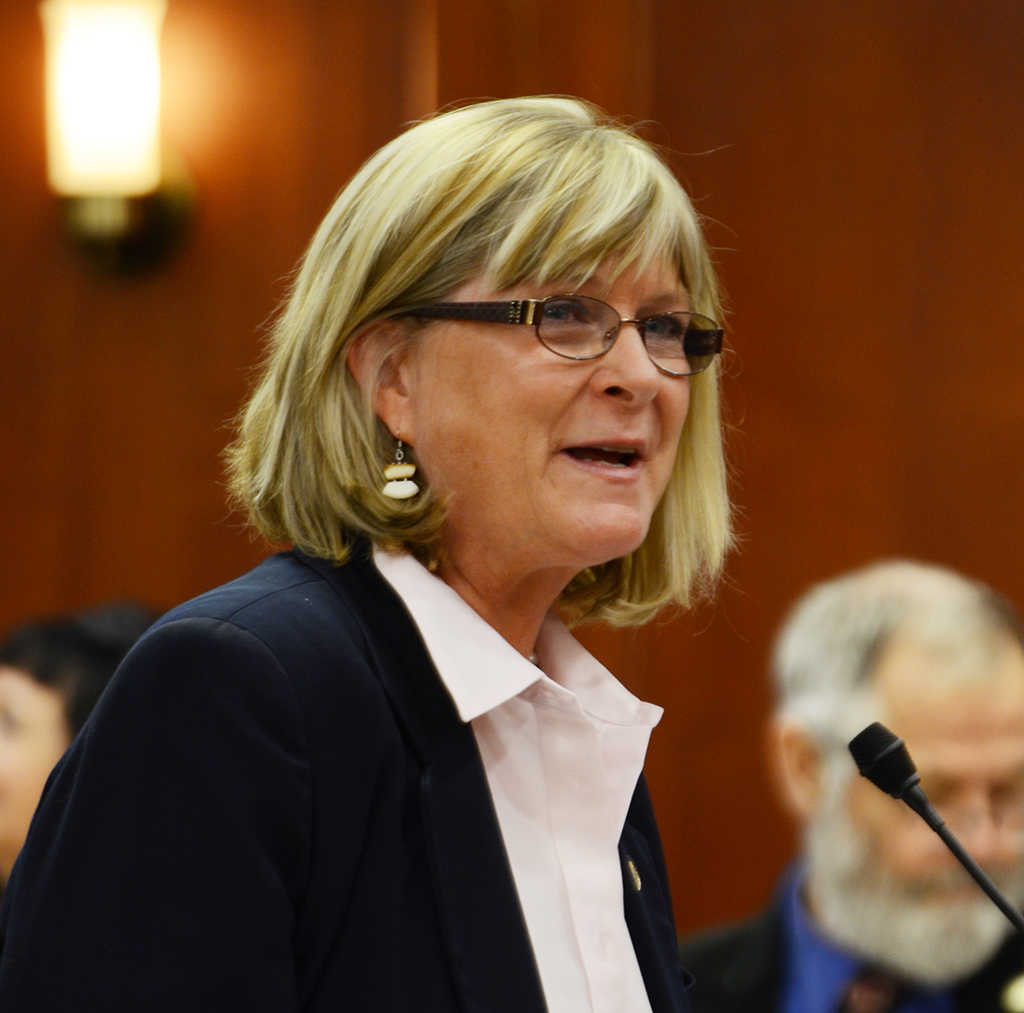
Rep. Beth Kerttula’s final day in office is Friday. (Photo by Skip Gray/KTOO)
Kerttula understands some of the perceived benefits of the office space standards, which were set into policy under former Administration Commissioner Becky Hultberg. Kerttula likes the idea of breaking down barriers between employees and supervisors, “but you know that doesn’t seem to be the way that this is turning out,” she says. “It seems to be that there are some people who will have barriers while many will be stuck in what I just truly feel is not a healthy place for state employees.”
The state’s space standards impose guidelines on who gets an office. Senior management and administrative positions, like attorneys or physicians, do. Everyone else gets a cubicle.
Kerttula’s office has been hearing complaints about the space standards since last spring, although she says cubicles have been a problem for a while. Juneau’s delegation, she says, has long been advocating for a new state office building in the capital to improve workspace.
In her letter to Commissioner Thayer, Kerttula says many employees are afraid to speak out against the office standards for fear of retribution:
“When you start to see your work space, which is almost, you know, it’s an extension of yourself. When you start to see things happening with that, I think it causes a lot of fear, and this one did strike a chord with people. They were afraid to really speak up and come forward and say, ‘This isn’t going to work.’”
Thayer previously said the space standards will save the state about $125 million over the next 20 years, but Kerttula says that doesn’t take into account diminished productivity and employee morale. She fears the state could start losing employees. “If we’re going to have a job that we can excel at and do good work for the state, we’ve got to have a place that we can work in and feel valued,” Kerttula says.
So far, Universal Space Standards have been implemented on some floors in Juneau’s State Office Building and Anchorage’s Robert Atwood Building. Renovations to the Nome and Douglas state office buildings are set to begin this spring.
In his reply, Commissioner Thayer states that his department has worked closely with each agency that’s affected by space standards, and that it’s up to the agency’s management to make the final decision on floor plans. He also states that all employees of the affected agencies had the opportunity to offer input.
Andy Mills, a spokesman for the Administration Department, says, “When the space standards are being applied, there is a holistic look at what are the agency needs, what are individual staff needs. Some need the confidentiality of a closed door and in other cases, like Fish and Game, they have very different needs than, say, Commerce or Revenue, and so they’ll get a lab to do some of the work in, store wet gear.”
The Alaska State Employees Association filed a class action grievance over the state’s space standards policy last July. Arbitration is scheduled for May.
Close
Update notification options
Subscribe to notifications
Subscribe
Get notifications about news related to the topics you care about. You can unsubscribe anytime.