"As Managing Editor, I work with the KTOO news team to develop and shape news and information for the Juneau community that's accurate and digestible."
Daniel Martin is the owner of Wild Oven Bakehouse. (Photo by Annie Bartholomew/KTOO)
Wild Oven Bakehouse is closing its retail store to focus completely on wholesale.
Saturday will be the last day to shop at the North Franklin Street bakery, but the artisan bread will still be available at its primary vendor, Rainbow Foods, as well as Foodland IGA, Super Bear Supermarket, and several Juneau restaurants, including B’s Bakey and Bistro, Coppa, Zephyr, and Rockwell.
Wild Oven owner Daniel Martin says it’s been difficult to make a living at retail only, so he’s branched into wholesale.
“Once I started to augment retail with wholesale, they started butting into each other,” he says. “We have a tiny space; we can’t do both. So for me, this was an all or nothing decision. I was all retail and then once I realized that wholesale was going to conflict with that, now we’re going all wholesale.”
Martin says he expects to double bread production to 150 loaves a day. He says the change also means less time in the office and more time doing what he loves.
“In my estimate, we’re making better bread now than we ever have before. It’s awesome, and so I just want to keep going with that. I want to keep focusing on the bread. I wake up every morning and put bread in the oven and that’s what I want to keep doing.”
The change also means Martin will reduce his payroll by about half and lay off a couple of employees. The price of bread will go up 50 cents, to $6.49. He says customers will not be able to get other Wild Oven goods after Saturday.
“They won’t be able to get our cookies, our macaroons, our focaccia squares – our ready to eat pizza-like focaccia stuff. We’re not going to make those anymore,” Martin says.
He says he hopes to sell Wild Oven bread to other Juneau restaurants and may market elsewhere in Southeast Alaska.
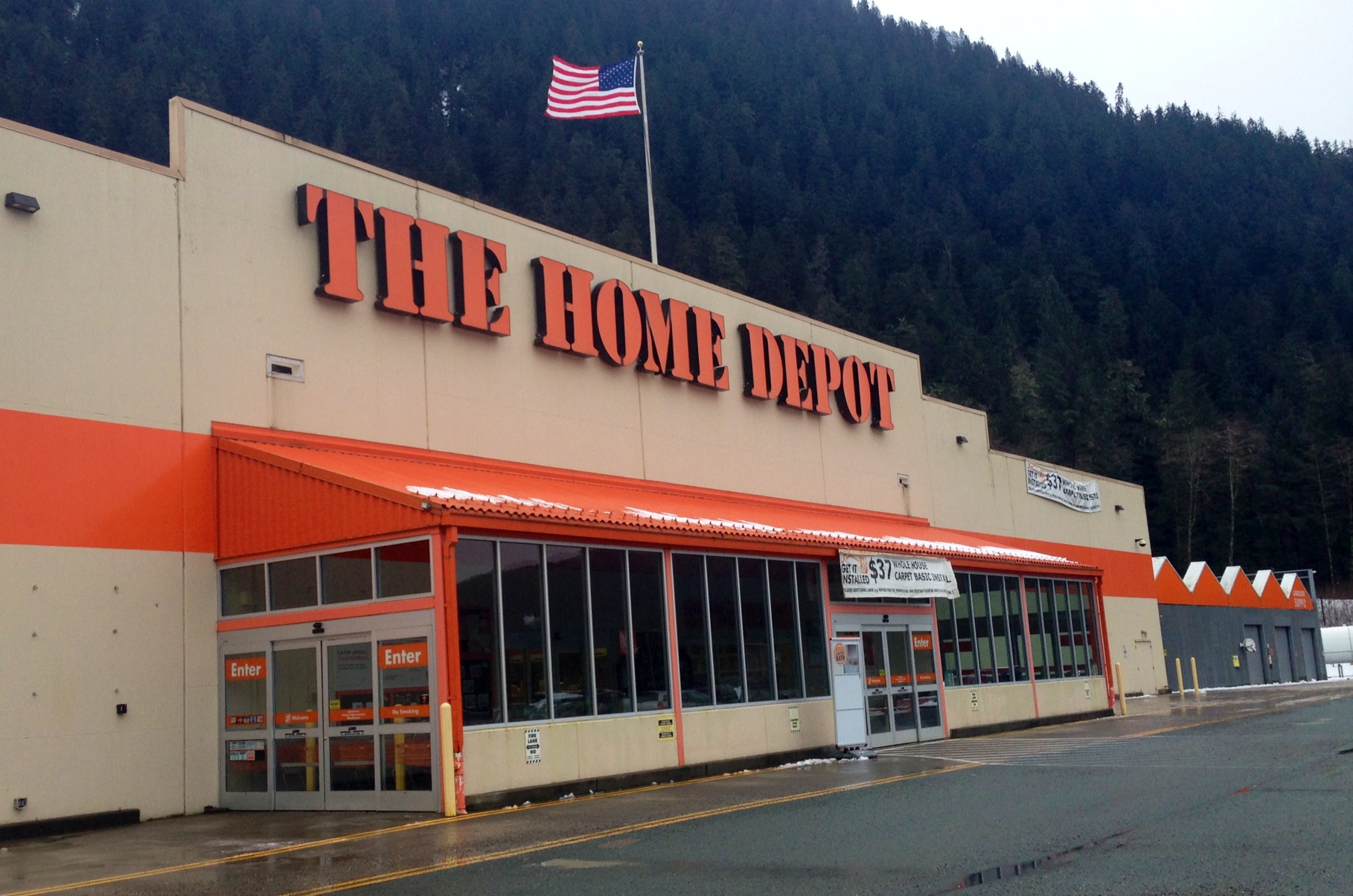
Juneau’s Home Depot is looking to hire 45 seasonal employees for the spring. (Photo by Casey Kelly/KTOO)
The Home Depot is touting a nationwide initiative seeking 80,000 “new hires” this spring and summer, including 270 in Alaska — but that’s nothing new.
The home improvement retailer is looking to hire 45 seasonal employees in Juneau, 45 in Fairbanks, and 180 in Anchorage.
State research economist Alyssa Shanks with the Department of Labor says these numbers won’t account for a boost in employment numbers.
“When we look at it on an annual basis and we compare it to the rest of our employment numbers, we probably won’t see too much of an impact, just because relative to employment in those areas, it’s a fairly small number of jobs,” Shanks says.
In 2012, employment in the retail sector in Alaska increased by about 2,000 jobs in the spring and summer months compared to the rest of the year. Home Depot’s 270 seasonal hires account for roughly 14 percent of that increase.
From an employee’s perspective, Shanks says this is still good news.
“Those are a handful of jobs at least in Juneau and in Fairbanks and in Anchorage, compared to the size, that could help a lot of people if they don’t have a job right now and are looking for additional work, so despite the fact that it’s seasonal and, relatively speaking, it’s not a lot of jobs, it could really be helpful to some people,” Shanks says.
Juneau Home Depot store manager Tom Hart says a seasonal job from May to September could turn into a year-round position.
“The best associates that are certainly passionate about customer service, we’re going to try to keep them on board and transition into full-time associates.”
Hart says the store hopes to hire locally. Positions at Juneau’s Home Depot include cashier, freight and customer service associates.
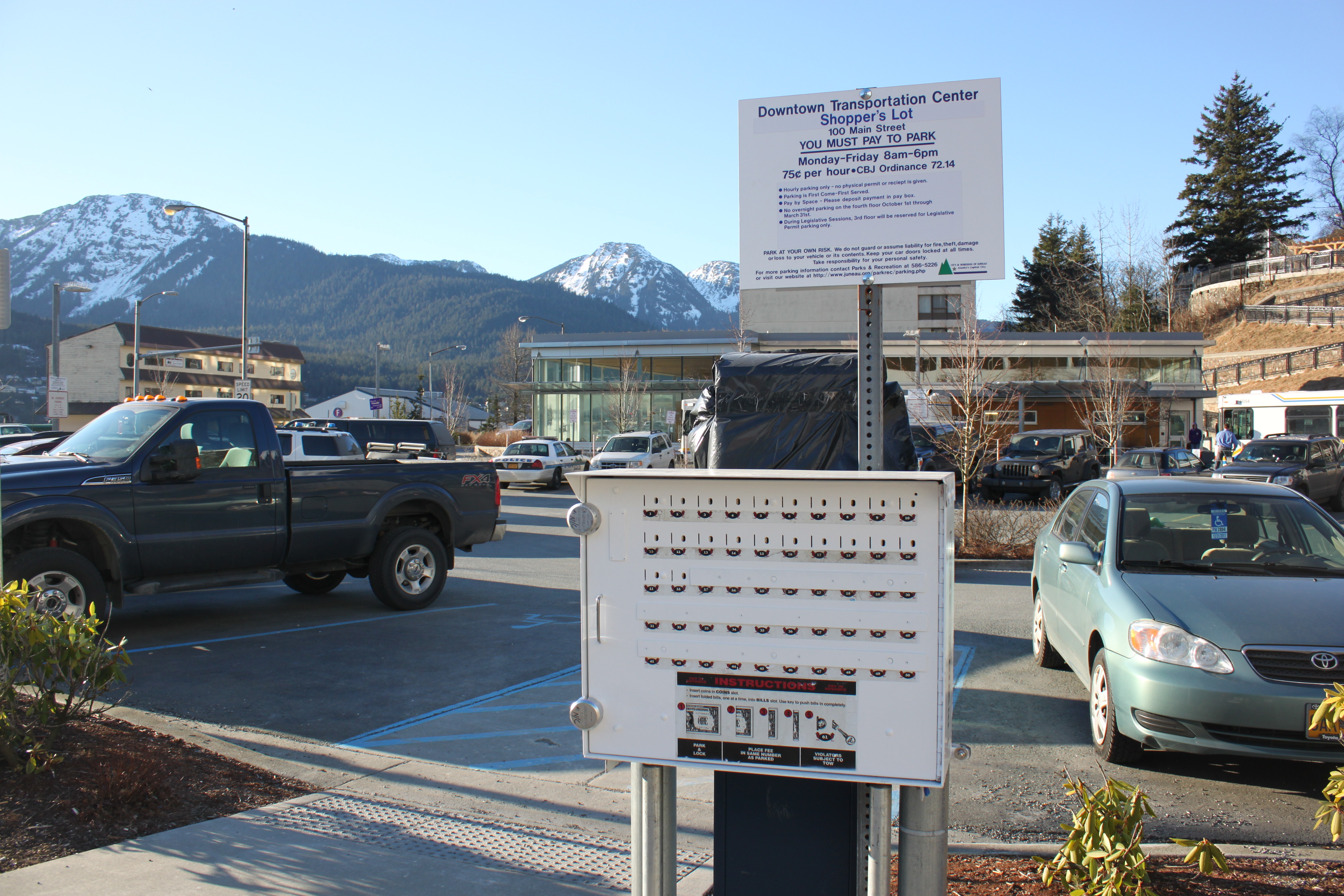
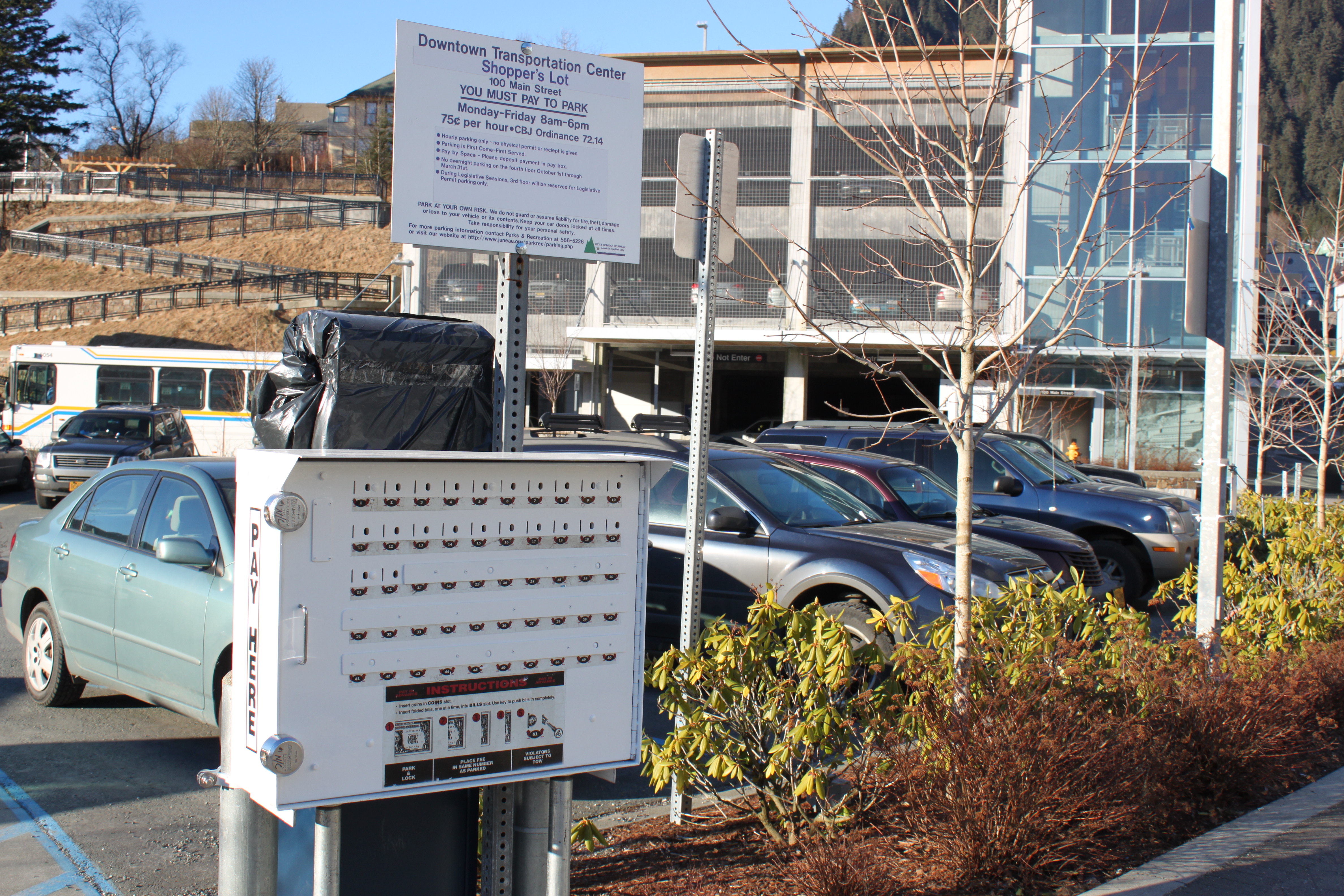
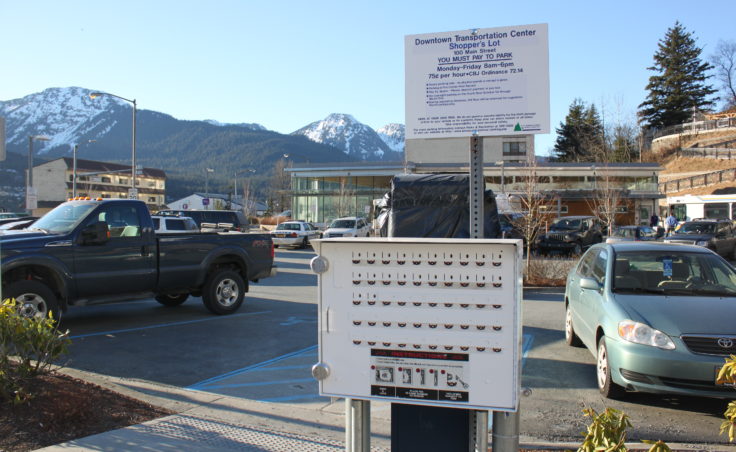
The city has no current plans to replace downtown coin-operated parking boxes. (Photo by Lisa Phu/KTOO)
(Photo by Lisa Phu/KTOO)
(Photo by Lisa Phu/KTOO)
(Photo by Lisa Phu/KTOO)
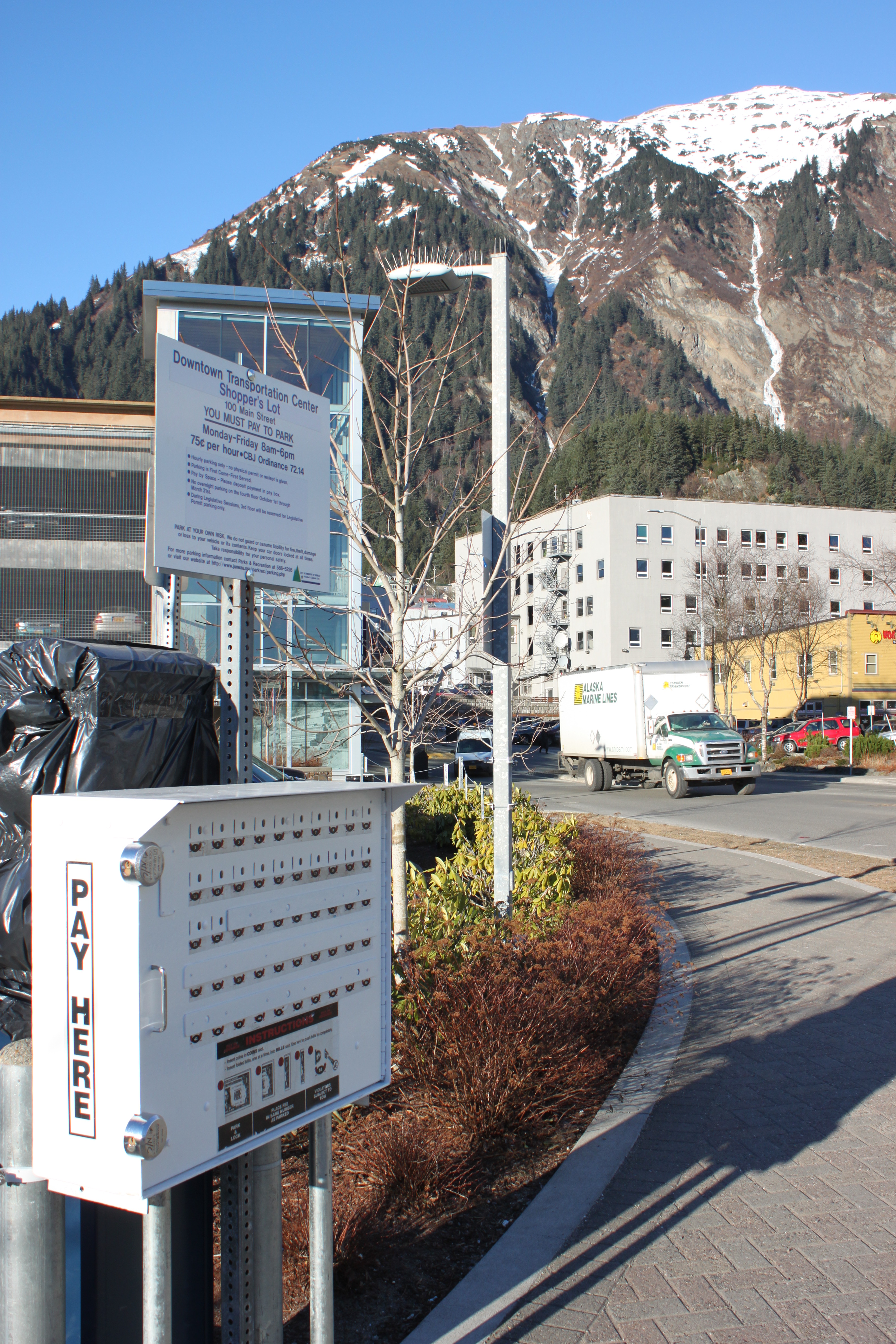
The city has no current plans to replace downtown coin-operated parking boxes. (Photo by Lisa Phu/KTOO)
(Photo by Lisa Phu/KTOO)
Juneau’s parking holiday is over, as the City and Borough switches to a temporary downtown parking system.
City manager Kim Kiefer says on-street parking will still be free for the first two hours. Beyond that, motorists will have to park in a coin-operated lot.
“The parking lot up by the Baranof will be a coin-pay only parking lot. There will be some spaces in the Marine Parking Garage that will be pay coin ops only, and then the lot that we refer to as Shoppers Lot – the corner of Egan and Main Street – will be pay by space.”
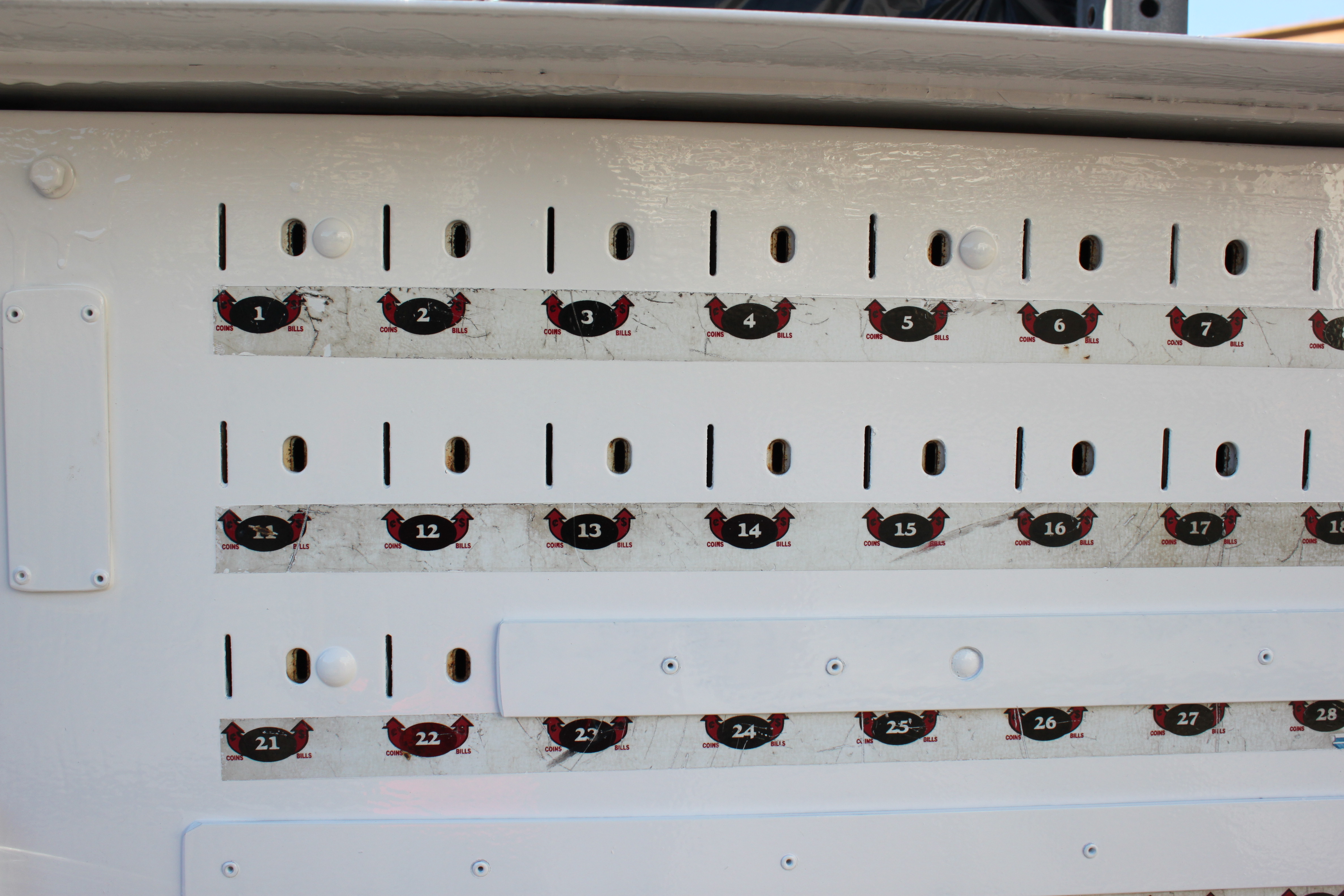
It will cost 75 cents an hour to park in each of the three coin-operated lots. A number on each parking space corresponds to a slot in a pay box that takes coins or dollar bills.
Keifer calls the system “purposely low-tech.” She says the coin pay stations are a temporary solution in the downtown parking zone.
“If you’re parking on Whittier Street, it doesn’t count. We’re talking about the area that basically is from the Downtown Library, up to 4th Street, over to Main, and then down to Marine Park.”
Motorists also have the option of buying weekly or monthly parking permits for the Marine Parking Garage. Permits for the Downtown Transportation Center have been sold out and enforcement there has already begun.
Kiefer says the city is planning an informational campaign about the new downtown parking system, including signs and advertisements, before police start to ticket.
“We’ll give people time to get used to the new system. We’ll do warnings.”
The city terminated the contract with Aparc Systems in December and initiated a lawsuit against the Nevada company, after it failed to respond to various complaints. The Assembly last month approved $110,000 for legal fees to outside counsel for the litigation.
Since 2010, the city has invested nearly half-a-million dollars in the problematic parking system.
The temporary pay boxes have so far cost $1,900, including shipping.
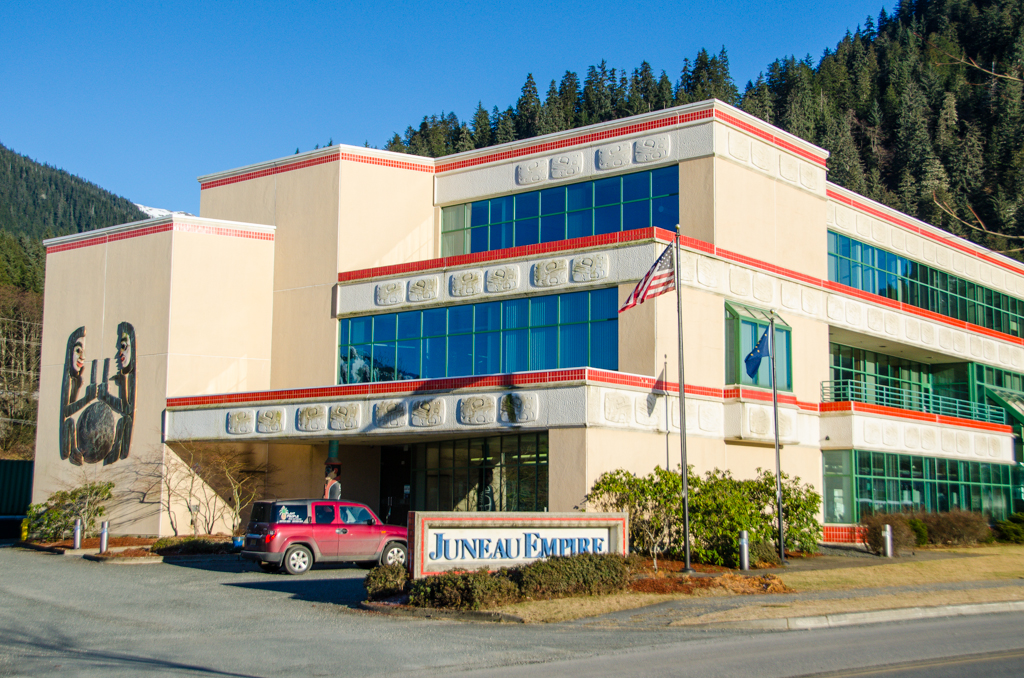
The Juneau Empire on Channel Drive. (Photo by Heather Bryant/KTOO)
A former Juneau Empire reporter says she was fired when she refused to set up a meeting between the publisher and a legislator on a bill that affects newspapers.
Jennifer Canfield left her job as state capital reporter last week.
The last few years at the Empire have been marked by turnover and some uncertainty as its parent company struggled financially.
Municipalities buy space in newspapers to publish notices on certain information, like raising taxes, meetings, and foreclosures. House Bill 275 would give municipalities another option – publish the information electronically, to be accessed on a municipal website.
Rep. Mike Hawker is the main sponsor of the bill. He says it would empower municipalities to find the most cost effective way to operate.
“It’s information that we have determined that it is in the public necessity and good that it’s made available and, as time has progressed and moved forward, there are alternatives to the traditional newspaper route of publication that might actually even do a better and more efficient and effective job of informing a public.”
Juneau Empire publisher Ruston Burton disagrees.
“It’s a common legislative move that’s made in a lot of states, it’s been made before, trying to basically take public information and hide it behind a website that nobody goes to essentially.”
After state government reporter Jennifer Canfield pointed out the bill to Burton, he asked her to set up a meeting with Rep. Hawker. Burton said he intended Canfield be present at the meeting as well.
“In my mind, I’m thinking that as we’re sitting with him, she’s asking the questions – a reporter would be asking the questions about, you know, ‘Why are you wanting to push this bill? What’s the reason behind it? What instigated it to make you feel it was super important?’ It’s pretty simple. There’s somebody pushing a bill, we want to know why, and we’re going to tell the story about it.”
Reporter Canfield didn’t think it was so simple. She didn’t want to do it.
“There really needs to be a firewall between the business side and the editorial side and I think any journalist understands that implicitly,” says Canfield.
To Burton, it was just a meeting. He says the Empire has a financial stake if HB275 passes, but says his concern is not about the money. He says less than 1 percent of the paper’s total revenue comes from municipal notices.
“I didn’t think anything of it at the time when I asked and I didn’t expect such a push back on it either. I don’t know that there’s anything unethical about saying, ‘Hey we’re going to go talk to this guy that’s trying to push a bill and I want to be there when you’re talking to him and you can report the news.’”
Canfield made it clear she didn’t want to set up the meeting.
“It was insisted that I do it, and eventually the conversation got to the point where I was told that if I didn’t do it, our working relationship could not continue. I again expressed my ethical concerns and I was fired.”
Canfield says she got notice of her termination the day after being asked to set up the meeting. She says being fired is a direct consequence of her saying no.
“In our conversation it was pretty clear that was the reason.”
Burton says the two events are unrelated.
“A decision had been made long before there was ever anybody asking for a meeting with Hawker,” says Burton.
Canfield is not the first reporter to abruptly lose their job at the Empire. In 2012, state government reporter Pat Forgey was dismissed from the paper; he went on to cover the capitol for the Alaska Dispatch. His replacement at the Empire, Andrew Miller, quit after just one day, claiming the work environment was “dysfunctional.”
At the time of the interview, Burton still hadn’t set up an interview with Hawker but says he plans to.
Editor’s note: Story updated to clarify that Canfield initially notified Burton about the bill.
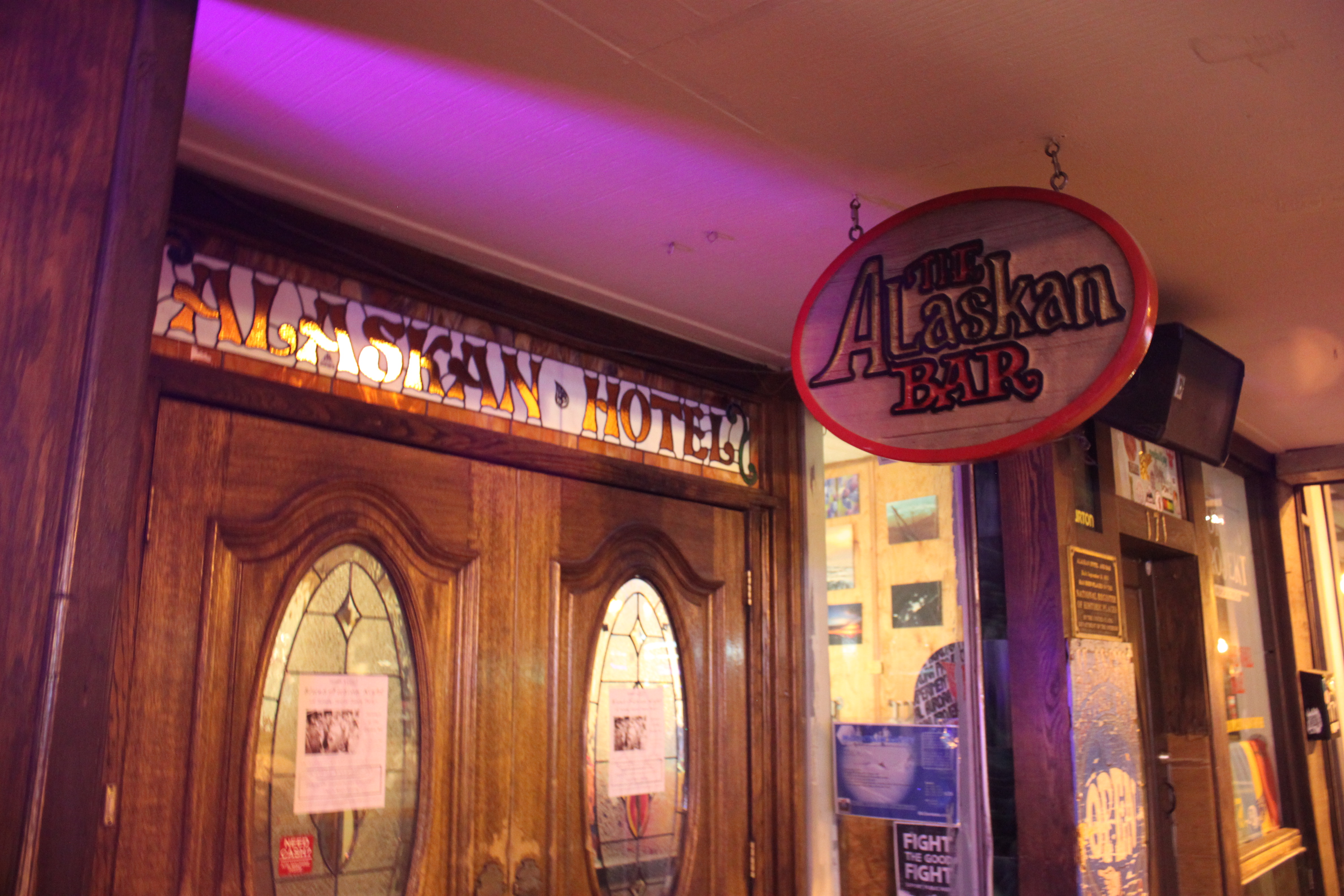
Hotel Impossible filmed at the 100-year-old Alaskan Hotel & Bar last September. (Photo by Lisa Phu/KTOO)
A former bar manager of The Alaskan Hotel & Bar is threatening a lawsuit. He says being featured on Hotel Impossible has caused serious problems to his life. Lane Taylor claims the reality show episode was pre-scripted and says he was fired on television for ratings.
Lane Taylor (Photo by Lisa Phu/KTOO)
On television, Lane Taylor was fired from his job. He was the bar manager of The Alaskan Hotel & Bar, a job he’d held for two years. But, Taylor says, he was informed that – in reality – he wasn’t really fired:
“I discovered that it was probable that they were still going to air that I was fired on the show when in fact, I hadn’t been fired, and so I felt like I had no choice except to resign. I mean that’s my reputation and if I’m not really being fired, and it’s reality TV, why couldn’t they show that?”
Taylor says he never wanted to be part of the filming, done by New York-based Atlas Media Corp., but felt pressure to sign the participation and release agreement, “I was receiving threats from the producers. My employer was telling me she was going to replace me. I thought, well, if I don’t sign one of these, I’m done.”
Taylor says his televised termination was all part of a pre-scripted plan:
“That episode was rigged. It was flat out set up and anybody that thinks that what they showed on TV has anything with what was really going on has been duped.”
Alaskan Hotel acting general manager C. Scott Fry disagrees:
“I think they have some ideas of which way the show can go. Their mission is not to defame or embarrass anybody. Their mission is to show you better ways to run your business.”
Kelly Mazzei is the executive director of the state’s film office, which handles tax credits for production companies. She says reality TV is technically called unscripted television, but, “it’s still the entertainment industry and it’s still being filmed to make money and to get an audience to watch it.”
She says she hasn’t heard complaints about being intimidated to be on a show or inquiries about labor laws.
After leaving The Alaskan Hotel & Bar, Taylor filed for unemployment benefits, but was denied. He appealed it.
Before the Hotel Impossible episode at the Alaskan Hotel aired Jan. 27, Taylor attempted to block it, claiming his participation agreement was invalid since it was signed under coercion. He never heard from the production company. Now he’s threatening a lawsuit.
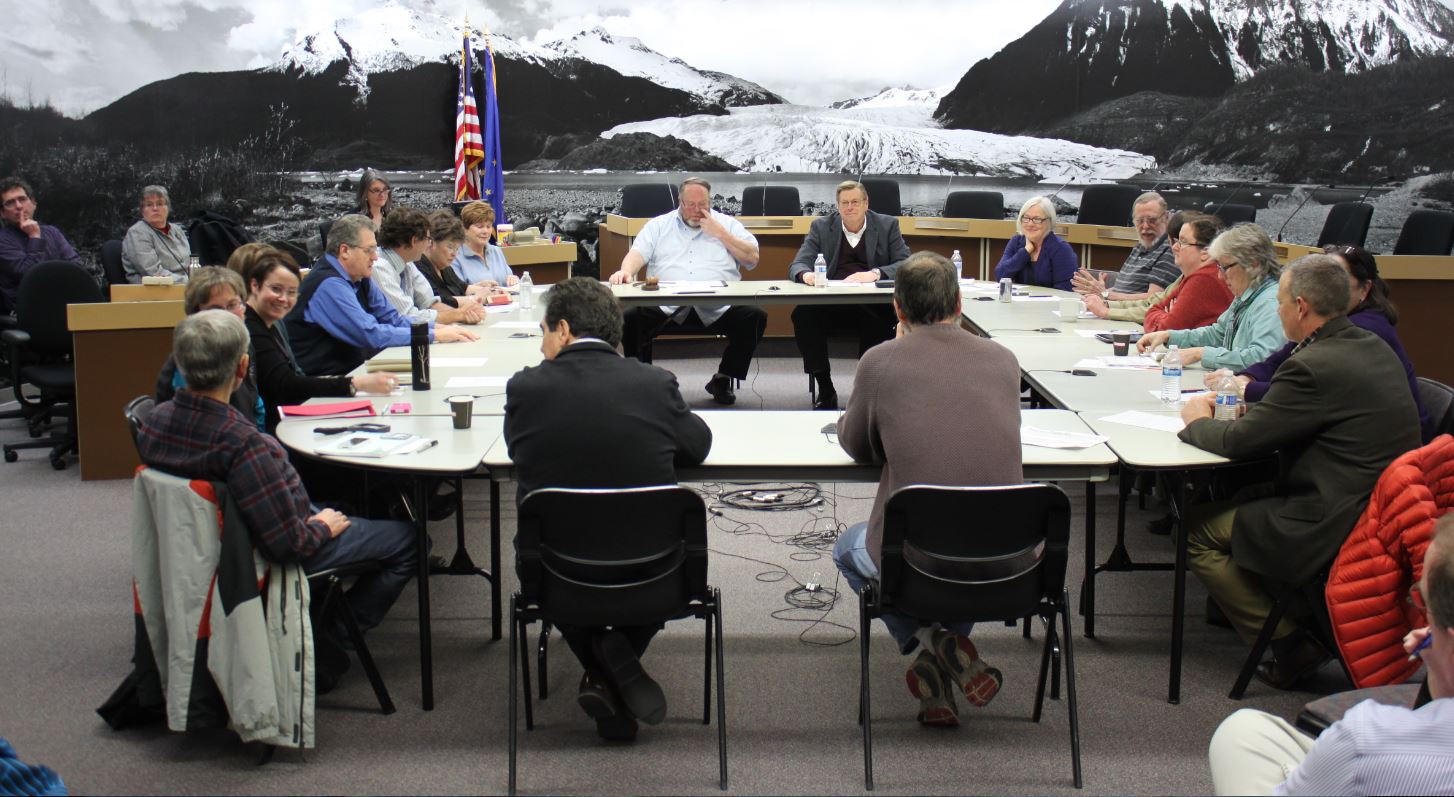
The Juneau Assembly met with the hospital board to discuss the severance packages of former hospital officials. (Photo by Lisa Phu/KTOO)
Bartlett Regional Hospital Board of Directors did not know about the severance packages of the former chief financial officer and personnel director until two weeks after the agreements were already signed. That’s what the board told the Juneau Assembly Wednesday night during a special joint meeting.
“The CEO indicated that the contracts were developed with an attorney and we did not see the contracts, we did not see the separation agreements until after they were approved by our CEO,” says board member Linda Thomas, who recently finished serving as president.
Former CEO Chris Harff approved the severance packages of former personnel director Norma Adams and former CFO Ken Brough on Aug. 9, one day after results of a personnel investigation into senior management had been discussed with Harff.
As the Juneau Empire reported in January, close to $300,000 in severance pay went to these top hospital officials.
Thomas says the separation agreement for Harff was approved by the hospital board and went through CBJ Law and Human Resources departments. According to city attorney Amy Mead, the agreement called for Harff to stay on the job longer than she wanted to provide for a smooth transition.
Thomas says Brough also stayed on longer than he wanted to finish projects that were financially important for the hospital. One was a settlement agreement with Medicaid.
“Mr. Brough was in the final stages of negotiating that and that resulted in a considerable amount of money and much more than was paid in retention. I guess the question comes on, could somebody else have done that? Possibly so, but we made the business decision. He had been the one doing the negotiations and it was very close to being finished,” Thomas explains.
Mead says it is within a CEO’s responsibilities to handle personnel matters, like severance agreements. Thomas says the board is working on establishing more oversight.
“The interim CEO is working with CBJ Law and Risk Management on developing procedures regarding any contractual relationships and we’re developing the tree of decision-making and helping to set those parameters in advance. That’s a work in progress,” she says.
During the special joint meeting, the Assembly learned that Harff had approved another severance agreement with a former Bartlett employee, the details of which were discussed in executive session.
Close
Update notification options
Subscribe to notifications
Subscribe
Get notifications about news related to the topics you care about. You can unsubscribe anytime.