"As Managing Editor, I work with the KTOO news team to develop and shape news and information for the Juneau community that's accurate and digestible."
He says Juneau also ranks high nationally, “Our water is so clean that it’s cleaner than the stuff you buy out of a plastic jug. We’ve got a wonderful health infrastructure around here for our size. Our hospital is an amazing hospital even with a target population regionally of 50,000, so it’s the reason why we’re so well rated by national surveys in terms of health.”
Felix says part of the report’s goal is to give community health planners an indication of how to make a community healthier, so the report also focuses on Juneau’s weaknesses.
“The primary ones are drug and alcohol abuse and all the diseases associated with those two things. And there were two surveys done in Juneau – one in 2005, the Compass Survey, and another, the McDowell Survey in 2010 – and people in the community identified alcohol and drug abuse as the main issues, too, so the community is aware,” Felix says.
According to the report, Southeast Alaska is the heaviest drinking region in the state and one of the highest consuming regions in the nation.
Felix says Juneau also has a high rate of Hepatitis C, similar to the rest of the state, and a high rate of sexually transmitted diseases.
The Healthy Indicators report also shows that Juneau’s population is rapidly aging, says Felix:
“We are one of the fastest – if not the fastest – communities in the United States in terms of our aging population. That’s going to impact our healthcare system here tremendously both financially and in terms of special kinds of care that we’re going to need.”
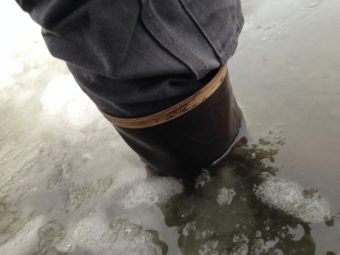
Xtratuf weather: National Weather Service says, as of 10:30 a.m. Tuesday, the Mendenhall Valley reported 3.45 inches of rain since Monday afternoon. (Photo courtesy of Frank Rogers)
Meteorologist Wes Adkins says Montana Creek and Jordan Creek are being watched.
As of 10 a.m., Montana Creek was at 13.4 feet, with flood stage starting at 15.5 feet. Jordan Creek was 9.1 feet as of 11 a.m., with flooding at 9.7 feet, although Adkins says Jordan Creek does not rise quickly.
Muddy water and small debris gush from a culvert onto Gastineau Avenue on Tuesday. (Photo by Jeremy Hsieh/KTOO)
Heavy rain is expected to continue till late this afternoon.
“We should start to get a front pass through here and that will – maybe not turn off the precipitation – but it should make it more showery and that just means more off and on rain, so therefore our rates of rainfall will come way down, so that will give some time for these streams and rivers to start on the diminishing trend,” Adkins says.
The flood warning is in effect until 6 p.m.
“It’s pretty amazing that at the coldest point of the calendar in Southeast Alaska, we’re getting temperatures in the 40s right now, so it’s really moist and just a very saturated air mass,” says Adkins.
Tom Mattice is Emergency Programs Manager for the City and Borough of Juneau. He says avalanche danger continues to accelerate:
“We’re going to have continued danger into tomorrow and the next day but it should start slowing down a little bit as precipitation rates slow down a little bit , so if we get through the dark without anything huge, then it’ll start to at least stabilize. As we are right now, danger is still going up as we continue to add this significant mass to it.”
Record-breaking weather:
Meteorologist Wes Adkins says Staney Creek near Klawock on Prince of Wales Island has reached flood level. It’s also broken a past record not seen since the early 1990s. As of 11:30 a.m., Staney Creek was at 17.5 feet, but Adkins says it’s starting to level off. The previous record was 17.2 feet. At this time of year, the creek is usually between 7 and 9 feet.
Mattice says there’s been avalanche activity on Thane Road and the Behrends Avenue avalanche path, but nothing significant, “The problem is, is there are multiple starting zones in those areas so with low cloud coverage, it’s hard to determine if we had a piece of hill come down or the whole thing come down, so there’s still significant potential throughout the whole community.”
Mattice says people should limit their time in danger areas:
“Definitely don’t hike the Flume or Perseverance Trail today. Definitely don’t walk, jog, or park along Thane Road today. If you have to go to the Behrends neighborhood for something, minimize time there. There’s no reason to hang out in the streets and play basketball with the kids.”
To report an avalanche or mudslide, call Mattice at 586-0419. If it’s an emergency situation, call 911.
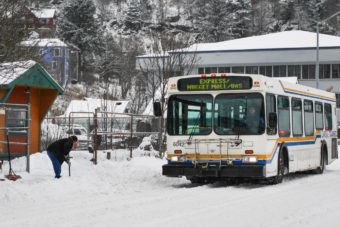
Capital Transit provides between 4,000-4,500 passenger rides each week day. The Transit Development Improvement Plan hopes to grow that ridership. (Photo by Kelli Burkinshaw/KTOO)
Potential changes to Juneau’s bus system could include service to Riverside Drive, more reliable on-time service, and earlier buses. But expanding service to Costco or the ferry terminal could be cost prohibitive. That’s what the Juneau Assembly heard during Monday’s committee of the whole meeting.
According to Geoff Slater with Nelson/Nygaard Consulting Associates, Juneau has a great transit system. He says ridership on Capital Transit is among the highest in the country for a community of Juneau’s size, but there are some weaknesses:
“More people riding the buses are slowing down the buses. More traffic lights, more traffic are slowing down the buses, and the buses can’t keep on schedule for much of the day, especially in the afternoon. As the buses run behind, people miss transfers, the buses can’t stay on schedule, and I think for people to be able to rely on the system, it has to run reliably.”
After looking at the issue for more than a year, which includes working with the public and city staff, Slater presented several short-term recommendations for Capital Transit. He says the recommendations would fix existing operational issues and allow the system to expand into a new area, “Service would run on time a lot more. There would be service to Riverside Drive, the express route would come into the Downtown Transit Center, service would operate differently out on the Back Loop, and service would operate until 9:30 at night in and out of [University of Alaska Southeast].”
Riverside Drive has been deemed a high demand area in Juneau not currently served. Service there would provide access to Dimond Park Aquatic Center, Thunder Mountain High School, sports fields, and the future Mendenhall Valley Public Library. The recommendations would also have the Express service run earlier to get people to work by 7 a.m., but discontinue the North Douglas midday trip.
Capital Transit provides up to 4,500 passenger trips per weekday. Slater says his short-term recommendations would see that number increase:
“Service into Riverside brings service to a lot of people who aren’t served now and some of these operational improvement – with service being more reliable – that will also increase ridership. Overall, this plan will bring service to within a quarter mile about ten percent more households in Juneau. So more people will have access to this service and will avail themselves to it.”
Annually, the transit system costs the City and Borough of Juneau roughly $5 million. These recommendations would cost the city an additional $200,000.
Slater’s short term recommendations do not include service to the Lemon Creek industrial area, which includes Costco and Home Depot, or the Auke Bay Ferry Terminal. Expansion to those areas would cost the city an estimated $1 million per year.
Alaska Robotics owner Pat Race says the shop will start accepting bitcoin for payment this summer. (Photo by Lisa Phu/KTOO)
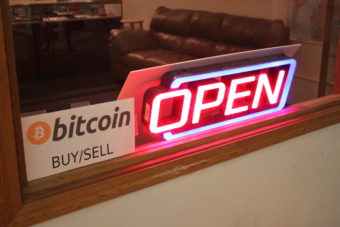
Since the bitcoin sign went up in his storefront window four weeks ago, Dylan Hammons says he's gotten a lot of interest. (Photo by Lisa Phu/KTOO)
Unlike these coins for sale at Gold & Silver Exchange at the Nugget Mall, bitcoin is not something you can hold or touch. It only exists on the internet. (Photo by Lisa Phu/KTOO)
The Alaska Robotics shop in downtown Juneau opened in 2011. It sells comic books, graphic novels, and local art. (Photo by Lisa Phu/KTOO)
Gold and Silver Exchange owner Dylan Hammons estimates one bitcoin will be worth $3,000-$5,000 by the end of the year. (Photo by Lisa Phu/KTOO)
Owner Dylan Hammons says Gold & Silver Exchange at the Nugget Mall is the hub of the bitcoin community. (Photo by Lisa Phu/KTOO)
This limited edition Pat Race print of Miley Cyrus riding a bitcoin while drones fly overhead is selling for .04 bitcoin. (Courtesy of Alaska Robotics)
Bitcoin is not just speculation, it’s also a way to pay for products and services.
Introduced in 2009, bitcoin is a digital currency, or cryptocurency, not backed by any country’s government. The currency that only exists on the internet has been growing in popularity over the past year and a half.
Now, a couple businesses in the capital city are starting to deal in bitcoin and accept it for payment.
In the Alaska Robotics shop in downtown Juneau, shelves are lined with comic books and graphic novels, local art hangs from the walls, and kids talk about Minecraft.
“Do you have any comic books about Minecraft?” a young customer asks shop owner Pat Race.
“Oh, that’s a good question. I don’t think we do… ” Race replies checking his inventory, but he sees that such a comic book does exist and says he’ll order it.
“It’s kind of sciencey,” the customer explains. “You put sand in a furnace and make glass”
Besides Minecraft, another hot topic at the shop is bitcoin. Owner Pat Race got his first bitcoin last spring. “I sent a MoneyGram off to some Eastern European country and then my bitcoin appeared in some account.”
Race bought $150 worth, which, at the time, equaled one bitcoin. Since then, the value of bitcoin has fluctuated. “Back at the beginning of 2013, the price was about $18-$19 for a bitcoin and it peaked at about $1,242 in mid-Nov. and then immediately crashed down to almost $500 in Dec. and is back up to about $800-$850,” Race explains.
Race wants to incorporate bitcoin into his business.
“I would like to adopt bitcoin here at the store just because I think it will emerge as a global currency. And I don’t know if specifically it will be bitcoin but I think some kind of cryptocurrency is in our future,” he says.
Alaska Robotics recently advertised its first item selling for bitcoin – a limited edition print of Miley Cyrus riding a bitcoin with drones flying overhead. It costs .04 bitcoin. That’s the equivalent of roughly $30, and Race is only accepting bitcoin.
He’s not the only business owner in Juneau embracing cryptocurrency. In the window of Gold & Silver Exchange at Nugget Mall, a sign reads, “bitcoin – BUY/SELL”
“It’s only been there three weeks but it’s gotten a lot of attention, ” says owner Dylan Hammons. He’s only sold bitcoin to one person, but he’s not worried. He considers his shop the hub of the bitcoin community. “There’s a lot of talk about bitcoin. I’ve been talking about bitcoin pretty much nonstop for the last month and a half since it shot through the roof, so I’m chatting everybody up about it. There’s a lot of people that are showing interest. People are aware of it now.”
Hammons says some people who got into bitcoin a couple years ago are now bitcoin millionaires.
“From what I hear, there’s actually a bitcoin millionaire walking around town here, so that’s pretty big news,” Hammons says.
When asked if he was the bitcoin millionaire, Hammons replies, “No, it’s not me. I wish it was.”
Hammons hopes to capitalize on educating others about bitcoin, specifically other Juneau businesses. “The more people get bitcoin into their head, the more they’re going to want to spend it. So, as time goes on, more people are going to be coming into their shops and asking, ‘Hey, do you guys take bitcoin?’ And then the businesses are going to be like, ‘Oh hey, wait a minute, we better figure this thing out.’ So then they’re going to be calling people and that’s where I come in and I go and show them how to do it.”
Northern Economics Senior Economist Jonathan King is surprised with the bitcoin activity in Juneau businesses. “Wow,” he says, “they’re starting to accept bitcoin, huh?”
He doesn’t know of other Alaska businesses doing it, but thinks those that are may be ahead of the curve.
“It’s really interesting and definitely puts those businesses out on the leading edge of a new frontier,” King says.
With that, he says, comes inherent risk, “If you end up in a volatile currency that changes value rapidly, you could end up a big winner or you could end up a big loser.”
The idea of alternatives to traditional currency has been around for a while, but King says bitcoin is something different:
“You can get online, you can do business with somebody in India, you can do business with somebody in China, or you can do it locally if you can find somebody who’s willing to take them, and I think that’s what makes it different. It’s probably one of the first internationally exchangeable alternative currencies.”
King anticipates regulatory hurdles when it comes to taxes. “The U.S. Treasury is probably going to be want an accounting of the exchanges that occurred with bitcoin and they’re probably going to want to get paid in dollars.”
Alaska Robotics owner Pat Race isn’t too worried about that yet. He admits the concept of accepting bitcoin is a bit gimmicky at this point, “but it’s also a technology that I want to support. I think that tourists that come in and say, ‘Oh wow, I found this shop in Alaska that took bitcoin’ – I think it will be a very limited – but those people will be excited to see it.”
This summer, Race plans to accept bitcoin for everything in the store, which means soon you can go into Alaska Robotics and buy a Minecraft comic book with a simple scan of your smart phone.
David Katzeek, Marsha Hotch, Alice Taff, and Lance Twitchell are guests on Forum@360: Living the Language. (Video still from Forum@360: Living the Language)
On this episode of Forum@360, Tlingit speaker and clan leader David Katzeek, UAS Tlingit Language Instructor Marsha Hotch, UAS Assistant Professor of Alaska Native Languages Lance Twitchell, and linguist Alice Taff explore what living the language means and why it’s important.
David Katzeek speaks on the power and spirit of the Tlingit language, Marsha Hotch shows us how we can bring language into the home, Lance Twitchell talks about how to create a multilingual community, and Alice Taff highlights language resources for the community.
Forum@360: Living the Language also features a question and answer segment between the panel and members of a live studio audience. This program was recorded at @360 in Juneau Dec. 20, 2013.
Forum@360: Living the Language broadcasts on 360 North statewide television on Jan. 11 at 12 a.m. and 4 a.m., Jan. 12 at 1 p.m., and Jan. 13 at 4 a.m. and 11 a.m.
Douglas locals will have to go elsewhere for morning coffee now that the convenience store at Douglas Depot is shut down. (Photo by Heather Bryant/KTOO)
The convenience store at Douglas’s only gas station, Douglas Depot, shut down Jan. 1. The Depot continues to sell gas, at least for now.
When Crowley Petroleum Distribution bought Taku Oil Sales last September, part of the transition plan involved shutting down the convenience store at the Douglas Depot.
“We decided that operating the convenience store is not something we do particularly well,” says Bob Cox, Crowley’s vice president in Alaska.
Crowley owns facilities in Western Alaska and the Railbelt, and moved into Southeast last year with the acquisition of Taku Oil in Juneau and Anderes Oil in Ketchikan. It doesn’t operate any other convenience stores in Alaska.
Cox isn’t sure how much traffic went through the Douglas Depot store on a daily basis, but says it wasn’t much, “I would say it this way, it provided a service locally to the community, but it’s a very small market over there on Douglas. And by the time you staff it fully and stock perishable products, it’s difficult. You need a lot of volume through a store like that to make it successful.”
Jeff Hansen is one of the former owners of Taku Oil and has been working for Crowley on a contract basis. He says Crowley’s decision to close the convenience store is the right call, “It’s a mom and pop kind of place. That’s just kind of the way those small stores got to be. It needs to be kind of a family-owned operation.”
Hansen says the Douglas Depot store was originally built as a Unocal service station. Unocal sold it to Taku Oil in the early 1980s. About a decade later, the service station was converted into a convenience store.
John Isaak has been a Douglas resident for more than 66 years and a loyal customer of the convenience store since it opened. He says people in Douglas are upset about the closure:
“It’s really sad because it’s kind of a coffee klatch operation in the morning. Everybody comes in – the locals – and everybody buys their cigarettes and whatever and that’s about it. I don’t know if they’re going to reopen or what they’re going to do ever.”
The convenience store employed one full-time and two part-time workers who are no longer with Taku Oil. Douglas Depot is currently run as an unattended gas station, just like Taku Oil’s Lemon Creek station.
Crowley’s Cox says he hopes the Depot can continue to function that way:
“I hope people will continue to support that. It’s the only gas station out there on the island so we think there’s a good market for that. We’d like to continue that. But I guess the market will eventually dictate if that’s going to be successful or not.”
Cox isn’t sure what Crowley will do with the convenience store building, but says there’s a possibility of leasing it to a separate business.
Close
Update notification options
Subscribe to notifications
Subscribe
Get notifications about news related to the topics you care about. You can unsubscribe anytime.